Form I-864 · Basis for Filing
I-864 vs. I-864EZ vs. I-864A: Which Affidavit of Support Form Do You Need (2026)
Three forms, very different purposes. Most sponsors file Form I-864. The simplified I-864EZ has narrow eligibility. Form I-864A is not an affidavit of support at all.
Quick answer
Most marriage-based green card filers: use Form I-864. Use I-864EZ only if your income alone passes the threshold and you have a single petition. Form I-864A is filed with your I-864 by your household members, not by you as an alternative.
Summary
Form I-864 is the default affidavit of support for all marriage-based green card filers. Form I-864EZ is a shorter version for petitioning sponsors who qualify on individual income alone with a single petition. Form I-864A is not an alternative affidavit; it is a contract signed by household members who are adding their income to the sponsor's total, filed alongside the I-864. Joint and substitute sponsors must always use Form I-864.
| Form I-864 | The standard affidavit of support. Required for all petitioning sponsors, all joint sponsors, and all substitute sponsors. |
| Form I-864EZ | Simplified version. Available only to petitioning sponsors (not joint or substitute sponsors) who are qualifying on individual income alone, have a single I-130/I-129F/I-600/I-800 petition, and do not need household member income. |
| Form I-864A | Not an affidavit of support. A contract signed by household members (spouse, adult child, parent, sibling, or certain dependents) who are adding their income to help the sponsor meet the 125% threshold. Filed with the I-864, not instead of it. |
| Joint and substitute sponsors | Must use Form I-864. I-864EZ is never available to joint or substitute sponsors. |
What Part 1 of Form I-864 shows
Part 1, Items 1.a through 1.f, is where the sponsor declares the basis for filing. Items 1.d and 1.e are for joint sponsors.
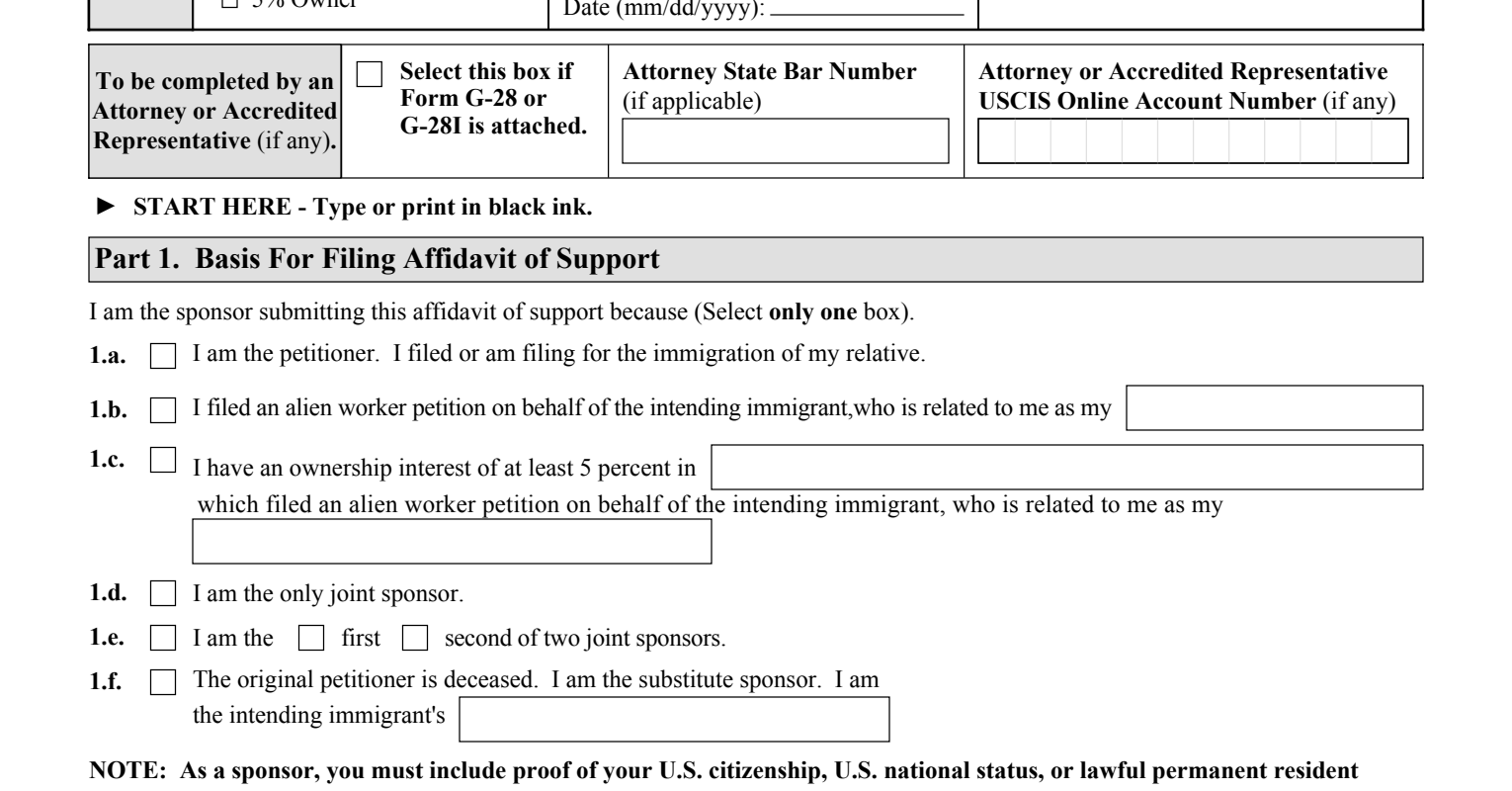
Verbatim -- Part 1, Items 1.d and 1.e (I-864 Instructions, edition 08/24/26)
“Item Number 1.d. Select this box if you are the only joint sponsor. Item Number 1.e. Select this box if you are either of two joint sponsors. NOTE: A joint sponsor does not have to be related to the intending immigrant. Indicate whether you are the only joint sponsor or one of two joint sponsors. Check with the petitioning sponsor or the intending immigrant if you are not certain.”
Free tool
I-864 Income Requirement Calculator
2026 · household of 3
$34,150
Answer a few plain questions about the sponsor's household and income to see whether they meet the 2026 I-864 Affidavit of Support amount, and what can close the gap if they do not.
Free — enter your email and it opens right up. Unsubscribe anytime.
We post free tips on preparing your marriage green card. Follow along:
Side-by-side comparison
The three forms serve different roles. Only Form I-864 covers every scenario.
| Topic | Form I-864 | Form I-864EZ | Form I-864A |
|---|---|---|---|
| Who files it | Petitioning sponsor, joint sponsor, or substitute sponsor | Petitioning sponsor only | Household member adding income to sponsor's I-864 |
| Income source requirement | Any qualifying income: wages, salary, self-employment, benefits | Individual income only. Cannot combine household member income. | N/A -- household member lists their own income for the I-864 |
| Number of petitions | One or more I-130/I-129F/I-600/I-800 petitions | Exactly one qualifying petition | N/A -- not a petition-driven form |
| Standalone or companion? | Standalone affidavit | Standalone affidavit (when eligible) | Companion to I-864. Cannot be filed alone. |
| Available to joint sponsors? | Yes | No | No |
When Form I-864EZ applies: all three conditions must be true
I-864EZ eligibility is narrower than it sounds. If any one condition is not met, use the full Form I-864 instead.
You are the petitioning sponsor
Not a joint sponsor or substitute sponsor. The petitioner is the U.S. citizen or permanent resident who filed the I-130 (or I-129F, I-600, or I-800) for the immigrant.
You have a single qualifying petition
One Form I-129F, I-130, I-600, or I-800 for the immigrant you are sponsoring. If you have filed multiple petitions, use I-864.
You qualify on your individual income alone
Your personal income meets 125% of the poverty guideline for your household size without adding any household member income. If you need to count a spouse's, parent's, or other household member's income, you need I-864 plus I-864A, not I-864EZ.
Common mistakes
These filing errors appear in RFEs and can delay the review.
- 01
Treating I-864A as an alternative affidavit of support
Form I-864A is not an affidavit of support. It is a contract between the petitioning sponsor and a household member. The household member signs it to make their income available to the sponsor's I-864 total. The I-864A is always filed alongside the I-864, never as a standalone replacement.
- 02
Joint sponsor attempting to use I-864EZ
Form I-864EZ is available only to petitioning sponsors. A joint sponsor must file Form I-864 even if their income comes entirely from wages and they have no complicating factors. There are no exceptions to this rule.
- 03
Petitioning sponsor skipping their own I-864 when a joint sponsor is filing
The petitioning sponsor must complete and submit a signed Form I-864 even if a joint sponsor is also filing. Per the I-864 Instructions (edition 08/24/26): 'The petitioning sponsor must complete and submit a signed Form I-864 for the intending immigrant even if a joint sponsor will be used.' The petitioner's form is not optional.
- 04
Using I-864EZ when household member income is needed
If your individual income alone does not meet the 125% threshold and you are relying on income from a household member (spouse, adult child, parent, or sibling), I-864EZ is not an option. You must use Form I-864 and the household member must complete Form I-864A.
Marriage-based filers: use Form I-864 in most cases
The typical marriage-based green card case involves a U.S. citizen petitioner sponsoring their foreign-national spouse. In that scenario:
- Petitioner's income alone meets the threshold. I-864EZ may work if you have exactly one I-130 petition and no need for household member income. Many petitioners prefer the full I-864 regardless, since it is the more familiar form and the one software and attorneys typically use.
- Petitioner's income falls short. Use Form I-864 plus either Form I-864A (for household member income) or a joint sponsor's separate I-864. The petitioner's I-864 is still required even when a joint sponsor also files.
- A joint sponsor is stepping in. The joint sponsor files their own separate Form I-864. They cannot use I-864EZ. The petitioner still files their own I-864 alongside the joint sponsor's.
- Immigrant spouse's income will be counted. If the immigrant spouse has income that will continue after obtaining lawful permanent resident status, that income is handled in Part 6 Items 8-14 of the petitioner's I-864, not through a separate affidavit. See the household member income page for the rules.
Need help completing Form I-864?
Our software asks plain-English questions, calculates your household size and income threshold, and generates the complete I-864 packet.
Start FreeRelated guides
Form and pathway context
Related I-864 questions
- I-864 Part 5, Item 1: Total Number of Persons in Household (2026)
- I-864 Joint Sponsor: When You Need One and What They Must Do (2026)
- I-864A: Who Can Combine Income with the Sponsor (2026)
- I-864 Assets (Part 7): When to Use Them and How to Report in 2026
- I-864 Current Annual Income (Part 6, Item 7): What to Enter in 2026
Frequently asked questions
Can I use I-864EZ if I am a joint sponsor?
No. Form I-864EZ is available only to petitioning sponsors. Joint and substitute sponsors must use Form I-864 regardless of their income type or number of petitions.
Do I need to file I-864A separately from the I-864?
Form I-864A is filed as a companion to Form I-864. It is signed by the household member (not by the petitioner), and it is submitted together with the petitioner's I-864. It cannot be filed as a standalone form.
What happens if I file I-864EZ but I was not eligible?
USCIS may issue an RFE (request for evidence) asking you to file a complete Form I-864. Filing the correct form in response to the RFE resolves this, but it can delay the case. Check eligibility carefully before choosing I-864EZ.
Is Form I-864A required when the immigrant spouse's income is counted?
Not always. Per the I-864 Instructions (edition 08/24/26, Part 6, Items 8-14): 'If you included the income of the intending immigrant who is your spouse..., you must provide evidence that his/her income will continue from the current source after obtaining lawful permanent resident status. He or she does not need to complete Form I-864A unless he or she has accompanying children.' Immigrant spouses counted for their own income generally do not need to sign an I-864A.
How do I know which form is current?
Always download the current edition directly from uscis.gov on the day you compile your packet. The edition date appears in the bottom-left corner of each form. USCIS rejects packets using outdated editions.
Key takeaways
- ✓
Form I-864 is the default. Use it if you are a petitioning sponsor, a joint sponsor, a substitute sponsor, or if your income alone does not meet the threshold.
- ✓
Form I-864EZ is only for petitioning sponsors with a single petition who qualify on their individual income alone. Joint and substitute sponsors cannot use it.
- ✓
Form I-864A is a companion contract, not an affidavit of support. Household members sign it to add their income to the petitioner's I-864 total. It is filed with the I-864, never as a standalone replacement.
- ✓
The petitioning sponsor must always file their own I-864 even when a joint sponsor is also filing a separate I-864.
This page is for educational purposes only and is not legal advice. Green Card Genius is self-help immigration software, not a law firm, and does not provide legal representation. Immigration law and USCIS policy change frequently. For advice on a specific case, consult a licensed immigration attorney. Form I-864, edition 08/24/26. Last verified May 2026.
Stay informed
Green card guides in your inbox
Practical, plain-English updates to help you navigate the process with confidence.
Unsubscribe anytime.
Continue reading
- 01I-864 Part 5, Item 1: Total Number of Persons in Household (2026)
- 02I-864 Joint Sponsor: When You Need One and What They Must Do (2026)
- 03I-864A: Who Can Combine Income with the Sponsor (2026)
- 04I-864 Assets (Part 7): When to Use Them and How to Report in 2026
- 05Who Is Exempt From Filing Form I-864 (Affidavit of Support)?
- 06I-864 Current Annual Income (Part 6, Item 7): What to Enter in 2026
Be a Genius
Only pay when you file