Form I-864 · Joint Sponsor
I-864 Joint Sponsor: When You Need One and What They Must Do (2026)
A joint sponsor is not optional support for the petitioner -- they file a completely separate I-864 and qualify on their own income. No family relationship required.
Quick answer
You need a joint sponsor if your household income falls below the 125% Federal Poverty Guideline threshold and you cannot bridge the gap with household member income or assets alone. The joint sponsor must meet the threshold independently on their own income.
Summary
A joint sponsor files a separate Form I-864 when the petitioning sponsor's income alone does not meet the 125% poverty guideline. The joint sponsor must qualify independently -- their income is not combined with the petitioner's. Any U.S. citizen, U.S. national, or lawful permanent resident who is at least 18, domiciled in the United States, and willing to be jointly liable qualifies. No family relationship is required. The petitioner must still file their own I-864.
| When needed | Petitioner's income (or household income including I-864A members) falls below 125% of the Federal Poverty Guidelines for the petitioner's household size. |
| Who qualifies | U.S. citizen, U.S. national, or lawful permanent resident (green card holder). At least 18 years old. Domiciled in the United States. Willing to be jointly liable. |
| Family relationship required? | No. The joint sponsor does not have to be related to the petitioner or to the immigrant. |
| How they qualify | Independently, on their own income and/or assets. Their income does not combine with the petitioner's. They must meet the 125% threshold for their own household size. |
| Maximum number of joint sponsors | Two. If the first joint sponsor covers some but not all family members, a second may sponsor the remaining members. |
| Petitioner's I-864 still required? | Yes. The petitioning sponsor must complete and submit a signed Form I-864 even when a joint sponsor is also filing. |
| 2026 threshold for household of 2 | $27,050 (125% of $21,640). For a household of 3: $34,150. For a household of 4: $41,250. |
When to consult an attorney
This page covers standard joint sponsorship: a U.S.-domiciled person whose income is verifiable. Consult an immigration attorney if the proposed joint sponsor lives outside the United States, has a complex income situation (primarily self-employed or primarily foreign income), or if there is any dispute about their domicile or eligibility to serve as joint sponsor.
Free tool
I-864 Income Requirement Calculator
2026 · household of 3
$34,150
Answer a few plain questions about the sponsor's household and income to see whether they meet the 2026 I-864 Affidavit of Support amount, and what can close the gap if they do not.
Free — enter your email and it opens right up. Unsubscribe anytime.
We post free tips on preparing your marriage green card. Follow along:
What the USCIS instructions say
Verbatim from Form I-864 Instructions, edition 08/24/26, pages 14-15.
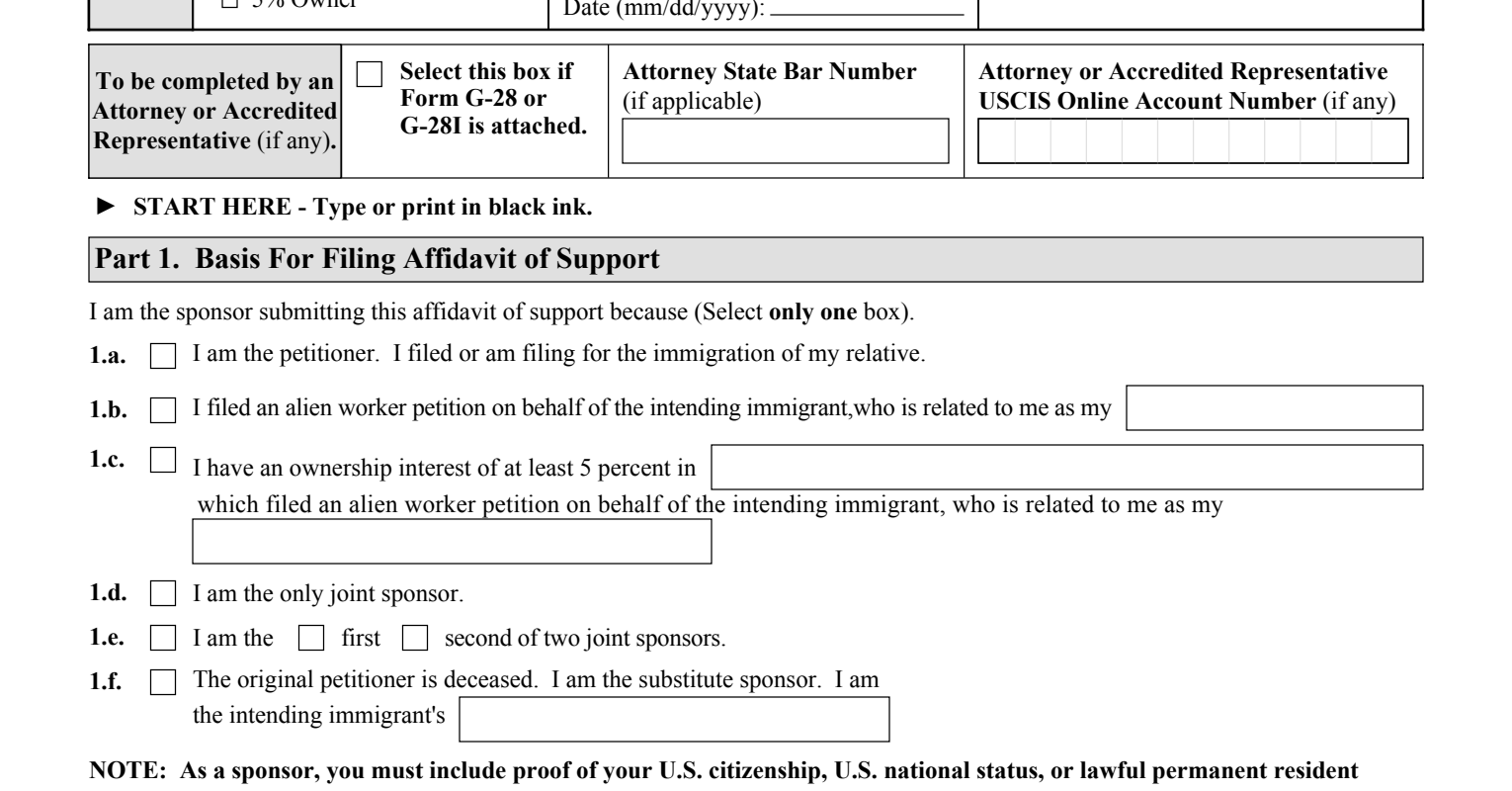
Verbatim -- who can be a joint sponsor (I-864 Instructions, edition 08/24/26, pages 14-15)
“If the person who is seeking the immigration of one or more of his or her relatives cannot meet the income requirements, a joint sponsor who can meet the requirements may submit Form I-864 to sponsor all or some of the family members. A joint sponsor can be any U.S. citizen, lawful permanent resident, or U.S. national who is at least 18 years of age, domiciled in the United States, or its territories or possessions, and willing to be held jointly liable with the petitioner for the support of the intending immigrant. A joint sponsor does not have to be related to the petitioning sponsor or the intending immigrant.”
Verbatim -- qualifying independently (I-864 Instructions, edition 08/24/26, pages 14-15)
“If the first joint sponsor completes Form I-864 for some rather than all the family members, a second qualifying joint sponsor will be required to sponsor the remaining family members. There may be no more than two joint sponsors. A joint sponsor must be able to meet the income requirements for all the persons he or she is sponsoring without combining resources with the petitioning sponsor or a second joint sponsor.”
Verbatim -- petitioner obligation remains (I-864 Instructions, edition 08/24/26)
“NOTE: Even if one or more Form I-864s are submitted for an intending immigrant, the petitioning sponsor remains legally accountable for the financial support of the sponsored immigrant along with the joint sponsors. The petitioning sponsor must complete and submit a signed Form I-864 for the intending immigrant even if a joint sponsor will be used. The petitioning sponsor must also provide his or her Federal income tax return for the most recent tax year with supporting tax documents unless otherwise not required to file a Federal income tax return for the most recent tax year.”
Verbatim -- when income falls short (I-864 Instructions, edition 08/24/26, pages 13-14)
“If your income alone is not sufficient to meet the requirement for your household size, the intending immigrant will be ineligible for an immigrant visa or adjustment of status, unless the requirement can be met using any combination of the following: 1. Income from any relatives or dependents living in your household or dependents listed on your most recent Federal income tax return who signed Form I-864A, Contract Between Sponsor and Household Member; 2. Income from the intending immigrant, if that income will continue from the same source after immigration, and if the intending immigrant is currently living in your residence. If the intending immigrant is your spouse, his or her income can be counted regardless of current residence, but it must continue from the same source after he or she becomes a lawful permanent resident; 3. The value of your assets, the assets of any household member who has signed Form I-864A, or the assets of the intending immigrants; or 4. A joint sponsor whose income and/or assets equal at least 125 percent of the Federal Poverty Guidelines.”
2026 income thresholds for a joint sponsor
The joint sponsor must independently meet 125% of the poverty guideline for their own household size. These thresholds apply to the 48 contiguous states and D.C. Alaska and Hawaii have higher numbers. Verify the current table at uscis.gov/i-864p before filing.
| Household size | 100% FPG | 125% FPG (required threshold) |
|---|---|---|
| 2 | $21,640 | $27,050 |
| 3 | $27,320 | $34,150 |
| 4 | $33,000 | $41,250 |
Source: HHS Annual Update of the Poverty Guidelines, effective March 1, 2026.
Joint sponsor eligibility: all five criteria must be met
A proposed joint sponsor who does not meet all criteria cannot file a qualifying I-864.
U.S. citizen, U.S. national, or lawful permanent resident
Green card holders qualify. No citizenship requirement.
At least 18 years of age
Per the I-864 Instructions (edition 08/24/26): 'A sponsor is required to be at least 18 years of age...'
Domiciled in the United States
Must have U.S. domicile at the time of signing. Living abroad on a temporary basis with U.S. ties may qualify, but a clearly foreign-domiciled person cannot serve as joint sponsor.
Willing to be jointly liable
The joint sponsor takes on the same legal obligation as the petitioner: to support the immigrant at or above 125% of the poverty guideline until one of the terminating events occurs.
Income meets 125% threshold independently
The joint sponsor's income is evaluated for their own household size. They cannot combine with the petitioner's income.
Common mistakes with joint sponsorship
These errors appear in RFEs and can delay or block the case.
- 01
Assuming joint sponsor income adds to the petitioner's income
It does not. A joint sponsor's income is evaluated independently. Per the I-864 Instructions (edition 08/24/26, pages 14-15): 'A joint sponsor must be able to meet the income requirements for all the persons he or she is sponsoring without combining resources with the petitioning sponsor or a second joint sponsor.' A petitioner earning $20,000 and a joint sponsor earning $14,000 do not together meet the $27,050 threshold for a household of 2.
- 02
Petitioner skipping their own I-864 when a joint sponsor is filing
The petitioner's I-864 is still required. Per the I-864 Instructions (edition 08/24/26): 'The petitioning sponsor must complete and submit a signed Form I-864 for the intending immigrant even if a joint sponsor will be used.' Both forms must be in the packet.
- 03
Joint sponsor living outside the United States
The joint sponsor must be domiciled in the United States. A U.S. citizen or LPR who permanently lives abroad generally cannot serve as joint sponsor unless they meet the narrow domicile exceptions (qualified abroad employment or temporary abroad status). This is the conditional attorney-lane scenario.
- 04
Sending the joint sponsor's I-864 without supporting documents
The joint sponsor's I-864 requires the same documentation as the petitioner's: most recent federal tax return with supporting documents, recent pay stubs, and an employer letter. The signed form alone is not sufficient.
- 05
Using more than two joint sponsors
Per the instructions, there may be no more than two joint sponsors. The first joint sponsor covers some or all family members; the second (if needed) covers the remaining members. A third joint sponsor is not permitted.
Marriage-based filers: what triggers the need for a joint sponsor
The 2026 threshold for the most common case (household of 2, standard filer) is $27,050. Use the I-864 Income Calculator to confirm your threshold before looking for a joint sponsor.
- Petitioner's income is below $27,050 for a household of 2 (2026). A joint sponsor is needed if income cannot be supplemented through household member income (I-864A) or qualifying assets. Use the I-864 Income Calculator to confirm before identifying a joint sponsor.
- Petitioner has a household of 3 or more. The threshold rises with household size: $34,150 for a household of 3 in 2026, $41,250 for a household of 4. Prior I-864 obligations and dependents count in the household size even if they do not live with the petitioner.
- The joint sponsor is a friend or colleague. No family relationship is required. A neighbor, coworker, or friend who meets the eligibility requirements can serve as joint sponsor. They should understand the legal obligation they are taking on before signing.
- Proposed joint sponsor lives outside the United States. This triggers the attorney lane. A joint sponsor must be domiciled in the United States. Whether a U.S. citizen or LPR living abroad meets the domicile requirement under the I-864 rules is a fact-specific question that benefits from legal review.
Not sure if you need a joint sponsor?
The I-864 Income Calculator shows your threshold, compares it against your income, and identifies whether a joint sponsor, I-864A, or assets would bridge any gap.
Start FreeRelated guides
Form and pathway context
Related I-864 questions
- I-864 vs. I-864EZ vs. I-864A: Which Form Do You Need (2026)
- I-864 Country of Domicile (Part 2, Item 5): What It Means and How to Answer (2026)
- I-864 Part 5, Item 1: Total Number of Persons in Household (2026)
- I-864 Assets (Part 7): When to Use Them and How to Report in 2026
- I-864 Current Annual Income (Part 6, Item 7): What to Enter in 2026
- I-864A: Who Can Combine Income with the Sponsor (2026)
Frequently asked questions
Can I use a friend as a joint sponsor on my I-864?
Yes. Per the I-864 Instructions (edition 08/24/26, pages 14-15): 'A joint sponsor does not have to be related to the petitioning sponsor or the intending immigrant.' Any U.S. citizen, national, or lawful permanent resident who meets the eligibility requirements can serve.
How many joint sponsors are allowed?
A maximum of two. The first joint sponsor may cover some or all family members. If the first covers only some, a second joint sponsor is required to cover the remaining members. A third is not permitted.
Does the petitioner still need to file their own I-864 if a joint sponsor is filing?
Yes. The petitioning sponsor must complete and submit a signed Form I-864 even if a joint sponsor will also file. The petitioner's I-864 and the joint sponsor's I-864 are submitted together in the packet.
Can I add my income and the joint sponsor's income together to meet the threshold?
No. Per the I-864 Instructions, a joint sponsor must meet the income requirements independently -- without combining resources with the petitioning sponsor or a second joint sponsor. Each I-864 is evaluated on its own.
Does a joint sponsor take on a permanent obligation?
Yes. The joint sponsor becomes jointly and severally liable with the petitioner for the support of the immigrant. The obligation continues until one of the terminating events occurs: the immigrant becomes a U.S. citizen, earns 40 qualifying work quarters, permanently departs the U.S., or dies. Divorce does not end the obligation for either the petitioner or the joint sponsor.
Can the joint sponsor use their assets instead of income?
Yes, within limits. The I-864 Instructions (edition 08/24/26) state that a qualifying joint sponsor's 'income and/or assets' must equal at least 125% of the Federal Poverty Guidelines. Assets are counted at a multiplier -- typically 5 times the shortfall (3 times for a U.S. citizen sponsoring a spouse). See the assets page for the full rules.
Key takeaways
- ✓
A joint sponsor is needed when the petitioner's income (and any I-864A household member income or assets) falls below the 125% threshold for their household size.
- ✓
The 2026 threshold for a household of 2 is $27,050. For a household of 3: $34,150. For a household of 4: $41,250.
- ✓
The joint sponsor must qualify independently. Their income is not added to the petitioner's total.
- ✓
No family relationship is required. Any U.S. citizen, national, or lawful permanent resident who is 18+, domiciled in the U.S., and meets the threshold qualifies.
- ✓
The petitioner must still file their own signed I-864 even when a joint sponsor is also filing.
- ✓
The joint sponsor takes on the same long-term legal obligation as the petitioner. Divorce does not end it.
This page is for educational purposes only and is not legal advice. Green Card Genius is self-help immigration software, not a law firm, and does not provide legal representation. Immigration law and USCIS policy change frequently. For advice on a specific case, consult a licensed immigration attorney. Form I-864, edition 08/24/26. Last verified May 2026.
Stay informed
Green card guides in your inbox
Practical, plain-English updates to help you navigate the process with confidence.
Unsubscribe anytime.
Continue reading
- 01I-864 vs. I-864EZ vs. I-864A: Which Affidavit of Support Form Do You Need (2026)
- 02I-864 Country of Domicile (Part 2, Item 5): What It Means and How to Answer (2026)
- 03I-864 Part 5, Item 1: Total Number of Persons in Household (2026)
- 04I-864 Assets (Part 7): When to Use Them and How to Report in 2026
- 05I-864 Current Annual Income (Part 6, Item 7): What to Enter in 2026
- 06I-864A: Who Can Combine Income with the Sponsor (2026)
Be a Genius
Only pay when you file