Form I-864A · Part 6, Items 8-14
I-864A: Who Can Combine Income with the Sponsor (2026)
Form I-864A is not an alternative affidavit of support -- it is a contract that household members sign to make their income available to the sponsor's I-864 total. Different income sources follow different rules.
Quick answer for marriage-based filers
The most common scenario for marriage-based filers: the sponsor's immigrant spouse has income that will continue after obtaining the green card. That income can be added in Part 6 of the sponsor's I-864 -- the immigrant spouse generally does not need to complete Form I-864A unless they have accompanying children.
Summary
Form I-864A (Contract Between Sponsor and Household Member) allows household members to add their income to the petitioning sponsor's total. The I-864A is filed alongside the I-864, not instead of it. Three categories of income sources have different I-864A requirements: household members listed in Part 5, the intending immigrant who is the sponsor's spouse, and other intending immigrants. The rules differ for each category.
| What I-864A is | A contract signed by a household member, making their income available to the sponsor's I-864 total. Filed alongside the I-864, not as a standalone replacement. |
| Who must sign I-864A | Any household member listed in Part 5 Items 3-5 and 7 whose income is being counted (spouse, adult child, parent, or sibling). Must be 18 or older. |
| Immigrant spouse exception | The intending immigrant who is the sponsor's spouse does not need to sign I-864A unless they have accompanying children. Evidence that their income will continue is required. |
| Residence requirement | Household members listed in Part 5 must reside with the sponsor. The intending immigrant spouse is an exception: their income can be counted regardless of current residence. |
| Attorney lane trigger | Household member's income source is disputed, their residency or dependency status is unclear, or the intending immigrant's income comes from a visa-tied source that may not continue after obtaining LPR status. |
When to consult an attorney
This page covers straightforward household income combination scenarios. Consult an immigration attorney if: (1) the household member's income source is disputed or their residency or dependency status is unclear; (2) the intending immigrant's income comes from a visa-tied source that may not continue after they obtain LPR status; or (3) the income involves a foreign employer or a work-authorization category that does not automatically transfer to LPR.
Free tool
I-864 Income Requirement Calculator
2026 · household of 3
$34,150
Answer a few plain questions about the sponsor's household and income to see whether they meet the 2026 I-864 Affidavit of Support amount, and what can close the gap if they do not.
Free — enter your email and it opens right up. Unsubscribe anytime.
We post free tips on preparing your marriage green card. Follow along:
What the USCIS instructions say
Verbatim from Form I-864 Instructions, edition 08/24/26, Part 6, Items 8-14, pages 10-11 and pages 13-14.
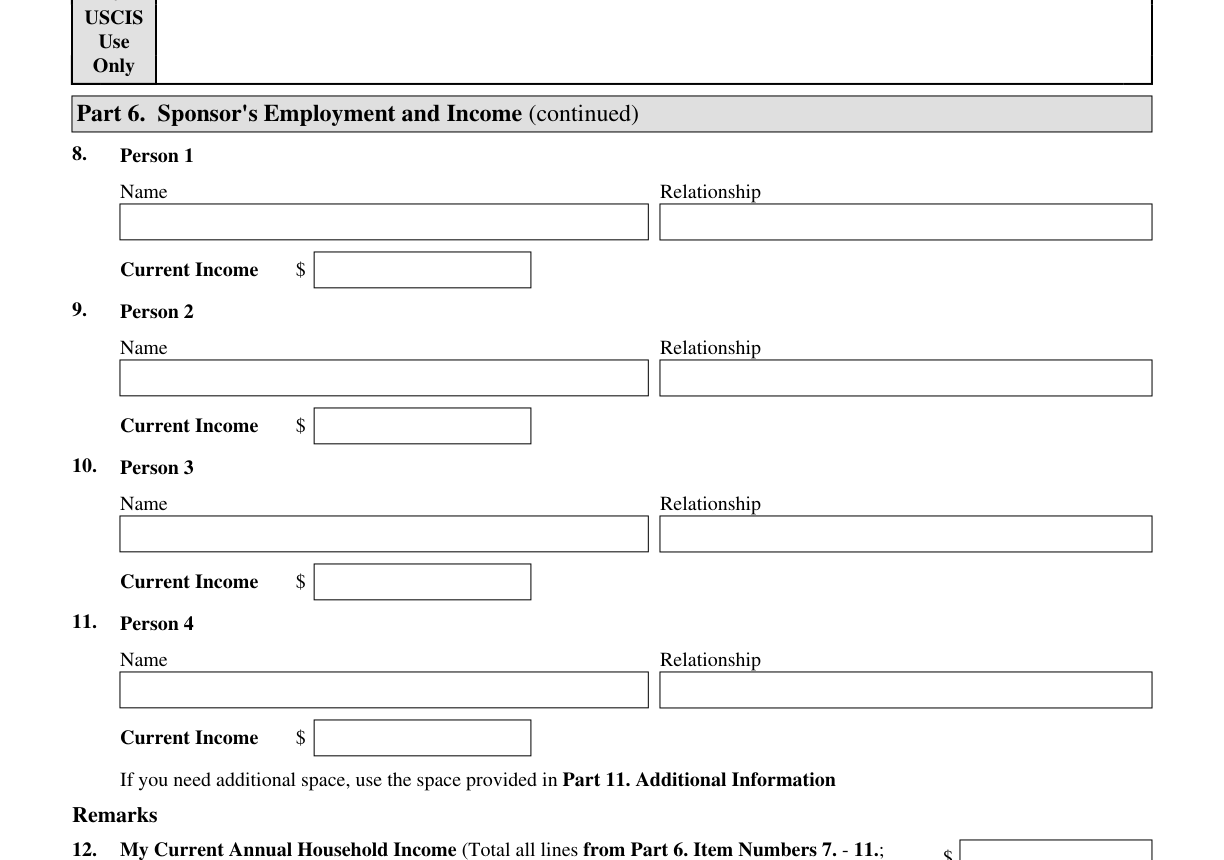
Verbatim -- three rules for household income (I-864 Instructions, edition 08/24/26, Part 6, Items 8-14)
“1. If you included the income of your spouse listed in Part 5., Item Number 3., any child listed in Part 5., Item Number 4., any dependent listed in Part 5., Item Number 5., or any siblings, parents, or adult children listed in Part 5., Item Number 7., each one of these individuals must be over 18 years of age and must complete Form I-864A. 2. If you included the income of the intending immigrant who is your spouse (he or she would be counted in Part 5., Item Number 1.), you must provide evidence that his/her income will continue from the current source after obtaining lawful permanent resident status. He or she does not need to complete Form I-864A unless he or she has accompanying children. 3. If you included the income of the intending immigrant who is not your spouse, (he or she would be counted on Part 5., Item Number 1.), evidence that his or her income will continue from a lawful source after obtaining lawful permanent resident status must be provided and the intending immigrant must provide evidence that he or she is living in your residence. He or she does not need to complete Form I-864A, unless he or she has an accompanying spouse or children.”
Verbatim -- how household members can help (I-864 Instructions, edition 08/24/26, pages 13-14)
“You may use the income of your spouse and/or any other relatives living in your residence if they are willing to be jointly responsible with you for the intending immigrants you are sponsoring. If you have any unrelated dependents listed on your Federal income tax return you may include their income regardless of where they reside. The income of such household members and dependents can be used to help you meet the income requirements if they complete and sign Form I-864A, Contract Between Sponsor and Household Member, and if they are at least 18 years of age when they sign the affidavit.”
Four categories of combinable income: what each requires
The I-864A requirement, residence requirement, and continuing-income evidence requirement differ by income category.
Sponsor's spouse, children, dependents, siblings, parents, or adult children (Part 5, Items 3-5 and 7)
Each household member whose income is counted must be 18 or older and must complete and sign Form I-864A. They must reside with the sponsor. Their income combines with the sponsor's in Part 6.
Intending immigrant who is the sponsor's spouse
Does not need to complete Form I-864A unless they have accompanying children. Income must continue from the same source after obtaining LPR status. Current residence does not matter -- even an immigrant spouse living abroad can have their income counted if it will continue.
Intending immigrant who is not the sponsor's spouse
Does not need Form I-864A unless they have an accompanying spouse or children. Income must continue from a lawful source after obtaining LPR status. The immigrant must provide evidence they are living in the sponsor's residence.
Unrelated dependents listed on the sponsor's federal tax return
Income can be counted regardless of where they reside, as long as they are listed on the sponsor's most recent federal tax return and are 18 or older. Must complete Form I-864A.
Common mistakes with Form I-864A
These errors appear in RFEs and can delay the I-864 review.
- 01
Filing I-864A instead of I-864
Form I-864A is not a substitute for Form I-864. The household member signs I-864A to make their income available, but the petitioning sponsor must still complete and file Form I-864. The two forms are filed together.
- 02
Requiring an I-864A from the immigrant spouse when none is needed
Per the I-864 Instructions (edition 08/24/26, Part 6, Items 8-14): an intending immigrant who is the sponsor's spouse does not need to complete Form I-864A unless they have accompanying children. Requiring it adds unnecessary paperwork and can create inconsistencies in the packet.
- 03
Counting household member income without an I-864A
If you list income in Part 6 from a household member (other than the immigrant spouse exception above), that person must complete Form I-864A. Filing without it triggers an RFE.
- 04
Counting a household member who is under 18
Per the I-864 Instructions (edition 08/24/26): each household member whose income is counted 'must be over 18 years of age.' Income from a minor household member cannot be included regardless of the amount.
- 05
Counting immigrant spouse income that will not continue after LPR
The instructions require that the immigrant spouse's income 'will continue from the same source after obtaining lawful permanent resident status.' Income from a temporary work visa or a job that will end at departure cannot be counted. The continuing-income evidence requirement is a common source of RFEs.
Marriage-based filers: adding your immigrant spouse's income
The most common reason marriage-based sponsors turn to this page is to understand whether they can add their immigrant spouse's income. The answer is usually yes, with conditions.
- Adding immigrant spouse's income from a job they hold abroad. The income can be counted if it will continue from the same source after they become a lawful permanent resident. Evidence of continuing employment is required. Form I-864A is not needed from the immigrant spouse (unless they have accompanying children).
- Adding immigrant spouse's income from a job they hold inside the U.S. Same rule: the income must continue from the same source after LPR status. Evidence of continuing employment is required. No I-864A is needed from the immigrant spouse (unless they have accompanying children).
- Adding income from the sponsor's parent, adult child, or sibling who lives with them. That household member must be 18 or older, must reside with the sponsor, and must complete and sign Form I-864A with their own income documentation.
- Immigrant spouse's income is tied to a visa that will expire. This is the attorney-lane scenario. If the immigrant spouse's current income comes from work authorization that expires before they receive LPR status, or from a visa category that does not carry over to LPR status, there is a real question about whether the income 'will continue from the same source.' An immigration attorney can assess whether the income is countable.
Not sure if you need Form I-864A?
Our software determines whether your income alone passes the threshold and, if not, which combination of household member income, assets, or a joint sponsor would bridge the gap.
Start FreeRelated guides
Form and pathway context
Related I-864 questions
- I-864 Joint Sponsor: When You Need One and What They Must Do (2026)
- I-864 Household Member Income (Part 6, Items 8-14): When to Add It and How in 2026
- I-864 Part 5, Item 1: Total Number of Persons in Household (2026)
- I-864 Current Annual Income (Part 6, Item 7): What to Enter in 2026
- I-864 Assets (Part 7): When to Use Them and How to Report in 2026
Frequently asked questions
Does my immigrant spouse have to file Form I-864A?
Generally no. Per the I-864 Instructions (edition 08/24/26, Part 6, Items 8-14), an intending immigrant who is the sponsor's spouse does not need to complete Form I-864A unless they have accompanying children. However, evidence that their income will continue from the same source after obtaining LPR status is required.
Can I count my parent's income if they live with me?
Yes, if the parent is 18 or older, lives with you, and is willing to sign Form I-864A. Their income combines with yours in Part 6 of your I-864.
Can I count income from a relative who lives in another state?
Only if that relative is an unrelated dependent listed on your federal tax return, or if they are the intending immigrant spouse (whose income can be counted regardless of residence if it will continue after LPR). A sibling or adult child who lives in another state and is not listed as your tax dependent generally cannot have their income counted, because the residence requirement would not be met.
What evidence do I need that the immigrant spouse's income will continue?
Standard evidence includes an employment letter from the employer confirming current employment and salary, recent pay stubs, and confirmation that the job is not contingent on a visa status that will not transfer to LPR. If the job requires work authorization that will need to be renewed, a clear explanation of the renewal path helps.
Is Form I-864A free to file?
Yes. Form I-864A has no USCIS filing fee. It is submitted as part of the I-864 packet.
Key takeaways
- ✓
Form I-864A is a companion contract, not an alternative affidavit. It is filed alongside the I-864, never instead of it.
- ✓
Household members listed in Part 5 (Items 3-5 and 7) who are contributing income must be 18 or older, reside with the sponsor, and complete Form I-864A.
- ✓
The intending immigrant who is the sponsor's spouse does not need to complete I-864A (unless they have accompanying children), but evidence that their income will continue is required.
- ✓
The sponsor's immigrant spouse's income can be counted regardless of whether they currently live in the U.S. -- as long as the income will continue from the same source after obtaining LPR status.
- ✓
If the income's continuation after LPR status is uncertain (visa-tied work, expiring authorization), consult an immigration attorney before including it.
This page is for educational purposes only and is not legal advice. Green Card Genius is self-help immigration software, not a law firm, and does not provide legal representation. Immigration law and USCIS policy change frequently. For advice on a specific case, consult a licensed immigration attorney. Form I-864 Instructions, edition 08/24/26. Last verified May 2026.
Stay informed
Green card guides in your inbox
Practical, plain-English updates to help you navigate the process with confidence.
Unsubscribe anytime.
Continue reading
- 01How to Fill Out Form I-864A (Part 3, Part 6): Household Member Income & Signature (2026)
- 02I-864 Joint Sponsor: When You Need One and What They Must Do (2026)
- 03I-864 Household Member Income (Part 6, Items 8-14): When to Add It and How in 2026
- 04I-864 Part 5, Item 1: Total Number of Persons in Household (2026)
- 05I-864 Current Annual Income (Part 6, Item 7): What to Enter in 2026
Be a Genius
Only pay when you file