Form I-864 · Part 5, Item 1
I-864 Household Size (Part 5, Item 1): Who Counts in 2026
Part 5, Item 1 sets your income threshold. USCIS looks up your household size in the Federal Poverty Guidelines table to find the 125% income floor you must meet or exceed.
Most marriage-based filers
Your household size is most likely 2.
Sponsoring your spouse with no children and no prior I-864 obligations: your answer is 2. Keep reading to verify your situation and handle any exceptions.
Summary
For most marriage-based green card cases, your I-864 household size is 2: you plus your immigrant spouse. If you have no children, no prior I-864 obligations, and no additional dependents on your tax return, write 2. Your household size determines your income threshold: USCIS uses it to find your row in the Federal Poverty Guidelines table (I-864P) and sets your 125% income floor from there.
| Who always counts | You (the sponsor), your current spouse, and your unmarried children under 21 -- regardless of custody or tax filing status |
| Who counts from current petition | The person you are sponsoring (usually your spouse) plus any of their children immigrating within 6 months under this same I-864 |
| Prior obligations | Any immigrants you previously sponsored on an I-864 or I-864EZ whose obligation is still active and who are now lawful permanent residents |
| Who does NOT count | Roommates, housemates, adult relatives not on your tax return, and children sponsored on a different I-864 who have not yet immigrated to the U.S. |
| What this number determines | The row of the Federal Poverty Guidelines table (I-864P) that sets your 125% income threshold |
Scope of this page
This page covers the standard household size calculation for a primary petitioner or a joint sponsor filing from within the United States. If your situation involves a joint sponsor whose U.S. domicile is uncertain, or if income qualification is disputed because a household member's residency or dependency status is unclear, consult an immigration attorney before completing Part 5.
Free tool
I-864 Income Requirement Calculator
2026 · household of 3
$34,150
Answer a few plain questions about the sponsor's household and income to see whether they meet the 2026 I-864 Affidavit of Support amount, and what can close the gap if they do not.
Free — enter your email and it opens right up. Unsubscribe anytime.
We post free tips on preparing your marriage green card. Follow along:
What the USCIS instructions say
The I-864 Instructions (edition 08/24/26, Part 5) list exactly who to count. The following is verbatim from the instructions.
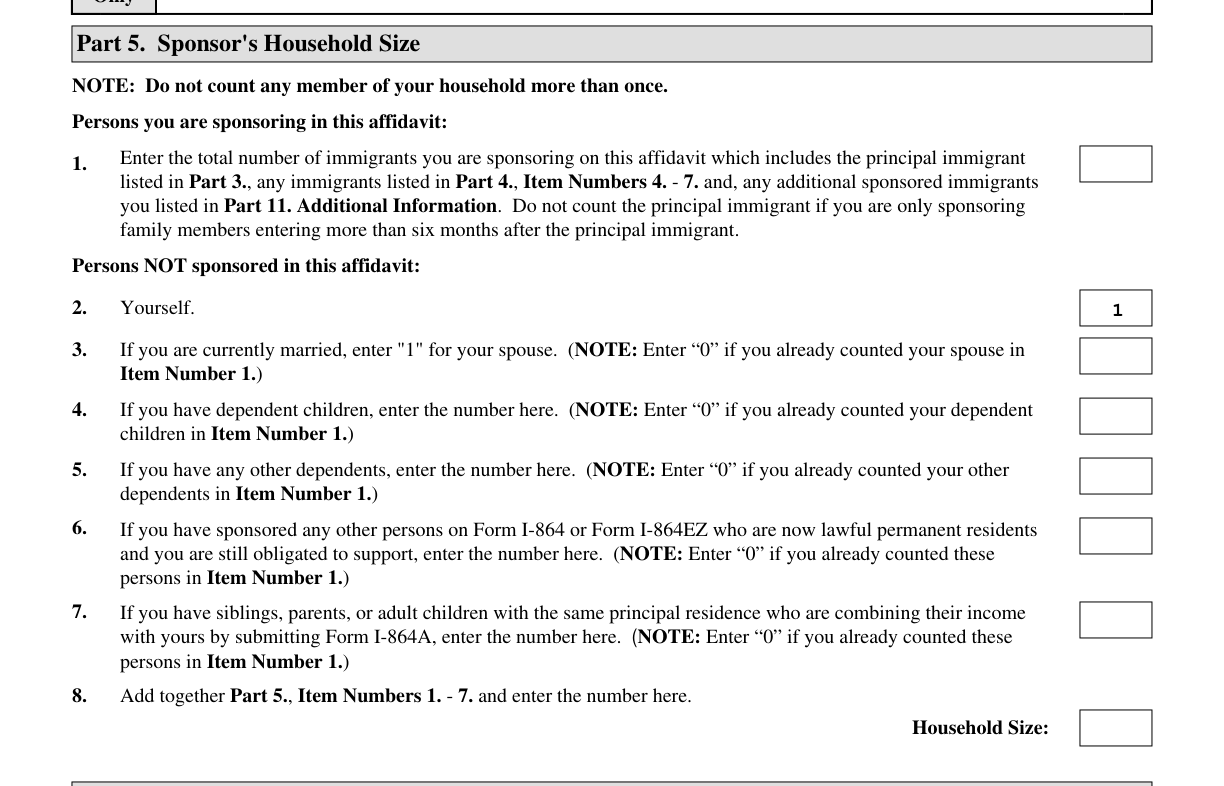
Verbatim from Form I-864 Instructions, edition 08/24/26, Part 5
"Add together the number of persons for whom you are financially responsible. Some of these persons may not be residing with you."
Item 1Immigrants being sponsored
“Enter the total number of immigrants you are sponsoring on this affidavit from Part 3., any immigrants who are family members of the principal immigrant you are also sponsoring that are listed in Part 4., Item Numbers 4. - 7. and (if applicable), any additional immigrants listed for these questions in Part 11. Additional Information. Do not count the principal immigrant if you are only sponsoring family members entering more than 6 months after the principal immigrant.”
Item 2You (the sponsor)
“This field is auto-populated to "1."”
Item 3Your spouse
“Type or print "1" if you are married. Type or print "0" if you are not married or if you already counted your spouse in Item Number 1.”
Item 4Your unmarried children under 21
“Type or print the number of unmarried children you have who are under 21 years of age, even if you do not have legal custody of these children. You may exclude any unmarried children under 21 years of age, if these children have reached majority under the law of their place of domicile and you do not claim them as dependents on your Federal income tax returns. Type or print "0" if you already counted your dependent children in Item Number 1.”
Item 5Other tax dependents
“Type or print the number of any other dependents. You must include each and every person whom you have claimed as a dependent on your most recent Federal income tax return, even if that person is not related to you. Even if you are not legally obligated to support that person, you must include the person if, in fact, you did support that person and claimed the person as a dependent on your Federal income tax returns. Type or print "0" if you already counted your other dependents in Item Number 1.”
Item 6Prior I-864 obligations (LPRs)
“Type or print the number of lawful permanent residents whom you are currently obligated to support based on your previous submission of Form I-864 as a petitioning, substitute, or joint sponsor, or Form I-864EZ, Affidavit of Support Under Section 213A of the INA, as a petitioning sponsor. Include only those persons who have already immigrated to the United States. Do not include anyone for whom your obligation to support has ended through the sponsored immigrant's acquisition of U.S. citizenship, death, abandonment of lawful permanent residence in the United States, acquisition of 40 quarters of earned or credited work in the United States, or obtaining a new grant of adjustment of status while in removal proceedings based on a new affidavit of support, if one is required. Type or print "0" if you already counted these persons in Item Number 1.”
Item 7Non-dependent household relatives (optional)
“You may include certain other non-dependent relatives who are living in your residence as part of your household size. Such relatives may include your mother, father, sister, brother or adult children, if they are living in your residence. However, the only reason to include these relatives in your household size is if you need to include their income when you calculate your household income for purposes of meeting the income requirement for this affidavit. To be considered, any relative included in this category must sign and submit Form I-864A, Contract Between Sponsor and Household Member. Type or print "0" (zero) if you have no non-dependent relatives who are living in your residence that can be counted as part of your household size, or if you already counted these persons in Item Number 1.”
Critical: “Make sure you do not count any individual more than once. In some cases, the same person could fit into two categories.”
What USCIS does with this number
USCIS uses the household size figure to look up which row of the Federal Poverty Guidelines table (Form I-864P) applies to the case. Your 125% income threshold is set entirely by this number.
| Household size | 2026 income floor (125%) | Active-duty military (100%) |
|---|---|---|
| 2 | $27,050 | $21,640 |
| 3 | $34,150 | $27,320 |
| 4 | $41,250 | $33,000 |
| 5 | $48,350 | $38,680 |
| 6 | $55,450 | $44,360 |
| +1 per person over 6 | +$7,100 | +$5,680 |
Source: USCIS I-864P, effective March 1, 2026. Verify at uscis.gov/i-864p before filing.
Incorrect household size is the leading cause of I-864 RFEs
An understated household size makes income look sufficient when it is not. USCIS catches this when processing the file, issues a Request for Evidence, and the case stalls. Overstating household size raises your threshold unnecessarily but does not cause a denial.
Who counts toward your household size?
Always counts
- You (the sponsor)
- Your current spouse (regardless of their tax filing status)
- Your unmarried children under 21 (regardless of custody or where they live)
Counts from this I-864
- The immigrant you are sponsoring -- usually your spouse
- The immigrant's children who will arrive within 6 months under this same I-864
These are the persons listed in Part 3 and Part 4 of the I-864 itself.
Counts from your tax return
- Anyone you claimed as a dependent on your most recent federal tax return (even non-relatives)
Counts from prior obligations
- Anyone you sponsored on a prior I-864 or I-864EZ whose obligation is still active
- Only those who are currently lawful permanent residents (green card holders)
- Counts regardless of whether they live with you today
Source: Form I-864 Instructions, edition 08/24/26, Part 5
Does NOT count
- Roommates, housemates, or co-residing relatives who are not your tax dependents
- Adult relatives who live with you but are not on your tax return
- Derivatives on other I-864s who have not yet immigrated to the United States
- People you previously sponsored who are now U.S. citizens or have earned 40 qualifying work quarters
How to calculate your household size: step by step
- 01
Count the immigrants sponsored in this affidavit (Part 5, Item 1)
Enter the total number of immigrants you are sponsoring in this I-864: the person you are sponsoring from Part 3 plus any of their family members listed in Part 4, Items 4-7. The instructions add: "Do not count the principal immigrant if you are only sponsoring family members entering more than 6 months after the principal immigrant."
Example: Sponsoring your spouse plus two accompanying stepchildren: enter 3 in Item 1. - 02
Add yourself -- the sponsor (Part 5, Item 2)
Item 2 is auto-populated to "1" on the form. The instructions confirm this field represents you, the sponsor. You always count as 1.
Example: Running total after Items 1 and 2: 3 + 1 = 4. - 03
Add your current spouse (Part 5, Item 3)
The instructions say: "Type or print '1' if you are married. Type or print '0' if you are not married or if you already counted your spouse in Item Number 1." If your spouse is the immigrant you are sponsoring, you counted them in Item 1 -- enter 0 here.
Example: Married, spouse is a separate person from the immigrant being sponsored: add 1. - 04
Add your unmarried children under 21 (Part 5, Item 4)
The instructions specify "even if you do not have legal custody of these children." You may exclude a child only if they have reached majority under the law of their place of domicile and you do not claim them as dependents on your federal tax return. Enter 0 if you already counted these children in Item 1.
Example: Two children under 21, one living with a former spouse: add 2. - 05
Add any other tax dependents (Part 5, Item 5)
The instructions require you to include "each and every person whom you have claimed as a dependent on your most recent Federal income tax return, even if that person is not related to you." Check your most recent 1040. Enter 0 if already counted in Item 1.
Example: Elderly parent claimed as dependent on your 1040: add 1. - 06
Add prior I-864 obligations still active (Part 5, Item 6)
Include lawful permanent residents you previously sponsored on an I-864 or I-864EZ whose obligation is still active. The instructions specify the obligation ends when they acquire U.S. citizenship, die, abandon LPR status, earn 40 qualifying work quarters, or receive a new AOS grant with a new affidavit. The instructions state: "Include only those persons who have already immigrated to the United States."
Example: Sponsored a parent 3 years ago, they are an LPR and have not naturalized: add 1. - 07
Check for double-counting
The instructions state: "Make sure you do not count any individual more than once. In some cases, the same person could fit into two categories." The most common overlap: your immigrant spouse appears in Item 1 (persons being sponsored) and could also appear in Item 3 (your spouse). If you counted them in Item 1, enter 0 in Item 3.
Example: Immigrant spouse counted in Item 1: enter 0 in Item 3.
Common counting mistakes
These errors appear repeatedly on I-864 RFEs. Each one has a specific cause and a specific fix.
- 01
Forgetting prior I-864 obligations
If you sponsored a parent, sibling, or anyone else on an I-864 in the past, and that person is now an LPR who has not naturalized or earned 40 qualifying work quarters, they still count toward your household size today. This is the most common source of I-864 RFEs.
- 02
Counting housemates and roommates
Co-residing relatives or friends who are not listed as dependents on your tax return do not count in your household size, regardless of how long they have lived with you. Only the six categories in the I-864 Instructions (Part 5) apply.
- 03
Double-counting the immigrant spouse
If your spouse is both your current spouse (step 2) and the immigrant being sponsored (step 5), count them once. Per the instructions, no person should appear in the total more than once.
- 04
Excluding unmarried children under 21 without custody
The instructions specifically state: 'You need to include them even if you do not have legal custody of these children.' Shared custody, non-custodial status, or a child living with a former partner does not remove them from your count.
- 05
Not counting the immigrant's children who arrive within 6 months
If the person you are sponsoring has minor children who will arrive with them or within 6 months, those children count toward your household size. Excluding them understates household size and can trigger a Request for Evidence (RFE) when their visas are processed.
The trickiest household size situations
These are the cases that generate the most forum questions and the most RFEs.
Adult married child living in your home
My 26-year-old married son lives with me. Can I count him in my household size?
No, not automatically. An adult married child is not included in the six categories in the I-864 Instructions (Part 5) unless they appear as a dependent on your most recent federal tax return. If they are not on your tax return, they do not count toward your household size. They could sign Form I-864A to contribute their income to your total -- but signing I-864A does not add them to the count.
Previously sponsored LPR (e.g., parent from years ago)
I sponsored my parent on an I-864 three years ago. They are a green card holder. Do they count now?
Yes. Part 5, Item 6 of the I-864 Instructions (edition 08/24/26) requires you to count lawful permanent residents you are currently obligated to support based on a prior I-864 or I-864EZ submission. Your obligation to your parent remains active until they naturalize, earn 40 qualifying work quarters, permanently depart the U.S., die, or obtain a new AOS grant with a new affidavit of support. They count toward your household size today even if they no longer live with you.
Non-filing spouse
My spouse does not file taxes because they earn below the threshold. Do I still count them?
Yes. Part 5, Item 3 of the I-864 Instructions (edition 08/24/26) directs you to enter 1 if married. Tax filing status has no bearing on this. If your spouse is the immigrant you are sponsoring, they were already counted in Item 1 -- enter 0 in Item 3. Count them once, not twice.
Spouse's children not yet in the U.S.
My spouse's two children from a previous relationship are still abroad. Do they count?
Yes, if they are listed in this same I-864 and will immigrate within 6 months. Part 5, Item 1 covers all family members of the person you are sponsoring who are listed in Part 4. However, Item 6 of the I-864 Instructions specifies that prior-obligation counting only applies to persons who have already immigrated to the United States -- so children on a separate I-864 who have not yet arrived do not count under Item 6.
You have not filed taxes recently
I did not file taxes last year. What household size do I report?
Household size is determined by the six categories in the I-864 Instructions, not by who appeared on a prior return. If you did not file because you were not required to, use your current household composition. However, you must explain the missing return and may need to submit prior years' returns and a written statement. Household size itself does not change based on filing history -- the people who must be counted remain the same.
Find your situation
Each scenario below shows how to calculate the household size using the six counting categories.
Single sponsor, no children, no prior obligations
2U.S. citizen spouse (no children, no prior I-864 sponsorships) sponsoring their immigrant spouse
You (1) + immigrant spouse being sponsored (1) = 2
Petitioner with two minor children
4U.S. citizen sponsoring their immigrant spouse; sponsor has two unmarried children under 21 from a prior relationship
You (1) + immigrant spouse (1) + two minor children (2) = 4. Children count even without custody and even if living with the other parent.
Immigrant spouse with children immigrating together
4U.S. citizen sponsoring immigrant spouse plus the spouse's two minor children (all three immigrating together)
You (1) + immigrant spouse (1) + two stepchildren (2) = 4. All three persons sponsored in this affidavit count.
Petitioner with prior I-864 obligation still active
3U.S. citizen previously sponsored a parent (now LPR, not yet naturalized), now sponsoring their immigrant spouse
You (1) + immigrant spouse (1) + parent still under prior I-864 obligation (1) = 3. This raises the income threshold from $27,050 to $34,150 (2026).
Joint sponsor scenario
2A friend serving as joint sponsor: no spouse, one child, no prior I-864 obligations
Joint sponsor counts their own household size independently: themselves (1) + their child (1) = 2. The household size of the primary sponsor and the immigrant are irrelevant for the joint sponsor's I-864.
When to consult an attorney before filling in Part 5
If you are a joint sponsor whose U.S. domicile is not established (for example, you are temporarily abroad and your U.S. residency is disputed), the household size calculation may depend on a legal determination about your domicile status. That determination has consequences beyond Part 5 and should not be resolved based on a general explanation. An immigration attorney needs to review your specific facts before you complete this field.
Marriage-based filers: what household size usually is
Most sponsors filing a marriage-based green card petition have a household size of 2. Here is the standard breakdown and what moves it higher.
Standard case: household of 2
U.S. citizen sponsor with no prior children, no prior I-864 obligations, sponsoring immigrant spouse only.
2026 income requirement at household of 2: $27,050/year (125% of Federal Poverty Guidelines).
What raises the count
- You have children under 21. Each one adds 1, even if they live with a former partner or you share custody. At household of 4 (you + spouse + 2 kids), the 2026 income floor is $41,250.
- Your spouse has children immigrating with them. Each of your spouse's children who will arrive within 6 months under this same I-864 adds 1.
- You previously sponsored someone on an I-864. If that person is now an LPR and has not naturalized or earned 40 qualifying work quarters, they still count today.
- You claimed other dependents on your last tax return. Anyone on your 1040 as a dependent must be counted, even if they are not related to you.
Form I-864 has dozens of fields like this one
Our software walks through every field in plain English, flags your household size automatically, and builds the complete packet for you to review and sign.
Start FreeRelated guides
Form and pathway context
Frequently asked questions
Can I count my adult married child living with me if they are not my tax dependent?
No. An adult married child who is not listed as a dependent on your most recent federal tax return does not fall into any of the six counting categories in the I-864 Instructions (Part 5). They may sign Form I-864A to contribute their income, but that does not add them to the household count.
If I sponsored a parent years ago and they are an LPR, do they count toward my household size now?
Yes. Part 5, Item 6 of the I-864 Instructions (edition 08/24/26) requires you to count lawful permanent residents you are currently obligated to support based on a prior I-864 or I-864EZ submission. The instructions specify the obligation ends only when the sponsored immigrant acquires U.S. citizenship, dies, abandons LPR status, earns 40 qualifying work quarters, or obtains a new AOS grant with a new affidavit of support. Until one of those conditions is met, they count today even if they no longer live with you.
My spouse does not file taxes. What household size do I use?
Your spouse always counts. Part 5, Item 3 of the I-864 Instructions (edition 08/24/26) directs sponsors to enter 1 if married, with one exception: enter 0 if you already counted your spouse in Item 1 (i.e., your spouse is the immigrant being sponsored). Tax filing status has no bearing on this. Count them once, not twice.
Do the immigrant's children count toward household size?
Yes, if they are listed in this same I-864 and will immigrate within 6 months. Part 5, Item 1 of the I-864 Instructions (edition 08/24/26) covers all immigrants sponsored in this affidavit, including family members listed in Part 4. Children on a separate I-864 who have not yet immigrated to the United States do not count -- Item 6 applies only to persons who have already immigrated.
Does a housemate or roommate count toward my I-864 household size?
No. A housemate or roommate who is not a dependent on your most recent federal tax return does not count. The I-864 Instructions define the six specific categories. Co-residing relatives outside those categories can add their income via Form I-864A, but they do not themselves count in the household size.
What income threshold does my household size unlock on the 2026 Federal Poverty Guidelines?
USCIS looks up your household size in the I-864P table. For 2026: household of 2 requires $27,050/year; household of 3 requires $34,150; household of 4 requires $41,250; household of 5 requires $48,350. Each additional person beyond 8 adds $7,100. Active-duty military sponsoring a spouse or minor child qualify at 100% of the guideline instead of 125%. Source: USCIS I-864P, effective March 1, 2026.
Key takeaways
- ✓
Household size for I-864 purposes is not just people living in your home. The instructions define six specific categories, and physical residence is not the test.
- ✓
Prior I-864 obligations count today. If you sponsored someone years ago and that obligation is still active, they count in your household size even if they have moved out.
- ✓
Your spouse always counts, regardless of tax filing status. If your spouse is also the immigrant being sponsored, count them once only.
- ✓
Unmarried children under 21 count even without custody and even if they live elsewhere.
- ✓
The immigrant's children count if they are immigrating within 6 months under the same I-864.
- ✓
Incorrect household size is the leading cause of I-864 RFEs. Understating it overstates your income eligibility; overstating it forces a higher income threshold unnecessarily.
This page is for educational purposes only and is not legal advice. Green Card Genius is self-help immigration software, not a law firm, and does not provide legal representation. Immigration law and USCIS policy change frequently. For advice on a specific case, consult a licensed immigration attorney. Form I-864, edition 08/24/26. Last verified May 2026.
Stay informed
Green card guides in your inbox
Practical, plain-English updates to help you navigate the process with confidence.
Unsubscribe anytime.
Continue reading
- 01Form I-864 Affidavit of Support: Complete 2026 Guide
- 02What If the Petitioner's Income Is Too Low? Joint Sponsor Options
- 03I-864 Affidavit of Support Income Calculator (2026)
- 04I-864 Current Annual Income (Part 6, Item 7): What to Enter in 2026
- 05I-864 Affidavit of Support: Field-by-Field Guide (2026)
Be a Genius
Only pay when you file