Form I-130 · Online filing · Evidence upload
I-130 “Evidence - Official Statement” (Online Filing): What to Upload
What the “Evidence - Official Statement” document-upload slot in the online I-130 is for, when to leave it empty, and what to put in it when a required document is not available.
Quick answer
The "Evidence - Official Statement" slot in the online I-130 is optional. Use it only when you cannot submit a document USCIS requires. When you use it, upload a signed statement from the government office (the civil authority) that issued the record, certifying the record is unavailable, plus secondary evidence such as a religious, school, or census record. If you have every required document, including your marriage and birth certificates, you can leave this slot empty.
Summary
For most marriage-based filers who already have their marriage certificate and birth certificate, the online I-130 "Evidence - Official Statement" upload slot stays empty. You are the petitioner, the U.S. citizen or green card holder (lawful permanent resident) sponsoring your spouse, the beneficiary. This slot is not a numbered question in Part 1 or Part 4 of the form; it is a document-upload category in the myUSCIS online flow. It exists for one narrow purpose the Form I-130 Instructions spell out under General Requirements, Item 8: when an official document you are required to submit is not available, you upload a signed statement from the appropriate civil authority (the government office that would normally issue the record) certifying that the record does not exist or cannot be obtained, together with secondary evidence. Filers also use this slot for third-party affidavits, written statements from people with personal knowledge that support a missing record or the bona fides of the marriage. If you are reaching for this slot to explain an immigration-history problem, a prior denial, or a name discrepancy that could raise fraud questions, that is an attorney question, not a document-upload question.
| Is it required? | No. It is optional. Leave it empty if you can submit every required document, including your marriage certificate and each spouse's birth certificate. |
| When you do use it | When a required document is unavailable. Upload a statement from the civil authority (the issuing government office) certifying the record cannot be obtained, plus secondary evidence. |
| What counts as secondary evidence | Per the I-130 Instructions: a religious record, a school record, or a census record. If none exist, two or more written statements (affidavits) from people with personal knowledge of the event. |
| Marriage affidavits go here too | Third-party affidavits attesting to a bona fide (real) marriage are a fit for this slot when you choose to include them, though photos, leases, and joint accounts usually upload under a bona fide marriage category. |
| Attorney territory | Using this slot to explain an immigration-history problem, a prior USCIS denial, or a name or identity discrepancy that could raise fraud concerns. Do not draft that alone. |
Who this page is for
This page covers what the online I-130 “Evidence - Official Statement” upload slot is for and what belongs in it: a civil authority’s statement that a required document is unavailable, the secondary evidence that goes with it, and third-party affidavits about a bona fide marriage. It does not tell you how to word a statement that explains an immigration-history problem, a prior USCIS denial, or a name or identity discrepancy that could raise fraud concerns. Those carry legal consequences for your case. Consult an immigration attorney before drafting anything for that purpose. That branch is flagged again below.
Free tool
Marriage Green Card Cost Calculator
2026 · AOS · full packet
$3,005
See your exact 2026 USCIS filing fees for a marriage green card through Adjustment of Status, with a full line-item breakdown and the costs most guides leave out.
Free — enter your email and it opens right up. Unsubscribe anytime.
We post free tips on preparing your marriage green card. Follow along:
Where this slot comes from in the instructions
The “Evidence - Official Statement” slot is a document-upload category in the myUSCIS online flow. It is not a numbered question in Part 1 or Part 4 of the paper form, so there is no field box to screenshot. What it maps to is the General Requirements evidence rule in the Form I-130 Instructions, Item 8: what to do when an official document you are required to submit is not available.
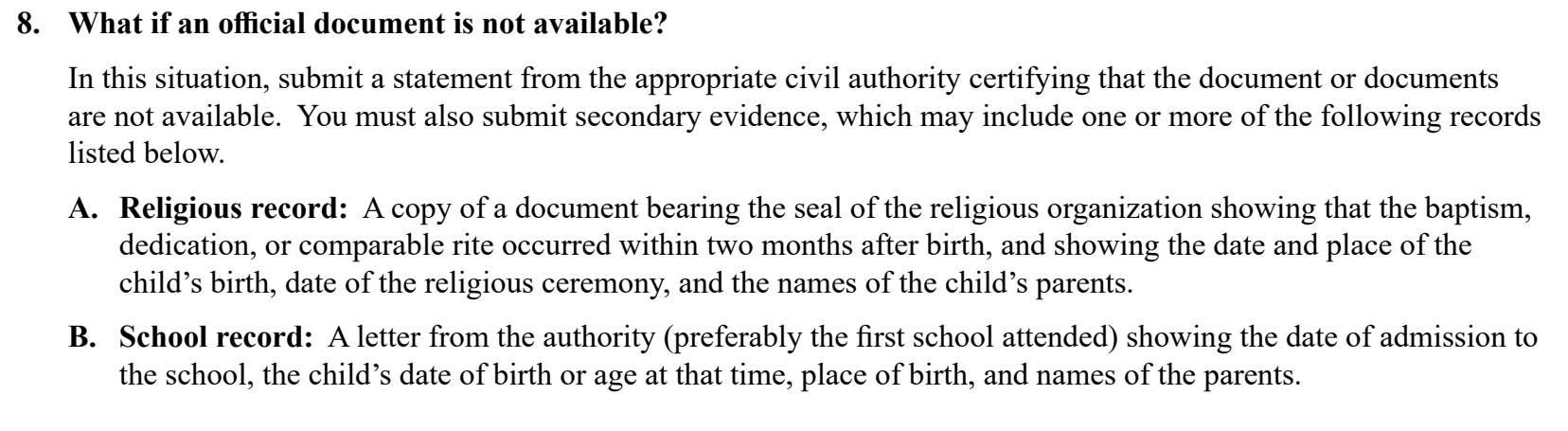
Verbatim · Form I-130 Instructions, General Requirements, Item 8 (edition 04/01/24, page 8)
“In this situation, submit a statement from the appropriate civil authority certifying that the document or documents are not available. You must also submit secondary evidence, which may include one or more of the following records listed below.”
In plain terms: the slot is where you account for a required document you cannot produce. You upload the issuing office’s statement that the record is unavailable, and you add secondary evidence to prove the same facts another way. The instructions list a religious record, a school record, and a census record as secondary evidence. If none of those exist, they allow written statements from people who were there:
Verbatim · Form I-130 Instructions, General Requirements, Item 8.D (edition 04/01/24, page 9)
“If records like those described above are not available, then you may submit two or more written statements from individuals who were living at the time and who have personal knowledge of the event you are trying to prove, such as the date and place of birth, marriage, or death. The individuals making the written statements do not have to be U.S. citizens.”
“Each written statement must contain the following information regarding the individual making the written statement: his or her full name, address, date and place of birth, full information concerning the event, and complete details explaining how the individual acquired personal knowledge of the event.”
“Finally, each individual's written statement must include the following declaration, “I declare (or certify, verify, or state) under penalty of perjury under the laws of the United States of America that the foregoing is true and correct. Executed on [date], [signature].””
The instructions also describe affidavits that attest to a bona fide (real) marriage, which fit this slot when you choose to include them:
Verbatim · Form I-130 Instructions, General Requirements, Item 5, note (5) (edition 04/01/24, page 7)
“Affidavits sworn to or affirmed by third parties having personal knowledge of the bona fides of the marital relationship. Each affidavit must contain the full name and address of the person making the affidavit; date and place of birth of the person making the affidavit; and complete information and details explaining how the person acquired his or her knowledge of your marriage.”
Always file the current edition from uscis.gov/i-130; USCIS rejects outdated editions.
What belongs in this slot
Five kinds of upload fit the “Evidence - Official Statement” category. Most filings use none of them.
A statement of unavailability from the issuing authority
This is the core use. If a document USCIS requires (commonly a birth or marriage certificate) does not exist or cannot be obtained, you get a signed statement from the government office that would normally issue it, saying so. The I-130 Instructions call this office the “appropriate civil authority.” Some countries publish a standard non-availability certificate; the U.S. State Department's Reciprocity pages list which countries have no reliable civil records.
Secondary evidence to stand in for the missing record
A statement of unavailability is not enough on its own. The instructions direct you to also submit secondary evidence: a religious record (for example a baptismal certificate issued within two months of birth), a school record from the first school attended, or a state or federal census record showing the facts you are trying to prove.
Written statements (affidavits) when no record exists
If none of the secondary records exist either, the instructions allow two or more written statements from people who were alive at the time and have personal knowledge of the birth, marriage, or death. Each statement carries specific required contents and a penalty-of-perjury declaration, quoted below. These are a natural fit for the official-statement slot.
Third-party affidavits about your marriage
Affidavits from friends or relatives who can attest that your marriage is real (in USCIS terms, bona fide) fit here when you choose to include them. The instructions set out exactly what each affidavit must contain. Documentary proof like a joint lease, joint bank statements, or photos usually uploads under a bona fide marriage evidence category rather than this one.
A short cover statement explaining an unavoidable gap
If one required item is genuinely missing and you are supplying substitutes, a brief signed note from you explaining what is missing and what you enclosed instead can go here. Keep it factual. A cover note does not replace the civil-authority statement of unavailability; it sits alongside it.
What does not go here
Required, available documents each have their own upload prompt in the online flow. Putting them in the official-statement slot can misfile them.
| Document | Where it goes instead |
|---|---|
| Your marriage certificate | The relationship / marriage certificate evidence category. It is a required document, not an “official statement,” and it is available, so it never goes in this slot. |
| Each spouse's birth certificate | The proof-of-relationship category for the petitioner and beneficiary. Only if a birth certificate is unavailable does the statement of unavailability (not the certificate) come into play. |
| Petitioner's proof of U.S. citizenship or green card | The petitioner-status evidence category (passport, naturalization certificate, or green card copy). This is a required document, not a statement. |
| Passport-style photos of the petitioner and beneficiary | The photo upload prompts. The online flow asks for these separately; they are not an official statement. |
| Joint lease, joint bank statements, utility bills, photos | The bona fide marriage evidence category. Third-party affidavits about the marriage can go under the official-statement slot, but the documentary proof itself belongs with the marriage evidence. |
How to prepare and upload it
Four rules for a clean upload when you do use the slot.
Upload a single, legible PDF or image per document
The online flow accepts PDF, JPG, and other common formats and caps each file's size. Scan the signed statement so every line is readable. A blurry or cropped statement invites a Request for Evidence (an RFE, a USCIS notice asking for more).
Translate anything not in English
If a statement of unavailability or an affidavit is in another language, the I-130 Instructions require a full English translation with the translator's signed certification. Upload the original and the translation together.
Match the perjury declaration wording for written statements
Third-party written statements offered when no record exists must end with the exact penalty-of-perjury declaration the instructions provide, signed and dated. An affidavit missing that line is weaker evidence.
Do not use this slot as a catch-all
Uploading required documents here instead of under their own prompts can misfile them. Put each document under the category the online flow names for it, and reserve this slot for statements and affidavits that have no better home.
Marriage-based filers: the slot usually stays empty
For a straightforward marriage-based I-130 (you sponsoring your spouse), the required proof is your marriage certificate, each spouse's birth certificate, proof of your U.S. citizenship or green card, and the passport-style photos. Every one of those has its own upload prompt in the online flow, and none of them is an “official statement.” So the “Evidence - Official Statement” slot usually stays empty. You reach for it only in two situations: a required civil document (most often a foreign birth or marriage certificate) cannot be obtained, so you upload the issuing authority's statement of unavailability plus secondary evidence; or you choose to add third-party affidavits attesting that your marriage is bona fide, following the affidavit contents the instructions require.
When a marriage-based filer does use it
A required certificate cannot be obtained
A foreign birth or marriage certificate does not exist or the government will not issue one. Upload the civil authority's statement of unavailability and secondary evidence here.
You are adding affidavits about the marriage
Friends or relatives are attesting to the bona fides of your marriage. Their affidavits, formatted per the instructions, are a fit for this slot.
A record exists but under a different name
For a simple name change with a legal document (marriage certificate or court order), upload the legal document under the name-change prompt. A discrepancy that could look like two identities is the attorney branch flagged below.
Not sure which document goes in which upload slot?
Our software asks plain questions about your case, tells you which documents you need for a marriage-based I-130, sorts each one into the right upload category, and flags when a missing record or an unusual situation calls for an attorney.
Start FreeStop here if the statement would explain a legal problem
Uploading a statement of unavailability for a missing birth or marriage certificate is administrative. Writing a statement to explain a prior USCIS denial, an immigration-history issue, or a name or identity discrepancy that could look like two identities is not. What you say in that kind of statement can shape how an officer views your whole case, and a poorly worded explanation can create a problem that was not there before.
This page explains what the slot is for and what a document-availability statement contains. It does not tell you how to word a statement that addresses a legal issue. An immigration attorney needs to review your facts first.
Find an immigration attorneyWhat USCIS does with this upload
USCIS reviews everything uploaded to your online I-130 to decide whether you have proven the family relationship you are petitioning for. The official-statement slot has a specific job in that review: it is where you account for a document you cannot produce. When a required record is missing, an unexplained gap reads as a failure to establish eligibility, and the officer can issue a Request for Evidence or deny the petition. A civil-authority statement of unavailability, backed by secondary evidence or qualifying affidavits, tells the officer the record is genuinely unobtainable and gives them an accepted substitute to weigh. It does not add points for a complete filing; its value shows only when a required document is out of reach. Uploading available documents here instead of under their own prompts does not help and can slow the case by misfiling them.
Common mistakes
These are the ones that show up most often with this upload slot.
- 1
Treating the slot as required and forcing something into it
The slot is optional. If you can submit every required document, leaving it empty is correct. Uploading a random document just to fill the box can misfile it and confuse the officer.
- 2
Uploading a statement of unavailability with no secondary evidence
The instructions require both: the civil authority's statement that the record is unavailable and secondary evidence (religious, school, or census record, or qualifying written statements). One without the other is incomplete.
- 3
Putting the marriage or birth certificate here
Required, available documents belong under their own upload prompts (relationship evidence, petitioner status, photos). This slot is for statements and affidavits, not for the primary records themselves.
- 4
Affidavits missing the required contents or the perjury line
A written statement offered when no record exists must include the person's full name, address, date and place of birth, the facts of the event, how they know them, and the exact penalty-of-perjury declaration, signed and dated. Missing pieces weaken it.
- 5
Using the slot to explain an immigration or identity problem alone
A statement meant to explain a prior denial, an immigration-history issue, or a name discrepancy that could raise fraud questions is not a routine document-availability matter. Have an immigration attorney review before you draft it.
Related guides
Form and pathway context
Frequently asked questions
What is the “Evidence - Official Statement” slot on the online I-130?
It is an optional document-upload category in the myUSCIS online I-130 flow, not a numbered field on the paper form. It exists for the situation the Form I-130 Instructions describe under General Requirements, Item 8: when a document you are required to submit is not available, you upload a signed statement from the appropriate civil authority certifying that the record cannot be obtained, together with secondary evidence.
Do I have to upload anything to the official-statement slot?
No. If you can submit every required document, including your marriage certificate and each spouse's birth certificate, you can leave this slot empty. It is only used when a required record is unavailable, or when you choose to add third-party affidavits about your marriage.
My birth certificate is not available. What do I upload here?
Upload a signed statement from the government office that would normally issue your birth certificate, certifying that the record does not exist or cannot be obtained. The instructions also require secondary evidence alongside it: a religious record, a school record, or a census record. If none of those exist, two or more written statements from people with personal knowledge of your birth, each carrying the required contents and the penalty-of-perjury declaration.
Can I put my marriage certificate or affidavits about my marriage here?
Your marriage certificate is a required, available document and belongs under the relationship or marriage-certificate upload prompt, not this slot. Third-party affidavits attesting that your marriage is bona fide can go under the official-statement slot when you choose to include them. Documentary proof like a joint lease, joint bank statements, or photos usually uploads under a bona fide marriage evidence category.
What exactly must a written statement (affidavit) contain?
Per the I-130 Instructions, each written statement must contain the individual's full name, address, date and place of birth, full information concerning the event, and complete details explaining how they acquired personal knowledge of it. It must also end with the exact penalty-of-perjury declaration the instructions provide, signed and dated. The person does not have to be a U.S. citizen.
I want to explain a prior denial or a name discrepancy in this slot. Should I?
Stop and get advice first. A statement meant to explain a prior USCIS denial, an immigration-history problem, or a name or identity discrepancy that could raise fraud questions is not a routine document-availability matter, and what you write can affect your case in ways that are hard to undo. An immigration attorney should review your facts before you draft anything for that purpose.
Key takeaways
- ✓
The online I-130 “Evidence - Official Statement” slot is optional. If you have every required document, including your marriage and birth certificates, leave it empty.
- ✓
Its core use is Item 8 of the I-130 Instructions: when a required record is unavailable, upload the civil authority's statement of unavailability plus secondary evidence.
- ✓
Secondary evidence is a religious, school, or census record; if none exist, two or more written statements from people with personal knowledge, each with the perjury declaration.
- ✓
Required, available documents (marriage certificate, birth certificates, proof of status, photos) go under their own prompts, not this slot.
- ✓
Using the slot to explain a prior denial, an immigration-history problem, or a fraud-sensitive name discrepancy is an attorney question. Do not draft it alone.
This page is for educational purposes only and is not legal advice. Green Card Genius is self-help immigration software, not a law firm, and does not provide legal representation. Immigration law and USCIS policy change frequently. For advice on a specific case, consult a licensed immigration attorney. Form I-130 Instructions, edition 04/01/24. Last verified July 2026.
Stay informed
Green card guides in your inbox
Practical, plain-English updates to help you navigate the process with confidence.
Unsubscribe anytime.
Be a Genius
Only pay when you file