Form I-130 · Part 4, Items 57-58
I-130 Beneficiary's Native Written Language (Part 4, Items 57-58)
When to write your spouse's name and foreign address in their own script, and when to leave these fields blank.
Quick answer
If your spouse's native language is written in Roman (Latin) letters (Spanish, French, Tagalog, Vietnamese, Portuguese), leave Items 57 and 58 blank. If it uses a non-Roman script (Chinese, Arabic, Korean, Japanese, Russian/Cyrillic, Thai, Hindi, Amharic), type or print your spouse's name and foreign address in that script.
Summary
For most marriage-based filers, Form I-130 Part 4, Items 57 and 58 only need an answer when the beneficiary (the immigrant spouse) has a native language that does not use Roman letters. In that case you write the spouse's name (Item 57) and their foreign address (Item 58) in their own script, for example Chinese characters or the Arabic alphabet. If the spouse's language already uses Roman letters, including languages with accent marks like Spanish or Vietnamese, you leave these items blank. The petitioner is the U.S. citizen or green card holder filing the form; the beneficiary is the immigrant spouse, and this is the spouse's information.
| What it asks | The beneficiary spouse's name (57) and foreign address (58) written in their native script, only if that language does not use Roman letters. |
| Most marriage cases | Leave blank if the spouse's language uses Roman letters (Spanish, French, Tagalog, Vietnamese, Portuguese, Indonesian). |
| When to complete it | Complete it for non-Roman scripts: Chinese, Arabic, Korean, Japanese, Russian and other Cyrillic, Thai, Hindi/Devanagari, Amharic, Hebrew, Greek. |
| Transliteration | Not accepted. The field wants the actual native script, not a romanized spelling. |
| Who provides it | The immigrant spouse. If the U.S. petitioner cannot type the script, the spouse writes or types it. |
Who this page is for
This page covers the standard case: writing your spouse's name and foreign address in their native script. Name discrepancies across a passport, prior immigration filings, and other records are a common reason USCIS asks follow-up questions, and people in that situation often consult a licensed immigration attorney.
Free tool
Marriage Green Card Cost Calculator
2026 · AOS · full packet
$3,005
See your exact 2026 USCIS filing fees for a marriage green card through Adjustment of Status, with a full line-item breakdown and the costs most guides leave out.
Free — enter your email and it opens right up. Unsubscribe anytime.
We post free tips on preparing your marriage green card. Follow along:
What Items 57 and 58 look like on the form
These fields sit in Part 4 (Information About Beneficiary). Item 57 is the spouse's name; Item 58 is their foreign address.
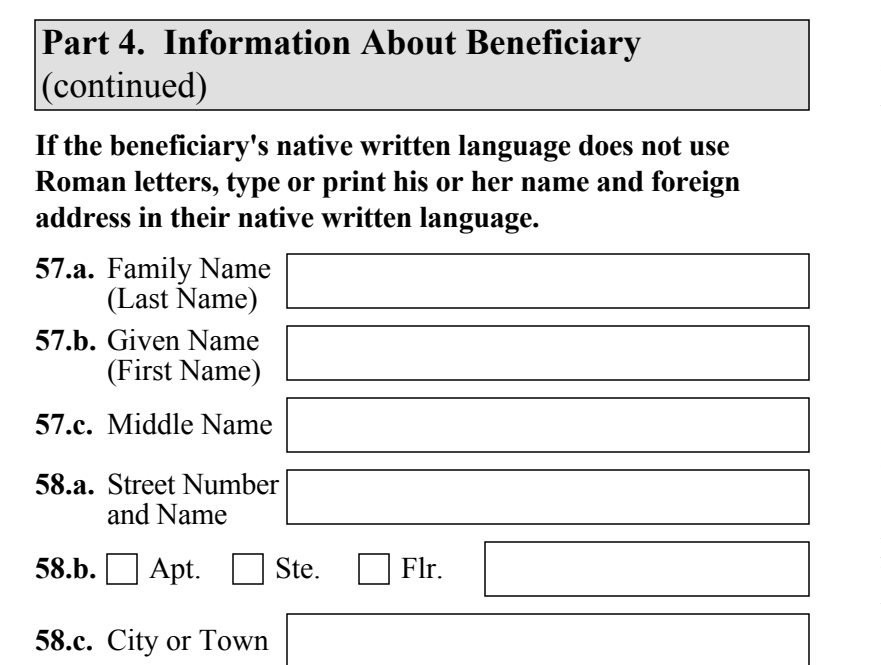
Verbatim · Part 4 note above Item 57 (Form I-130, edition 04/01/24, page 8)
“If the beneficiary's native written language does not use Roman letters, type or print his or her name and foreign address in their native written language.”
57.a. Family Name (Last Name) 57.b. Given Name (First Name) 57.c. Middle Name
58.a. Street Number and Name 58.b. Apt./Ste./Flr. 58.c. City or Town 58.d. Province 58.e. Postal Code 58.f. Country
The I-130 Instructions do not separately walk through Items 57-58; the note printed on the form itself is the controlling guidance. Always complete the current edition from uscis.gov/i-130; USCIS rejects outdated editions.
Does your spouse's language use Roman letters?
That single question decides whether you complete or skip Items 57 and 58. Roman (Latin) letters are the A-to-Z alphabet, including versions with accent marks.
| Spouse's language | Script | Items 57-58 |
|---|---|---|
| Spanish, French, Portuguese, Italian | Roman (Latin) | Leave blank |
| Tagalog/Filipino | Roman (Latin) | Leave blank |
| Vietnamese | Roman (Latin) with accent marks | Leave blank |
| Indonesian, Swahili, Turkish | Roman (Latin) | Leave blank |
| Mandarin / Cantonese (Chinese) | Chinese characters | Complete in Chinese |
| Arabic | Arabic alphabet | Complete in Arabic |
| Russian, Ukrainian, Serbian | Cyrillic | Complete in Cyrillic |
| Korean | Hangul | Complete in Korean |
| Japanese | Kanji/Kana | Complete in Japanese |
| Hindi, Nepali | Devanagari | Complete in the native script |
| Thai, Amharic, Hebrew, Greek | Non-Roman | Complete in the native script |
How to fill it in
Four steps for a non-Roman script. If your spouse's language uses Roman letters, you are done: leave both items blank.
Check the script, not the country
What matters is whether the writing system uses Roman (Latin) letters, not where your spouse is from. A spouse from the Philippines (Tagalog) or Vietnam writes in Roman letters, so you leave these items blank. A spouse from China, Egypt, Russia, or Korea writes in a non-Roman script, so you complete them.
Write the name exactly as in Item 57
Put the family name in 57.a, given name in 57.b, and middle name in 57.c, all in the native script. Match the order USCIS uses on the rest of the form (family name first), even if the native convention differs.
Write the foreign address in 58
Item 58 is the spouse's address abroad in the native script. Use the same address you listed in the Roman-letter address fields earlier in Part 4, just written in the native characters.
Use the script itself, not a spelling-out
Do not romanize. "Zhang Wei" goes in the Roman-letter name fields elsewhere on the form; Items 57 and 58 want the actual characters. If you are filing on paper and cannot type the script, the immigrant spouse can hand-print it neatly in black ink.
Marriage-based filers: usually about your spouse's home-country records
On a marriage petition the beneficiary is your immigrant spouse, so Items 57 and 58 are their information, not yours. The most common pattern is a cross-cultural couple: a U.S. citizen or green card holder (the petitioner) married to a spouse whose documents abroad are in a non-Roman script. If that is you, the spouse writes their own name and foreign address in Chinese, Arabic, Korean, Cyrillic, or whichever script their passport and home-country records use.
If your spouse's language uses Roman letters (a spouse from Mexico, the Philippines, Vietnam, Brazil, or Nigeria, for example), you leave both items blank. There is nothing to add.
Not sure which fields apply to your spouse's situation?
Our software asks a few plain questions about your spouse and fills the right fields the right way, keeping names consistent across your whole I-130 and I-485 packet.
Start FreeWhat USCIS does with the native written language
USCIS and the U.S. consulate use the native-script name and address to match your spouse against records kept abroad, such as a household registration, a passport in the home country, or police and civil records requested later in the process. Names that pass through romanization can be spelled several different ways, so the native script is the reliable key for identity verification and record-matching. Getting it right reduces the chance of a mismatch that slows the case at the National Visa Center or the consulate.
Common mistakes
These are the ones that show up most often on this field.
- 1
Romanizing instead of using the script
Typing "Mohammed Al-Sayed" or "Wang Fang" in these fields defeats the purpose. The Roman spelling already appears in the main name fields. Items 57 and 58 want the Arabic or Chinese characters themselves.
- 2
Completing it for a Roman-letter language
Vietnamese and Tagalog use the Roman alphabet, so filers from Vietnam and the Philippines often fill these items in unnecessarily. If the language uses Latin letters (even with accent marks), leave 57 and 58 blank.
- 3
Leaving it blank when the script is non-Roman
If your spouse's name appears on their passport in Chinese, Arabic, or Cyrillic characters, USCIS expects those characters here. Skipping it on a non-Roman case can draw a Request for Evidence (an RFE, a USCIS notice asking for more information).
- 4
Name order that does not match the rest of the form
Keep family name in 57.a and given name in 57.b to line up with how you completed the Roman-letter name fields, even when the native order would normally be reversed.
Related guides
Form and pathway context
Related questions
Frequently asked questions
Do I have to complete Items 57 and 58 if my spouse is from the Philippines or Latin America?
No. Tagalog, Spanish, Portuguese, and French use the Roman (Latin) alphabet, so you leave these items blank. The fields only apply when the beneficiary's native written language uses a non-Roman script.
My spouse's language uses accent marks. Is that a non-Roman script?
No. Vietnamese, Spanish, and similar languages use Roman letters with diacritics, which still counts as Roman letters. Leave 57 and 58 blank.
I am the U.S. citizen petitioner and cannot type Chinese or Arabic. What do I do?
Your spouse, the beneficiary, supplies their own name and address in the native script. If you are filing on paper, the spouse can hand-print it. If you are filing online, the spouse can type it using their device's native-language keyboard and you copy it in.
Can I just transliterate the name into English letters?
No. The form specifically asks for the native written language when it does not use Roman letters. A romanized spelling already appears in the main name fields. These items need the actual characters.
What does USCIS use this for?
To match your spouse against records held abroad, where the native-script name is the reliable identifier. Romanized spellings vary, so the native script helps verify identity and avoid record mismatches at the National Visa Center and the consulate.
Key takeaways
- ✓
Items 57 and 58 only apply when the beneficiary spouse's native language does not use Roman (Latin) letters.
- ✓
Roman-letter languages (Spanish, French, Tagalog, Vietnamese, Portuguese) leave these blank, even with accent marks.
- ✓
Non-Roman scripts (Chinese, Arabic, Korean, Japanese, Cyrillic, Thai, Devanagari) require the spouse's name and foreign address in that script.
- ✓
Use the actual script, not a romanized spelling. The Roman spelling already appears in the main name fields.
- ✓
The immigrant spouse provides the script when the U.S. petitioner cannot type it.
This page is for educational purposes only and is not legal advice. Green Card Genius is self-help immigration software, not a law firm, and does not provide legal representation. Immigration law and USCIS policy change frequently. For advice on a specific case, consult a licensed immigration attorney. Form I-130, edition 04/01/24. Last verified May 2026.
Stay informed
Green card guides in your inbox
Practical, plain-English updates to help you navigate the process with confidence.
Unsubscribe anytime.
Continue reading
Be a Genius
Only pay when you file