Form I-485 · Part 1, Items 10-12
I-485 Place and Date of Last Arrival (Part 1, Items 10-12) in 2026
How and when you most recently entered the United States. Nearly every answer comes off one document: your Form I-94.
Quick answer
Get your most recent Form I-94 from cbp.gov/I94 (free). The date of last arrival, the port, and your class of admission all come from it. In Item 11, most people who entered on a visa or the Visa Waiver Program check the first box, “inspected at a Port of Entry and admitted.” If you entered without inspection or were paroled, stop and talk to an immigration attorney before answering.
Summary
Items 10 through 12 in Part 1 ask how and when you most recently entered the United States: your passport or travel document and visa used at your last arrival, the place (city or town) and date of last arrival, how you were processed at the border (Item 11), and your Form I-94 details (Item 12). The date and class of admission come straight off your most recent Form I-94, which you can pull for free from the CBP website. The standard answer for someone who entered on a visa or the Visa Waiver Program is the first box in Item 11: inspected at a Port of Entry and admitted.
| Where it is on the form | Part 1, Items 10 through 12: Recent Immigration History (passport, visa, place and date of last arrival), manner of entry (Item 11), and Form I-94 information (Item 12). |
| Where the answers come from | Your most recent Form I-94 (Arrival/Departure Record). It shows the date and place of your last arrival and your class of admission. Get it free at cbp.gov/I94. |
| Place and date of last arrival | The city or town where you physically entered the United States most recently, and the date of that arrival in mm/dd/yyyy. Use the most recent entry, not your first-ever entry. |
| Manner of entry (Item 11) | How you were processed at the border: inspected and admitted, inspected and paroled, came in without admission or parole, or other. Most visa and Visa Waiver entrants are “inspected and admitted.” |
| When to get an attorney | If you entered without admission or parole, were paroled, or cannot document how you were admitted, the manner-of-entry answer has major eligibility consequences. Talk to an immigration attorney before completing Item 11. |
Who this page is for
This page covers the factual place, date, and documents of your last entry for someone who was inspected and admitted on a nonimmigrant visa or the Visa Waiver Program. If you entered the United States without admission or parole (entry without inspection), were paroled, or are unsure how you were admitted, the manner-of-entry answer in Item 11 has serious eligibility consequences. Consult an immigration attorney before completing it. That branch is flagged again below.
Free tool
Marriage Green Card Cost Calculator
2026 · AOS · full packet
$3,005
See your exact 2026 USCIS filing fees for a marriage green card through Adjustment of Status, with a full line-item breakdown and the costs most guides leave out.
Free — enter your email and it opens right up. Unsubscribe anytime.
We post free tips on preparing your marriage green card. Follow along:
What Items 10 and 11 look like on the form
Item 10 collects your passport, visa, and the place and date of your last arrival. Item 11 asks how you were processed at the border.
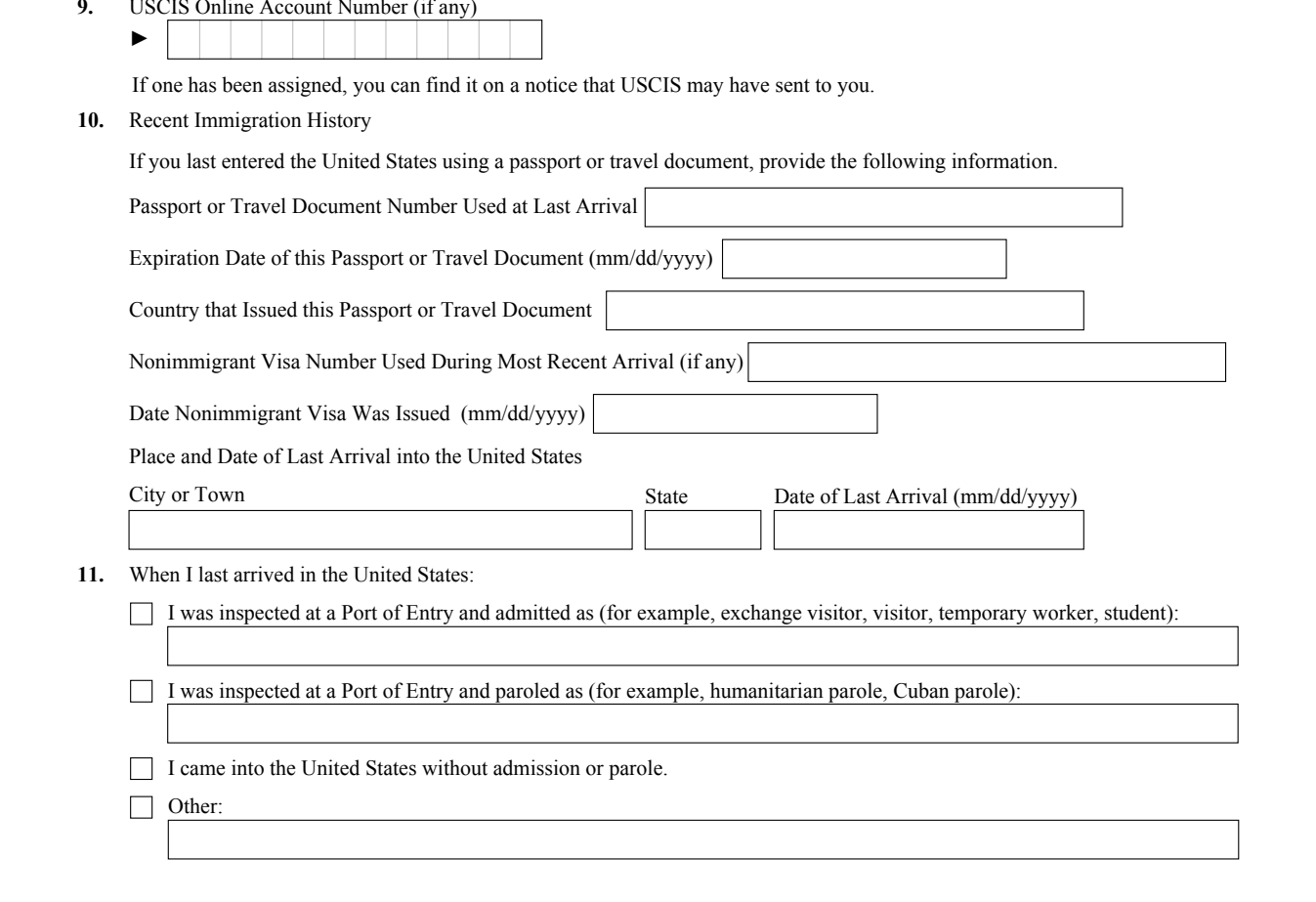
Verbatim -- Part 1, Item 10 (Form I-485, edition 09/18/26)
“Place and Date of Last Arrival into the United States. City or Town. State. Date of Last Arrival (mm/dd/yyyy).”
Verbatim -- Part 1, Item 11 manner of entry (Form I-485, edition 09/18/26)
“When I last arrived in the United States:”
“I was inspected at a Port of Entry and admitted as (for example, exchange visitor, visitor, temporary worker, student):”
“I was inspected at a Port of Entry and paroled as (for example, humanitarian parole, Cuban parole):”
“I came into the United States without admission or parole.”
“Other:”
What the instructions require
The Form I-485 Instructions (page 11) tie this field to evidence of your entry and point you to your Form I-94:
Verbatim -- Evidence of inspection and admission (I-485 Instructions, edition 09/18/26, page 11)
“All other applicants must provide evidence of inspection and admission or inspection and parole into the United States. This evidence also must be related to the most recent arrival into the United States.”
“You may visit the CBP website at www.cbp.gov/I94 to obtain a paper version of an electronic Form I-94 if needed.”
Always complete the current edition downloaded from uscis.gov/i-485; USCIS rejects outdated editions.
How to fill in your last arrival
Four steps, all anchored to your Form I-94.
Pull your most recent Form I-94 first
Go to cbp.gov/I94 and retrieve your most recent Arrival/Departure Record. It lists the date of your last arrival, the port where you entered, and your class of admission (the visa category you were admitted in). Item 12 copies these details.
Use your most recent entry, not your first
Items 10 and 11 are about the last time you arrived, even if you have entered the United States many times. Enter the city or town and the date of that most recent arrival.
Match the manner of entry to your I-94
In Item 11, the first box (inspected and admitted) is the standard answer for someone admitted on a nonimmigrant visa or under the Visa Waiver Program. Your I-94 class of admission confirms it. Check it against the document rather than from memory.
Keep the passport and visa details consistent
Item 10 asks for the passport or travel document number, its expiration date, the issuing country, and the visa number and issue date used at your most recent arrival. Copy them from the documents so they match your I-94 and your other forms.
Stop here if you were not clearly inspected and admitted
Item 11 is the one part of this field with legal weight. If you came into the United States without admission or parole (entry without inspection), were paroled, or cannot document how you were admitted, the answer affects whether you can adjust status at all. The instructions are explicit about the risk:
“If you cannot produce this primary evidence, and DHS has no record of the admission or parole, USCIS will presume that you came into the United States without inspection and admission or parole.”
Do not guess at Item 11. An immigration attorney needs to review your entry before you answer it.
Find an immigration attorneyWhat USCIS does with your last-arrival answer
USCIS uses your manner and date of last entry to confirm a threshold eligibility requirement for adjustment of status: generally, you must have been inspected and admitted or inspected and paroled into the United States. The class of admission and date also let the officer verify your I-94 and check that your stay and status line up with the rest of your application. Per the instructions, if you cannot document inspection and admission or parole and DHS has no record of it, USCIS presumes you entered without inspection, which can defeat eligibility to adjust. That is why the manner-of-entry answer carries real legal weight.
Common mistakes
These show up in Requests for Evidence (RFEs, USCIS notices asking for more documents).
- 01
Entering your first arrival instead of your most recent one
Items 10 and 11 ask about your last arrival. If you have entered the United States more than once, use the most recent entry, with the date and port from your latest Form I-94.
- 02
Guessing the date instead of using the I-94
The date and class of admission are on your Form I-94 at cbp.gov/I94. Use the document. A date that does not match your I-94 or your other forms is a common Request for Evidence trigger.
- 03
Checking a manner-of-entry box you are not sure about
Item 11 is not a guess. If you do not clearly know that you were inspected and admitted (or paroled), and you cannot document it, this is the point to consult an immigration attorney rather than choose a box.
- 04
Forgetting to attach the entry evidence
The instructions require evidence of inspection and admission or parole tied to your most recent arrival, such as the passport admission stamp, the passport page with your visa, and the Form I-94. Leaving it out invites a Request for Evidence.
Pulling details off your I-94 and onto the form correctly matters.
Our software walks you through your entry details, keeps your passport, visa, and I-94 information consistent across the packet, and flags when a manner-of-entry situation calls for an attorney.
Start FreeRelated guides
Form and pathway context
Frequently asked questions
Where do I find my date and place of last arrival for Form I-485?
From your most recent Form I-94 (Arrival/Departure Record), which you can pull for free at cbp.gov/I94. It shows the date of your last arrival, the port where you entered, and your class of admission. Items 10 through 12 copy these details.
Which arrival do I list if I have entered the U.S. several times?
Your most recent arrival. Items 10 and 11 ask how and when you last entered the United States, not your first-ever entry. Use the date, port, and class of admission from your latest Form I-94.
What does Item 11 (manner of entry) mean?
It asks how you were processed at the border on your last arrival: inspected at a Port of Entry and admitted, inspected and paroled, came into the United States without admission or parole, or other. Most people admitted on a nonimmigrant visa or under the Visa Waiver Program are “inspected and admitted.”
What if I entered without inspection or am not sure how I was admitted?
Stop and consult an immigration attorney before answering Item 11. Whether you were inspected and admitted (or paroled) is a threshold eligibility requirement for adjustment of status, and entering without inspection generally affects whether you can adjust. The instructions note that if you cannot document admission or parole and DHS has no record of it, USCIS presumes you entered without inspection. This is not a box to guess at.
Do I need to attach proof of how I entered?
Yes, in most cases. The instructions require evidence of inspection and admission or inspection and parole tied to your most recent arrival, such as your passport admission stamp, the passport page with your visa, and your Form I-94. A short list of exempt categories (for example, VAWA self-petitioners and certain others) does not have to submit it.
Key takeaways
- ✓
Items 10 through 12 ask how and when you most recently entered the U.S.: passport and visa used, place and date of last arrival, manner of entry, and Form I-94 details.
- ✓
Pull the date, port, and class of admission from your most recent Form I-94 at cbp.gov/I94. Use the document, not your memory.
- ✓
Use your most recent arrival, not your first entry, if you have entered more than once.
- ✓
Most visa and Visa Waiver entrants check “inspected at a Port of Entry and admitted” in Item 11.
- ✓
If you entered without admission or parole, were paroled, or cannot document your admission, talk to an immigration attorney before answering Item 11. The instructions warn that undocumented admission can be presumed to be entry without inspection.
This page is for educational purposes only and is not legal advice. Green Card Genius is self-help immigration software, not a law firm, and does not provide legal representation. Immigration law and USCIS policy change frequently. For advice on a specific case, consult a licensed immigration attorney. Form I-485, edition 09/18/26. Last verified May 2026.
Stay informed
Green card guides in your inbox
Practical, plain-English updates to help you navigate the process with confidence.
Unsubscribe anytime.
Continue reading
- 01Form I-485: Application to Adjust Status (2026 Guide)
- 02I-485 Filing Category (Part 2): Which Box a Spouse Checks (2026)
- 03Can I Get a Marriage Green Card if I Overstayed My Visa?
- 04Adjustment of Status Guide (2026): Marriage Green Card
- 05I-485 Address History (Part 1, Item 18): Your 5-Year List (2026)
Be a Genius
Only pay when you file