Form I-485 · Part 2, Item 3.a
I-485 Filing Category (Part 2): Which Box a Spouse Checks in 2026
Part 2 of Form I-485 asks you to pick your immigrant category. For a marriage-based case it comes down to one box, and which box depends on whether your spouse is a citizen or a green card holder.
Quick answer
Spouse of a U.S. citizen: check Part 2, Item 3.a Family-based, then “Spouse of a U.S. Citizen.” That is the immediate relative category, which has no waiting line. Spouse of a green card holder (a lawful permanent resident): check “Spouse of a lawful permanent resident,” the F2A preference category, which does have a waiting line. Entered on a K-1 fiance visa and married after? You check the K-1/K-2 box instead, even though you are now married.
Summary
You, the immigrant spouse, file Form I-485, and Part 2 is where you pick your immigrant category. For a marriage-based filer whose spouse is a U.S. citizen, the category is Family-based, immediate relative (a category with no annual cap and no waiting line), “Spouse of a U.S. Citizen,” under Part 2, Item 3.a. If your sponsoring spouse (the petitioner, the person who filed the I-130 for you) holds a green card instead of citizenship, the category is “Spouse of a lawful permanent resident,” which is the F2A preference category (it has annual limits, so there is a waiting line). You select only one category, and it has to match the petition (Form I-130) filed for you. People who entered on a K-1 fiance visa and then married the petitioner are an exception: they select the K-1/K-2 box, not the spouse box.
| Where it is on the form | Part 2, “Application Type or Filing Category.” The category list is Item 3, and the family-based group is Item 3.a. You select only one category. |
| Spouse of a U.S. citizen | Check Item 3.a Family-based, then “Spouse of a U.S. Citizen.” This is the immediate relative category. An immigrant visa is always available, so you can file Form I-485 at the same time as the I-130 (concurrent filing). |
| Spouse of a green card holder | Your sponsoring spouse is a lawful permanent resident (a green card holder, abbreviated LPR), not a citizen. Check Item 3.a Family-based, then “Spouse of a lawful permanent resident.” This is the F2A preference category. A visa number must be available to you on the Department of State Visa Bulletin (the monthly government chart showing whose turn it is to apply) before you can file Form I-485. |
| Principal or derivative applicant | The Principal Applicant is the person the I-130 was filed for, so the sponsored spouse files as the principal. A Derivative Applicant is a spouse or child who qualifies through someone else's principal case. Immediate relatives (spouse of a U.S. citizen) have no derivatives; a spouse of a green card holder may bring children as derivatives under F2A. |
| K-1 fiance entrants | If you entered on a K-1 fiance visa and married the U.S. citizen who petitioned for you, you select the K-1/K-2 box, not “Spouse of a U.S. Citizen.” The K-1 category has its own way of adjusting status (applying for the green card from inside the U.S.). |
Who this page is for
This page covers selecting the immigrant category in Part 2 for a marriage-based filer whose spouse is a U.S. citizen or a green card holder, filing directly with USCIS (not in immigration court). On a marriage-based case, you (the immigrant spouse) file Form I-485, while your sponsoring spouse files the I-130 petition. This page is about the category you select on your I-485. If you are filing while in removal, exclusion, rescission, or deportation proceedings (Part 2, Item 1), or you are a VAWA self-petitioner (someone applying on their own under the Violence Against Women Act), consult an immigration attorney before selecting your category. Those situations are flagged again below at the point they come up.
Free tool
Marriage Green Card Cost Calculator
2026 · AOS · full packet
$3,005
See your exact 2026 USCIS filing fees for a marriage green card through Adjustment of Status, with a full line-item breakdown and the costs most guides leave out.
Free — enter your email and it opens right up. Unsubscribe anytime.
We post free tips on preparing your marriage green card. Follow along:
What Part 2 looks like on the form
Part 2 is titled “Application Type or Filing Category.” The category list is Item 3, and the family-based group, including the spouse boxes, is Item 3.a.
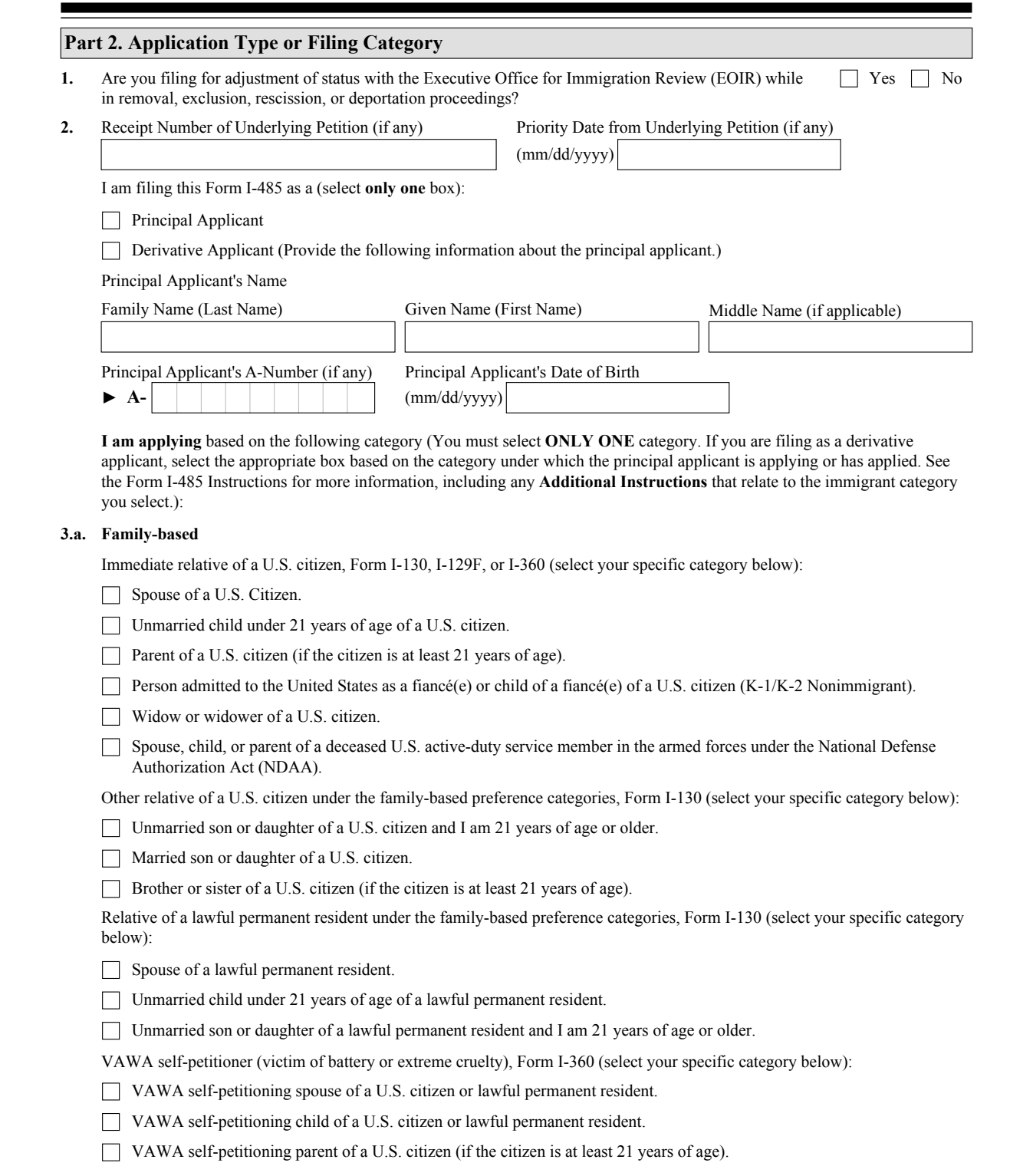
Verbatim -- Part 2, Item 3 selection instruction (Form I-485, edition 09/18/26)
“I am applying based on the following category (You must select ONLY ONE category. If you are filing as a derivative applicant, select the appropriate box based on the category under which the principal applicant is applying or has applied. See the Form I-485 Instructions for more information, including any Additional Instructions that relate to the immigrant category you select.)”
Verbatim -- Part 2, Item 3.a (Form I-485, edition 09/18/26)
As printed on the form, these are three separate lines: the category header, the sub-header, and the checkbox.
“3.a. Family-based”
“Immediate relative of a U.S. citizen, Form I-130, I-129F, or I-360 (select your specific category below):”
“Spouse of a U.S. Citizen.”
What the instructions say about each category
The Form I-485 Instructions spell out the two marriage-based situations under “Additional Instructions for Family-Based Applicants.” The immediate relative category (spouse of a U.S. citizen) reads:
Verbatim -- Immediate Relative of a U.S. Citizen (I-485 Instructions, edition 09/18/26, page 19)
“If you are an immediate relative, you may file your Form I-485 together with your Form I-130, while Form I-130 is pending, or after your Form I-130 is approved.”
“Derivative applicants are not allowed in this category.”
The spouse of a green card holder falls under the family-based preference categories, which the same page covers separately:
Verbatim -- Family-Based Preference Categories (I-485 Instructions, edition 09/18/26, page 19)
“If an immigrant visa is immediately available, you may file your Form I-485 together with your Form I-130, while Form I-130 is pending, or after your Form I-130 is approved. Otherwise, you may file your Form I-485 only after your Form I-130 is approved and an immigrant visa is immediately available. See the When Should I File Form I-485 section for more information.”
The form's printed instruction directs you to the Form I-485 Instructions, including any Additional Instructions tied to the category you select. Always download the current edition from uscis.gov/i-485 the day you compile your packet; USCIS rejects outdated editions.
Which box applies to you?
For a marriage-based case, the choice is driven by your sponsoring spouse's status. Both boxes live under Item 3.a Family-based.
Your spouse is a U.S. citizen
Who this is: The person sponsoring you (the petitioner) is a U.S. citizen, and an I-130 was filed naming you as the spouse.
Box to check: Item 3.a Family-based, then “Spouse of a U.S. Citizen” under “Immediate relative of a U.S. citizen.”
Visa availability: You are an immediate relative. There is no annual cap and no waiting line, so an immigrant visa is always available. That is why a spouse of a U.S. citizen can file the I-485 in the same packet as the I-130.
Your spouse is a green card holder
Who this is: The person sponsoring you is a lawful permanent resident (a green card holder, not a citizen), and an I-130 was filed naming you as the spouse.
Box to check: Item 3.a Family-based, then “Spouse of a lawful permanent resident” under “Relative of a lawful permanent resident.”
Visa availability: You are in the F2A preference category. Preference categories have annual limits, so you can file the I-485 only once a visa number is available to you on the Department of State Visa Bulletin. Check the Visa Bulletin before filing.
When to stop and talk to an attorney
Two filing-category situations have legal consequences that depend on your specific facts, and the guidance above does not cover them. If Part 2, Item 1 applies to you (you are filing for adjustment while in removal, exclusion, rescission, or deportation proceedings before the immigration court), or you are filing as a VAWA self-petitioner, an immigration attorney needs to review your situation before you select a category. Selecting the wrong basis in either case can affect your eligibility in ways that are hard to undo.
Find an immigration attorneyCommon wrong choices on this field
These category errors show up in Requests for Evidence (RFEs, USCIS notices asking for more documents) and rejections. Each one is avoidable.
- 01
K-1 fiance entrant checking “Spouse of a U.S. Citizen”
If you entered on a K-1 fiance visa and then married the U.S. citizen who petitioned for you, it feels natural to check “Spouse of a U.S. Citizen.” That is the wrong box. USCIS requires K-1 entrants to adjust under the fiance category, the box reading “Person admitted to the United States as a fiancé(e) or child of a fiancé(e) of a U.S. citizen (K-1/K-2 Nonimmigrant).” The K-1 box is the one that matches how you were admitted.
- 02
Matching the wrong sponsor status
The category has to match whether your sponsoring spouse is a citizen or a green card holder. A spouse of a green card holder who checks “Spouse of a U.S. Citizen” is claiming a visa is immediately available when it may not be. A spouse of a citizen who checks the green card holder box gives up immediate relative treatment. Confirm your spouse's status before selecting.
- 03
Selecting more than one category
The form states you select ONLY ONE category. Checking a family-based box and an employment-based box, or two family-based boxes, creates a conflict that does not match your single I-130. USCIS reads the I-485 category against the petition it was filed with.
- 04
Confusing Principal Applicant with Derivative Applicant
The spouse named in the I-130 is the Principal Applicant on their own I-485. “Derivative Applicant” is for a spouse or child adjusting based on someone else's principal case. A spouse of a U.S. citizen is always a principal, because immediate relatives have no derivatives. Checking Derivative here misstates the basis of your case.
What happens if you select the wrong category
The filing category is read against the petition filed for you, so a mismatch has concrete consequences.
Mismatch with your I-130
USCIS reviews the I-485 filing category against the immigrant petition (Form I-130) filed for you. If the category on the I-485 does not line up with the petition, the officer cannot confirm a visa is available to you, which is a setup for a Request for Evidence (an RFE, USCIS's formal notice asking for more documents) or a denial.
Filing before a visa is available
Checking an immediate relative box when you are actually in the F2A preference category claims a visa that may not yet be available. USCIS can reject an I-485 filed before a visa number is available to the applicant.
Fixable, but it costs time
A category error is usually correctable by responding to an RFE or refiling with the right box, but both add months. Confirming the category against your sponsor's status and your I-130 before you file is faster than fixing it later.
What USCIS does with the filing category
The filing category sets your immigrant classification, and that single choice drives the rest of the case. It tells USCIS whether an immigrant visa is immediately available to you (always, for immediate relatives such as the spouse of a U.S. citizen; only when the Visa Bulletin shows your date is current, for preference categories like F2A). It controls whether you can file the I-485 at the same time as the petition or have to wait. It also tells the officer which eligibility rules, bars, and category-specific Additional Instructions apply to your application. The category you check has to be the same one the underlying I-130 establishes.
Marriage-based filers: the category in one place
The typical marriage-based case is the spouse of a U.S. citizen filing from inside the United States. Here is how the category maps to each common situation.
- Spouse of a U.S. citizen (the common case). Check Item 3.a Family-based, then “Spouse of a U.S. Citizen.” You are an immediate relative, a visa is always available, and you can file the I-485 concurrently with the I-130.
- Spouse of a green card holder. Check Item 3.a Family-based, then “Spouse of a lawful permanent resident.” You are in the F2A preference category and file the I-485 once a visa number is available to you on the Visa Bulletin.
- You entered on a K-1 fiance visa. Check the K-1/K-2 box, not the spouse box, even though you are now married. The K-1 category is its own adjustment path with its own evidence.
- Your children are adjusting too. Children of a spouse of a green card holder can be Derivative Applicants under F2A. A stepchild of a U.S. citizen needs a separate I-130 and files as an immediate relative in their own right, since immediate relatives have no derivatives.
Form I-485 has dozens of fields like this one.
Our software asks plain-English questions, picks the right filing category from your answers, and assembles the full marriage-based packet (I-130, I-485, I-864, and the rest) so the forms match each other.
Start FreeRelated guides
Form and pathway context
Frequently asked questions
Which box does the spouse of a U.S. citizen check on Form I-485 Part 2?
Check Item 3.a Family-based, then “Spouse of a U.S. Citizen” under “Immediate relative of a U.S. citizen.” The spouse of a U.S. citizen is an immediate relative, so an immigrant visa is always available and the I-485 can be filed at the same time as the I-130.
What is the difference between filing as the spouse of a U.S. citizen and the spouse of a green card holder?
The spouse of a U.S. citizen is an immediate relative: no annual cap, a visa is always available, and concurrent filing with the I-130 is allowed. The spouse of a lawful permanent resident is in the F2A preference category, which has annual limits, so the I-485 can be filed only once a visa number is available on the Department of State Visa Bulletin. Both are checked under Part 2, Item 3.a Family-based, but they are different boxes.
I entered on a K-1 fiance visa and married my petitioner. Do I check “Spouse of a U.S. Citizen”?
No. A K-1 fiance entrant who married the U.S. citizen petitioner adjusts under the fiance category, the box reading “Person admitted to the United States as a fiancé(e) or child of a fiancé(e) of a U.S. citizen (K-1/K-2 Nonimmigrant),” not the “Spouse of a U.S. Citizen” box. The category matches how you were admitted to the U.S.
Am I the Principal Applicant or the Derivative Applicant?
The spouse named in the I-130 files as the Principal Applicant on their own I-485. Derivative Applicant is for a spouse or child adjusting based on another person's principal case. A spouse of a U.S. citizen is always a principal applicant, because immediate relatives have no derivatives.
What happens if I select the wrong filing category?
USCIS reviews the category against your I-130. A mismatch (or claiming an immediate relative category when you are in a preference category) can trigger a Request for Evidence or a rejection, especially if it implies a visa is available when it is not. It is usually fixable by responding to the RFE or refiling with the correct box, but that adds time.
Can the spouse of a U.S. citizen file Form I-485 at the same time as the I-130?
Yes. Because the spouse of a U.S. citizen is an immediate relative with a visa always available, USCIS allows the I-485 to be filed concurrently with the I-130 in one packet. This is the standard approach for spouses of U.S. citizens who are already in the United States.
Key takeaways
- ✓
Filing category lives in Part 2, “Application Type or Filing Category.” The category list is Item 3, and you select only one box.
- ✓
Spouse of a U.S. citizen: Item 3.a Family-based, “Spouse of a U.S. Citizen” (immediate relative). A visa is always available, so you can file concurrently with the I-130.
- ✓
Spouse of a green card holder: Item 3.a Family-based, “Spouse of a lawful permanent resident” (F2A preference). File only once a visa number is available on the Visa Bulletin.
- ✓
K-1 fiance entrants select the K-1/K-2 box, not the spouse box, even after marrying the petitioner.
- ✓
The category on the I-485 has to match the I-130 filed for you. A mismatch is a common Request for Evidence trigger.
This page is for educational purposes only and is not legal advice. Green Card Genius is self-help immigration software, not a law firm, and does not provide legal representation. Immigration law and USCIS policy change frequently. For advice on a specific case, consult a licensed immigration attorney. Form I-485, edition 09/18/26. Last verified May 2026.
Stay informed
Green card guides in your inbox
Practical, plain-English updates to help you navigate the process with confidence.
Unsubscribe anytime.
Continue reading
- 01Form I-485: Application to Adjust Status (2026 Guide)
- 02Form I-130: Petition for Alien Relative (2026 Guide)
- 03Adjustment of Status Guide (2026): Marriage Green Card
- 04Adjustment of Status vs Consular Processing (2026 Guide)
- 05I-864 vs. I-864EZ vs. I-864A: Which Affidavit of Support Form Do You Need (2026)
Be a Genius
Only pay when you file