Form I-485 · Part 1, Item 18
I-485 Address History (Part 1, Item 18): Your 5-Year List in 2026
Part 1, Item 18 asks where you have physically lived. If your current address does not go back a full 5 years, you list the prior ones too, with dates.
Quick answer
Enter your current U.S. physical address first. If you have lived there less than 5 years, answer “No” and list every prior address for the last 5 years with From and To dates, working backward, with no gaps. If you lived outside the U.S. for more than a year, the form also asks for your most recent address abroad.
Summary
Item 18 in Part 1 asks for your current U.S. physical address and, if you have lived there less than 5 years, every prior address going back 5 years with the dates you lived at each one. List physical addresses (where you actually lived), not just mailing addresses, and leave no gaps in the timeline. The form starts with a yes/no: have you resided at your current address for at least 5 years? If yes, you list only the current address; if no, you add the prior ones.
| Where it is on the form | Part 1, Item 18 (“Addresses”). Current U.S. physical address, then the yes/no question “Have you resided at your current address for at least 5 years?”, then prior addresses if the answer is No. |
| Time period covered | The last 5 years of where you physically lived. If your current address covers the full 5 years, that is the only one you list. |
| Physical vs. mailing | Item 18 wants physical addresses (the places you actually lived). There is a separate mailing-address field for where you receive mail, and a safe-address option for certain applicants. |
| Addresses abroad | The form asks separately for your most recent physical address outside the United States where you lived for more than one year, if it is not already listed in your 5-year history. |
| Running out of space | If you have more prior addresses than the form has room for, continue them in Part 14 (Additional Information). Do not drop any. |
Who this page is for
This page covers how to fill in the address-history fields in Part 1, Item 18. It is a biographical timeline, not a legal-eligibility question. If your address history would reveal time spent in the U.S. without authorization or other admissibility issues, the addresses themselves are still reported as asked, but those underlying issues are separate questions an immigration attorney should review.
Free tool
Marriage Green Card Cost Calculator
2026 · AOS · full packet
$3,005
See your exact 2026 USCIS filing fees for a marriage green card through Adjustment of Status, with a full line-item breakdown and the costs most guides leave out.
Free — enter your email and it opens right up. Unsubscribe anytime.
We post free tips on preparing your marriage green card. Follow along:
What Item 18 looks like on the form
After your current U.S. physical address, Item 18 asks a yes/no question and then, if needed, a block for each prior address with dates.
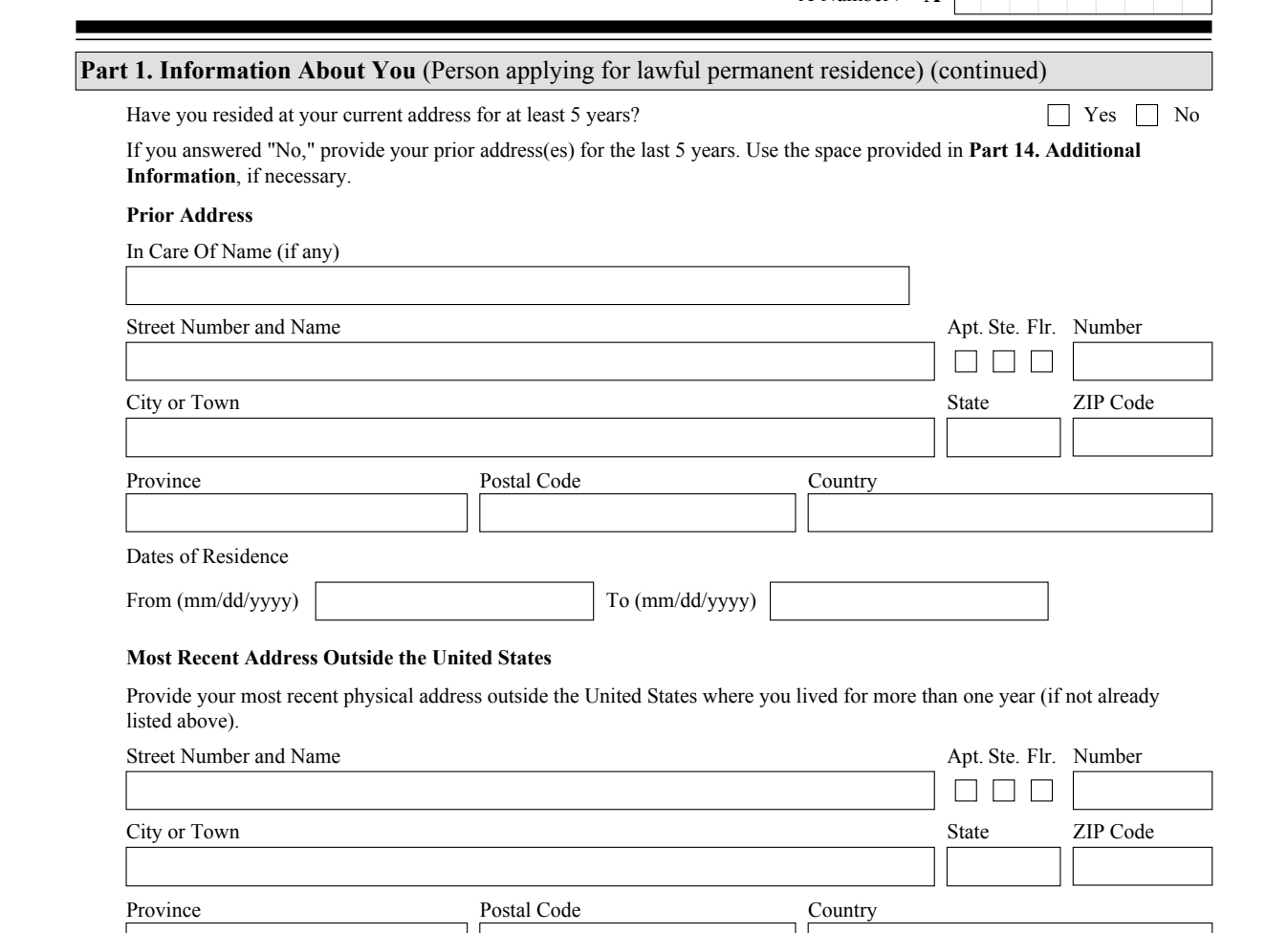
Verbatim -- Part 1, Item 18 (Form I-485, edition 09/18/26)
“Have you resided at your current address for at least 5 years?”
“If you answered “No,” provide your prior address(es) for the last 5 years. Use the space provided in Part 14. Additional Information, if necessary.”
“Provide your most recent physical address outside the United States where you lived for more than one year (if not already listed above).”
Always complete the current edition downloaded from uscis.gov/i-485; USCIS rejects outdated editions.
How to fill in your address history
Four steps cover almost every situation.
Start with your current physical address
Enter the U.S. address where you live now, with the date you first started living there. Then answer the yes/no question: have you been at this address for at least 5 years? Yes means you list only this address. No means you continue with prior addresses.
Work backward with no gaps
List each prior address with a From date and a To date. The To date of one address should match or connect to the From date of the next, so the 5-year timeline has no unexplained holes. USCIS reads the dates as a continuous record of where you lived.
Use physical addresses, not P.O. boxes
Item 18 is asking where you physically lived. A P.O. box or a relative's address you only used for mail does not belong here. Mailing addresses go in the separate mailing-address field.
Add the most recent address abroad if it applies
If you lived outside the United States for more than one year and that address is not already in your 5-year list, the form has a dedicated field for your most recent physical address abroad. Fill it in even if it falls outside the 5-year window.
Common situations
- You moved several times in 5 years. List every address, oldest gaps included. If the form runs out of rows, continue in Part 14 (Additional Information) with the same From/To date format. Leaving addresses off to save space is a common reason USCIS issues a Request for Evidence.
- You do not remember an exact move-in date. Use your best good-faith estimate of the month and year. The form uses mm/dd/yyyy; if you only know the month, use the first of the month. Do not leave the date blank, and keep it consistent with the same dates on your other forms.
- You lived abroad during the last 5 years. Foreign addresses count. Include them in the 5-year history with their dates. The form also has a separate field for your most recent address outside the U.S. where you lived for more than a year.
- You do not feel safe listing your physical address. If you have a pending or approved VAWA (Violence Against Women Act), T (trafficking victim), or U (crime victim) case and do not feel safe receiving mail at your physical address, the instructions let you give a safe mailing address in the mailing-address field. Your physical address history is still required, but mail can go elsewhere.
Verbatim -- Safe mailing address (I-485 Instructions, edition 09/18/26, page 6)
“If you have a pending or approved petition or application for Violence Against Women Act (VAWA) benefits, as a human trafficking victim (T nonimmigrant), or as a victim of qualifying criminal activity (U nonimmigrant), and you do not feel safe receiving mail about this application at your physical address, provide a safe mailing address in this field.”
What USCIS does with your address history
USCIS uses your 5-year address history to run the required background and security checks against every place you have lived and to confirm which USCIS field office has jurisdiction over your case (the office nearest your current address schedules your interview). Adjudicators also cross-check these addresses against the address history on your other forms, including Form I-130 and Form I-130A. Gaps or addresses that do not match across forms are a common trigger for a Request for Evidence.
Verbatim -- Address change (I-485 Instructions, edition 09/18/26)
“You must notify USCIS any time you change your mailing address or your physical address. You must notify us no later than 10 days after making such change.”
Common mistakes
These show up in Requests for Evidence (RFEs, USCIS notices asking for more documents).
- 01
Listing a mailing address instead of where you lived
Item 18 asks for physical addresses. Entering a P.O. box, a mail-forwarding service, or a relative's address you only used for mail misstates where you actually lived. Mailing addresses belong in the separate mailing-address field.
- 02
Leaving gaps in the 5-year timeline
If the To date of one address and the From date of the next do not connect, USCIS sees an unexplained gap. Make the dates continuous so the 5 years are fully covered.
- 03
Addresses that do not match your other forms
Your address history on Form I-485 should line up with the address history on Form I-130A and any addresses on Form I-130. Inconsistent addresses across the packet are a frequent Request for Evidence trigger.
- 04
Dropping addresses to fit the form
The form has limited rows. If you have more addresses than fit, continue them in Part 14 (Additional Information). Omitting an address to save space leaves an incomplete record.
Form I-485 asks for a lot of dated history like this.
Our software collects your addresses once, keeps the dates consistent across every form in the packet, and overflows extras into Part 14 for you.
Start FreeRelated guides
Form and pathway context
Frequently asked questions
How far back does the I-485 address history go?
Five years. Part 1, Item 18 asks whether you have lived at your current address for at least 5 years. If you have, you list only that address. If not, you add each prior address going back 5 years, with the dates you lived at each one.
Do I list physical addresses or mailing addresses?
Physical addresses, meaning the places where you actually lived. Item 18 is about residence history. There is a separate field for your current mailing address (where you receive mail), which can be different from where you live.
What if I lived outside the United States during the last 5 years?
Foreign addresses count and go in the 5-year history with their dates. The form also asks separately for your most recent physical address outside the United States where you lived for more than one year, if it is not already listed.
What if I run out of space for all my addresses?
Continue your prior addresses in Part 14 (Additional Information), using the same From and To date format. Do not leave any address off to make the list fit the boxes on the form.
What if I do not remember the exact dates I moved?
Use your best good-faith estimate of the month and year. If you only know the month, use the first of that month. Keep the dates consistent with the same addresses on your other forms (Form I-130A, for example). Do not leave the dates blank.
Key takeaways
- ✓
Part 1, Item 18 asks for your current U.S. physical address and every prior address for the last 5 years, with From and To dates.
- ✓
List physical addresses (where you lived), not P.O. boxes or mail-only addresses. Those go in the separate mailing-address field.
- ✓
Keep the timeline continuous with no gaps, and continue extra addresses in Part 14 rather than dropping any.
- ✓
Foreign addresses count; the form also asks separately for your most recent address abroad if you lived there more than a year.
- ✓
Make your address history match the addresses on Form I-130A and Form I-130. Mismatches are a common Request for Evidence trigger.
This page is for educational purposes only and is not legal advice. Green Card Genius is self-help immigration software, not a law firm, and does not provide legal representation. Immigration law and USCIS policy change frequently. For advice on a specific case, consult a licensed immigration attorney. Form I-485, edition 09/18/26. Last verified May 2026.
Stay informed
Green card guides in your inbox
Practical, plain-English updates to help you navigate the process with confidence.
Unsubscribe anytime.
Be a Genius
Only pay when you file