Form I-130 · Part 4, Items 17-24
I-130 Beneficiary's Prior Marriage Information (Part 4, Items 17-24)
How to record your immigrant spouse's marital history in Part 4: how many times they have been married, each prior spouse's name, and the date each prior marriage ended.
Quick answer
Count every marriage your immigrant spouse (the beneficiary) has ever had, including the current one, in Item 17. Then list each spouse by name and, for prior marriages, the date that marriage legally ended in Item 22 or 24. A final divorce decree, death certificate, or annulment order is what proves a prior marriage ended.
Summary
Form I-130 Part 4 is where you record the beneficiary's marital history. The petitioner is the U.S. citizen or green card holder filing the form; the beneficiary is the immigrant spouse the petition is for. Item 17 asks how many times the beneficiary has been married, counting the current marriage to you. Item 18 is their current marital status. The form then asks for the name of each spouse, current first and then prior spouses, with the date each prior marriage ended. For the common case, a single prior marriage that ended in a final divorce, this is factual: list the prior spouse's name and the date the divorce became final, and keep a copy of the divorce decree. If the validity of a prior divorce is unclear, see the stop below.
| What Item 17 asks | The total number of times the beneficiary has been married, including the current marriage to the petitioner. |
| What Item 18 asks | The beneficiary's current marital status: Single (Never Married), Married, Divorced, Widowed, Separated, or Annulled. |
| Prior spouses (Items 21 to 24) | Each spouse's name (current spouse first, then prior spouses), with the date each prior marriage ended. |
| Proof a prior marriage ended | A final divorce decree, a death certificate, or an annulment order. You file this with the petition when the beneficiary was married before. |
| Keep counts consistent | The number here must match the times-married answer on the I-485 and any other form in the packet. |
Who this page is for
This page covers the common case: a beneficiary whose prior marriage ended in a divorce with a final divorce decree, or whose prior spouse died. Listing the count, the prior spouse's name, and the end date is factual. If a prior divorce was granted abroad and its validity is unclear, was an annulment, was a religious-only divorce, or you are not sure the prior marriage legally ended, stop and talk to a licensed immigration attorney. That branch is flagged again below.
Free tool
Marriage Green Card Cost Calculator
2026 · AOS · full packet
$3,005
See your exact 2026 USCIS filing fees for a marriage green card through Adjustment of Status, with a full line-item breakdown and the costs most guides leave out.
Free — enter your email and it opens right up. Unsubscribe anytime.
We post free tips on preparing your marriage green card. Follow along:
What the prior-marriage fields look like on the form
These fields sit in Part 4 (Information About Beneficiary). Item 17 is the count, Item 18 is current marital status, and Items 21 through 24 collect each spouse's name and the date each prior marriage ended.
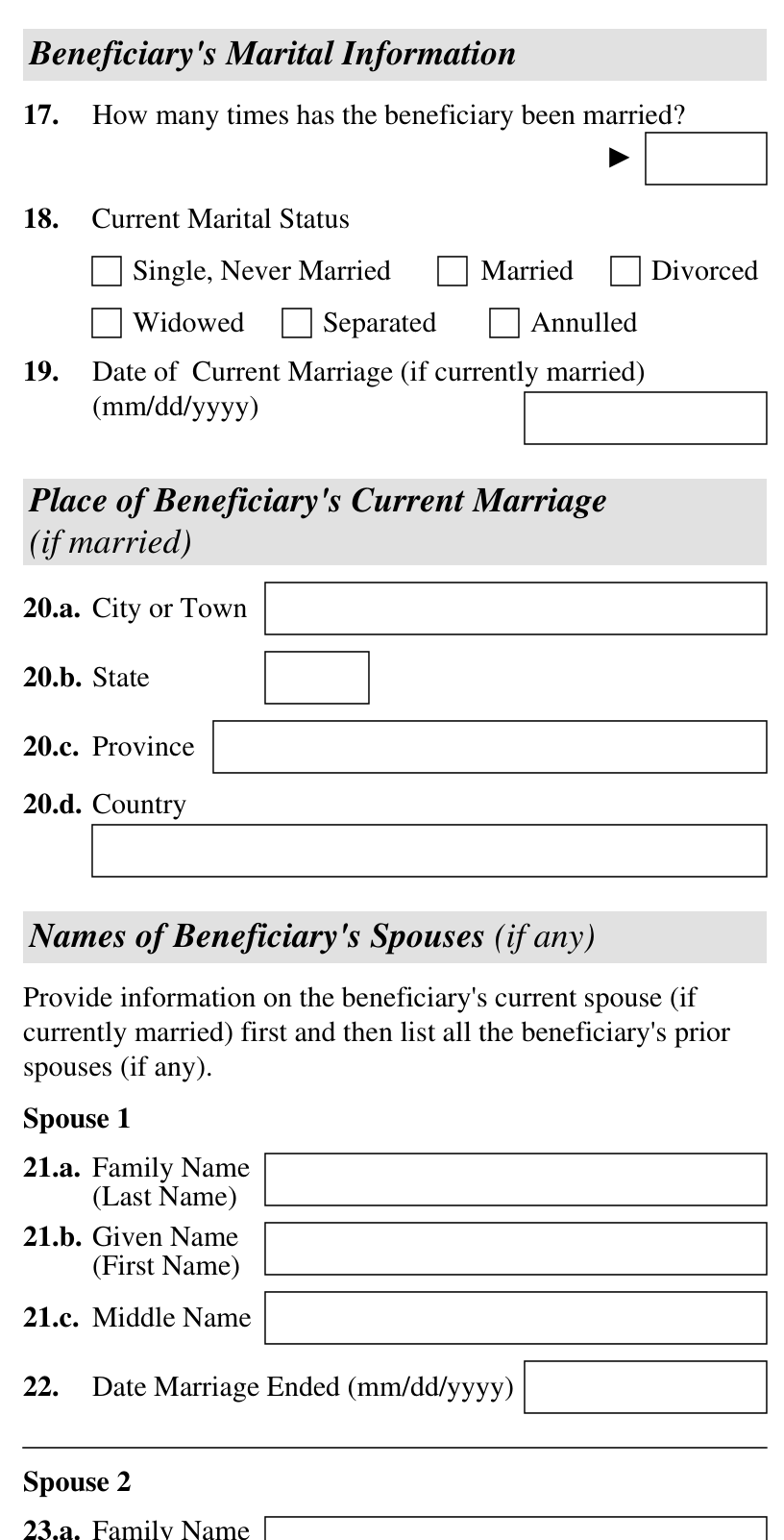
Verbatim · Part 4, Item 17 (Form I-130, edition 04/01/24, page 6)
“How many times has the beneficiary been married?”
Verbatim · instruction above the spouse fields (Form I-130, edition 04/01/24, page 6)
“Provide information on the beneficiary's current spouse (if currently married) first and then list all the beneficiary's prior spouses (if any).”
17. How many times has the beneficiary been married?
18. Current Marital Status: Single, Never Married · Married · Divorced · Widowed · Separated · Annulled
Spouse 1 · 21.a. Family Name (Last Name) · 21.b. Given Name (First Name) · 21.c. Middle Name
22. Date Marriage Ended (mm/dd/yyyy)
Spouse 2 · 23.a. Family Name (Last Name) · 23.b. Given Name (First Name) · 23.c. Middle Name
24. Date Marriage Ended (mm/dd/yyyy)
Always complete the current edition downloaded from uscis.gov/i-130; USCIS rejects outdated editions.
How to fill in the beneficiary's marital history
Five steps for the common case: a clean prior divorce or a prior spouse who died.
Count every marriage in Item 17
Write the total number of marriages the beneficiary has had, including the current marriage to you. A spouse who was married once before and is now married to you has been married two times. Do not write 1 just because the prior marriage ended.
Pick the current marital status in Item 18
For most marriage-based petitions the beneficiary is Married (to you), so select Married. The Divorced, Widowed, Separated, and Annulled boxes describe a beneficiary's status when they are not currently married, which is uncommon on a spousal I-130.
List the current spouse first, then prior spouses
The form wants the current spouse (you) listed first, then each prior spouse. Put the prior spouse's family, given, and middle name in the name fields exactly as it appeared during that marriage.
Enter the date each prior marriage ended
Item 22 (Spouse 1) and Item 24 (Spouse 2) ask for the date the marriage ended in mm/dd/yyyy. For a divorce, that is the date the divorce became final on the decree, not the date of separation or the date you filed. For a death, it is the date on the death certificate.
Attach the proof
USCIS wants the document that shows a prior marriage legally ended: a final divorce decree, a death certificate, or an annulment order. File it with the petition. The date you wrote in Item 22 or 24 should match the date on that document.
Stop here if the prior marriage may not have legally ended
A marriage is only valid for immigration if every earlier marriage legally ended before it began. Some situations are not clear-cut, and getting this wrong can sink the whole petition. Talk to a licensed immigration attorney before you answer if any of these apply to the beneficiary:
- ·A prior divorce was granted in another country and you are not certain it is recognized as valid.
- ·The prior marriage ended in an annulment.
- ·There was only a religious divorce or a religious-only marriage, with no civil record.
- ·You cannot produce a final divorce decree, or you are unsure whether the prior marriage was ever legally dissolved.
We do not analyze whether a foreign divorce or annulment legally ended a marriage. An attorney needs to review the documents before you answer.
Find an immigration attorneyMarriage-based filers: this is your spouse's history, and it has to clear the way
On a marriage petition the beneficiary is your immigrant spouse, so Items 17 through 24 are their marital history, not yours. The petitioner is the U.S. citizen or green card holder filing the form; the beneficiary is the spouse the petition is for. The reason USCIS asks is straightforward: your marriage can only be the basis for a green card if your spouse's earlier marriages all legally ended before you married. A prior marriage that was never dissolved would make the current marriage invalid.
For the common case, that is easy to show. If your spouse was divorced once and the divorce became final before your wedding, you count two marriages in Item 17, list the prior spouse's name, enter the date the divorce became final in Item 22, and file the final divorce decree with the petition. If your spouse was widowed, you file the death certificate and use the date of death. The whole point is to give USCIS a clean, documented timeline.
Want the marital-history fields filled the right way?
Our software asks plain questions about your spouse's prior marriages, keeps the count consistent across your I-130 and I-485, and flags when a foreign or unclear divorce calls for an attorney.
Start FreeWhat USCIS does with the prior-marriage answer
USCIS reads the beneficiary's marital history to confirm that any prior marriage legally ended before your current marriage began. A marriage is only valid for immigration if both people were free to marry, so the agency checks that each earlier marriage was dissolved by divorce, death, or annulment on a date before your wedding. The count in Item 17 and the names and end dates of prior spouses let an officer line up the dates against the divorce decrees or death certificates you file. Gaps or dates that do not match the documents are a common reason for a Request for Evidence (an RFE, a USCIS notice asking for more information).
Common mistakes
These show up in Requests for Evidence (RFEs, USCIS notices asking for more documents).
- 1
Not counting the current marriage in Item 17
Item 17 is the total number of marriages, including the one to you. A beneficiary with one prior marriage has been married two times, not one. Undercounting here contradicts the prior-spouse entries below it.
- 2
Using the separation date instead of the divorce date
Item 22 and Item 24 want the date the marriage legally ended. For a divorce that is the date the decree became final, not when the couple stopped living together or filed the paperwork. Use the date printed on the final divorce decree.
- 3
Listing a prior spouse but not filing the proof
If the beneficiary was married before, USCIS expects the document that ended that marriage: a final divorce decree, death certificate, or annulment order. Listing the prior spouse without filing the proof draws an RFE.
- 4
A count that does not match the I-485
The beneficiary later answers a times-married question on the I-485. If Item 17 here says two and the I-485 says one, the officer sees a conflict. Keep the count identical across every form in the packet.
Related guides
Frequently asked questions
Does Item 17 include the current marriage?
Yes. Item 17 is the total number of times the beneficiary has been married, counting the current marriage to the petitioner. A spouse with one earlier marriage has been married two times.
What date do I put for when a prior marriage ended?
Use the date the marriage legally ended. For a divorce, that is the date the decree became final, as printed on the final divorce decree. For a spouse who died, it is the date on the death certificate. It is not the separation date or the date the case was filed.
What document proves the beneficiary's prior marriage ended?
A final divorce decree, a death certificate, or an annulment order, depending on how the marriage ended. File the matching document with the I-130 when the beneficiary was married before.
What if the beneficiary's prior divorce was granted in another country?
Whether a foreign divorce legally ended the prior marriage depends on the law of the place it was granted, and it is not always clear. Do not guess. This page does not analyze foreign-divorce validity. Talk to a licensed immigration attorney before you answer, because if the prior marriage did not legally end, the current marriage may not be valid for immigration.
Does the prior-marriage count have to match my other forms?
Yes. The number in Item 17 should match the times-married answer the beneficiary gives on the I-485 and anywhere else in the packet. Officers cross-check these, and a mismatch can trigger a Request for Evidence.
Key takeaways
- ✓
Item 17 is the total number of marriages, including the current one. One prior marriage plus the current marriage equals two.
- ✓
Item 18 is the beneficiary's current marital status; for most spousal petitions it is Married.
- ✓
List the current spouse first, then each prior spouse by name, with the date each prior marriage ended in Item 22 or 24.
- ✓
A final divorce decree, death certificate, or annulment order proves a prior marriage legally ended; file it with the petition.
- ✓
Keep the count consistent with the times-married answer on the I-485.
- ✓
If a prior divorce was foreign, religious-only, annulled, or its validity is unclear, stop and consult a licensed immigration attorney before answering.
This page is for educational purposes only and is not legal advice. Green Card Genius is self-help immigration software, not a law firm, and does not provide legal representation. Immigration law and USCIS policy change frequently. For advice on a specific case, consult a licensed immigration attorney. Form I-130, edition 04/01/24. Last verified May 2026.
Stay informed
Green card guides in your inbox
Practical, plain-English updates to help you navigate the process with confidence.
Unsubscribe anytime.
Continue reading
- 01Form I-130: Petition for Alien Relative (2026 Guide)
- 02I-485 How Many Times Have You Been Married (Part 6, Item 3) (2026)
- 03I-864 Part 5, Item 1: Total Number of Persons in Household (2026)
- 04How to Prove Your Marriage is Real to USCIS (2026 Evidence Guide)
- 05Marriage Green Card by Country: Country-Specific Guides (2026)
Be a Genius
Only pay when you file