Form I-130 · Section 5.A (A spouse)
I-130 Bona Fide Marriage Evidence: What to Submit With the Petition
The documentary proof a petitioner files with Form I-130 (Section 5.A) to show the marriage is genuine, separated into what is required and what supports the case.
Quick answer
The I-130 instructions (Section 5.A) name three required items for a spouse petition: your marriage certificate, proof that any prior marriages legally ended, and two passport-style photos of each spouse. The instructions then list six categories of bona fide marriage proof you should add, such as joint property, a shared lease, combined finances, children together, third-party affidavits, and any other proof of an ongoing marital union.
Summary
Form I-130 is the petition that opens a marriage green card case. The petitioner is the U.S. citizen or green card holder filing the form; the beneficiary is the immigrant spouse. The I-130 instructions split the spouse-evidence requirement in two. First, Section 5.A lists the required initial evidence USCIS must see to accept the petition: a marriage certificate, proof that any earlier marriages were legally terminated, and passport-style photos. Second, a NOTE on page 7 lists six categories of documentation that may prove a bona fide marriage, meaning a real marriage entered for life together rather than for an immigration benefit. This page covers which categories USCIS recognizes and how they fit into the petition. It is general information about evidence categories, not advice on a specific case.
| What 'bona fide' means | A marriage entered in good faith for a life together, not for an immigration benefit. The I-130 instructions use the phrase 'bona fide marriage' directly. |
| Required initial evidence (Section 5.A) | Marriage certificate; proof any prior marriages were legally terminated; two identical color passport-style photos of each spouse taken within 30 days of filing. |
| Bona fide proof categories (page 7 NOTE) | Joint property, a shared lease, combined finances, children together, third-party affidavits, and any other proof of an ongoing marital union. |
| Required vs. supporting | The Section 5.A items are mandatory to accept the petition. The six bona fide categories are documentation you 'should submit' to support that the marriage is real. |
| Where it appears | I-130 Instructions, edition 04/01/24, Section 5 ('What documents do you need to prove family relationship?'), Item 5.A (A spouse), pages 6 to 7. |
What this page covers
This page explains the categories of evidence the I-130 instructions name for a spouse petition. It is general information about what kinds of documents USCIS recognizes, not advice on a specific case and not a way to make a weak relationship look stronger than it is. For how USCIS weighs evidence in depth, see our guide to proving your marriage is real.
Free tool
Marriage Green Card Evidence Checklist
The 6 kinds USCIS names
4 of 6
USCIS asks for one or more of six kinds of proof that your marriage is real. Tick what you have, see which kinds you cover, and print a numbered index for your packet.
Free — enter your email and it opens right up. Unsubscribe anytime.
We post free tips on preparing your marriage green card. Follow along:
What the I-130 instructions say about spouse evidence
Section 5 of the instructions covers proving a family relationship. Item 5.A is the spouse case. It first lists the required initial evidence, then a NOTE lists the bona fide marriage categories.
Required initial evidence · Section 5.A (page 6)
You have to prove that there is a family relationship between you and the beneficiary. If you are filing for a relative listed below, submit the following documentation to prove the family relationship.
- A copy of your marriage certificate;
- If either you were or your spouse was previously married, submit copies of documents showing that each of the prior marriages was legally terminated; and
- You must submit two identical color passport-style photographs of yourself and your spouse (if he or she is in the United States) taken within 30 days of filing this petition. The photos must have a white to off-white background, be printed on thin paper with a glossy finish, and be unmounted and unretouched.
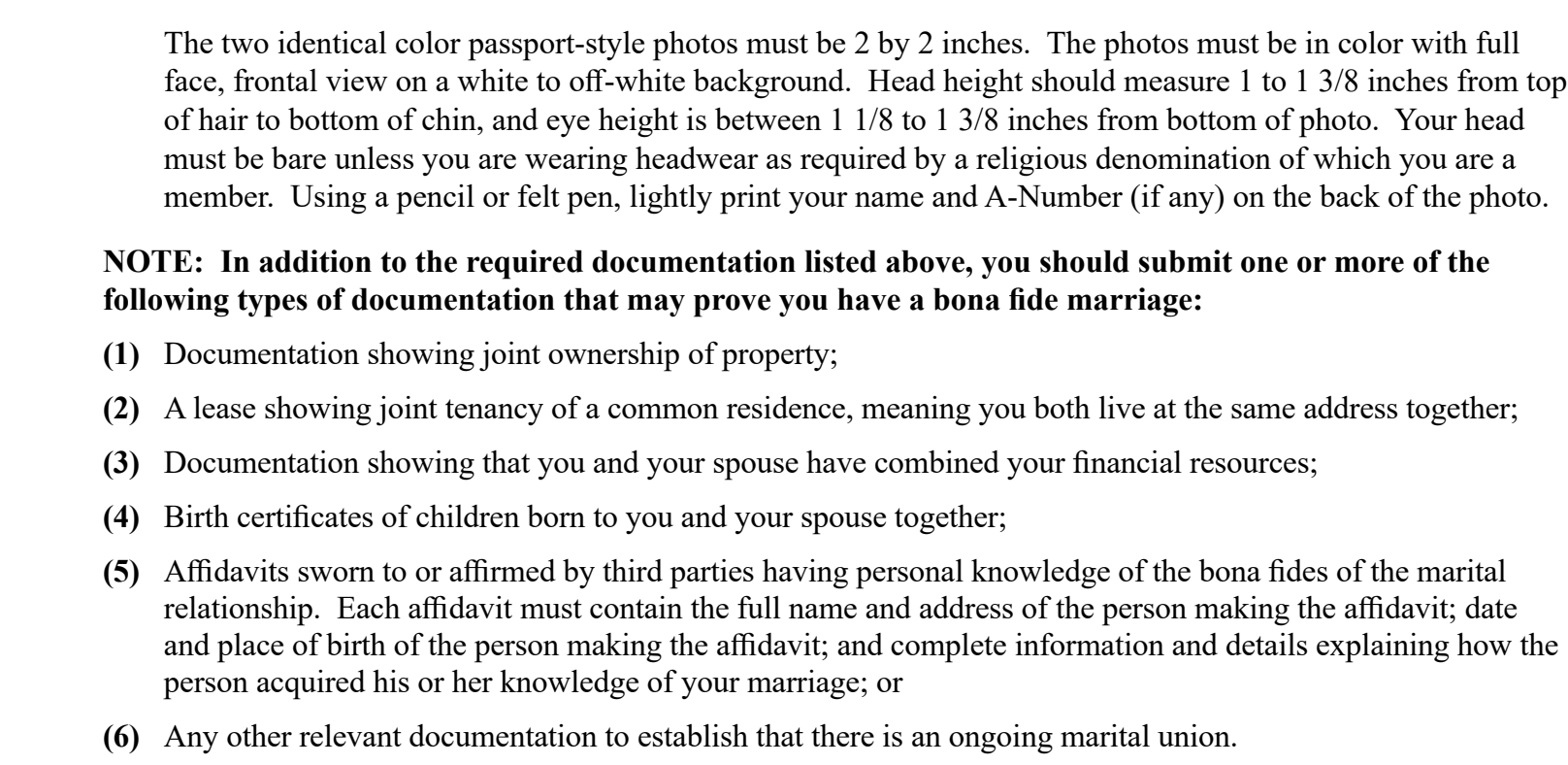
Verbatim · bona fide marriage NOTE (I-130 Instructions, Item 5.A, edition 04/01/24, page 7)
“In addition to the required documentation listed above, you should submit one or more of the following types of documentation that may prove you have a bona fide marriage:”
- Documentation showing joint ownership of property;
- A lease showing joint tenancy of a common residence, meaning you both live at the same address together;
- Documentation showing that you and your spouse have combined your financial resources;
- Birth certificates of children born to you and your spouse together;
- Affidavits sworn to or affirmed by third parties having personal knowledge of the bona fides of the marital relationship. Each affidavit must contain the full name and address of the person making the affidavit; date and place of birth of the person making the affidavit; and complete information and details explaining how the person acquired his or her knowledge of your marriage; or
- Any other relevant documentation to establish that there is an ongoing marital union.
Always file the current edition from uscis.gov/i-130; USCIS rejects outdated editions.
The bona fide marriage evidence categories USCIS recognizes
These mirror the categories named in the I-130 instructions, with plain examples of the documents that fall into each one.
Joint financial documents
- Examples:
- Joint bank or credit card statements, shared tax returns filed as married, jointly held investment or retirement accounts.
- What it shows:
- Combined financial resources. The instructions name 'documentation showing that you and your spouse have combined your financial resources' as a bona fide category.
Shared residence and cohabitation
- Examples:
- A lease or mortgage with both names, utility bills at one address, mail addressed to each spouse at the same home.
- What it shows:
- That the couple lives together. The instructions list 'a lease showing joint tenancy of a common residence' and 'joint ownership of property.'
Combined obligations
- Examples:
- Joint auto or health insurance policies, each spouse named as the other's beneficiary on life insurance or a retirement plan, jointly signed loans.
- What it shows:
- That the spouses have intertwined their legal and financial commitments to each other over time.
Children together
- Examples:
- Birth certificates of children born to the couple, naming both spouses as parents.
- What it shows:
- A shared family. The instructions name 'birth certificates of children born to you and your spouse together' as its own category.
Photos and travel
- Examples:
- Photographs of the couple over time and with family, itineraries or boarding passes from trips taken together.
- What it shows:
- A relationship that exists in daily life across time, not just on paper.
Affidavits and communication
- Examples:
- Sworn statements from people who know the couple, plus records of calls, messages, and letters across the relationship.
- What it shows:
- Third-party knowledge of the marriage. The instructions require each affidavit to list the writer's full name, address, date and place of birth, and how they came to know the marriage.
Required initial evidence vs. supporting bona fide evidence
The difference matters for how you build the packet. The Section 5.A items, the marriage certificate, proof of any prior-marriage terminations, and the passport-style photos, are the required initial evidence. Without them USCIS may reject or issue a Request for Evidence (an RFE, a notice asking for more information) before the petition can move forward. The six bona fide categories in the page-7 NOTE are documentation you 'should submit' on top of the required items. They are how you show the marriage is genuine, but they are described as supporting evidence rather than a fixed checklist. USCIS weighs the whole picture, so the categories work together rather than any single document carrying the case.
Marriage-based filers: how this evidence supports the petition
At the petition stage USCIS is deciding whether a qualifying marriage exists between the petitioner and the beneficiary. The marriage certificate establishes the legal marriage; the prior-marriage terminations confirm both people were free to marry; the photos identify the couple. The bona fide categories then speak to whether the marriage is real rather than arranged for immigration. The same evidence often reappears later, at the I-485 adjustment interview or the consular interview, so the petition is usually where a couple first assembles it. This page describes the categories USCIS recognizes. It does not advise on a specific situation, and it is not a way to make a weak relationship look stronger than it is.
Not sure which documents belong with your I-130?
Our software asks plain questions about your marriage and assembles the I-130 packet, keeping your evidence organized and consistent across the I-130, I-485, and I-864.
Start FreeWhen the instructions require “clear and convincing” evidence
The instructions flag two situations that demand more than the usual proof. If you married while your spouse was in exclusion, deportation, removal, or rescission proceedings (including during judicial review), or if you are a green card holder who got your status through a prior marriage and you are now petitioning for a spouse you married within five years of getting that status, the instructions say you 'must submit clear and convincing evidence that you and your spouse entered into the marriage in good faith and not for immigration purposes.' These situations carry a higher evidentiary bar set by statute, and people in them often consult a licensed immigration attorney.
Common mistakes
These are the ones that show up most often with spouse-petition evidence.
- 1
Treating the bona fide categories as optional extras
The required Section 5.A items get the petition accepted, but the page-7 categories are how USCIS sees that the marriage is real. The instructions say you 'should submit one or more' of them, so leaving them out entirely weakens the petition.
- 2
Submitting affidavits without the required details
The instructions require each third-party affidavit to contain the writer's full name and address, their date and place of birth, and a complete explanation of how they came to know about the marriage. A short note that says 'I know they are happily married' does not meet the standard the instructions describe.
- 3
Skipping proof that a prior marriage ended
If either spouse was married before, Section 5.A requires copies of documents showing each prior marriage was legally terminated, such as a divorce decree, annulment, or death certificate. Omitting it is a common reason for a Request for Evidence.
- 4
Forgetting the passport-photo specifics
Section 5.A calls for two identical color passport-style photos of each spouse (the beneficiary's only if in the United States), taken within 30 days of filing, on a white to off-white background, glossy, unmounted, and unretouched. Old or non-conforming photos draw follow-up requests.
Related guides
Form and pathway context
Frequently asked questions
What evidence is actually required to file the I-130 for a spouse?
Section 5.A of the I-130 instructions lists three required items: a copy of your marriage certificate, copies of documents showing any prior marriages were legally terminated, and two identical color passport-style photos of each spouse (the beneficiary's only if in the United States) taken within 30 days of filing.
What counts as bona fide marriage evidence on the I-130?
The instructions list six categories on page 7: joint ownership of property, a lease showing joint tenancy of a common residence, combined financial resources, birth certificates of children born to the couple, third-party affidavits with the required details, and any other documentation of an ongoing marital union.
Is the bona fide evidence required, or just recommended?
The marriage certificate, prior-marriage terminations, and photos are required initial evidence. The six bona fide categories are documentation the instructions say you 'should submit one or more' of, so they support the petition rather than being a fixed required list. USCIS weighs the full picture.
How is this different from the broader evidence guide?
This page is scoped to what the I-130 instructions ask for with the petition itself, the Section 5.A required items and the page-7 bona fide categories. Our broader resource guide on proving your marriage is real explains how USCIS weighs evidence, the interview, and Requests for Evidence in depth. The evidence-scorer tool checks the strength of a specific package.
Do affidavits have to follow a format?
The instructions require each third-party affidavit to contain the writer's full name and address, their date and place of birth, and complete details explaining how they came to know about the marriage. That is the standard the I-130 instructions describe for affidavits.
When does USCIS need 'clear and convincing' evidence?
The instructions name two situations: marrying while the spouse was in exclusion, deportation, removal, or rescission proceedings, or a green card holder petitioning for a spouse married within five years of getting status through a prior marriage. Both carry a higher evidentiary bar set by statute, and people in them often consult a licensed immigration attorney.
Key takeaways
- ✓
The I-130 instructions split spouse evidence into required initial evidence (Section 5.A) and bona fide marriage documentation (the page-7 NOTE).
- ✓
Required: marriage certificate, proof any prior marriages legally ended, and two passport-style photos of each spouse taken within 30 days of filing.
- ✓
Bona fide categories USCIS recognizes: joint property, a shared lease, combined finances, children together, third-party affidavits, and any other proof of an ongoing marital union.
- ✓
Affidavits must list the writer's full name, address, date and place of birth, and how they know about the marriage.
- ✓
Two situations require 'clear and convincing' evidence and a higher evidentiary bar; people in them often consult a licensed immigration attorney.
This page is for educational purposes only and is not legal advice. Green Card Genius is self-help immigration software, not a law firm, and does not provide legal representation. Immigration law and USCIS policy change frequently. For advice on a specific case, consult a licensed immigration attorney. Form I-130, edition 04/01/24. Last verified May 2026.
Stay informed
Green card guides in your inbox
Practical, plain-English updates to help you navigate the process with confidence.
Unsubscribe anytime.
Continue reading
- 01Form I-130: Petition for Alien Relative (2026 Guide)
- 02How to Prove Your Marriage is Real to USCIS (2026 Evidence Guide)
- 03Marriage Green Card Evidence Checklist: How Much Is Enough? (2026)
- 04I-130 Beneficiary's Native Written Language (Part 4, Items 57-58)
- 05Marriage Green Card Document Checklist (2026)
Be a Genius
Only pay when you file