Form I-130 · Part 2, Items 40.a-40.b
I-130 Petitioner's Class of Admission (Part 2, Items 40.a-40.b)
Where a green card holder petitioner finds the class-of-admission code and date of admission, and why a U.S. citizen petitioner leaves these fields blank.
Quick answer
If you, the petitioner, are a U.S. citizen, leave Items 40.a and 40.b blank (or write N/A). If you are a green card holder (lawful permanent resident), copy the class-of-admission code and the 'Resident Since' date printed on your green card into 40.a and 40.b.
Summary
When the petitioner is a green card holder, Form I-130 Part 2, Item 40.a (Class of Admission) and Item 40.b (Date of Admission) ask you to copy two pieces of information that already appear on your green card: the category code that admitted you and the date you became a permanent resident. The petitioner is the spouse who files the form; the beneficiary is the immigrant spouse being sponsored. The form prints a note above these fields: complete Item Numbers 40.a through 41 only if you are a lawful permanent resident (a green card holder, abbreviated LPR). If you are a U.S. citizen petitioner, these two fields do not apply to you and you leave them blank or write N/A.
| Who completes it | Only a lawful permanent resident (green card holder) petitioner. U.S. citizen petitioners leave 40.a and 40.b blank or write N/A. |
| 40.a Class of Admission | The category code that granted you permanent residence, for example IR1, CR1, F11, or DV1. It is printed on your green card and immigrant visa. |
| 40.b Date of Admission | The date you became a permanent resident. On the green card it is the 'Resident Since' date. |
| Where to find both | Your current green card (Form I-551), the immigrant visa in your passport, or an I-551 stamp / ADIT stamp in your passport if you do not yet have the physical card. |
| U.S. citizen petitioners | Not applicable. Leave 40.a and 40.b blank or write N/A; complete Item 37 instead. |
Who this page is for
This page covers where to find and how to copy the class-of-admission code and date of admission off your own green card, immigrant visa, or I-551 stamp. It does not cover whether your status lets you sponsor a particular relative or any timing question tied to your category. For advice on your eligibility to petition, consult a licensed immigration attorney.
Free tool
Marriage Green Card Cost Calculator
2026 · AOS · full packet
$3,005
See your exact 2026 USCIS filing fees for a marriage green card through Adjustment of Status, with a full line-item breakdown and the costs most guides leave out.
Free — enter your email and it opens right up. Unsubscribe anytime.
We post free tips on preparing your marriage green card. Follow along:
What Items 40.a and 40.b look like on the form
These fields sit in Part 2 (Information About You, the petitioner), in the block that opens only for lawful permanent residents. Item 40.a is the class of admission; Item 40.b is the date of admission.
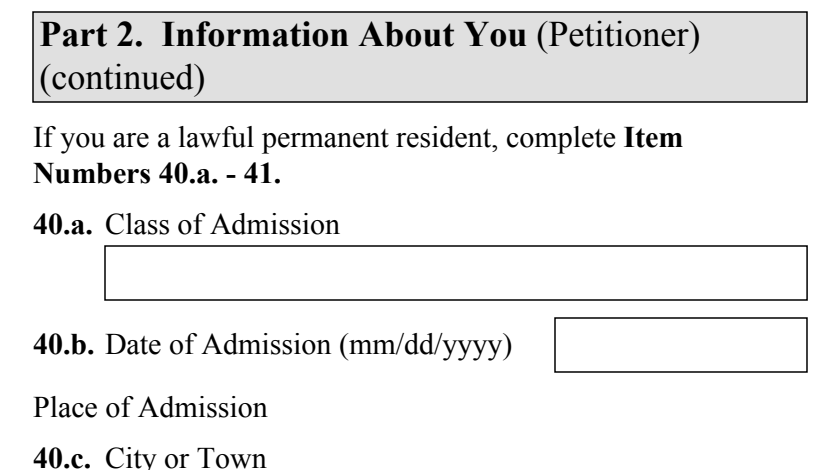
Verbatim · Part 2 note above Item 40.a (Form I-130, edition 04/01/24, page 4)
“If you are a lawful permanent resident, complete Item Numbers 40.a. - 41.”
40.a. Class of Admission
40.b. Date of Admission (mm/dd/yyyy)
Place of Admission 40.c. City or Town 40.d. State
The I-130 Instructions do not separately walk through Item 40; the note printed on the form itself is the controlling guidance. Always complete the current edition from uscis.gov/i-130; USCIS rejects outdated editions.
Where the class of admission and date of admission appear
Both values are already printed on a document you hold. You are copying them, not looking them up or calculating them.
| Document | Class of admission (40.a) | Date of admission (40.b) |
|---|---|---|
| Green card (Form I-551), current version | Two- or three-character code in the 'Category' field on the front | The 'Resident Since' date on the front of the card |
| Immigrant visa (in your passport at entry) | Shown in the visa's classification or category field | Not on the visa itself. Your date of admission is the admission stamp date CBP placed in your passport at the port of entry. |
| I-551 / ADIT stamp in passport (temporary proof) | The category code is handwritten or printed on the stamp | The admission date appears on the stamp |
How to fill it in
Four steps for a green card holder petitioner. If you are a U.S. citizen, you are done: leave 40.a and 40.b blank or write N/A.
Confirm you are the lawful permanent resident petitioner
Item 36 earlier in Part 2 asks whether you are a U.S. citizen or a lawful permanent resident. Items 40.a and 40.b apply only if you selected lawful permanent resident. A U.S. citizen petitioner skips them.
Read the class of admission off your green card
Look at the front of your current green card for the 'Category' field. The two- or three-character code there (for example IR1, CR1, F11, F21, or DV1) is your class of admission. Copy it exactly into Item 40.a.
Read the 'Resident Since' date for the date of admission
On the front of the green card, the 'Resident Since' date is your date of admission as a permanent resident. Enter it in Item 40.b in mm/dd/yyyy format.
If you do not have the physical card yet
If you became a permanent resident but have not received the card, the class of admission and admission date appear on the immigrant visa in your passport, or on the I-551 (ADIT) stamp a USCIS officer placed in your passport as temporary evidence. Use those.
Marriage-based filers: the green-card-holder spouse copies it off their own card
When a green card holder (the petitioner) sponsors their immigrant spouse (the beneficiary), Items 40.a and 40.b are about the petitioner, not the spouse being sponsored. You read your own class-of-admission code and your own “Resident Since” date off your green card and copy them in. Item 40.a is the category code, Item 40.b is the admission date.
If you are a U.S. citizen sponsoring your spouse, Items 40.a and 40.b do not apply to you. Leave them blank or write N/A, and complete Item 37 (how your citizenship was acquired) instead. This is purely about which fields to fill based on the document in front of you.
Not sure which fields apply to you?
Our software asks a few plain questions about your status and fills the right fields the right way, so a green card holder petitioner's category and admission date land where they belong and a citizen petitioner's do not.
Start FreeWhat USCIS does with the class and date of admission
USCIS uses the class of admission and date of admission to confirm the petitioner's permanent resident status and to read it off the same records the agency already holds. The category code tells USCIS how you obtained your green card, and the admission date establishes when your permanent residence began. Both come straight from your card, immigrant visa, or I-551 stamp, so the field is a record-matching check rather than anything you calculate.
Common mistakes
These are the ones that show up most often on this field.
- 1
A U.S. citizen petitioner filling in 40.a and 40.b
These fields are for green card holders only. The form's own note limits Items 40.a through 41 to lawful permanent residents. If you are a U.S. citizen, leave them blank or write N/A and complete Item 37 instead.
- 2
Guessing the class-of-admission code from memory
The code is not something to recall. Read it off the 'Category' field on your green card, your immigrant visa, or your I-551 stamp and copy it exactly. A code that does not match your card can trigger a Request for Evidence (an RFE, a USCIS notice asking for more information).
- 3
Using the card's issue date instead of the 'Resident Since' date
Item 40.b is your date of admission as a permanent resident, which is the 'Resident Since' date on the card. The card issue date or expiration date is a different field on the card and is not what this item asks for.
- 4
Leaving it blank when you are a green card holder
If you selected lawful permanent resident at Item 36, USCIS expects 40.a and 40.b completed. Skipping them on an LPR petition can draw an RFE.
Related guides
Frequently asked questions
I am a U.S. citizen petitioning my spouse. Do I fill in Items 40.a and 40.b?
No. The form limits Items 40.a through 41 to lawful permanent residents (green card holders). As a U.S. citizen petitioner you leave 40.a and 40.b blank or write N/A, and you complete Item 37 (how your citizenship was acquired) instead.
Where is the class of admission on my green card?
It is the two- or three-character code in the 'Category' field on the front of the current green card, for example IR1, CR1, F11, or DV1. Copy that code exactly into Item 40.a.
What date goes in Item 40.b?
Your date of admission as a permanent resident, which on the green card is the 'Resident Since' date. Enter it in mm/dd/yyyy format. It is not the card's issue date or expiration date.
I do not have my physical green card yet. Where do I find these values?
The class of admission and admission date appear on the immigrant visa in your passport, or on the I-551 (ADIT) stamp a USCIS officer placed in your passport as temporary evidence of permanent residence. Use those until the card arrives.
What does USCIS use Items 40.a and 40.b for?
To confirm the petitioner's permanent resident status by matching the category code and admission date against records the agency already holds. The category shows how you obtained your green card, and the date shows when your permanent residence began.
Key takeaways
- ✓
Items 40.a and 40.b apply only to a petitioner who is a lawful permanent resident (green card holder); U.S. citizen petitioners leave them blank or write N/A.
- ✓
Item 40.a (Class of Admission) is the category code on your green card, for example IR1, CR1, F11, or DV1.
- ✓
Item 40.b (Date of Admission) is the 'Resident Since' date printed on your green card.
- ✓
If you do not have the physical card, both values appear on your immigrant visa or your I-551 (ADIT) stamp.
- ✓
Copy both values off the document; do not recall them from memory, and do not use the card's issue or expiration date.
This page is for educational purposes only and is not legal advice. Green Card Genius is self-help immigration software, not a law firm, and does not provide legal representation. Immigration law and USCIS policy change frequently. For advice on a specific case, consult a licensed immigration attorney. Form I-130, edition 04/01/24. Last verified May 2026.
Stay informed
Green card guides in your inbox
Practical, plain-English updates to help you navigate the process with confidence.
Unsubscribe anytime.
Continue reading
Be a Genius
Only pay when you file