Form I-864A · Parts 3 & 6
How to Fill Out Form I-864A (Part 3 Income, Part 6 Signature): The Household Member's Section in 2026
Form I-864A is a two-signer contract: the household member (the relative adding income) and the sponsor (the person filing Form I-864) each fill out and sign different parts. This page walks the household member through the income section (Part 3), the tax and assets section (Part 4), and the signature (Part 6).
Quick answer for the household member
You fill out Parts 1-4 and sign Part 6. The sponsor fills out Part 5.
You (the household member) fill out Parts 1-4 and sign Part 6. The sponsor fills out Part 5. Enter your own current annual income (salary before taxes) in Part 3, Item 7, report your most recent tax-year Total Income in Part 4, and then sign and date Part 6 in black ink.
Summary
For most marriage-based filers, the household member is a relative who lives with the U.S. citizen sponsor (often a parent or adult child) and whose income helps the sponsoring spouse meet the income requirement. If that is you: you complete Parts 1 through 4 and sign Part 6, while the sponsor completes Part 5. Your own current annual income (your salary before taxes) goes in Part 3, Item 7. One other person can be the household member: the immigrant spouse, but only when children are immigrating with them.
| Who fills out what | The household member (the relative adding income) completes Parts 1-4 and 6. The sponsor (the person filing the I-864) completes Part 5. |
| Part 3, Item 7 | Your current individual annual income: your salary before taxes (gross income) from all employers, plus any other lawful income you are counting. |
| Part 4 | Your federal tax information (most recent tax-year Total Income) and, only if the sponsor is using them, your assets. Attach your most recent tax return or IRS transcript. |
| Part 6 | Your promise, printed name, signature, and date. A stamped or typed name is not a valid signature. An unsigned Part 6 means the income cannot be counted. |
| Excluded income | Means-tested public benefits (SSI, SNAP, Medicaid, TANF, housing vouchers) and a 401(k) employer match are not income you can enter. |
| When to get an attorney | If your income is mainly from self-employment (reported on Schedule C, the business profit-or-loss tax form) or you did not file a required tax return for the most recent year, consult an immigration attorney before completing Parts 3 and 4. |
Scope of this page
If you are the immigrant getting the green card, you usually do not fill out this form; the relative whose income is being added does (the exception is when your own children are immigrating with you). This page is for that household member: a W-2 employed or retired person (a W-2 is the wage-and-tax statement an employer gives an employee) entering standard income (salary, retirement, alimony, child support, dividends, interest) and signing the contract. Consult an immigration attorney before completing Parts 3 and 4 if: (1) your income is primarily from self-employment reported on Schedule C or a business you own; (2) you did not file a required federal income tax return for the most recent tax year; or (3) your right to add your income is disputed because your residency or dependency relationship to the sponsor is unclear.
Free tool
I-864 Income Requirement Calculator
2026 · household of 3
$34,150
Answer a few plain questions about the sponsor's household and income to see whether they meet the 2026 I-864 Affidavit of Support amount, and what can close the gap if they do not.
Free — enter your email and it opens right up. Unsubscribe anytime.
We post free tips on preparing your marriage green card. Follow along:
What the USCIS instructions say
Part 3 is where the household member reports income. The following is verbatim from the Form I-864A Instructions, edition 08/24/26, Part 3, Item 7.
Verbatim -- current individual annual income (I-864A Instructions, edition 08/24/26, Part 3, Item 7)
“Enter your current individual earned or retirement annual income that you are using to meet the requirements of this contract and type or print the total on this line. You may include evidence supporting your claim about your expected income for the current year if you believe that submitting this evidence will help you establish an ability to maintain sufficient income. You are not required to submit this evidence, however, unless specifically instructed to do so by a government official. For example, you may include a recent letter from your employer, showing your employer's address and telephone number, and indicating your annual salary. You may also provide pay stubs showing your income for the previous six months. If your claimed income includes alimony, child support, dividend or interest income, or income from any other source, you may also include evidence of ability to maintain that income. However, you may not include any means-tested public benefits as income for the purposes of meeting the income requirement.”
Verbatim -- who completes which part (I-864A Instructions, edition 08/24/26, Specific Instructions)
“This contract is divided into nine parts. The sponsor completes Part 5. Sponsor's Promise, Statement, Contact Information, Declaration, Certification, and Signature of this contract and the household member completes Parts 1. - 4., and 6.”
In plain terms: you, the household member, own Parts 1-4 (your details, your relationship to the sponsor, your income, and your taxes and assets) and Part 6 (your promise and signature). The sponsor owns Part 5. Both signatures belong on the same form.
Who fills out which part?
The single most common I-864A error is the wrong person filling in the wrong part. The form is split cleanly between the two signers.
You, the household member
The relative (or immigrant spouse with accompanying children) adding income.
- Part 1 -- your name, address, date of birth, and numbers
- Part 2 -- your relationship to the sponsor
- Part 3 -- your employment and income
- Part 4 -- your tax information and (if used) assets
- Part 6 -- your promise, printed name, and signature
The sponsor
The person filing Form I-864 (usually the U.S. citizen spouse).
- Part 5 -- the sponsor's promise, the list of intending immigrants, and the sponsor's signature
Parts 7 and 8 are for an interpreter or preparer, only if one was used. Part 9 is extra space.
What USCIS does with your I-864A
Your income from Part 3 is added to the sponsor's own income on their Form I-864, and the combined total is measured against the 125% Federal Poverty Guidelines for the sponsor's household size.
Your signature makes the income count
By signing Part 6 you agree to be jointly responsible with the sponsor for supporting the immigrant. That promise is what lets USCIS add your income to the sponsor's. Without your signature, the income cannot be used.
The contract is filed with the I-864
Form I-864A is never filed on its own. It is submitted together with the sponsor's Form I-864, and all pages must be included.
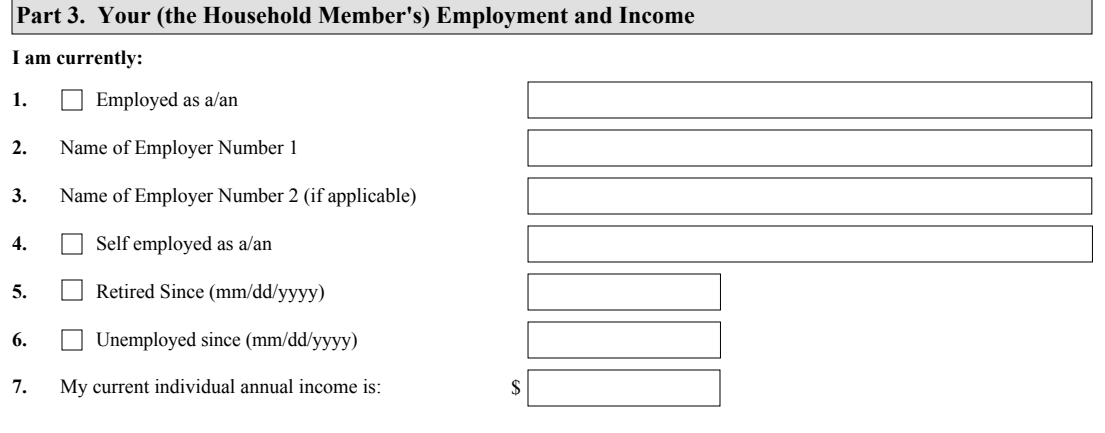
How to complete Part 3: your employment and income
- 01
Mark your employment status in Part 3, Items 1-6
Select all boxes that apply. If you work, check 'Employed as a/an' (Item 1) and name your employer in Item 2 (and a second employer in Item 3, if any). Retired household members check Item 5; unemployed household members check Item 6. Do not count income from any illegal source, even if you paid taxes on it.
Example: A parent who works full time as a nurse checks Item 1, writes 'Registered Nurse' on the Item 1 line, and puts the hospital name in Item 2. - 02
Report your current annual income in Part 3, Item 7
This is your own current individual income before taxes (gross income), not your take-home pay. For a salaried job, use the annual salary on your offer letter or pay stub. If you are paid hourly full time, multiply your rate by 2,080 (40 hours x 52 weeks). Combine wages from all your employers.
Example: Hourly rate of $28 at 40 hours/week: $28 x 2,080 = $58,240 goes in Item 7. - 03
Add any other lawful income you want counted
The instructions let you add alimony, child support, dividend or interest income, retirement income, or income from any other lawful source to your Item 7 total. Include supporting documents for each source. Do not add any means-tested public benefit.
Example: Salary of $40,000 plus $9,000/year in pension income: enter $49,000 and keep the pension statement. - 04
Do not deduct anything from employment income
For wages and salary, do not subtract taxes, your 401(k) deferral, or health insurance premiums. USCIS measures Item 7 against a before-tax benchmark. Net rental income is the one exception: use rent received minus expenses (consistent with Schedule E, the rental-income tax form), not the total rent collected.
Example: Salary of $55,000 with $8,000 withheld for taxes: enter $55,000, not $47,000.
Self-employed or did not file a tax return? This page does not cover your case
If your income comes mainly from self-employment reported on Schedule C (the profit-or-loss business tax form) or a business you own, your income calculation follows rules the instructions do not spell out in detail. The steps above cover W-2 employment and retirement income only. The same applies if you were required to file a federal income tax return for the most recent year and did not. Consult an immigration attorney before completing Parts 3 and 4.
What income counts in Item 7 -- and what doesn't?
Include
- Wages and salary (all employers combined): Your salary before taxes (gross income) or annualized hourly rate. Part 3 has fields for Employer Number 1 and Employer Number 2, so a second job adds to your income rather than replacing it.
- Retirement income: Pension payments, 401(k) and IRA distributions, and Social Security retirement benefits. The instruction names 'earned or retirement' income directly.
- Alimony received: Court-ordered alimony you receive; the instructions allow evidence such as a divorce decree and payment records.
- Child support received: Court-ordered child support you receive; document with the court order and payment records.
- Dividend and interest income: Investment dividends and bank or bond interest; document with recent account statements.
- Net rental income: Rent received minus documented expenses, consistent with tax Schedule E. Do not enter the total rent collected.
Exclude
- SSI (Supplemental Security Income): A means-tested benefit; the instructions explicitly bar means-tested public benefits.
- SNAP (food stamps): Means-tested benefit; cannot be counted.
- Medicaid: Means-tested benefit; cannot be counted.
- TANF and cash welfare: Means-tested benefit; cannot be counted.
- Housing vouchers and Section 8: Means-tested benefit; cannot be counted.
- 401(k) employer match: Your employer's matching contribution is not income you receive; it goes into a retirement account and cannot be added to Item 7.
- The sponsor's income: Part 3, Item 7 is your individual income only. The sponsor's own income is on their Form I-864, not on your I-864A.
Income before taxes, not take-home pay
For wages and salary, report the amount before income taxes, payroll taxes, and other deductions come out (your gross income). That is the figure on an employer letter or pay stub. Take-home pay (what lands in your bank account) is lower and understates your income. Net rental income is the exception: use rent received minus expenses, consistent with Schedule E.
Part 4: your tax information and assets
Part 4 is where you report your federal tax history and, only when needed, your assets.
Item 1 -- did you file for the last three years?
Select the box if you filed a federal income tax return for each of the three most recent tax years. You must attach an IRS transcript or a photocopy of your return for the most recent year (the second and third years are optional).
Item 2 -- most recent tax-year Total Income
Report your Total Income from your most recent federal return. Per the I-864A Instructions (edition 08/24/26, Part 4), the “Total Income” line on IRS Form 1040 is the figure USCIS uses (for the older 1040EZ, it is the adjusted gross income line, meaning your total income minus certain adjustments). Item 2 of that section directs that if the amount was zero, you enter “zero” or “N/A.”
Items 3-5 -- assets (only if the sponsor uses them)
The I-864A Instructions (edition 08/24/26, Part 4) are explicit: “Complete this item only if the sponsor is using the value of your assets... If you are using only your income to help the sponsor meet the requirements, do not complete this item.” When assets are used, list cash and bank balances, the net value of real estate, and other assets, and attach proof of ownership and value.
Part 6: signing the contract
Part 6 is the household member's promise and signature. Read the promise (items A through D on the form) before signing: you are agreeing to be jointly responsible with the sponsor for supporting the immigrant.
Verbatim -- the household member's signature (I-864A Instructions, edition 08/24/26, Part 6)
“Read the household member's promise carefully, type or print your name in the spaces provided in Part 6. then sign and date the contract. If you do not type or print your name in the Signature section and sign and date the contract, the intending immigrant cannot be issued a visa or be granted adjustment of status based upon the income and/or assets listed on this contract.”
In plain terms, without your signature the immigrant cannot get a green card, whether through adjustment of status (applying from inside the United States) or a visa at a consulate abroad.
A typed or stamped name is not a signature
The instructions state USCIS “will not accept a stamped or typewritten name in place of any signature on this contract,” and that an unsigned or invalidly signed contract will be rejected. Part 6 needs your printed name and your handwritten ink signature with the date. A photocopy, fax, or scan of that ink signature is fine.
Common mistakes on Form I-864A
These errors show up on RFEs (Requests for Evidence) and delay the I-864 review. Each has a specific fix.
- 01
The wrong person signs Part 5 or Part 6
Per the I-864A Instructions (edition 08/24/26), the household member completes Parts 1-4 and 6, and the sponsor completes Part 5. Part 6 is the household member's signature; Part 5 is the sponsor's. Swapping them, or leaving one blank, is a frequent RFE (Request for Evidence) trigger.
- 02
Entering take-home pay instead of income before taxes
Part 3, Item 7 asks for your current individual income before taxes (gross income), not the amount deposited in your bank account. Employer letters and pay stubs show the before-tax figure. Using take-home pay understates your income and can make a qualifying income look insufficient.
- 03
Signing with a typed or stamped name
The I-864A Instructions (edition 08/24/26) state USCIS 'will not accept a stamped or typewritten name in place of any signature on this contract.' Part 6 needs a handwritten ink signature. An unsigned or invalidly signed contract is rejected, and the household member's income cannot be counted.
- 04
Including a 401(k) employer match or means-tested benefits
The instructions bar means-tested public benefits (SSI, SNAP, Medicaid, TANF, housing vouchers) from Item 7. A 401(k) employer match is also excluded, because it is not income you receive. Only count income that is actually paid to you from a lawful source.
- 05
Skipping the required tax return in Part 4
Part 4 requires you to attach an IRS transcript or photocopy of your federal income tax return for the most recent tax year. Reporting a Total Income figure without the return attached is one of the most common reasons an I-864A gets an RFE.
Marriage-based filers: who the household member usually is
In a marriage-based green card case (a U.S. citizen or green card holder sponsoring their spouse), the household member signing I-864A is almost always one of two people.
A relative living with the U.S. citizen sponsor (the most common case)
When the sponsoring spouse's income alone is below the threshold, a parent, adult child, or sibling who shares the sponsor's home can add their income by filing I-864A. That relative completes Parts 1-4 and signs Part 6; the sponsor completes Part 5.
The immigrant spouse, but only with accompanying children
If the sponsor is counting the immigrant spouse's income, the spouse does not file I-864A unless children are immigrating with them. In that case the spouse is the household member: they complete Parts 1-4 and sign Part 6, and their income must be shown to continue after they become a green card holder (a lawful permanent resident, or LPR).
What changes what you enter
- You have two jobs. Name both employers in Part 3, Items 2 and 3, and combine the wages into your Item 7 total.
- You are retired. Check Item 5, enter the date you retired, and put your pension, 401(k), IRA, or Social Security retirement income in Item 7.
- You receive alimony, child support, dividends, or interest. Add those amounts to your salary figure in Item 7 and keep supporting documents for each source.
- The sponsor is using your assets, not just your income. Complete Part 4, Items 3-5 with your cash, real-estate net value, and other assets, and attach proof of ownership and value.
Not sure if you even need an I-864A?
Our software checks whether the sponsor's income alone clears the threshold and, if not, builds the I-864 and I-864A together with each field filled in for you to review and sign.
Start FreeRelated guides
Form and pathway context
Related I-864 and I-864A questions
- I-864A: Who Can Combine Income with the Sponsor (2026)
- I-864 Household Member Income (Part 6, Items 8-14): When to Add It and How in 2026
- I-864 Current Annual Income (Part 6, Item 7): What to Enter in 2026
- I-864 Joint Sponsor: When You Need One and What They Must Do (2026)
- I-864 Assets (Part 7): When to Use Them and How to Report in 2026
Frequently asked questions
Who fills out which part of Form I-864A?
Per the I-864A Instructions (edition 08/24/26), the household member (the relative adding income) completes Parts 1-4 and Part 6, and the sponsor (the person filing Form I-864) completes Part 5. Part 6 carries the household member's signature; Part 5 carries the sponsor's. Both people must sign the same form for it to count.
What income do I enter in Part 3, Item 7?
Your current individual annual income before taxes (gross income) from all lawful sources you want counted. For a salaried job, use the annual salary on your offer letter or pay stub. If you are paid hourly full time, multiply your rate by 2,080. You may add retirement income, alimony, child support, dividends, and interest. You may not include any means-tested public benefit, per the I-864A Instructions (edition 08/24/26, Part 3).
What documents do I submit to support my I-864A income?
Per the I-864A Instructions (edition 08/24/26, Part 4), you must attach an IRS transcript or a photocopy of your federal income tax return for the most recent tax year. Employer letters and six months of pay stubs are optional support for your Item 7 figure unless a government official specifically requests them. If you claim alimony, child support, dividends, or interest, include evidence for each source.
Can I sign Form I-864A with a typed or electronic name?
No. The I-864A Instructions (edition 08/24/26) state USCIS 'will not accept a stamped or typewritten name in place of any signature on this contract.' Part 6 needs your handwritten ink signature and the date. A photocopy, fax, or scan of that handwritten signature is acceptable, but a typed name is not.
Do I have to complete the assets section in Part 4?
Only if the sponsor is using the value of your assets to help meet the requirement. The I-864A Instructions (edition 08/24/26, Part 4) say: if you are using only your income, do not complete the assets items (Part 4, Items 3-5). You still report your most recent tax-year Total Income in Part 4, Item 2.
Is there a filing fee for Form I-864A?
There is no separate USCIS filing fee for Form I-864A. It is submitted together with Form I-864, and it must be filed with the I-864, not on its own.
Key takeaways
- ✓
The household member (the relative adding income) completes Parts 1-4 and signs Part 6; the sponsor completes Part 5.
- ✓
Part 3, Item 7 is your own current annual income before taxes (gross income), combining wages from all employers plus any other lawful income.
- ✓
Means-tested public benefits and a 401(k) employer match are not income you can enter in Item 7.
- ✓
Part 4 requires your most recent federal tax return or IRS transcript. Complete the assets items only if the sponsor is using your assets.
- ✓
Part 6 needs a handwritten ink signature. A typed or stamped name is not valid, and an unsigned contract means the income cannot be counted.
- ✓
If your income is mainly from self-employment (Schedule C) or you did not file a required tax return, talk to an immigration attorney before completing Parts 3 and 4.
This page is for educational purposes only and is not legal advice. Green Card Genius is self-help immigration software, not a law firm, and does not provide legal representation. Immigration law and USCIS policy change frequently. For advice on a specific case, consult a licensed immigration attorney. Form I-864A and Form I-864A Instructions, edition 08/24/26. Last verified August 2026.
Stay informed
Green card guides in your inbox
Practical, plain-English updates to help you navigate the process with confidence.
Unsubscribe anytime.
Continue reading
- 01I-864A: Who Can Combine Income with the Sponsor (2026)
- 02I-864 Household Member Income (Part 6, Items 8-14): When to Add It and How in 2026
- 03I-864 Current Annual Income (Part 6, Item 7): What to Enter in 2026
- 04I-864 Joint Sponsor: When You Need One and What They Must Do (2026)
- 05I-864 Assets (Part 7): When to Use Them and How to Report in 2026
Be a Genius
Only pay when you file