Form I-864 · Part 1, Items 1.a–1.f
I-864 Part 1 Basis for Filing (Items 1.a–1.f): Which Box to Check
Part 1 asks why you are filing this affidavit of support. You pick exactly one box, 1.a through 1.f, to state your relationship to the immigrant. The box you choose tells USCIS whether you are the petitioner, a joint sponsor, or a substitute sponsor.
Most marriage-based filers
The petitioning spouse checks box 1.a.
If you are the U.S. citizen or green card holder who filed Form I-130 for your husband or wife, you are the petitioner, and you check 1.a: “I am the petitioner. I filed or am filing for the immigration of my relative.” Keep reading to confirm and to see when a different box applies.
Summary
For most marriage-based green card cases, the sponsoring spouse selects box 1.a in Part 1: “I am the petitioner. I filed or am filing for the immigration of my relative.” The petitioner is the U.S. citizen or green card holder who filed Form I-130 (Petition for Alien Relative) for their husband or wife. That same spouse signs the I-864 as the sponsor and checks 1.a. A third person who steps in only to add income is a joint sponsor and checks 1.d or 1.e instead. Boxes 1.b and 1.c are employment-based bases and do not apply to a marriage case.
Scope of this page
This page covers the standard marriage-based case: a living U.S. citizen or green card holder spouse who filed Form I-130 and is completing the I-864 as the sponsor. If the spouse who filed the I-130 has died (the substitute-sponsor situation, box 1.f), or if it is unclear who the petitioner is because the petition was filed by someone other than the sponsoring spouse, consult an immigration attorney before completing Part 1.
Free tool
I-864 Income Requirement Calculator
2026 · household of 3
$34,150
Answer a few plain questions about the sponsor's household and income to see whether they meet the 2026 I-864 Affidavit of Support amount, and what can close the gap if they do not.
Free — enter your email and it opens right up. Unsubscribe anytime.
We post free tips on preparing your marriage green card. Follow along:
What the USCIS instructions say
Part 1 lists six basis-for-filing options on the form, from Item 1.a through Item 1.f. The I-864 Instructions (edition 08/24/26, page 6) explain each one. Here is the on-form text and the instruction language, both verbatim. (In these quotes, “beneficiary” and “intending immigrant” both mean the person the petition is filed for, the immigrant seeking the green card.)
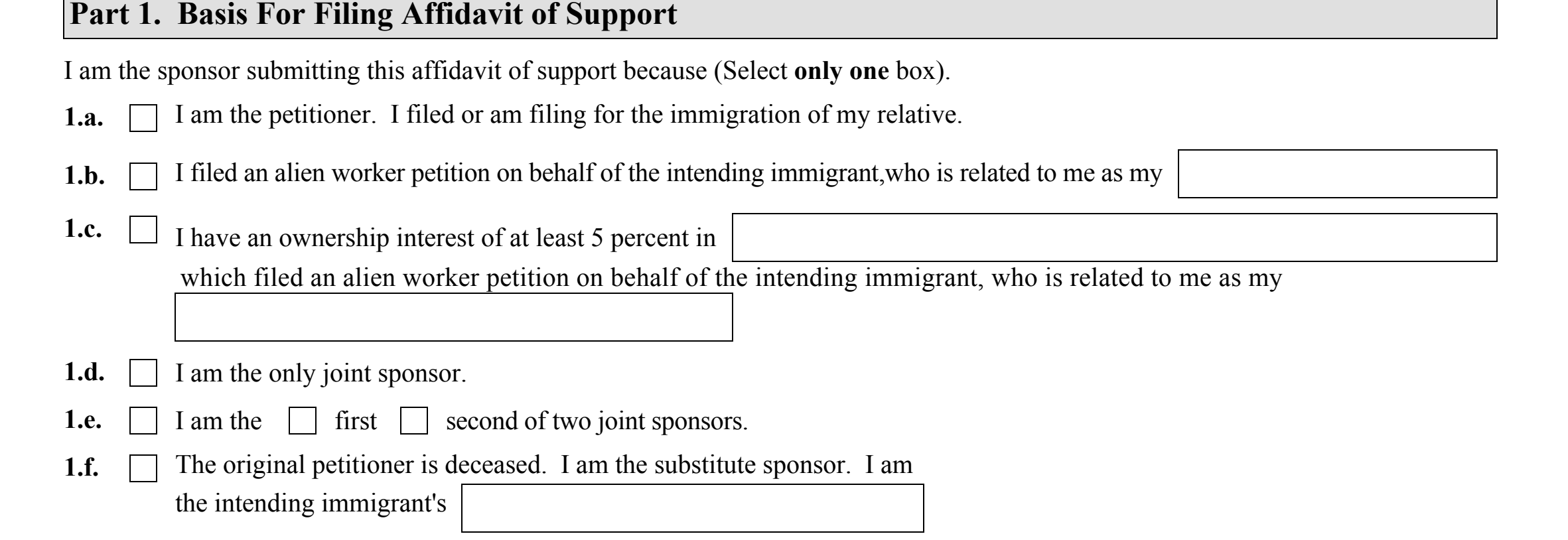
The six options exactly as printed on the form
“I am the sponsor submitting this affidavit of support because (Select only one box).”
- 1.a.“I am the petitioner. I filed or am filing for the immigration of my relative.”
- 1.b.“I filed an alien worker petition on behalf of the intending immigrant, who is related to me as my [relationship].”
- 1.c.“I have an ownership interest of at least 5 percent in [business], which filed an alien worker petition on behalf of the intending immigrant, who is related to me as my [relationship].”
- 1.d.“I am the only joint sponsor.”
- 1.e.“I am the [first / second] of two joint sponsors.”
- 1.f.“The original petitioner is deceased. I am the substitute sponsor. I am the intending immigrant's [relationship].”
Verbatim from Form I-864 Instructions, edition 08/24/26, page 6, Part 1
“Provide your full name (the sponsor) in the space provided, then select the Item Number that reflects your basis for filing Form I-864.”
Item 1.a.Petitioner
“Select this box if you are the petitioner who is filing or who has already filed Form I-129F, Petition for Alien Fiancé(e), for a fiancé(e); Form I-130, Petition for Alien Relative, for a family member; Form I-600, Petition to Classify Orphan as an Immediate Relative, for an orphan; or Form I-800, Petition to Classify Convention Adoptee as an Immediate Relative, for a convention adoptee.”
Item 1.b.Employment-based petitioner
“Select this box if you are filing or have filed Form I-140, Immigrant Petition for Alien Worker, for your husband, wife, father, mother, child, adult son or daughter, brother, or sister and indicate your relationship to the beneficiary in the space provided.”
Item 1.c.5 percent business owner
“Select this box if you have an ownership interest of at least five percent in a business, corporation, or other entity that filed or is filing Form I-140 for your husband, wife, father, mother, child, adult son or daughter, brother, or sister. Indicate the name of the business you have an ownership interest in, and your relationship to the beneficiary in the spaces provided.”
Item 1.d.Only joint sponsor
“Select this box if you are the only joint sponsor.”
Item 1.e.One of two joint sponsors
“Select this box if you are either of two joint sponsors.”
Item 1.f.Substitute sponsor
“Select this box if you are the substitute sponsor. A substitute sponsor is a sponsor who is completing Form I-864 on behalf of an intending immigrant whose original Form I-130 petitioner has died after the Form I-130 was approved, but before the intending immigrant obtained lawful permanent residence.”
NOTE (Instructions page 6): “A joint sponsor does not have to be related to the intending immigrant. Indicate whether you are the only joint sponsor or one of two joint sponsors. Check with the petitioning sponsor or the intending immigrant if you are not certain.”
What USCIS does with this box
The box you check tells USCIS which role you play in the case and what evidence your affidavit must carry. A petitioner (1.a) must prove U.S. citizenship, U.S. national status, or lawful permanent residence and show the petition link to the immigrant. A joint sponsor (1.d or 1.e) signals that a second I-864 is in the file and that USCIS should review that sponsor's income separately.
Checking the wrong box does not match the rest of the packet. If the petitioning spouse checks a joint-sponsor box, or a joint sponsor checks 1.a, the affidavit conflicts with the I-130 and the other I-864s on file. USCIS catches the mismatch and issues a Request for Evidence (a written notice asking you to fix or explain the discrepancy), which stalls the case.
Which box applies to you?
Each option below shows whether it fits a marriage-based filer and why. Select only one box.
You filed Form I-130 for your spouse
Marriage defaultThis is the marriage-based default. The U.S. citizen or green card holder who filed (or is filing) Form I-130 for their husband or wife is the petitioner. The petitioner is also the sponsor on the I-864, so you check 1.a and sign the affidavit yourself.
Employment-based: you filed an I-140
Not your boxForm I-140 is the petition for an employment-based green card, not a marriage green card. A spouse petitioning for a husband or wife files Form I-130, not I-140. If you are filing for your spouse, 1.b is not your box.
Employment-based: 5 percent business owner
Not your boxThis applies when a business you own at least 5 percent of filed an I-140 employment petition. It has no role in a marriage green card. Skip it.
You are the only joint sponsor
Not your boxA joint sponsor is a third person who agrees to support the immigrant because the petitioner's income alone is not enough. The joint sponsor files a separate I-864 and checks 1.d. The petitioning spouse never checks 1.d on their own affidavit. If you are the spouse who filed the I-130, your box is 1.a.
You are one of two joint sponsors
Not your boxUsed when two joint sponsors split the household so each covers part of it (for example, sponsoring a spouse and a stepchild separately). Each joint sponsor files their own I-864 and checks 1.e. Again, this is not the petitioning spouse's box.
The original I-130 petitioner has died
Not your boxA substitute sponsor steps in only when the spouse who filed the I-130 died after the petition was approved but before the immigrant got their green card. If the petitioning spouse is alive, this box does not apply. The deceased-petitioner situation needs case-specific review (see the note below).
If the original I-130 petitioner has died (box 1.f)
A substitute sponsor takes over only when the spouse who filed the I-130 died after the petition was approved but before the immigrant became a lawful permanent resident. Whether the case can continue, and who may serve as the substitute sponsor, depends on facts beyond this checkbox. An immigration attorney should review the situation before you complete Part 1.
Petitioner, sponsor, beneficiary, joint sponsor: who is who
Part 1 uses words that are easy to mix up. Here is what each one means in a marriage case so you know which box describes you.
| Petitioner | The U.S. citizen or green card holder who filed Form I-130 to start the case. In a marriage case, this is the sponsoring spouse. They check box 1.a. |
| Beneficiary (intending immigrant) | The person the petition is filed for: the immigrant spouse seeking the green card. The beneficiary does not fill out Part 1 of the I-864; the sponsor does. |
| Sponsor | Whoever signs the I-864 and promises to support the immigrant financially. In the standard marriage case, the petitioner and the sponsor are the same person. |
| Joint sponsor | A separate person (not necessarily a relative) who files their own I-864 to add income when the petitioner's income falls short. They check 1.d or 1.e, never 1.a. |
| Substitute sponsor | A qualifying relative who takes over the I-864 when the original I-130 petitioner has died. They check 1.f. |
Marriage-based filers: the petitioning spouse checks 1.a
In a marriage green card case, two roles usually land on the same person. The spouse who filed Form I-130 (the petitioner) is also the one who signs the I-864 (the sponsor). One person, one box: 1.a.
Standard case
U.S. citizen or green card holder spouse filed Form I-130 for their immigrant spouse and meets the income requirement on their own.
When a different box comes in
- Your income is too low. You still check 1.a. A separate person files their own I-864 as a joint sponsor and checks 1.d (only joint sponsor) or 1.e (one of two joint sponsors). Adding a joint sponsor never changes your box.
- You are helping a couple as a third party. If you did not file the I-130 and are only adding income, you are the joint sponsor: check 1.d or 1.e, not 1.a.
- The petitioning spouse has died. A qualifying relative may file as a substitute sponsor and check 1.f. This case needs attorney review (see above).
Not sure which box your situation calls for?
Our software asks who filed the I-130 and who is signing, then fills Part 1 for you and walks through every other field in plain English. You review and sign the finished packet.
Start FreeFrequently asked questions
Which Part 1 box does the petitioning spouse check on Form I-864?
Box 1.a. The on-form text reads: “I am the petitioner. I filed or am filing for the immigration of my relative.” Per the I-864 Instructions (edition 08/24/26, page 6), 1.a is for the petitioner who filed Form I-130 (the petition that starts a family-based case, including a marriage green card). The spouse who filed the I-130 also signs the I-864 as the sponsor and selects 1.a.
What is the difference between the petitioner and a joint sponsor on the I-864?
The petitioner is the U.S. citizen or lawful permanent resident (green card holder) who filed Form I-130 for their relative. They check box 1.a. A joint sponsor is a separate person who agrees to support the immigrant when the petitioner's income is too low; the joint sponsor files their own I-864 and checks box 1.d (only joint sponsor) or 1.e (one of two joint sponsors). The Instructions note a joint sponsor does not have to be related to the intending immigrant.
Do boxes 1.b and 1.c ever apply to a marriage green card?
No. Boxes 1.b and 1.c are for employment-based cases where someone filed Form I-140 (Immigrant Petition for Alien Worker) or owns at least 5 percent of a business that filed an I-140. A spouse petitioning for a husband or wife files Form I-130, not I-140, so these boxes never apply to a marriage green card.
My spouse filed the I-130 but does not earn enough. Do they still check 1.a?
Yes. The petitioning spouse always checks 1.a as the sponsor, regardless of income. If their income is below the requirement, a joint sponsor files a separate I-864 and checks 1.d or 1.e to add income. The petitioner's box does not change because a joint sponsor is added.
When does box 1.f (substitute sponsor) apply?
Only when the original Form I-130 petitioner has died after the petition was approved but before the immigrant obtained their green card. Per the Instructions (page 6), a substitute sponsor must be a qualifying relative of the intending immigrant and a U.S. citizen, lawful permanent resident, or U.S. national. A deceased-petitioner case has consequences beyond this checkbox and should be reviewed with an immigration attorney.
Who fills out Part 1 of the I-864, the sponsor or the immigrant?
The sponsor. Part 1 states the sponsor's basis for filing. In a standard marriage case, the sponsor is the petitioning spouse, so the U.S. citizen or green card holder spouse completes Part 1 and checks 1.a. The immigrant spouse (the beneficiary) does not select a Part 1 box.
Key takeaways
- ✓
In a marriage green card case, the spouse who filed Form I-130 checks box 1.a in Part 1: they are the petitioner and the sponsor at the same time.
- ✓
A joint sponsor (a third person adding income) files a separate I-864 and checks 1.d or 1.e, never 1.a.
- ✓
Boxes 1.b and 1.c are employment-based (Form I-140) bases and never apply to a marriage green card.
- ✓
Box 1.f (substitute sponsor) applies only when the original I-130 petitioner has died; that situation needs attorney review.
- ✓
Part 1 is completed by the sponsor, not the immigrant. Select only one box.
This page is for educational purposes only and is not legal advice. Green Card Genius is self-help immigration software, not a law firm, and does not provide legal representation. Immigration law and USCIS policy change frequently. For advice on a specific case, consult a licensed immigration attorney. Form I-864, edition 08/24/26. Last verified May 2026.
Stay informed
Green card guides in your inbox
Practical, plain-English updates to help you navigate the process with confidence.
Unsubscribe anytime.
Continue reading
- 01Form I-864 Affidavit of Support: Complete 2026 Guide
- 02I-864 vs. I-864EZ vs. I-864A: Which Affidavit of Support Form Do You Need (2026)
- 03I-864 Joint Sponsor: When You Need One and What They Must Do (2026)
- 04I-864 Part 5, Item 1: Total Number of Persons in Household (2026)
- 05Marriage Green Card by Country: Country-Specific Guides (2026)
Be a Genius
Only pay when you file