Form I-693 · Part 1, Items 1-4
Who Fills Out Form I-693 (Part 1): The Applicant or the Civil Surgeon in 2026
On the immigration medical exam form, you fill out only Part 1 (Information About You), Items 1 through 4. The civil surgeon completes the medical parts. Here is exactly what is yours to do.
Quick answer
You, the applicant, complete only Part 1 (Information About You), plus your name and A-Number at the top of every page. You do not touch the medical parts. The USCIS-designated civil surgeon (the doctor USCIS authorizes to do immigration medical exams) completes the rest. Do not sign Part 2 until the civil surgeon tells you to, and sign it in front of the civil surgeon.
Summary
Form I-693 Part 1 (Information About You), Items 1 through 4, is the only part you fill out yourself. The form header says so directly: it is "To be completed by the person requesting a medical examination, NOT the civil surgeon." You are the applicant, the immigrant spouse seeking a green card (lawful permanent resident status, abbreviated LPR); your U.S. citizen or LPR spouse is not involved in this form. You complete Part 1 (your name, address, sex, date and place of birth, and A-Number) before your appointment, and you write your name and A-Number at the top of every page. The civil surgeon, a doctor USCIS specifically designates to perform immigration medical exams, completes all the medical parts of the form. You also sign Part 2, but only when the civil surgeon tells you to and only in the civil surgeon's presence. This page explains who fills out what. It does not interpret any medical finding: if your exam raises a health-related question about admissibility, that is an attorney question, not a form-copying question.
| What you complete | Only Part 1 (Information About You), Items 1 through 4: your full legal name, current address, sex, date and place of birth, A-Number and USCIS Online Account Number (if any), and the medical-exam requirement checkbox in Item 4. |
| What the civil surgeon completes | Everything else. The civil surgeon (the USCIS-designated doctor) fills in the medical history, exam findings, tests, and the vaccination record, and signs the civil surgeon's certification. |
| Top of every page | Write your name and A-Number (if any) at the top of each page of the form. The civil surgeon checks that this matches your Part 1. |
| Signing (Part 2) | Do not sign or date the form in advance. Sign and date Part 2 only when the civil surgeon tells you to, and only in the civil surgeon's presence. |
| K-1 or previously examined abroad | If you already had an overseas exam signed by a panel physician (the doctor who does the exam abroad), Item 4.A may let you complete the vaccination record portion only. The civil surgeon still handles the medical parts. |
| Attorney territory | Any medical finding that could affect admissibility (a physical or mental disorder with associated harmful behavior, drug-related findings, a vaccine waiver) is a legal question. Do not guess. Have an attorney review it. |
Who this page is for
This page covers who completes which parts of Form I-693: the applicant fills out Part 1 and signs Part 2, and the USCIS-designated civil surgeon completes the medical parts. It does not give medical advice and does not interpret any exam finding. If your exam involves a physical or mental disorder with associated harmful behavior, a drug-related finding, a vaccine waiver, or anything that could affect your admissibility on health grounds, talk to a licensed immigration attorney before you file. That branch is flagged again below.
Free tool
Marriage Green Card Cost Calculator
2026 · AOS · full packet
$3,005
See your exact 2026 USCIS filing fees for a marriage green card through Adjustment of Status, with a full line-item breakdown and the costs most guides leave out.
Free — enter your email and it opens right up. Unsubscribe anytime.
We post free tips on preparing your marriage green card. Follow along:
What Part 1 looks like on the form
Part 1 is the first block on page 1 of Form I-693. Its header tells you plainly who completes it, and the items ask only for your basic biographic information.
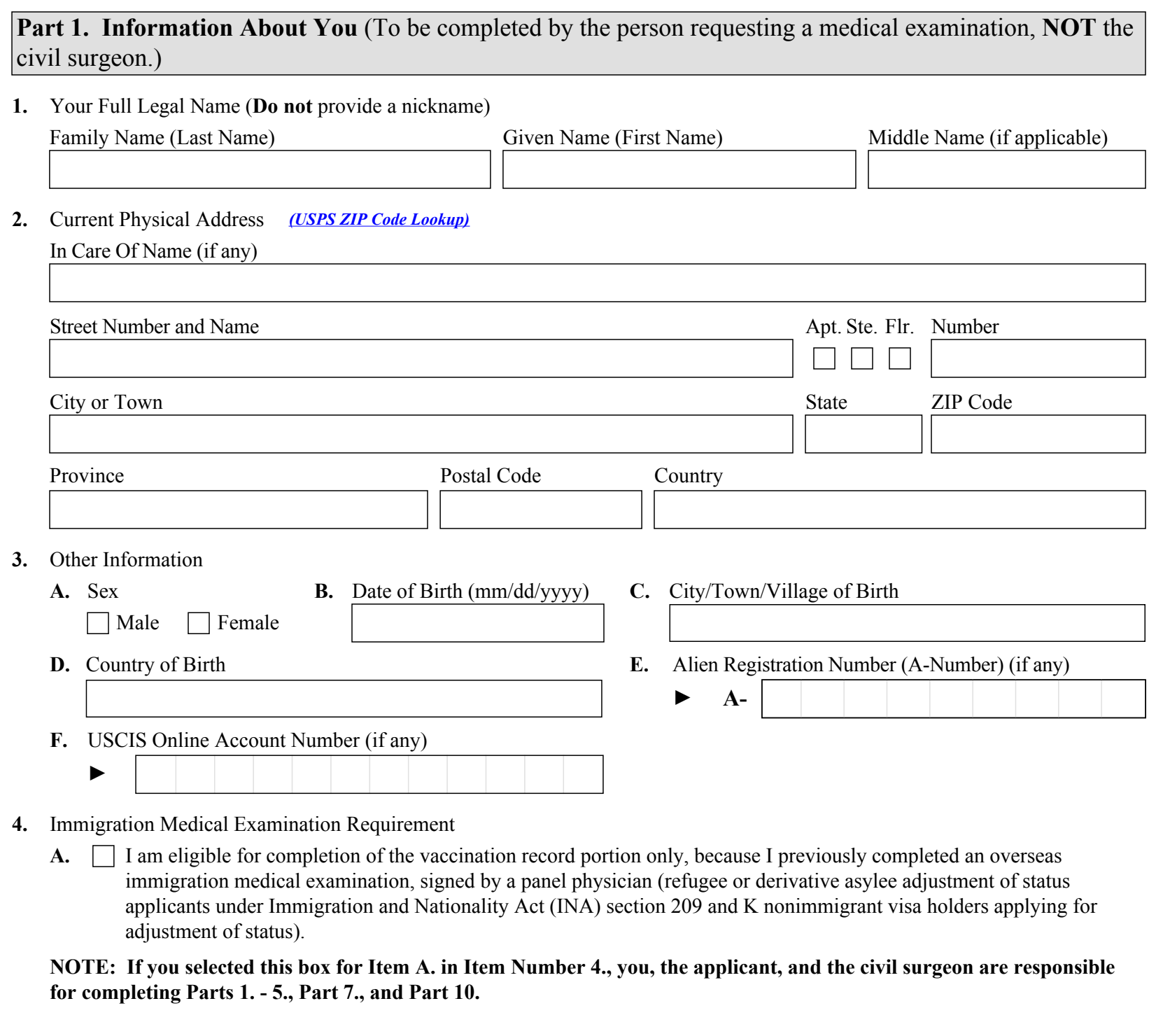
Verbatim · Part 1 header (Form I-693, edition 01/20/25, page 1)
“Part 1. Information About You (To be completed by the person requesting a medical examination, NOT the civil surgeon.)”
The header answers the question outright: Part 1 is completed by you, the person requesting the exam, and not by the civil surgeon (the doctor USCIS designates to perform immigration medical exams). The Instructions draw the same line for the rest of the form:
Verbatim · How To Fill Out My (the Applicant’s) Portion of Form I-693 (I-693 Instructions, edition 01/20/25, page 3)
“Only complete Part 1. of Form I-693 and the identifying information at the top of each page. The civil surgeon and any other doctors, clinics, or health departments that you are referred to will complete the remaining parts of Form I-693.”
The Instructions add what to do and when, tying your signature to the appointment itself:
Verbatim · How Do I File Form I-693?, Step 3 (I-693 Instructions, edition 01/20/25, page 1)
“Fill out Part 1. Information About You of Form I-693. Do not sign the form until the civil surgeon tells you to sign it. You must sign in the presence of the civil surgeon.”
And Part 2 on the form itself repeats the timing rule for your signature:
Verbatim · Part 2 note (Form I-693, edition 01/20/25, page 2)
“Do not sign or date Form I-693 until instructed to do so by the civil surgeon.”
Always complete the current edition from uscis.gov/i-693; USCIS rejects outdated editions.
Who completes each part
Form I-693 is divided into 11 parts. Only the first is yours. Here is who fills in each part.
| Part | Who completes it | What goes there |
|---|---|---|
| Part 1. Information About You | You (the applicant) | Your full legal name, current physical address, sex, date and place of birth, A-Number and USCIS Online Account Number (if any), and the Item 4 medical-exam requirement checkbox. |
| Name and A-Number at top of each page | You (the applicant) | Write your family name, given name, middle name, and A-Number (if any) in the header bar on every page so the pages stay matched to you. |
| Part 2. Applicant's Statement, Certification, and Signature | You (the applicant), but timed by the civil surgeon | Your contact details and your signature. You sign and date only when the civil surgeon directs you to, in the civil surgeon's presence. |
| Part 3. Interpreter | Your interpreter (only if you used one) | Completed and signed by the interpreter who read the form to you in a language you are fluent in. Left blank if you did not use one. |
| Part 4. Preparer (if other than you) | Your preparer (only if someone else prepared the form) | Completed and signed by anyone who filled the form out for you. Left blank if you completed it yourself. |
| Parts 5 through 10 (medical history, exam, tests, worksheet, vaccinations) | The civil surgeon | The applicant's identification information, medical history and findings, laboratory results, the civil surgeon worksheet, and the vaccination record. You never fill these in. |
How to complete your part
Four steps, drawn from Part 1 of the form and the applicant instructions.
Complete Part 1 before your appointment
Fill out Items 1 through 4 with your own information: your full legal name (not a nickname), your current physical address, your sex, date of birth, and place of birth, and your A-Number and USCIS Online Account Number if you have them. Do this before you see the civil surgeon so the visit is about the exam, not paperwork.
Write your name and A-Number on every page
Each page of Form I-693 has a header bar for your family name, given name, middle name, and A-Number (if any). Fill that in on every page. The civil surgeon checks that it matches your Part 1 so no page gets separated from your file.
Leave the medical parts blank
Do not write anything in Parts 5 through 10. Those cover the medical history, exam findings, tests, the civil surgeon worksheet, and the vaccination record, and only the civil surgeon completes them. If the form the doctor hands back is filled in and sealed, that is correct.
Sign Part 2 only when told, in the surgeon's presence
Part 2 is your certification and signature. Do not sign or date it in advance at home. The civil surgeon will tell you when to sign, and you must sign in front of the civil surgeon. Under 14, a parent or legal guardian signs for you.
The Instructions spell out the Part 1 detail directly:
Verbatim · Part 1 (I-693 Instructions, edition 01/20/25, page 3)
“Complete this part before your medical examination appointment. Fill out your name and A-Number (if any) at the top of each page of Form I-693. The civil surgeon will check that this information matches Part 1.”
What if your situation is different
A few situations change what you check or who signs, but not the basic rule that the applicant fills out Part 1.
You had a medical exam abroad (K-1, refugee, or derivative asylee)
If you already completed an overseas immigration medical exam signed by a panel physician (the doctor who performs the exam abroad), Item 4.A may let you complete the vaccination record portion only. This is the common path for a fiancé(e) who entered on a K-1 visa and for refugees or derivative asylees adjusting status. You still fill out Part 1; you check the Item 4.A box; and you bring your overseas vaccination documentation (often recorded on a Form DS-3025 vaccination worksheet) to the appointment. The civil surgeon transfers your vaccination history into the form. Confirming that you actually qualify for the vaccination-only path is a case-specific call, so verify it against your Form I-485 instructions or with an attorney before relying on it.
Someone helped you fill out the form
If an interpreter read the form to you in a language you are fluent in, that person completes and signs Part 3. If anyone other than you prepared the form, that person completes and signs Part 4. You still complete Part 1 yourself. If the same person interpreted and prepared, they complete both Part 3 and Part 4.
The applicant is a child or cannot sign
If the applicant is under 14, a parent or legal guardian may sign Part 2 on the applicant's behalf. A legal guardian may also sign for a person who is mentally incompetent. A stamped or typewritten name is never accepted in place of a signature.
You are not sure whether a finding affects your case
This page covers who fills out which parts. It does not tell you what any medical result means for your green card. If your exam raises a health-related question, see the attorney-lane note below before you file.
For reference, this is the exact Item 4.A text on the form that covers the vaccination-record-only path:
Verbatim · Part 1, Item 4.A (Form I-693, edition 01/20/25, page 1)
“I am eligible for completion of the vaccination record portion only, because I previously completed an overseas immigration medical examination, signed by a panel physician (refugee or derivative asylee adjustment of status applicants under Immigration and Nationality Act (INA) section 209 and K nonimmigrant visa holders applying for adjustment of status).”
What USCIS does with Part 1
Part 1 is the identity spine of the form. USCIS uses your name, date and place of birth, and A-Number (the number, beginning with "A," that identifies your immigration records) to match this medical report to the right person and the right case, and to confirm the person the civil surgeon examined is the person applying for the benefit. Splitting the form this way is deliberate: you supply and certify your identity, and a USCIS-designated civil surgeon independently reports the medical findings and signs for them. Keeping your name and A-Number on the top of every page prevents a loose page from being filed against the wrong applicant. And requiring your signature in the civil surgeon's presence, rather than in advance, ties your certification to the completed exam, which is why the form is submitted sealed and stays valid for two years from the date of the civil surgeon's signature.
Common mistakes
These are the ones that show up most often on the applicant part of the I-693.
- 1
Trying to fill in the medical sections
The applicant completes only Part 1. Parts 5 through 10 are for the civil surgeon. Writing your own medical history into the exam parts is not your job and can confuse the record. Leave them blank.
- 2
Signing Part 2 at home before the appointment
The form says not to sign or date until the civil surgeon instructs you to, and the instructions require you to sign in the civil surgeon's presence. A signature dated before the exam can invalidate the form.
- 3
Leaving the name and A-Number off inner pages
Your name and A-Number go on the header of every page, not just Part 1. The civil surgeon checks these match Part 1. Blank headers on inner pages are a common reason pages get separated or questioned.
- 4
Using a nickname or a partial name
Item 1 asks for your full legal name and says not to provide a nickname. Match the name on your identity document exactly so the medical report lines up with the rest of your green card file.
- 5
Opening or completing the vaccination transfer yourself
Even if you had an overseas exam and qualify for the vaccination-record-only path, you do not fill in or transfer the vaccination record. You bring your documentation and the civil surgeon completes the vaccination record and seals the form.
Putting your marriage-based green card packet together?
Our software fills your Part 1 for you, keeps your name and A-Number consistent across every form, tells you when to schedule the civil surgeon exam, and shows where the sealed I-693 goes in your I-485 packet.
Start FreeStop here if your exam raises a health-related finding
This page covers who fills out which parts. It does not interpret any medical result. If your civil surgeon notes a physical or mental disorder with associated harmful behavior, a drug-related finding, or anything that could make you inadmissible on health grounds, or if a vaccine waiver is involved, that determination can affect your green card eligibility in ways that are difficult to undo.
We do not answer those questions here. An immigration attorney needs to review your specific facts before you file.
Find an immigration attorneyFrequently asked questions
Which parts of Form I-693 do I fill out myself?
Only Part 1 (Information About You), Items 1 through 4, plus your name and A-Number at the top of every page. The form header states Part 1 is "To be completed by the person requesting a medical examination, NOT the civil surgeon." You also sign Part 2, but only when the civil surgeon tells you to. Everything else is completed by the civil surgeon.
Does the doctor or the applicant complete most of Form I-693?
The civil surgeon completes most of it. The instructions say to complete only Part 1 and the identifying information at the top of each page; the civil surgeon and any doctors, clinics, or health departments you are referred to complete the remaining parts. A civil surgeon is a doctor USCIS specifically designates to perform immigration medical exams.
Can I sign Form I-693 before my medical exam?
No. Part 2 carries a note not to sign or date the form until the civil surgeon instructs you to, and the instructions require you to sign in the civil surgeon's presence. Signing in advance can make the form invalid. If the applicant is under 14, a parent or legal guardian signs.
I entered on a K-1 visa and had a medical exam abroad. What do I complete?
You still complete Part 1. If you already completed an overseas immigration medical exam signed by a panel physician, Item 4.A may let you complete the vaccination record portion only. Bring your overseas vaccination documentation (often a Form DS-3025) to the appointment; the civil surgeon transfers the vaccination history. Confirm you qualify for the vaccination-only path against your Form I-485 instructions or with an attorney.
Why is the form completed partly by me and partly by the doctor?
USCIS separates who certifies what. You supply and certify your own identity in Part 1 and your signature in Part 2, while a USCIS-designated civil surgeon independently reports and signs for the medical findings. That is also why the form is submitted in a sealed envelope and why you sign in the civil surgeon's presence rather than beforehand.
Key takeaways
- ✓
You, the applicant, complete only Part 1 (Information About You), Items 1 through 4. The header says so: it is completed by the person requesting the exam, NOT the civil surgeon.
- ✓
Write your name and A-Number at the top of every page; the civil surgeon checks these against your Part 1.
- ✓
The civil surgeon, a doctor USCIS designates for immigration exams, completes all the medical parts. Leave Parts 5 through 10 blank.
- ✓
Sign Part 2 only when the civil surgeon tells you to, in the civil surgeon's presence. Never sign or date it in advance.
- ✓
K-1, refugee, and derivative asylee applicants who were examined abroad may complete the vaccination record portion only (Item 4.A), but the civil surgeon still handles the medical parts.
- ✓
Any medical finding that could affect admissibility is an attorney question. This page covers who fills out what, not what a finding means.
This page is for educational purposes only and is not legal or medical advice. Green Card Genius is self-help immigration software, not a law firm, and does not provide legal representation. Immigration law and USCIS policy change frequently. For advice on a specific case, consult a licensed immigration attorney. Form I-693, edition 01/20/25. Last verified July 2026.
Stay informed
Green card guides in your inbox
Practical, plain-English updates to help you navigate the process with confidence.
Unsubscribe anytime.
Be a Genius
Only pay when you file