Form I-693 · Part 10 vaccination record
Form I-693 Vaccination Requirements: What Part 10 Asks For in 2026
Form I-693 includes a vaccination record. Here is which vaccines USCIS requires, who records them, and why the COVID-19 vaccine is no longer on the list.
Quick answer
Form I-693 includes a vaccination record (Part 10). USCIS requires applicants for adjustment of status to be vaccinated against a set list of diseases. The civil surgeon reviews your records and gives any you are missing. Bring your existing vaccination records so you do not repeat doses. The COVID-19 vaccine is no longer required: USCIS stopped requiring it for adjustment-of-status applicants effective January 22, 2025.
Summary
Form I-693 (the immigration medical exam, edition 01/20/25) has two parts: the medical examination and the vaccination record, called Part 10 on the form. Per the I-693 Instructions (page 10), every applicant for adjustment of status must show they were vaccinated against a broad range of vaccine-preventable diseases. The civil surgeon, the doctor USCIS designates to perform immigration medical exams, reviews your vaccination history with you and records it on Part 10. If you are missing a required vaccine, the civil surgeon can give it to you at the visit. In a marriage-based green card case, you (the immigrant spouse, called the applicant) get the exam and submit the sealed I-693 with your Form I-485, the application to adjust status (get your green card without leaving the United States). Your U.S. citizen or green card holder spouse, the petitioner who filed the I-130 for you, does not need an exam or a vaccination record. The required-vaccine list is set by the CDC and USCIS, not by this form. One change to know: the COVID-19 vaccine is no longer required for adjustment-of-status applicants. USCIS removed that requirement effective January 22, 2025.
| What Part 10 is | The vaccination record on Form I-693. The civil surgeon records which required vaccines you have had and gives any you are missing. |
| Who it applies to | Per the Instructions, all applicants for adjustment of status must show they were vaccinated against the required diseases. The petitioning spouse does not. |
| Who sets the list | The required vaccines are set by the CDC and USCIS, not by the form. The civil surgeon follows the CDC Technical Instructions for Civil Surgeons. |
| COVID-19 vaccine | No longer required for adjustment-of-status applicants. USCIS removed the requirement effective January 22, 2025. |
| Bring your records | Per the Instructions, take your vaccination records to the appointment so the civil surgeon does not repeat doses you already had. |
| Missing a vaccine | The civil surgeon can give it to you at the visit, or your own doctor can give it after the civil surgeon evaluates you. Show those records to the civil surgeon to note on the form. |
Who this page is for
This page covers the vaccination-record part of Form I-693: which vaccines USCIS requires and how the civil surgeon records them. It does not give medical advice and does not interpret any medical finding or vaccination result. The civil surgeon and the CDC Technical Instructions govern the exam and the required-vaccine list. Vaccine waivers, whether medical, religious, or moral, are case-specific legal questions that we do not analyze. If you may need a vaccine waiver or have any health finding you are unsure about, talk to a licensed immigration attorney before you file.
Free tool
Marriage Green Card Cost Calculator
2026 · AOS · full packet
$3,005
See your exact 2026 USCIS filing fees for a marriage green card through Adjustment of Status, with a full line-item breakdown and the costs most guides leave out.
Free — enter your email and it opens right up. Unsubscribe anytime.
We post free tips on preparing your marriage green card. Follow along:
What the I-693 says about vaccinations
The vaccination record is Part 10 of Form I-693. The controlling language is in the “Vaccination Requirements” section on page 10 of the Instructions, and the vaccine list itself is on page 12 of the form.
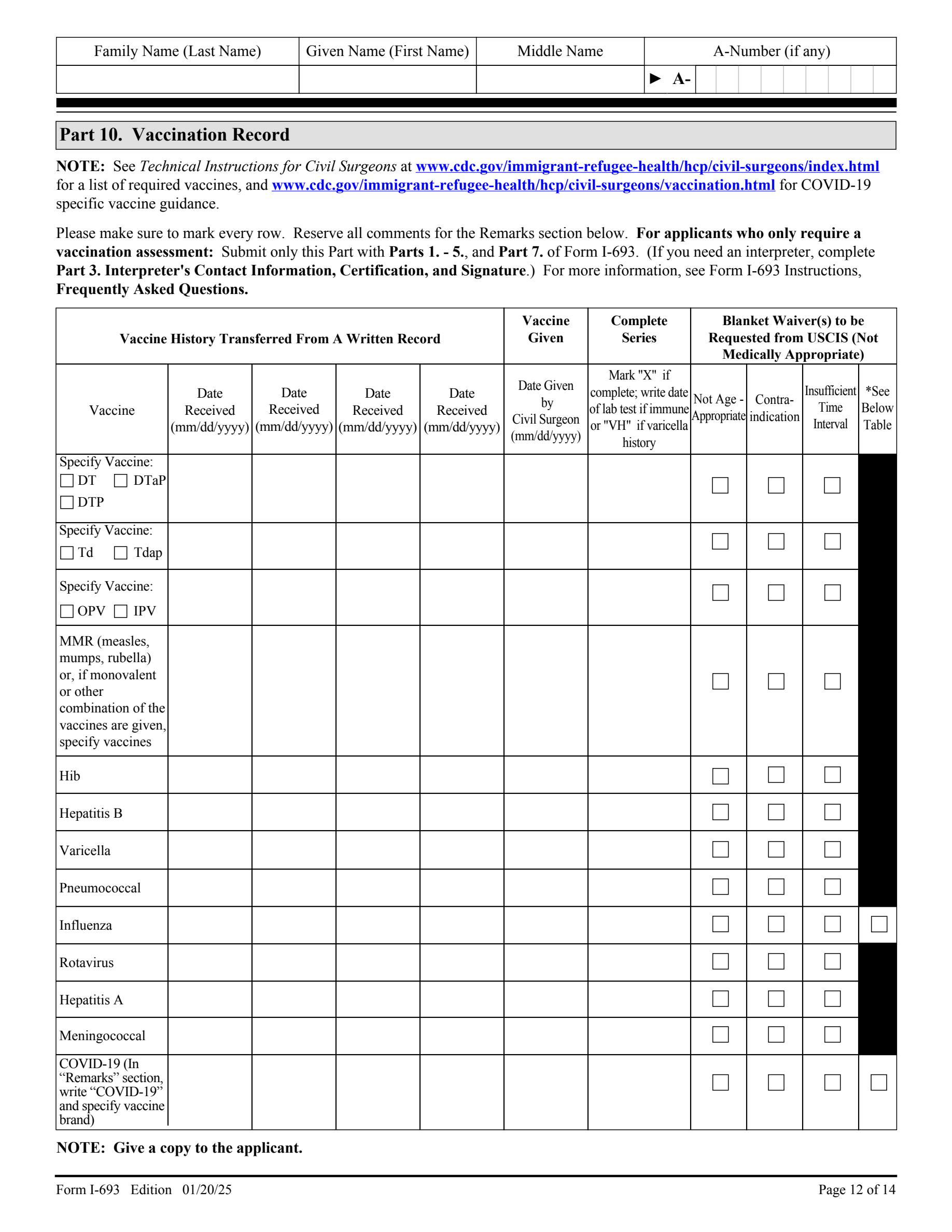
Verbatim · Vaccination Requirements (Form I-693 Instructions, edition 01/20/25, page 10)
“All applicants for adjustment of status must present documents showing they were vaccinated against a broad range of vaccine-preventable diseases. The civil surgeon will review your vaccination history with you to determine whether you have had all the required vaccinations. Make sure you take your vaccination records with you to your appointment with the civil surgeon.”
In plain terms, the civil surgeon, a doctor USCIS designates to perform immigration medical exams, goes through your vaccination history with you and records it on Part 10. If you are missing a required vaccine, the Instructions explain what happens:
Verbatim · Vaccination Requirements (Form I-693 Instructions, edition 01/20/25, page 10)
“If you never received certain vaccines, or you are unable to prove you received them, the civil surgeon can provide them to you. You also have the option to ask your family doctor to administer those vaccines to you after your evaluation by the civil surgeon. If you choose that option, show the records to the civil surgeon to note on Form I-693.”
The required-vaccine list is not set by the form. Part 10 itself points to the CDC for the current list:
Verbatim · Part 10 Vaccination Record note (Form I-693, edition 01/20/25, page 12)
“See Technical Instructions for Civil Surgeons at www.cdc.gov/immigrant-refugee-health/hcp/civil-surgeons/index.html for a list of required vaccines, and www.cdc.gov/immigrant-refugee-health/hcp/civil-surgeons/vaccination.html for COVID-19 specific vaccine guidance.”
The CDC list of required vaccines is at cdc.gov/immigrant-refugee-health/hcp/civil-surgeons. Always complete the current edition from uscis.gov/i-693; USCIS rejects outdated editions.
Vaccines listed on Part 10
These are the vaccine categories on Part 10 of Form I-693 (edition 01/20/25). The exact ages and number of doses are set by the CDC and USCIS Technical Instructions, which the civil surgeon follows. This table is not the dose-by-dose schedule.
| Vaccine | Notes |
|---|---|
| DTP / DTaP / DT / Td / Tdap | Diphtheria, tetanus, and pertussis vaccines, by age |
| MMR (measles, mumps, rubella) | Or a documented monovalent or other combination, specified by the civil surgeon |
| Polio (OPV / IPV) | Poliovirus vaccine, by age group |
| Hib | Haemophilus influenzae type b |
| Hepatitis A | By age group |
| Hepatitis B | By age group |
| Varicella | Chickenpox; varicella history can count, marked "VH" on the form |
| Pneumococcal | By age group |
| Influenza (seasonal) | Per the Instructions, not required if unavailable where the civil surgeon practices |
| Rotavirus | By age group |
| Meningococcal | By age group |
| COVID-19 | No longer required for adjustment-of-status applicants; USCIS removed the requirement effective January 22, 2025 |
Source: Part 10 of Form I-693 (edition 01/20/25) and the CDC Technical Instructions for Civil Surgeons. The COVID-19 removal effective January 22, 2025 is USCIS policy.
How the vaccination record gets completed
Four steps, drawn from the “Vaccination Requirements” section of the Instructions.
Gather your existing vaccination records before the appointment
Per the Instructions (page 10), take your vaccination records with you to the civil surgeon. Records of past doses, lab results showing immunity, or proof of varicella history can all count, so the civil surgeon does not give you doses you do not need.
The civil surgeon reviews your history with you
At the visit, the civil surgeon goes through your vaccination history against the required list (set by the CDC and USCIS) and records it on Part 10, the Vaccination Record portion of Form I-693.
The civil surgeon gives any vaccines you are missing
Per the Instructions, if you never got a required vaccine or cannot prove you did, the civil surgeon can give it at the visit. You may instead ask your own doctor to give it after the civil surgeon evaluates you, then show those records to the civil surgeon to note on the form.
The record goes in the sealed I-693 with your I-485
Part 10 is part of the same Form I-693 the civil surgeon seals in an envelope. In a marriage-based adjustment case, you file the sealed I-693 with your Form I-485 following the I-485 Instructions. Do not open the envelope.
Putting your marriage-based green card packet together?
Our software tells you when to schedule the civil surgeon exam, where the sealed I-693 goes in your I-485 packet, and keeps your details consistent across every form.
Start FreeWhy USCIS requires a vaccination record
USCIS uses the I-693 to confirm an applicant is not inadmissible on health-related grounds under INA section 212(a)(1), which includes the vaccination requirement. The vaccination record (Part 10) is how USCIS documents that an applicant meets that requirement. The civil surgeon, not USCIS, records the doses, and the required list comes from the CDC and USCIS Technical Instructions for Civil Surgeons rather than from the form itself. That is why the form points to the CDC site for the current list, and why the list can change without the form changing. The COVID-19 vaccine is the clearest recent example: the form (edition 01/20/25) still lists COVID-19 in Part 10, but USCIS stopped requiring it for adjustment-of-status applicants effective January 22, 2025, so a missing COVID-19 dose no longer affects the vaccination record for those applicants.
Common mistakes
These are the ones that show up most often with the I-693 vaccination record.
- 1
Not bringing existing vaccination records
The Instructions (page 10) tell you to take your vaccination records to the appointment. Without them, the civil surgeon may repeat doses you already had, which costs time and money. Records of past doses, immunity lab results, or varicella history can all count.
- 2
Assuming the COVID-19 vaccine is still required
Many older articles still say the COVID-19 vaccine is required. USCIS removed it for adjustment-of-status applicants effective January 22, 2025. The form (edition 01/20/25) still lists COVID-19 in Part 10, which confuses people, but a missing COVID-19 dose no longer affects the record for these applicants.
- 3
Getting required vaccines before the civil surgeon evaluates you
Per the Instructions, you should not try to meet the vaccination requirements before the civil surgeon evaluates you, in case a vaccine is not medically appropriate for you. The civil surgeon decides what you need and gives it at the visit.
- 4
Trying to read the I-693 as the vaccine schedule
Part 10 lists the vaccine categories but is not the dose-by-dose schedule. The required vaccines, ages, and doses are set by the CDC and USCIS Technical Instructions, which the civil surgeon follows. The form itself points to the CDC site for the current list.
Related guides
Form and pathway context
Related questions and steps
Frequently asked questions
Which vaccinations does Form I-693 require?
Per the I-693 Instructions, all applicants for adjustment of status must show they were vaccinated against a broad range of vaccine-preventable diseases. Part 10 of the form lists categories such as diphtheria-tetanus-pertussis (Td/Tdap), polio, MMR (measles, mumps, rubella), Hib, hepatitis A, hepatitis B, varicella, pneumococcal, seasonal influenza, rotavirus, and meningococcal. The exact required list, ages, and doses are set by the CDC and USCIS, not by the form, so the form points to the CDC Technical Instructions for the current list.
Is the COVID-19 vaccine still required for a green card?
No. USCIS removed the COVID-19 vaccine requirement for adjustment-of-status applicants effective January 22, 2025. The Form I-693 (edition 01/20/25) still lists COVID-19 in Part 10, which can be confusing, but a missing COVID-19 dose no longer affects the vaccination record for adjustment-of-status applicants. All other vaccine requirements still apply.
Who administers the required vaccines?
The civil surgeon, the doctor USCIS designates to perform immigration medical exams, reviews your history and can give any required vaccines you are missing at the visit. Per the Instructions, you may instead ask your own doctor to give them after the civil surgeon evaluates you, then show those records to the civil surgeon to note on Form I-693.
What records should I bring to the appointment?
Per the I-693 Instructions, take your vaccination records with you to the civil surgeon. Documentation of past doses, lab results showing immunity, or proof of having had a disease such as varicella can all reduce repeat doses. Bringing records keeps the visit faster and cheaper.
Can I get a waiver of a vaccine for religious or other reasons?
The I-693 Instructions describe waivers, including a waiver if you object to required vaccinations because of sincerely held religious beliefs or moral convictions, and exemptions where a vaccine is not medically appropriate. These are case-specific legal determinations. Green Card Genius does not analyze, advise on, or interpret vaccine waivers or medical findings. If you may need a vaccine waiver, talk to a licensed immigration attorney before you file.
Does my U.S. citizen spouse need vaccinations on file?
No. The vaccination record and Form I-693 are for the immigrant being sponsored, the applicant adjusting status. The petitioning spouse, the U.S. citizen or green card holder who filed the I-130, does not get an I-693 or a vaccination record.
Key takeaways
- ✓
Form I-693 includes a vaccination record (Part 10). Per the Instructions, all applicants for adjustment of status must show they were vaccinated against the required diseases.
- ✓
The civil surgeon reviews your vaccination history and gives any required vaccines you are missing; the required list is set by the CDC and USCIS, not the form.
- ✓
Bring your existing vaccination records to the appointment so the civil surgeon does not repeat doses you already had.
- ✓
The COVID-19 vaccine is no longer required for adjustment-of-status applicants. USCIS removed the requirement effective January 22, 2025, even though the 01/20/25 form still lists it.
- ✓
In a marriage-based case the immigrant spouse gets the exam and files the sealed I-693, including Part 10, with Form I-485; the petitioning spouse does not need one.
This page is for educational purposes only and is not legal or medical advice. Green Card Genius is self-help immigration software, not a law firm, and does not provide legal representation. Immigration law and USCIS policy change frequently. For advice on a specific case, including vaccine waivers, consult a licensed immigration attorney. Form I-693, edition 01/20/25. Last verified May 2026.
Stay informed
Green card guides in your inbox
Practical, plain-English updates to help you navigate the process with confidence.
Unsubscribe anytime.
Continue reading
Be a Genius
Only pay when you file