Form I-693 · Civil surgeon and sealed envelope
I-693 Civil Surgeon Requirement and Sealed Envelope Rule in 2026
The immigration medical exam form has two rules people miss: only a USCIS-designated doctor can complete it, and you submit it in the sealed envelope without opening it.
Quick answer
Only a doctor that USCIS has designated as a civil surgeon can complete Form I-693. A regular family doctor cannot, and USCIS rejects the form if a non-designated doctor signs it. The civil surgeon hands you the completed form in a sealed envelope: submit it sealed and never open it, or USCIS returns it.
Summary
Form I-693 (the immigration medical exam, edition 01/20/25) has to be done by a USCIS-designated civil surgeon, which is a doctor USCIS has specifically authorized to perform immigration medical exams. Your own primary-care doctor cannot complete it unless they happen to be on the USCIS list. After the exam, the civil surgeon seals your completed I-693 in an envelope and gives it to you. Per the I-693 Instructions (page 1), you must submit it to USCIS still sealed. If the envelope is opened, altered, or never sealed, USCIS returns the form and you start that step over. In a marriage-based green card case you (the immigrant spouse, called the applicant) get the exam done and submit the sealed I-693 with your Form I-485, the application to adjust status (get your green card without leaving the United States). Your U.S. citizen or green card holder spouse (the petitioner who filed the I-130 for you) does not need their own exam.
| Who can complete it | Only a USCIS-designated civil surgeon (a doctor USCIS authorized for immigration exams). A regular or personal doctor cannot, unless they are on the USCIS list. |
| How to find one | Use the USCIS Find a Doctor tool. Per the Instructions, enter "Find a Doctor" in the search box at uscis.gov, or go to uscis.gov/tools/find-a-civil-surgeon. |
| Sealed envelope rule | The civil surgeon gives you the completed form in a sealed envelope. Submit it sealed. Do not open it. |
| If you open it | USCIS returns the form if the envelope is opened or altered in any way, or if it was never sealed. You would need a new sealed copy. |
| Marriage-based filing | The immigrant spouse (applicant) gets the exam and submits the sealed I-693 with Form I-485. The petitioner spouse does not need an exam. |
| How long it stays valid | Per the Instructions, Form I-693 stays valid for two years from the date the civil surgeon signs it. |
Who this page is for
This page covers the procedure: who is allowed to complete Form I-693 and how to keep the sealed envelope valid. It does not give medical advice and does not cover what any specific medical finding means for your case. The civil surgeon and the CDC Technical Instructions govern the exam itself. If your exam involves a mental or physical health finding, a vaccine waiver, or anything you are unsure could affect admissibility, talk to a licensed immigration attorney before you file.
Free tool
Marriage Green Card Cost Calculator
2026 · AOS · full packet
$3,005
See your exact 2026 USCIS filing fees for a marriage green card through Adjustment of Status, with a full line-item breakdown and the costs most guides leave out.
Free — enter your email and it opens right up. Unsubscribe anytime.
We post free tips on preparing your marriage green card. Follow along:
What the I-693 Instructions say
The controlling language is in the “How Do I File Form I-693?” steps on page 1 of the Instructions. Steps 2 and 5 set the civil surgeon and sealed envelope rules.
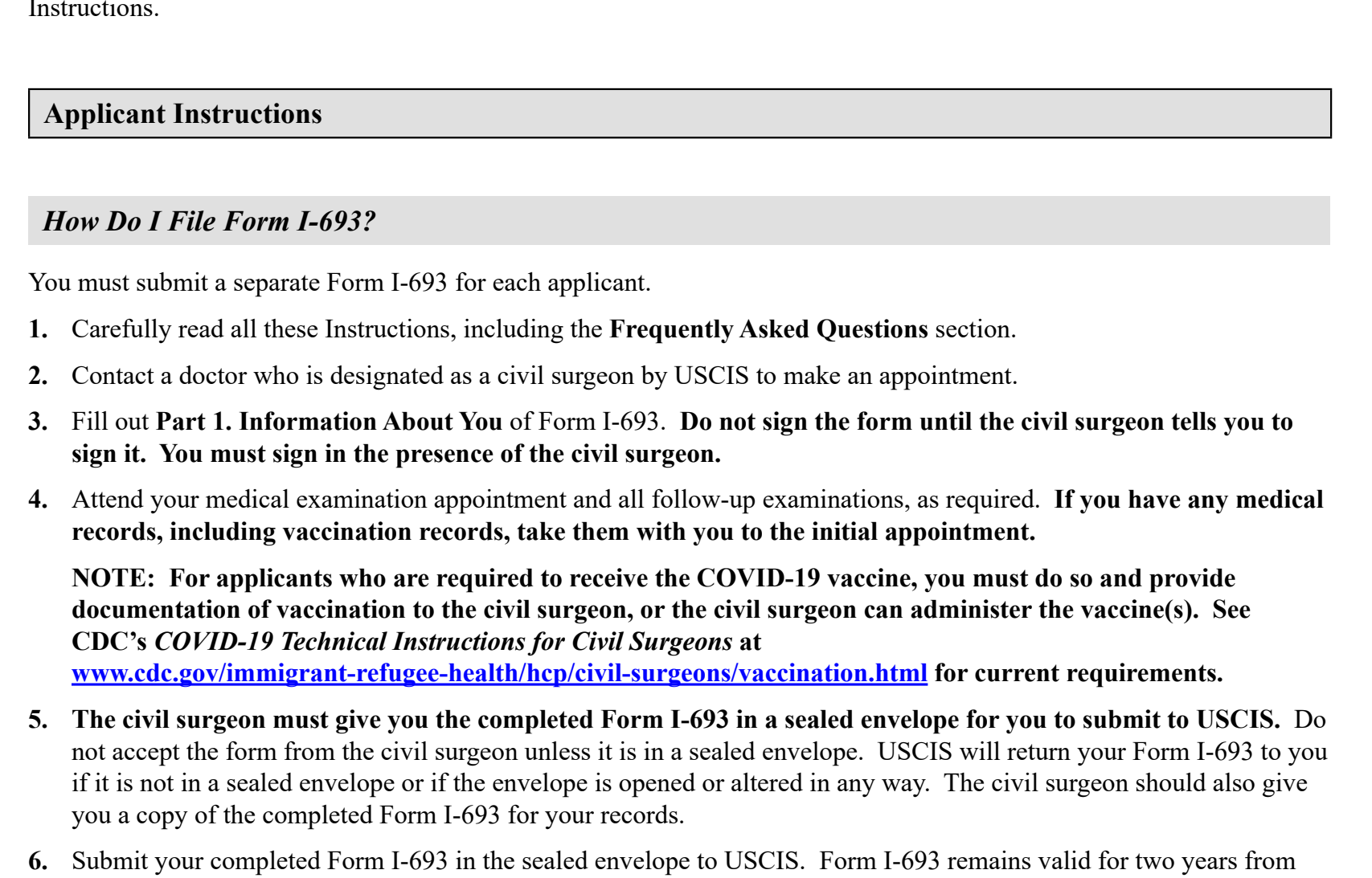
Verbatim · Step 2 (Form I-693 Instructions, edition 01/20/25, page 1)
“Contact a doctor who is designated as a civil surgeon by USCIS to make an appointment.”
In plain terms, a civil surgeon is a doctor USCIS has specifically authorized to perform immigration medical exams. A regular or personal doctor cannot complete the form unless they are on the USCIS list. Step 5 then sets the sealed envelope rule:
Verbatim · Step 5 (Form I-693 Instructions, edition 01/20/25, page 1)
“The civil surgeon must give you the completed Form I-693 in a sealed envelope for you to submit to USCIS. Do not accept the form from the civil surgeon unless it is in a sealed envelope. USCIS will return your Form I-693 to you if it is not in a sealed envelope or if the envelope is opened or altered in any way. The civil surgeon should also give you a copy of the completed Form I-693 for your records.”
For finding a designated doctor, the Instructions point to the USCIS Find a Doctor tool:
Verbatim · How Do I Find a Designated Civil Surgeon (I-693 Instructions, edition 01/20/25, page 2)
“To find a designated civil surgeon in your area, visit the USCIS website at www.uscis.gov. (Enter "Find a Doctor" into the "Search our Site" box.) The "Find a Doctor" site will provide instructions on how to search for a civil surgeon in your area.”
You can reach that tool directly at uscis.gov/tools/find-a-civil-surgeon. Always complete the current edition from uscis.gov/i-693; USCIS rejects outdated editions.
How the civil surgeon and sealed envelope steps work
Four steps, drawn from the “How Do I File Form I-693?” section of the Instructions.
Find a USCIS-designated civil surgeon
Per the Instructions (page 2), use the USCIS Find a Doctor tool at uscis.gov/tools/find-a-civil-surgeon. A civil surgeon is a doctor USCIS has authorized to do immigration medical exams. Your usual family doctor is not one unless their name comes up in that tool.
Fill out Part 1 before the appointment, then sign at the exam
Per step 3 of the Instructions, you complete Part 1 (Information About You) ahead of time but do not sign the form until the civil surgeon tells you to. You sign in the presence of the civil surgeon. Bring a valid government-issued photo ID so the civil surgeon can confirm your identity.
The civil surgeon completes and seals the form
The civil surgeon performs the exam, fills in the medical parts, signs, and seals your completed I-693 in an envelope. Per step 5, do not accept the form unless it is in a sealed envelope, and the civil surgeon should also give you an unsealed copy for your own records.
Submit it sealed with your I-485
Per step 6, you submit the sealed envelope to USCIS. In a marriage-based adjustment case you file it with Form I-485 following the I-485 Instructions. Keep the envelope sealed the whole time. If you open it to peek inside, USCIS returns it.
Putting your marriage-based green card packet together?
Our software tells you when to schedule the civil surgeon exam, where the sealed I-693 goes in your I-485 packet, and keeps your details consistent across every form.
Start FreeWhy USCIS requires a civil surgeon and a sealed envelope
USCIS uses the I-693 to confirm an applicant is not inadmissible on health-related grounds under INA section 212(a)(1), which covers certain communicable diseases, required vaccinations, and related findings. The civil surgeon designation and the sealed envelope are how USCIS keeps the medical results trustworthy: only a doctor USCIS has vetted can produce the report, and the sealed envelope is a chain-of-custody control so USCIS knows the results reaching them are exactly what the civil surgeon recorded, not changed after the fact. That is why an opened or altered envelope, per the Instructions (page 1), gets the form returned rather than reviewed.
Common mistakes
These are the ones that show up most often with the I-693 medical exam.
- 1
Using a regular doctor instead of a civil surgeon
A primary-care physician, urgent-care clinic, or any doctor not on the USCIS list cannot complete Form I-693 for immigration. The Instructions direct you to contact a doctor designated as a civil surgeon by USCIS. If a non-designated doctor signs it, USCIS does not accept the form.
- 2
Opening the sealed envelope
It is natural to want to check your own results, and the civil surgeon gives you an unsealed copy for exactly that. The official copy that goes to USCIS must stay sealed. Per the Instructions, USCIS returns the form if the envelope is opened or altered in any way.
- 3
Accepting an unsealed form from the civil surgeon
Step 5 of the Instructions says do not accept the form from the civil surgeon unless it is in a sealed envelope. If the office hands you loose pages, ask them to seal it before you leave.
- 4
Letting the form go stale
The Instructions state Form I-693 stays valid for two years from the date the civil surgeon signs it. Getting the exam far too early, then filing much later, can leave you with an expired report.
Related guides
Form and pathway context
Related questions and steps
Frequently asked questions
Can my own family doctor complete Form I-693?
Only if that doctor is a USCIS-designated civil surgeon. The Instructions direct you to contact a doctor who is designated as a civil surgeon by USCIS. A regular or personal doctor who is not on the USCIS list cannot complete the form, and USCIS will not accept an I-693 signed by a non-designated doctor.
How do I find a USCIS civil surgeon?
Per the I-693 Instructions, use the USCIS Find a Doctor tool: enter "Find a Doctor" in the search box at uscis.gov, or go directly to uscis.gov/tools/find-a-civil-surgeon. The tool lets you search for a designated civil surgeon near you.
Why does the I-693 come in a sealed envelope?
The sealed envelope is a chain-of-custody control. Per the Instructions (page 1), the civil surgeon gives you the completed Form I-693 in a sealed envelope for you to submit to USCIS, so USCIS knows the results are exactly what the civil surgeon recorded.
What happens if I open the sealed I-693 envelope?
USCIS returns the form. The Instructions state USCIS will return your Form I-693 to you if it is not in a sealed envelope or if the envelope is opened or altered in any way. The civil surgeon also gives you a separate copy for your records, so there is no need to open the sealed one.
When do I submit the I-693 in a marriage-based case?
You submit the sealed I-693 to USCIS, and for adjustment of status (getting your green card from inside the U.S.) you file it according to the Form I-485 Instructions. Many marriage-based applicants file it together with the I-485 packet. The form stays valid for two years from the civil surgeon's signature date.
Does my U.S. citizen spouse also need a medical exam?
No. The medical exam and I-693 are for the immigrant being sponsored (the applicant adjusting status). The petitioning spouse, the U.S. citizen or green card holder who filed the I-130, does not get an I-693.
Key takeaways
- ✓
Only a USCIS-designated civil surgeon can complete Form I-693. A regular or personal doctor cannot, and USCIS rejects a form signed by a non-designated doctor.
- ✓
Find a designated civil surgeon with the USCIS Find a Doctor tool at uscis.gov/tools/find-a-civil-surgeon.
- ✓
The civil surgeon gives you the completed I-693 in a sealed envelope. Submit it to USCIS still sealed.
- ✓
Per the Instructions, USCIS returns the form if the envelope is not sealed or has been opened or altered in any way.
- ✓
In a marriage-based case the immigrant spouse gets the exam and files the sealed I-693 with Form I-485; the petitioning spouse does not need an exam.
This page is for educational purposes only and is not legal or medical advice. Green Card Genius is self-help immigration software, not a law firm, and does not provide legal representation. Immigration law and USCIS policy change frequently. For advice on a specific case, consult a licensed immigration attorney. Form I-693, edition 01/20/25. Last verified May 2026.
Stay informed
Green card guides in your inbox
Practical, plain-English updates to help you navigate the process with confidence.
Unsubscribe anytime.
Continue reading
- 01Green Card Medical Exam (Form I-693): What You Need to Know (2026)
- 02Form I-485: Application to Adjust Status (2026 Guide)
- 03Marriage Green Card by Country: Country-Specific Guides (2026)
- 04I-485 Filing Category (Part 2): Which Box a Spouse Checks (2026)
- 05Adjustment of Status Guide (2026): Marriage Green Card
Be a Genius
Only pay when you file