Form I-485 · Part 8, Items 1-2
I-485 Ethnicity and Race (Part 8, Items 1-2): How to Answer in 2026
Part 8 of Form I-485 asks for your ethnicity and your race as two separate questions. Here is how the immigrant spouse answers each one.
Quick answer
Ethnicity (Item 1) and Race (Item 2) are two separate questions. For Ethnicity, pick exactly one box: Hispanic or Latino, or Not Hispanic or Latino. For Race, check every box that applies to you, even if you also picked Hispanic or Latino. A Hispanic or Latino applicant still selects one or more races.
Summary
On Form I-485, the immigrant spouse (the applicant, the person seeking the green card) completes Part 8, Items 1 and 2. Item 1, Ethnicity, asks you to select only one box: Hispanic or Latino, or Not Hispanic or Latino. Item 2, Race, asks you to select all applicable boxes from five options: American Indian or Alaska Native, Asian, Black or African American, Native Hawaiian or Other Pacific Islander, and White. USCIS treats ethnicity and race as two different questions, so a Hispanic or Latino applicant still picks one or more races. These answers are collected for demographic and identification description only and do not affect whether your case is approved.
| Who completes it | The applicant (the immigrant spouse seeking the green card). Each applicant fills out their own Part 8 on their own I-485. |
| Item 1 Ethnicity | Select only one box: Hispanic or Latino, or Not Hispanic or Latino. You must choose one. |
| Item 2 Race | Select all applicable boxes from five options. Check every race that applies, including more than one. |
| Hispanic or Latino applicants | Ethnicity and race are separate. If you select Hispanic or Latino in Item 1, you still select one or more races in Item 2. |
| Does it affect the case | No. The answers are used for demographic description and physical identification, not for eligibility. There is no wrong answer that denies a case. |
Who this page is for
This page covers the standard case: an applicant selecting their own ethnicity and race in Part 8. These are demographic fields with no eligibility consequence, so there is no attorney-lane situation tied to the answer itself. If other parts of your I-485 raise questions about criminal history, prior immigration violations, or inadmissibility (Part 9 covers organization membership and the eligibility and inadmissibility grounds), those are different fields and a licensed immigration attorney should review them.
Free tool
Marriage Green Card Cost Calculator
2026 · AOS · full packet
$3,005
See your exact 2026 USCIS filing fees for a marriage green card through Adjustment of Status, with a full line-item breakdown and the costs most guides leave out.
Free — enter your email and it opens right up. Unsubscribe anytime.
We post free tips on preparing your marriage green card. Follow along:
What Items 1 and 2 look like on the form
Ethnicity and Race are the first two items in Part 8 (Biographic Information), the same part that collects your height, weight, eye color, and hair color.
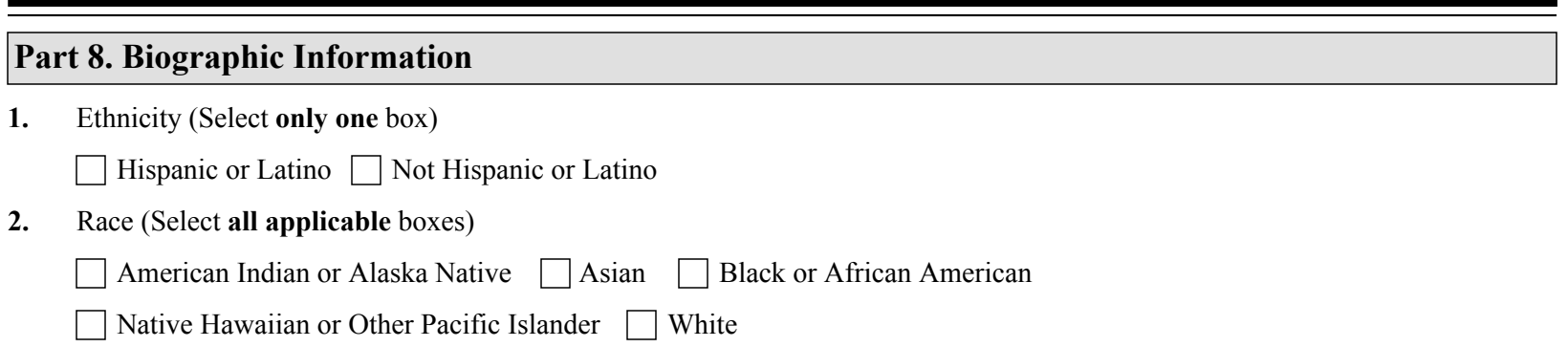
Verbatim · Part 8, Item 1 (Form I-485, edition 09/18/26, page 13)
“Ethnicity (Select only one box). Hispanic or Latino. Not Hispanic or Latino.”
Verbatim · Part 8, Item 2 (Form I-485, edition 09/18/26, page 13)
“Race (Select all applicable boxes). American Indian or Alaska Native. Asian. Black or African American. Native Hawaiian or Other Pacific Islander. White.”
The I-485 Instructions do not separately walk through Part 8; the selection text printed on the form itself is the controlling guidance for these two items. Always complete the current edition from uscis.gov/i-485; USCIS rejects outdated editions.
Ethnicity and race are two separate questions
The single most common source of confusion: USCIS treats ethnicity and race as different things. One is limited to a single box; the other lets you check as many as apply.
| Question | Item | How many boxes |
|---|---|---|
| Ethnicity | Item 1 | Choose exactly one of two boxes |
| Race | Item 2 | Choose one or more of five boxes |
The five race categories, defined
American Indian or Alaska Native
A person with origins in any of the original peoples of North, Central, or South America who maintains tribal affiliation or community attachment.
Asian
A person with origins in any of the original peoples of the Far East, Southeast Asia, or the Indian subcontinent. This includes, for example, China, India, the Philippines, Vietnam, Korea, Japan, Pakistan, and Thailand.
Black or African American
A person with origins in any of the Black racial groups of Africa.
Native Hawaiian or Other Pacific Islander
A person with origins in any of the original peoples of Hawaii, Guam, Samoa, or other Pacific Islands.
White
A person with origins in any of the original peoples of Europe, the Middle East, or North Africa.
These descriptions follow the standard federal (OMB) categories. Office of Management and Budget (OMB) is the federal office that sets the ethnicity and race categories used across U.S. government forms.
How to fill it in
Four steps. Answer Item 1, then answer Item 2 separately.
Answer Item 1 first: pick one ethnicity
Ethnicity has two boxes and you select only one. Choose Hispanic or Latino if you have Cuban, Mexican, Puerto Rican, South or Central American, or other Spanish culture or origin, regardless of race. Otherwise choose Not Hispanic or Latino. Leaving Item 1 blank is the most common error, so make sure one box is selected.
Answer Item 2 separately: pick every race that applies
Race is a different question from ethnicity. Check all five boxes that describe you. If you identify with more than one race, select more than one box. Your Item 1 answer does not limit your Item 2 answer.
If you are Hispanic or Latino, still select a race
Hispanic or Latino is an ethnicity, not a race, on these federal categories. After selecting Hispanic or Latino in Item 1, you still pick one or more races in Item 2. Many Hispanic or Latino applicants select White, Black or African American, American Indian, or a combination.
If none of the race options feels like an exact fit, pick the closest
The five race categories are broad federal groupings, not a complete list of every national origin. Middle Eastern and North African applicants fall under White on the current form. South Asian applicants (for example, from India, Pakistan, Bangladesh, or Sri Lanka) fall under Asian. Choose the box or boxes that come closest. There is no Other write-in for race on this edition.
Not sure how to answer a field on your I-485?
Our software asks a few plain questions and fills Part 8 and the rest of your I-485 the right way, keeping your answers consistent across your whole marriage green card packet.
Start FreeWhat USCIS does with your ethnicity and race
USCIS collects ethnicity and race using the standard categories set by the federal Office of Management and Budget (OMB), the same categories used across U.S. government forms. The answers support physical description and identification during the background-check and biometrics stage, alongside height, weight, eye color, and hair color in the same Part 8. They are demographic and identity-description fields. They are not an eligibility test, and your selections do not make your green card more or less likely to be approved. There is no answer in Item 1 or Item 2 that disqualifies an application.
Common mistakes
These are the ones that show up most often on these two items.
- 1
Treating ethnicity and race as one question
Item 1 (Ethnicity) and Item 2 (Race) are separate. Answering only one of them, or assuming Hispanic or Latino is your race so Item 2 can be skipped, leaves the form incomplete. Answer both.
- 2
Selecting more than one box for Ethnicity
Item 1 says select only one box. You cannot check both Hispanic or Latino and Not Hispanic or Latino. Pick the single box that fits.
- 3
Selecting only one box for Race when more apply
Item 2 says select all applicable boxes. If you are multiracial, check every race that describes you, not just one.
- 4
Leaving Item 1 or Item 2 blank
Both items expect an answer. A blank biographic field can lead USCIS to ask for the missing information later. Confirm one ethnicity box and at least one race box are selected before you file.
Related guides
Form and pathway context
Frequently asked questions
I am Hispanic or Latino. Do I still have to pick a race?
Yes. On the federal categories USCIS uses, Hispanic or Latino is an ethnicity (Item 1), not a race. After you select Hispanic or Latino in Item 1, you still select one or more races in Item 2, such as White, Black or African American, or American Indian.
Can I select more than one race?
Yes. Item 2 says select all applicable boxes. If you identify with more than one race, check every box that applies. Item 1 (Ethnicity) is the only one limited to a single selection.
None of the five race categories matches how I identify. What do I select?
Pick the closest category or categories. The five options are broad federal groupings. Middle Eastern and North African applicants are counted as White on this edition; South Asian applicants are counted as Asian. There is no Other write-in box for race on the 09/18/26 form.
Does my ethnicity or race answer affect whether my green card is approved?
No. These are demographic and physical-identification fields collected under standard federal categories. They support identity description during background checks and biometrics. They are not part of the eligibility decision.
Who fills out Part 8, the U.S. citizen spouse or the immigrant?
The applicant, meaning the immigrant spouse seeking the green card, completes Part 8 on their own I-485. The U.S. citizen or green card holder spouse is the petitioner on the separate I-130 and does not complete the applicant's Part 8.
Key takeaways
- ✓
Ethnicity (Part 8, Item 1) and Race (Part 8, Item 2) are two separate questions on Form I-485.
- ✓
Item 1 Ethnicity: select only one box, Hispanic or Latino or Not Hispanic or Latino.
- ✓
Item 2 Race: select all applicable boxes from the five federal categories, including more than one.
- ✓
A Hispanic or Latino applicant still selects one or more races in Item 2.
- ✓
These fields are demographic and identification description only and do not affect the case outcome.
This page is for educational purposes only and is not legal advice. Green Card Genius is self-help immigration software, not a law firm, and does not provide legal representation. Immigration law and USCIS policy change frequently. For advice on a specific case, consult a licensed immigration attorney. Form I-485, edition 09/18/26. Last verified May 2026.
Stay informed
Green card guides in your inbox
Practical, plain-English updates to help you navigate the process with confidence.
Unsubscribe anytime.
Continue reading
- 01Form I-485: Application to Adjust Status (2026 Guide)
- 02I-485 Filing Category (Part 2): Which Box a Spouse Checks (2026)
- 03I-485 Place and Date of Last Arrival (Part 1, Items 10-12) (2026)
- 04I-864 Part 5, Item 1: Total Number of Persons in Household (2026)
- 05Marriage Green Card by Country: Country-Specific Guides (2026)
Be a Genius
Only pay when you file