Form I-130 · Part 2, Items 36-39
I-130 Certificate of Naturalization Number (Part 2, Items 36-39): Where to Find It
What Part 2, Items 36 through 39 ask the U.S. citizen petitioner, where the certificate number sits on your Certificate of Naturalization, and what to enter if you were born a citizen or lost the certificate.
Quick answer
Items 36 through 39 are about you, the U.S. citizen spouse who is petitioning (the petitioner). If you naturalized, check "U.S. Citizen" (Item 36), "Naturalization" (Item 37), and "Yes" (Item 38), then copy the Certificate Number, Place of Issuance, and Date of Issuance straight off your Certificate of Naturalization (Form N-550). If you are a U.S. citizen by birth in the United States, you almost never have one of these certificates: check "No" at Item 38 and type "N/A" in Items 39.a through 39.c.
Summary
For most marriage-based filers, the person completing Form I-130 Part 2, Items 36 through 39 is the U.S. citizen spouse (the petitioner, the person asking USCIS to recognize the marriage), not the immigrant spouse (the beneficiary). Item 36 asks whether you are a U.S. citizen or a lawful permanent resident (a green card holder, abbreviated LPR). Item 37 asks how you became a citizen. Item 38 asks whether you have obtained a Certificate of Naturalization (Form N-550, the document issued when you naturalize) or a Certificate of Citizenship (Form N-560, issued to some people who became citizens through a U.S. citizen parent). If you answer "Yes," Items 39.a, 39.b, and 39.c ask for that certificate's number, its place of issuance, and its date of issuance. A naturalized citizen copies all three off the certificate. A citizen by birth in the United States usually has no such certificate, checks "No" at Item 38, and enters "N/A" in Item 39. Only a U.S. citizen petitioner completes Items 37 through 39; a lawful permanent resident petitioner skips them and completes Item 40 instead.
| Who these items are about | You, the petitioner (the U.S. citizen or green card holder spouse filing the I-130), not your immigrant spouse. Items 37 through 39 are for U.S. citizen petitioners only. |
| Item 39.a Certificate Number | The number printed on your Certificate of Naturalization (Form N-550) or Certificate of Citizenship (Form N-560), usually in red near the upper-right corner. Copy every digit and any letters exactly. |
| Item 39.b Place of Issuance | The issuing location shown on the certificate itself (the USCIS office or, on older certificates, the court). This is not always the city where your oath ceremony was held. Copy what the certificate shows. |
| Item 39.c Date of Issuance | The date printed on the certificate, in mm/dd/yyyy order. On a Certificate of Naturalization this is the date you became a citizen at your oath ceremony. |
| If you are a citizen by U.S. birth | You almost certainly have no Certificate of Naturalization or Citizenship. Check "No" at Item 38 and type "N/A" in Items 39.a through 39.c. Your proof of citizenship is your birth certificate or U.S. passport. |
| If your certificate is lost | You can request a replacement with Form N-565, or submit a copy of your unexpired U.S. passport as proof of citizenship instead, which the I-130 instructions accept. |
Who this page is for
This page covers copying the certificate number, place of issuance, and date off a Certificate of Naturalization or Certificate of Citizenship that belongs to you, the petitioner, and knowing what to enter when you are a citizen by U.S. birth or your certificate is lost. It does not decide whether you are in fact a U.S. citizen. If you are unsure whether you acquired citizenship, or the name on your certificate is materially different from the name on your other immigration filings or passports in a way that could raise an identity question, consult an immigration attorney before completing this field. That branch is flagged again below.
Free tool
Marriage Green Card Cost Calculator
2026 · AOS · full packet
$3,005
See your exact 2026 USCIS filing fees for a marriage green card through Adjustment of Status, with a full line-item breakdown and the costs most guides leave out.
Free — enter your email and it opens right up. Unsubscribe anytime.
We post free tips on preparing your marriage green card. Follow along:
What Items 36-39 look like on the form
Items 36 through 39 sit at the end of Part 2 (Information About You), in the block titled “Additional Information About You (Petitioner).” Item 36 sets whether you are a citizen or a green card holder, Item 37 sets how you became a citizen, Item 38 asks whether you hold a certificate, and Item 39 collects that certificate’s details.
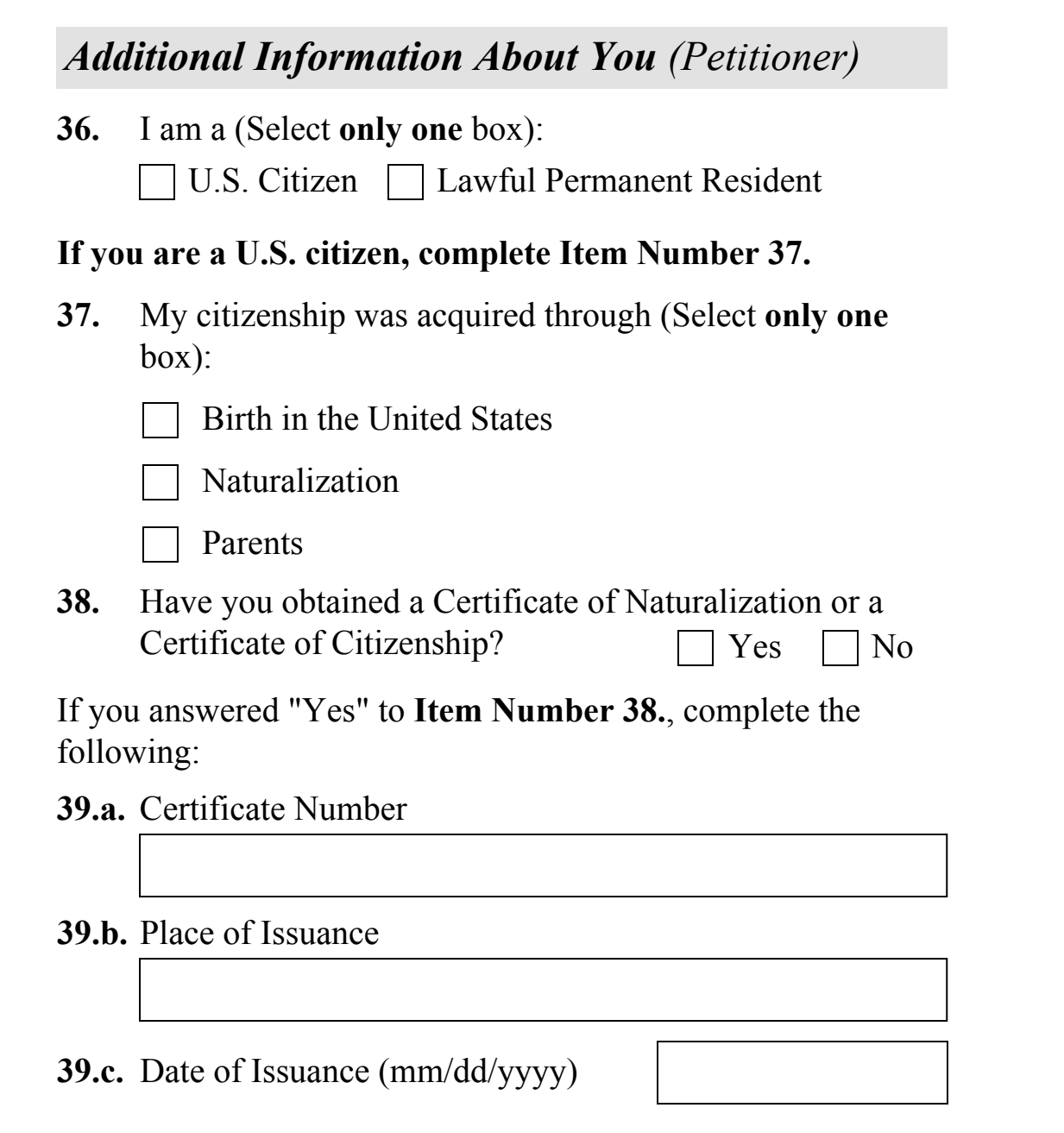
Verbatim · Form I-130, Part 2, Items 36-39 (edition 04/01/24, page 3 of 12)
“Additional Information About You (Petitioner)”
36. “I am a (Select only one box):” · “U.S. Citizen / Lawful Permanent Resident”
“If you are a U.S. citizen, complete Item Number 37.”
37. “My citizenship was acquired through (Select only one box):” · “Birth in the United States / Naturalization / Parents”
38. “Have you obtained a Certificate of Naturalization or a Certificate of Citizenship?”
“If you answered "Yes" to Item Number 38., complete the following:”
39.a. “Certificate Number” · 39.b. “Place of Issuance” · 39.c. “Date of Issuance (mm/dd/yyyy)”
What the instructions say about a field that does not apply
The I-130 Instructions do not add a line-by-line note for Items 36 through 39. Two general rules govern how you fill them. The first covers any field that does not apply to you, which is what a citizen by U.S. birth reaches at Item 39:
Verbatim · I-130 Instructions, “How To Complete Form I-130,” Item 3 (edition 04/01/24, page 4 of 11)
“Answer all questions fully and accurately. If a question does not apply to you (for example, if you have never been married and the question asks, “Provide the name of your current spouse”), type or print “N/A” unless otherwise directed. If your answer to a question which requires a numeric response is zero or none (for example, “How many children do you have” or “How many times have you departed the United States”), type or print “None” unless otherwise directed.”
The second sets the date format for the Date of Issuance in Item 39.c:
Verbatim · I-130 Instructions, “How To Complete Form I-130,” Item 4 (edition 04/01/24, page 4 of 11)
“Enter dates in mm/dd/yyyy format. If you cannot provide an exact date, provide an approximate date in the same format and include an explanation in Part 9. Additional Information.”
The instructions also list the citizenship documents you file with the petition. Your certificate is one accepted proof, and a U.S. passport is another, which matters if the certificate is lost:
Verbatim · I-130 Instructions, “What documents do you need to show that you are a U.S. citizen?” (edition 04/01/24, page 6 of 11)
“A copy of your naturalization certificate or certificate of citizenship issued by USCIS or the former Immigration and Naturalization Service (INS);”
“A copy of your unexpired U.S. passport; or”
Always complete the current edition from uscis.gov/i-130; USCIS rejects outdated editions.
What the certificate in Item 38 is
A Certificate of Naturalization (Form N-550) is the document USCIS issues at your oath ceremony when you become a U.S. citizen through naturalization. A Certificate of Citizenship (Form N-560) is a related document USCIS issues to certain people who became citizens automatically through a U.S. citizen parent, either at birth abroad or before turning 18. Item 38 asks whether you hold either one. If you do, its number is the reference USCIS uses to confirm your citizenship in their records. If you became a citizen by being born in the United States, you were never issued either certificate; your birth certificate or U.S. passport is your proof instead.
Where to find the certificate number, place, and date
Work through these in order. If you hold a certificate, all three answers are printed on it. If you do not, the last step points you to the right boxes.
Find your Certificate of Naturalization or Certificate of Citizenship
This is the full-page document USCIS gave you at your oath ceremony (Form N-550) or mailed to you (Form N-560). It has your photo, your name, and a printed certificate number. It is a different document from your U.S. passport and from your green card.
Read the Certificate Number near the upper-right corner
The certificate number is usually printed in red ink, most often in the upper-right area of the certificate. It is typically seven or eight digits, and some older certificates add a letter prefix. This is the number Item 39.a asks for.
Find the Place of Issuance on the certificate face
The certificate names the location where it was issued. On certificates issued by USCIS this is a USCIS office; on older, court-issued certificates it is the court. Item 39.b asks for that issuing location as printed, which can differ from the city where your oath ceremony was held.
Read the Date of Issuance off the same certificate
The date of issuance is printed on the certificate. On a Certificate of Naturalization it is the date you became a citizen at your oath ceremony. Item 39.c asks for this date in mm/dd/yyyy order.
No certificate? Confirm which citizenship box applies
If you are a citizen because you were born in the United States, you have no naturalization or citizenship certificate. Select "Birth in the United States" at Item 37, answer "No" at Item 38, and the certificate fields at Item 39 do not apply to you.
How to enter each field
Four rules for Items 39.a, 39.b, and 39.c.
Copy the certificate number exactly
Match the certificate number character for character, including any letters and leading zeros, as printed on the certificate. Do not add spaces or dashes that are not on the document, and do not shorten it.
Place of Issuance is what the certificate shows
For Item 39.b, use the issuing location printed on the certificate, not the city where your ceremony happened if the two differ. If a courthouse in one city hosted your oath but the certificate names a USCIS field office, copy the field office as printed.
Date of Issuance is mm/dd/yyyy
Enter the date of issuance in month/day/year order to match the form. This is a common spot for day/month slips if your prior documents were written the other way around.
Use "N/A" when Item 38 is "No"
If you have no Certificate of Naturalization or Certificate of Citizenship (for example, you are a citizen by U.S. birth), answer "No" at Item 38 and type "N/A" in Items 39.a through 39.c. The instructions direct "N/A" for questions that do not apply to you.
Stop here if the name on your certificate does not match your other filings
Copying the number, place, and date is routine when your certificate matches the rest of your identity documents. If the name on your Certificate of Naturalization or Certificate of Citizenship is materially different from the name on your passport, prior immigration filings, or this petition in a way that could raise an identity or fraud question, that branch has legal implications that vary by your specific facts.
The same is true if you are not certain you are a U.S. citizen at all, for example a claim to citizenship through a parent that was never documented. This page explains what the fields ask. It does not tell you how to resolve a name mismatch or a citizenship question for your situation. An immigration attorney needs to review your facts first.
Find an immigration attorneyMarriage-based filers: the two standard paths
In a marriage-based case, you (the sponsoring U.S. citizen spouse) are the petitioner, and Items 36 through 39 describe your citizenship, not your immigrant spouse's. Your spouse's immigration details go in Part 4 of the same form. Two standard paths cover almost every married U.S. citizen petitioner:
You naturalized (you became a citizen after immigrating)
Item 36: U.S. Citizen. Item 37: Naturalization. Item 38: Yes. Items 39.a-c: the Certificate Number, Place of Issuance, and Date of Issuance copied from your Certificate of Naturalization (Form N-550).
You are a citizen by birth in the United States
Item 36: U.S. Citizen. Item 37: Birth in the United States. Item 38: No (a U.S.-born citizen is not issued a naturalization or citizenship certificate). Items 39.a-c: N/A. File the petition with a copy of your birth certificate or U.S. passport as proof of citizenship.
Not sure which boxes to check?
Our software asks a few plain questions about how you became a citizen, checks the right boxes in Items 36 through 38, carries your certificate details into Item 39, and keeps your name consistent across your whole I-130 packet.
Start FreeWhat USCIS does with these fields
USCIS uses Items 36 through 39 to confirm that you, the petitioner, are eligible to file this petition and to verify your claimed citizenship against their records. Only a U.S. citizen or a lawful permanent resident can petition for a spouse, and a citizen petitioner unlocks immediate-relative processing, which has no waiting line for visa numbers. When you give a certificate number, place of issuance, and date, the officer can match it to the naturalization or citizenship record USCIS already holds. It is a record-matching field, not a scoring field: a correct number does not add merit to your case, but a number that does not match the record, or a certificate copy that is missing, can prompt a Request for Evidence (an RFE, a USCIS notice asking for more documents) and delay the petition. You must still file the petition with a copy of the citizenship evidence itself, because the number on the form alone is not proof.
Common mistakes
These are the ones that show up most often on this block.
- 1
Filling in Items 36-39 for the immigrant spouse instead of the petitioner
Part 2 is about you, the U.S. citizen or green card holder spouse who is filing. Your immigrant spouse's information belongs in Part 4. Describe your own citizenship here.
- 2
Entering the A-Number or a passport number as the Certificate Number
Item 39.a wants the certificate number printed on your Certificate of Naturalization or Certificate of Citizenship, usually in red near the upper-right corner. It is not your Alien Registration Number (A-Number) and not your U.S. passport number.
- 3
Putting the oath-ceremony city in Place of Issuance
Item 39.b asks for the issuing location printed on the certificate. That can be a USCIS field office in a different city from the courthouse where your oath ceremony was held. Copy the certificate, not your memory of the ceremony location.
- 4
Leaving Item 39 blank when you are a citizen by birth
If you answered "No" at Item 38 because you were born in the United States, do not leave Item 39 empty. Type "N/A" so USCIS can see the fields were answered and not skipped.
- 5
Using day/month order for the Date of Issuance
The form uses mm/dd/yyyy. If your certificate or prior documents write the day first, convert the date of issuance to month/day/year so it is not misread.
Related guides
Form and pathway context
Frequently asked questions
Where is the certificate number on my Certificate of Naturalization?
It is the number printed on the face of the certificate, usually in red ink near the upper-right corner. On a Certificate of Naturalization (Form N-550) or Certificate of Citizenship (Form N-560) it is typically seven or eight digits, and some older certificates add a letter prefix. Copy it exactly into Item 39.a, including any letters and leading zeros. It is not your A-Number and not your passport number.
What do I put for Place of Issuance in Item 39.b?
Enter the issuing location exactly as it appears on your certificate. On certificates issued by USCIS this is a USCIS office; on older court-issued certificates it is the court. This is not always the same city where your oath ceremony was held, so copy what the certificate shows rather than the ceremony location.
I am a U.S. citizen by birth. What do I answer for Items 37, 38, and 39?
Select "Birth in the United States" at Item 37, answer "No" at Item 38, and type "N/A" in Items 39.a through 39.c. A citizen born in the United States is not issued a Certificate of Naturalization or Certificate of Citizenship. File the petition with a copy of your birth certificate or unexpired U.S. passport as proof of citizenship, both of which the I-130 instructions accept.
I lost my naturalization certificate. What can I do for Item 39?
You can apply for a replacement using Form N-565, Application for Replacement Naturalization/Citizenship Document, to obtain the number, place, and date again. If you have an unexpired U.S. passport, the I-130 instructions also accept a copy of it as proof of citizenship, so you can file with the passport while your replacement request is pending. Do not guess the certificate number from memory.
Does the certificate number replace sending a copy of the certificate?
No. You must still file the I-130 with a copy of your naturalization certificate, certificate of citizenship, or another accepted proof of citizenship. The number in Item 39.a helps USCIS match their record, but the instructions require the supporting document itself as evidence.
Key takeaways
- ✓
Items 36 through 39 are about the petitioner, the U.S. citizen or green card holder spouse filing the I-130, not the immigrant spouse.
- ✓
The Certificate Number (Item 39.a) is printed on your Certificate of Naturalization (N-550) or Certificate of Citizenship (N-560), usually in red near the upper-right corner. Copy it exactly.
- ✓
Place of Issuance (Item 39.b) is the issuing office or court named on the certificate, which is not always the city where your oath ceremony was held.
- ✓
Date of Issuance (Item 39.c) is the date on the certificate, in mm/dd/yyyy order.
- ✓
Citizens by U.S. birth answer "No" at Item 38 and "N/A" at Item 39. If your certificate is lost, Form N-565 gets a replacement, or file with a U.S. passport copy.
This page is for educational purposes only and is not legal advice. Green Card Genius is self-help immigration software, not a law firm, and does not provide legal representation. Immigration law and USCIS policy change frequently. For advice on a specific case, consult a licensed immigration attorney. Form I-130, edition 04/01/24. Last verified July 2026.
Stay informed
Green card guides in your inbox
Practical, plain-English updates to help you navigate the process with confidence.
Unsubscribe anytime.
Continue reading
Be a Genius
Only pay when you file