Form I-130 · Part 2, Items 24-35
I-130 Information About Your Parents (Part 2, Items 24-35)
Why a marriage petition asks about the petitioner's parents, and what each field collects.
Quick answer
The parents in Part 2 are YOUR parents (the petitioner's), not your spouse's. Every petitioner answers them. It is routine biographic record collection that replaced the old G-325A form, not a sign your parents are part of the case. Enter each parent's name, date and country of birth, and city and country of residence.
Summary
On Form I-130 Part 2, Items 24 through 35 ask about the petitioner's two parents: the person filing the petition, not the immigrant spouse. People filing for a husband or wife often pause here because it feels off-topic. It is not. USCIS collects this from every petitioner as a standard identity and background record, the same data the agency used to gather on the separate G-325A biographic form before it was folded into the petition itself. Your parents are not sponsors, are not interviewed, and do not need to sign anything. You list Parent 1 in Items 24 to 29 and Parent 2 in Items 30 to 35: each parent's full name, date of birth, sex, country of birth, and city and country of residence.
| Whose parents | Yours, the petitioner (the U.S. citizen or green card holder filing). Not the immigrant spouse's parents. |
| Item range | Part 2, Items 24-29 (Parent 1) and Items 30-35 (Parent 2), on page 3 of the form. |
| What each parent field collects | Full name, date of birth, sex, country of birth, and city/town/village plus country of residence. |
| Why it is asked | Routine biographic record collection required of all petitioners. It replaced the old standalone G-325A form. |
| Are parents involved in the case | No. They are not sponsors, are not interviewed, and do not sign anything. It is background data only. |
Who this page is for
This page covers the standard case: a petitioner entering their own parents' biographic details. If your own immigration history has name discrepancies across records, or your citizenship was acquired through a parent and the details are unclear, people in that situation often consult a licensed immigration attorney.
Free tool
Marriage Green Card Cost Calculator
2026 · AOS · full packet
$3,005
See your exact 2026 USCIS filing fees for a marriage green card through Adjustment of Status, with a full line-item breakdown and the costs most guides leave out.
Free — enter your email and it opens right up. Unsubscribe anytime.
We post free tips on preparing your marriage green card. Follow along:
What the parents section looks like on the form
The section sits in Part 2 (Information About You, Petitioner) on page 3. Parent 1 is Items 24 to 29; Parent 2 is Items 30 to 35.
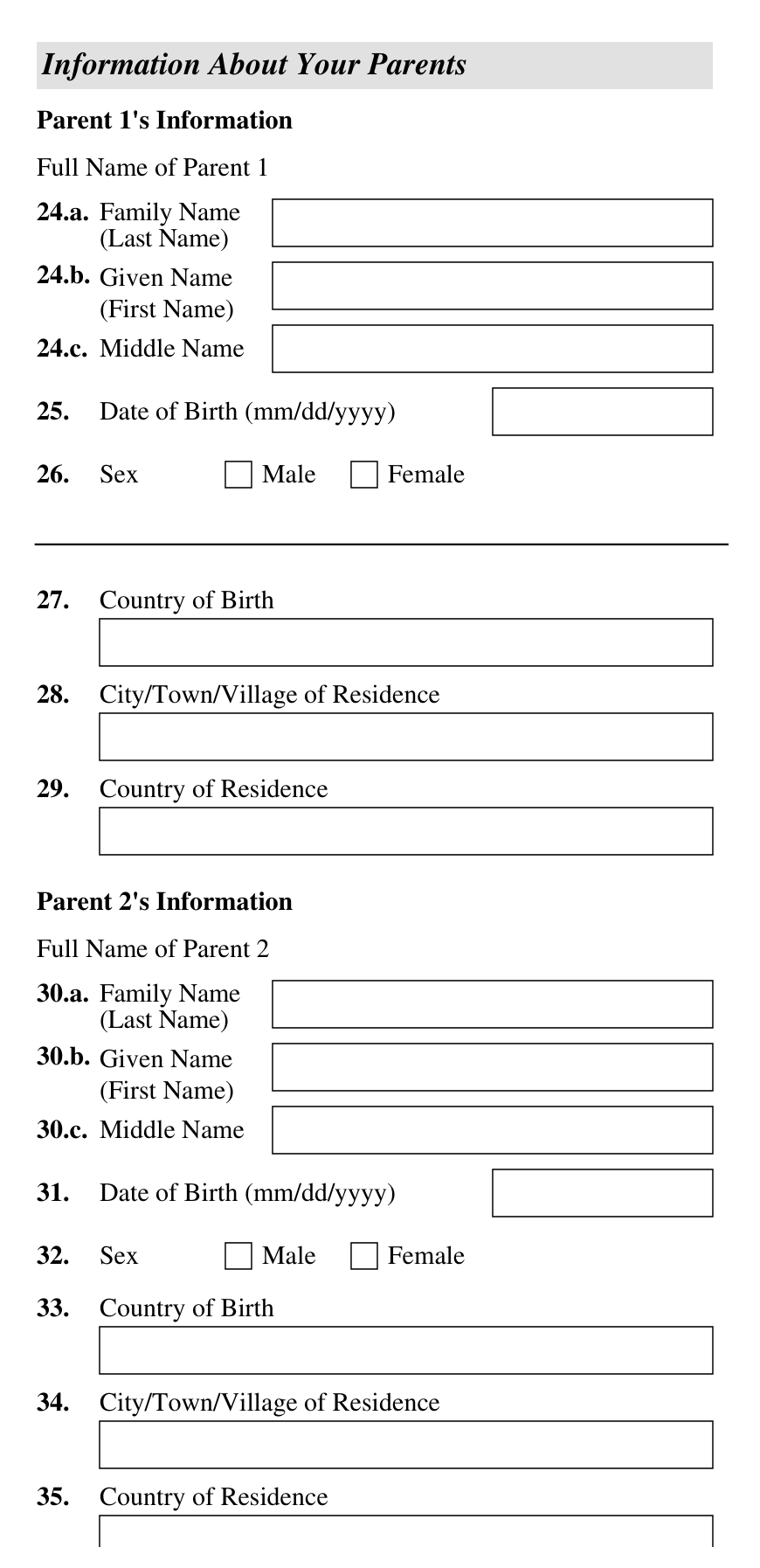
Verbatim · section heading and labels (Form I-130, edition 04/01/24, page 3)
“Information About Your Parents”
Parent 1's Information · Full Name of Parent 1
24.a. Family Name (Last Name) 24.b. Given Name (First Name) 24.c. Middle Name
25. Date of Birth (mm/dd/yyyy) 26. Sex (Male / Female)
27. Country of Birth 28. City/Town/Village of Residence 29. Country of Residence
Parent 2's Information · Full Name of Parent 2
30.a. Family Name (Last Name) 30.b. Given Name (First Name) 30.c. Middle Name
31. Date of Birth (mm/dd/yyyy) 32. Sex (Male / Female)
33. Country of Birth 34. City/Town/Village of Residence 35. Country of Residence
These fields replaced the separate G-325A (Biographic Information) form USCIS retired. Always complete the current edition from uscis.gov/i-130; USCIS rejects outdated editions.
What each parent field collects
You repeat the same set of fields for each parent: Parent 1 in the first column, Parent 2 in the second.
| Items | Field | What it collects |
|---|---|---|
| 24.a-c / 30.a-c | Full name | Each parent's family, given, and middle name. Use the name at birth where you can, including a mother's maiden name in the family-name field. |
| 25 / 31 | Date of birth | Month, day, year. If you do not know the exact date, type "unknown" rather than guessing. |
| 26 / 32 | Sex | Male or Female, as recorded on the parent's own documents. |
| 27 / 33 | Country of birth | Use the country's current name. If the country no longer exists or changed names, list the current name of the territory. |
| 28 / 34 | City/town/village of residence | Where the parent lives now. If the parent has died, type "deceased" in this field. |
| 29 / 35 | Country of residence | The country where the parent currently lives. For a deceased parent, this can also read "deceased." |
How to fill it in
Four steps that cover the cases people stumble on.
List your own parents, not your spouse's
Part 2 is Information About You (Petitioner). The parents here are the parents of whoever signs the petition. If you are the U.S. citizen or green card holder filing for your husband or wife, these are your mom and dad.
Parent 1 in 24-29, Parent 2 in 30-35
It does not matter which parent you call Parent 1. There is no required order. Enter the full name, date of birth, sex, country of birth, and city and country of residence for each.
Use the name at birth, including a maiden name
For a mother, USCIS wants her name as recorded at birth, so a maiden name typically goes in the family-name field (24.a or 30.a). This helps match her against records that predate any marriage.
Handle deceased and unknown cleanly
If a parent has died, type "deceased" in the city/town/village of residence field. If you do not know a date of birth, type "unknown." Do not invent dates or leave required fields fully empty.
Why do you need MY parents for MY spouse's case?
If you are filing for a spouse, the natural reaction to this section is: why do you need MY parents for MY spouse's case? The answer is that Part 2 is about you, the petitioner, and your parents are part of the standard biographic picture USCIS builds for the person sponsoring the petition. It is the same identity and background information the government used to collect on a separate form, the G-325A (Biographic Information), which USCIS retired and absorbed into the I-130 itself. Your parents are not joining the case. They are not financial sponsors (that role belongs to the I-864 affidavit of support), they are not interviewed, and they do not sign. The fields are there because every I-130 petitioner answers them, whether the beneficiary is a spouse, a parent, or a child.
Not sure which fields apply to your situation?
Our software asks a few plain questions and fills the right fields the right way, keeping your details consistent across your whole I-130 and I-485 packet.
Start FreeWhat USCIS does with your parent information
USCIS uses a petitioner's parent information as part of confirming who you are and building a consistent biographic record across your immigration history. The same names and birth details may appear on your own birth certificate, a naturalization record, or a prior filing, and the agency can cross-check them. For a U.S. citizen petitioner who acquired citizenship through a parent, the parent data also lines up with the citizenship claim recorded later in Part 2. None of this involves your spouse's family, and none of it makes your parents responsible for the case.
Common mistakes
These are the ones that show up most often on this section.
- 1
Entering the spouse's parents instead of your own
Part 2 is the petitioner's section. The parents belong to the person filing. The beneficiary spouse's parents are not collected on the I-130 at all. Putting your in-laws here is a mismatch USCIS can notice.
- 2
Leaving it blank because it feels irrelevant
It is a required part of every petition. Skipping Items 24-35 can draw a Request for Evidence (an RFE, a USCIS notice asking for more information) or slow processing while USCIS asks for the missing biographic data.
- 3
Guessing a date of birth
If you genuinely do not know a parent's date of birth, type "unknown" instead of inventing one. A guessed date that conflicts with other records is worse than a clear "unknown."
- 4
Not marking a deceased parent
If a parent has died, type "deceased" in the city/town/village of residence field rather than leaving the residence fields empty. You still complete the name and birth fields you know.
- 5
Using a married name where the birth name belongs
For a mother, the name at birth (often the maiden name) is the more useful entry in the family-name field, because it matches records created before any marriage.
Related guides
Form and pathway context
Related questions
Frequently asked questions
Why does my spouse's green card petition ask about MY parents?
Because Part 2 is Information About You (Petitioner), and your parents are part of the standard biographic record every petitioner provides. It is not because your parents are involved in your spouse's case. They are not sponsors, are not interviewed, and do not sign.
Do these have to be my spouse's parents?
No. The parents in Items 24-35 are the petitioner's parents, the person filing the I-130. The beneficiary spouse's parents are not collected on this form.
What do I do if a parent has passed away?
Type "deceased" in the city/town/village of residence field for that parent. Complete the name, date of birth, and other fields you know. A death does not remove the requirement to identify the parent.
I do not know one parent's date of birth. What should I enter?
Type "unknown" in the date of birth field. Do not guess. An honest "unknown" is better than a date that could conflict with other records.
Which parent is Parent 1?
There is no required order. You can list either parent as Parent 1 (Items 24-29) and the other as Parent 2 (Items 30-35).
Are my parents financially responsible for my spouse?
No. Financial responsibility comes from the I-864 affidavit of support, signed by the petitioner and any joint sponsor. Listing your parents in Part 2 creates no obligation for them.
Key takeaways
- ✓
The parents in Part 2, Items 24-35 are the petitioner's parents, not the immigrant spouse's.
- ✓
Every I-130 petitioner answers this. It replaced the old standalone G-325A biographic form.
- ✓
Each parent field collects name, date of birth, sex, country of birth, and city and country of residence.
- ✓
Use "deceased" in the residence field for a parent who has died, and "unknown" for a date of birth you do not know.
- ✓
Your parents are not sponsors, are not interviewed, and do not sign. The section is background data only.
This page is for educational purposes only and is not legal advice. Green Card Genius is self-help immigration software, not a law firm, and does not provide legal representation. Immigration law and USCIS policy change frequently. For advice on a specific case, consult a licensed immigration attorney. Form I-130, edition 04/01/24. Last verified May 2026.
Stay informed
Green card guides in your inbox
Practical, plain-English updates to help you navigate the process with confidence.
Unsubscribe anytime.
Continue reading
Be a Genius
Only pay when you file