Form I-130 · Part 4, Item 11
I-130 Beneficiary's Physical Address Abroad (Part 4, Item 11)
Where to enter your immigrant spouse's current physical address, abroad or in the United States, and how Item 13 and the consulate selection fit with it.
Quick answer
Item 11 is where your immigrant spouse physically lives right now. If they live abroad, enter their foreign address there. If they are already in the United States, enter their U.S. address. Item 13 is for a separate address outside the United States; type or print "SAME" in 13.a. if it matches Item 11, otherwise leave it for the rare case where the beneficiary has a second address abroad.
Summary
For most marriage-based filers, Form I-130 Part 4, Item 11 (Beneficiary's Physical Address) is where you enter the address at which your immigrant spouse currently, physically lives. The beneficiary is the immigrant spouse; the petitioner is the U.S. citizen or green card holder (lawful permanent resident, abbreviated LPR) filing the form. If your spouse lives abroad, you enter their foreign address in Item 11. If your spouse already lives in the United States, you enter their U.S. address there instead. Item 13 asks for the beneficiary's address outside the United States only if it is different from Item 11; if it is the same, you type or print "SAME" in Item 13.a. This is a different field from Item 12, which is the U.S. address where the beneficiary intends to live, and from Items 57 and 58, which repeat the foreign address in a non-Roman native script.
| What Item 11 asks | The beneficiary spouse's current physical address: where they actually live right now, whether that is abroad or in the United States. |
| Most marriage cases (spouse abroad) | Enter the foreign address in Item 11 (11.a-11.h). If the home has no street number or name, leave 11.a and 11.b blank per the on-form note. |
| Spouse already in the U.S. | Enter their U.S. address in Item 11. The physical address field follows where they live, not their citizenship. |
| Item 13 (address outside the U.S.) | Type or print "SAME" in 13.a if it matches Item 11. Only complete it separately for a second address abroad different from Item 11. |
| Not the same as Item 12 | Item 12 is the U.S. address where the beneficiary intends to live. Item 11 is where they physically live now. Keep them separate. |
Who this page is for
This page covers entering the beneficiary spouse's current physical address: a foreign address for a spouse abroad, or a U.S. address for a spouse already here. If your spouse's presence in the United States involves an unlawful entry, an overstay, or time spent here without authorization, where and how they finish the case can carry legal consequences, and people in that situation often consult a licensed immigration attorney before filing.
Free tool
Marriage Green Card Cost Calculator
2026 · AOS · full packet
$3,005
See your exact 2026 USCIS filing fees for a marriage green card through Adjustment of Status, with a full line-item breakdown and the costs most guides leave out.
Free — enter your email and it opens right up. Unsubscribe anytime.
We post free tips on preparing your marriage green card. Follow along:
What Items 11 and 13 look like on the form
These fields sit in Part 4 (Information About Beneficiary). Item 11 is the beneficiary's physical address; Item 12 is the intended U.S. address; Item 13 is the address outside the United States if it differs from Item 11.
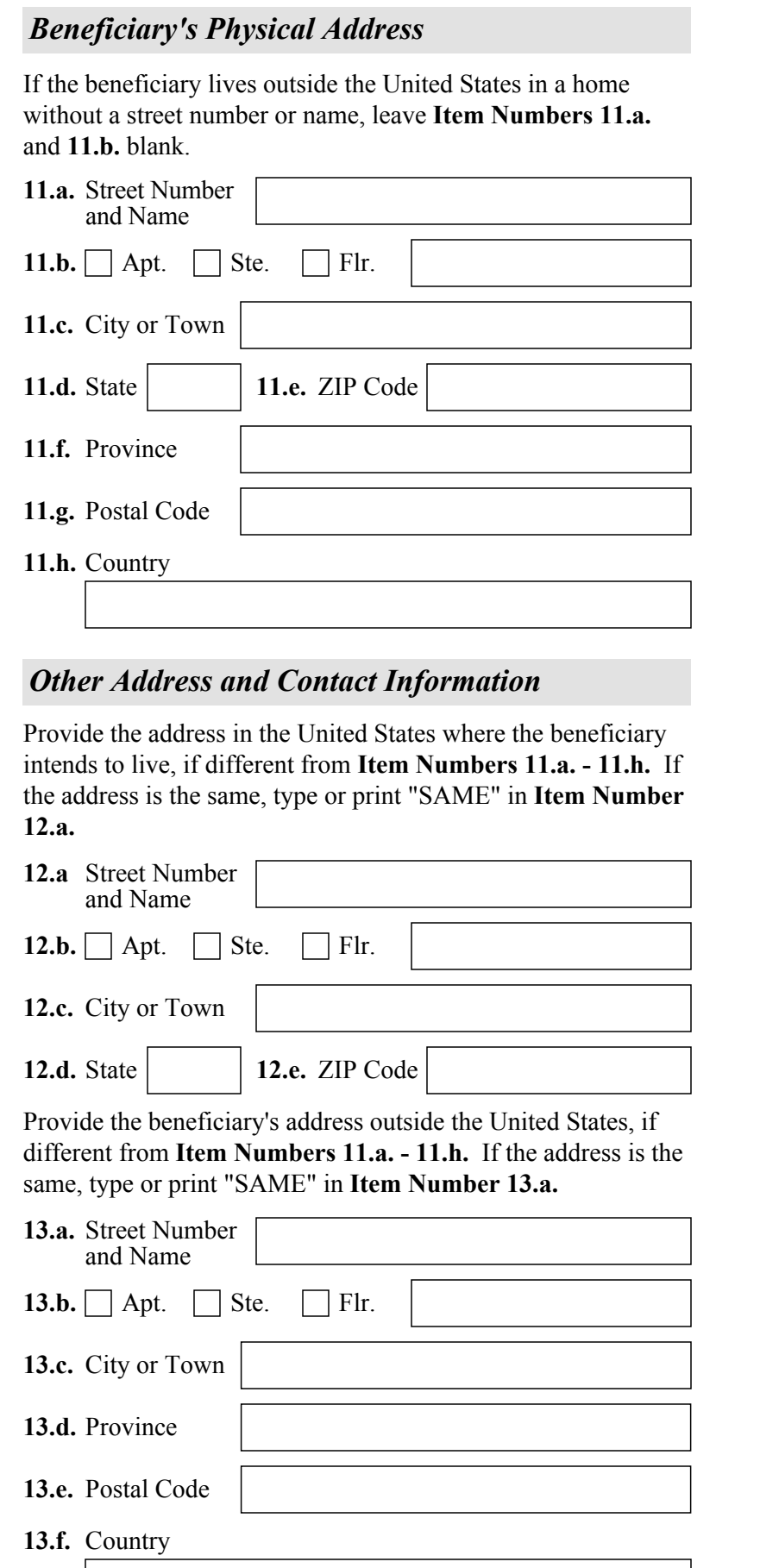
Verbatim · note above Item 11 (Form I-130, edition 04/01/24, page 5)
“If the beneficiary lives outside the United States in a home without a street number or name, leave Item Numbers 11.a. and 11.b. blank.”
Verbatim · note above Item 13 (page 5)
“Provide the beneficiary's address outside the United States, if different from Item Numbers 11.a. - 11.h. If the address is the same, type or print "SAME" in Item Number 13.a.”
11.a. Street Number and Name 11.b. Apt./Ste./Flr. 11.c. City or Town 11.d. State 11.e. ZIP Code 11.f. Province 11.g. Postal Code 11.h. Country
13.a. Street Number and Name 13.b. Apt./Ste./Flr. 13.c. City or Town 13.d. Province 13.e. Postal Code 13.f. Country
The I-130 Instructions do not separately walk through these items; the notes printed on the form itself are the controlling guidance. Always complete the current edition from uscis.gov/i-130; USCIS rejects outdated editions.
Which address field is which?
Part 4 has several address fields that look alike. This is what each one is for, so you do not put the foreign address where the U.S. address belongs.
| Field | What it is | Who uses it |
|---|---|---|
| Item 11 · Beneficiary's Physical Address | Where the beneficiary spouse physically lives right now. | Every beneficiary, whether abroad or in the United States. |
| Item 12 · Other Address and Contact Information | The U.S. address where the beneficiary intends to live. | Print "SAME" in 12.a if it matches Item 11. |
| Item 13 · Address outside the United States | A second foreign address, only if different from Item 11. | Print "SAME" in 13.a if it matches Item 11. |
| Items 57-58 · Native written language | The same foreign address, written in a non-Roman native script. | Only when the beneficiary's language does not use Roman letters. |
How to fill it in
Four steps that cover the spouse-abroad case and the spouse-already-here case.
Enter where the beneficiary physically lives now
Item 11 follows your spouse's current home. If they live abroad, the foreign address goes in 11.a through 11.h, using the Province (11.f), Postal Code (11.g), and Country (11.h) fields for the non-U.S. parts. If your spouse already lives in the United States, their U.S. address goes here instead, using State (11.d) and ZIP Code (11.e).
Use the no-street-number rule when it applies
Many homes abroad have no street number or street name. The form note says to leave 11.a (Street Number and Name) and 11.b (Apt./Ste./Flr.) blank in that case, then complete City or Town, Province, Postal Code, and Country so the consulate can still locate the beneficiary.
Handle Item 13 with "SAME" in most cases
Item 13 asks for the beneficiary's address outside the United States if it is different from Item 11. For the typical filing, the foreign address in Item 11 is the only one, so you type or print "SAME" in Item 13.a. Complete 13.a through 13.f separately only when the beneficiary keeps a second address abroad that differs from Item 11.
Keep Item 12 (intended U.S. address) separate
Item 12 is a different field: the U.S. address where the beneficiary plans to live. If that intended U.S. address matches what you already entered, print "SAME" in Item 12.a. Do not copy the foreign address into Item 12, and do not copy the intended U.S. address into Item 11.
How the address connects to consular processing
The address you enter for the beneficiary connects to how the case finishes. Lower in Part 4, Item 61 asks for the USCIS office where the beneficiary will apply for adjustment of status (the process for someone already in the United States to become a green card holder without leaving), and Item 62 asks for the U.S. Embassy or U.S. Consulate where the beneficiary will apply for an immigrant visa abroad (consular processing). A beneficiary living abroad uses Item 62 and names a consulate; a beneficiary already in the United States uses Item 61. The on-form note adds that choosing a consulate outside the country of the beneficiary's last residence does not guarantee that post will accept the case, so the foreign physical address in Item 11 and the consulate named in Item 62 usually point to the same country.
Marriage-based filers: Item 11 is wherever your spouse lives today
On a marriage petition the beneficiary is your immigrant spouse, so Item 11 is their physical address, not the petitioner's. The common pattern is a U.S. citizen or green card holder (the petitioner) married to a spouse who still lives abroad. If that is you, the foreign address goes in Item 11 (City or Town in 11.c, Province in 11.f, Postal Code in 11.g, Country in 11.h), Item 13.a reads “SAME,” and the spouse will apply for an immigrant visa at the consulate you name in Item 62.
If your spouse already lives with you in the United States, Item 11 is their U.S. address (State in 11.d, ZIP Code in 11.e), and they typically apply for adjustment of status at the USCIS office named in Item 61 rather than at a consulate abroad. Either way, the rule is the same: the petitioner (1) does not appear here; the field is the immigrant spouse's current home.
Not sure whether your spouse's case is consular or adjustment?
Our software asks a few plain questions about where your spouse lives and fills the address and processing fields the right way, keeping them consistent across your whole I-130 and I-485 packet.
Start FreeWhat USCIS does with the beneficiary's address
USCIS and, for a consular case, the National Visa Center and the U.S. consulate use the beneficiary's physical address to reach your spouse and to route the case to the right place. For a spouse abroad, the address in Item 11 tells the National Visa Center which consulate has jurisdiction and where to send interview and document notices. For a spouse already in the United States, the same field confirms they are present here and supports the adjustment-of-status path. A wrong or outdated address is a common reason notices go astray and cases stall, so it should match where your spouse can actually receive mail.
Common mistakes
These are the ones that show up most often on these fields.
- 1
Putting the intended U.S. address in Item 11
Item 11 is where the beneficiary physically lives now, not where they plan to live. If your spouse is still abroad, Item 11 is the foreign address. The intended U.S. address belongs in Item 12.
- 2
Forcing a street number into 11.a when there is none
If the home abroad has no street number or street name, the form note says to leave 11.a and 11.b blank. Filling them with a guess or a placeholder can create a mismatch with other records.
- 3
Re-typing the same address in Item 13 instead of "SAME"
When the beneficiary has only one foreign address, Item 13 should read "SAME" in 13.a. Re-typing the Item 11 address can read as two different addresses and draw a follow-up question.
- 4
Confusing Item 13 with Items 57-58
Item 13 is the foreign address in Roman letters. Items 57 and 58 repeat the name and foreign address in a non-Roman native script (Chinese, Arabic, Cyrillic), and only when the language does not use Roman letters. They are separate fields.
Related guides
Form and pathway context
Frequently asked questions
My spouse lives abroad. What goes in Item 11?
Their foreign address. Use the Province (11.f), Postal Code (11.g), and Country (11.h) fields for the non-U.S. parts. If the home has no street number or name, the form note says to leave 11.a and 11.b blank.
My spouse already lives in the United States. Does Item 11 change?
Yes. Item 11 follows where the beneficiary physically lives, so you enter their U.S. address there, using State (11.d) and ZIP Code (11.e). A spouse present in the United States typically applies for adjustment of status (Item 61) rather than at a consulate abroad.
What is the difference between Item 11, Item 12, and Item 13?
Item 11 is where the beneficiary physically lives now. Item 12 is the U.S. address where the beneficiary intends to live. Item 13 is a second address outside the United States, only if different from Item 11. Print "SAME" in 12.a or 13.a when they match Item 11.
What do I put in Item 13 if my spouse has only one foreign address?
Type or print "SAME" in Item 13.a. You complete 13.a through 13.f separately only when the beneficiary keeps a second address abroad that is different from Item 11.
How does the address relate to where my spouse will be interviewed?
For a spouse abroad, the physical address in Item 11 tells the National Visa Center which consulate has jurisdiction, and Item 62 names that U.S. Embassy or Consulate. For a spouse in the United States, Item 61 names the USCIS office for adjustment of status.
Key takeaways
- ✓
Item 11 (Beneficiary's Physical Address) is where the immigrant spouse physically lives right now, abroad or in the United States.
- ✓
If the spouse lives abroad, enter the foreign address; if the home has no street number or name, leave 11.a and 11.b blank.
- ✓
Item 13 is the address outside the U.S. if different from Item 11; type or print "SAME" in 13.a when it matches.
- ✓
Item 12 is a separate field: the U.S. address where the beneficiary intends to live. Do not mix it with Item 11.
- ✓
A spouse abroad applies through a consulate (Item 62); a spouse in the U.S. applies for adjustment of status (Item 61).
This page is for educational purposes only and is not legal advice. Green Card Genius is self-help immigration software, not a law firm, and does not provide legal representation. Immigration law and USCIS policy change frequently. For advice on a specific case, consult a licensed immigration attorney. Form I-130, edition 04/01/24. Last verified May 2026.
Stay informed
Green card guides in your inbox
Practical, plain-English updates to help you navigate the process with confidence.
Unsubscribe anytime.
Continue reading
- 01Form I-130: Petition for Alien Relative (2026 Guide)
- 02I-130 Beneficiary's Entry Information (Part 4, Items 45-46.d): I-94 & Class of Admission (2026)
- 03I-485 Place and Date of Last Arrival (Part 1, Items 10-12) (2026)
- 04Marriage Green Card Document Checklist (2026)
- 05Marriage Green Card by Country: Country-Specific Guides (2026)
Be a Genius
Only pay when you file