China Civil Documents · Updated May 2026
China Notarial Certificates (公证书 / Gōngzhèng-shū) for U.S. Immigration: Which Ones You Need and How to Get Them
China does not give you a copy of your civil records. It gives you a notarial certificate. Here is the map: which ones a marriage green card needs, in what order, and what you can skip.
Summary
Order the bilingual notarial certificates you need from a Chinese notary public office (公证处 gōngzhèng-chù); you do not need a separate translation or, for the U.S. filing, an apostille. China does not release raw civil records, so a notary office issues a notarial certificate (公证书 gōngzhèng-shū): a white A4 booklet with a red seal, built from your household registration (户口 hùkǒu) and archives, with the English translation bound inside. For a marriage green card you almost always need a notarial birth certificate, plus a police (no-criminal-record) certificate if the Chinese spouse lived in China 12 months or more. Add a marriage certificate if you married in China, and a single-status certificate only if asked. All mainland-China immigrant visa interviews happen at the U.S. Consulate General Guangzhou.
At a glance
| Topic | Details |
|---|---|
| What you order | Bilingual notarial certificates (公证书 gōngzhèng-shū) from a Chinese notary public office (公证处 gōngzhèng-chù). China does not hand out raw civil records; the notarial certificate is the operative document for a U.S. green card. |
| Which certificates for a marriage case | Birth (出生公证) and, for the spouse who lived in China, a police / no-criminal-record certificate (无犯罪记录公证). Add a marriage certificate (结婚公证) if you married in China, and a single-status certificate (未婚/未再婚公证) if NVC or the consulate asks you to prove you were free to marry. |
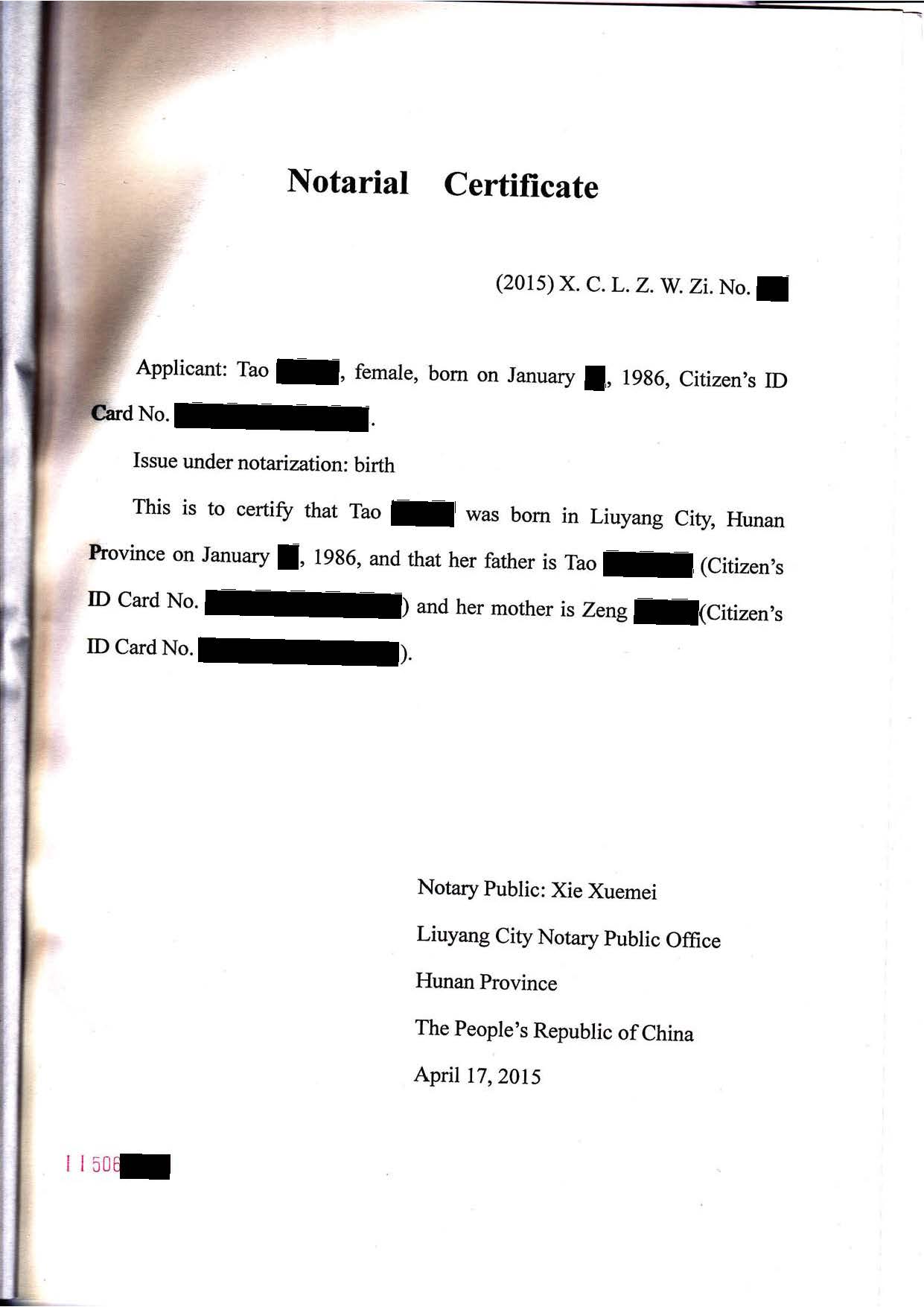
| What the booklet looks like | A white A4 booklet titled 公证书 with the notary office name, a red notary-office seal, the notary's signature, and (for U.S. cases) the Chinese original followed by an English translation and a translator's accuracy statement bound in the same booklet. |
| Translation | Built in. Ask the notary office to include the English translation and translator's certificate in the booklet, so you usually do not order a separate certified translation. State Department guidance says every notarial document must carry an English translation with a conformity statement. |
| Apostille | Not needed for the U.S. green-card filing. China joined the Hague Apostille Convention on November 7, 2023, but that governs cross-border recognition of public documents generally. NVC, USCIS, and the Guangzhou consulate work from the notarial booklet plus its translation, not an apostille. |
| Issuing authority | A notary public office (公证处) under the PRC Ministry of Justice, normally one with jurisdiction over the place where your household registration (户口 hùkǒu) is or was registered. Police certificates start at the Public Security Bureau (PSB) before notarization. |
| Typical cost | Roughly RMB 300 to 500 per notarial certificate including the translation, per State Department fee ranges (verify with the notary office; fees vary by city and document). |
| Where the interview happens | The U.S. Consulate General Guangzhou (43 Hua Jiu Road, Zhujiang New Town, Tianhe District) processes every mainland-China immigrant visa. Beijing, Shanghai, Shenyang, and Wuhan handle nonimmigrant visas only. |
Document details and fee ranges verified May 2026 against the U.S. Department of State China reciprocity page. Verify directly before relying on them.
Free tool
Marriage Green Card Cost Calculator
2026 · AOS · full packet
$3,005
See your exact 2026 USCIS filing fees for a marriage green card through Adjustment of Status, with a full line-item breakdown and the costs most guides leave out.
Free — enter your email and it opens right up. Unsubscribe anytime.
We post free tips on preparing your marriage green card. Follow along:
Which notarial certificates do I need?
Work down this list and order only what applies to you. Each line is a separate notarial certificate, and each has its own dedicated guide linked below.
Birth: 出生公证
Always. Every immigrant visa beneficiary needs a notarial birth certificate.
Apply to a notary office with jurisdiction over the Public Security Bureau where your hùkǒu is, was canceled, or where you were born. For births from 1996 on, the key evidence is your medical certificate of birth (出生医学证明). For earlier births, the notary usually works from a police-station statement of your birth circumstances.
Police / no-criminal-record: 无犯罪记录公证
If you are 16 or older and lived in China 12 months or more (or were arrested there).
Request the no-criminal-record statement from the Exit-Entry Administration of your local PSB, then take it to a notary office to be notarized and translated. The PSB statement is valid about 3 months, so notarize it promptly. One certificate covers one city or province; if you lived in several, you may need one for each.
Marriage: 结婚公证
If you married in China.
Take your original marriage certificate to the notary office. There are two forms: a Notarial Certificate for Marriage (certifies the marriage is genuine and legal) and a Notarial Marriage Certificate (certifies the copy matches the original). For a U.S. case the consulate accepts a notarial certificate based on your registered marriage; confirm which form your notary issues.
Single status: 未婚 / 未再婚公证
Only if NVC or the consulate asks you to prove you were free to marry (for example, a prior marriage that ended).
The notary office notarizes your declaration that you are unmarried or have not remarried, supported by a no-marriage-record certificate from the marriage registration office where you live. Under current rules the notary certifies your sworn statement; it does not independently verify your status.
What a Chinese notarial certificate actually is
In most countries you order a copy of the civil record itself: a birth certificate, a marriage certificate. China works differently. Your underlying records, such as your household registration (户口 hùkǒu) and your medical certificate of birth, stay in government archives. To prove a fact for use abroad, you go to a notary public office (公证处 gōngzhèng-chù), which reviews those records and issues a notarial certificate (公证书 gōngzhèng-shū) that certifies the fact. As the State Department puts it, a Chinese notary “uses their signature and official seal to confirm that the information provided by the applicant is true.”
The certificate is a white A4 booklet titled 公证书 with the notary office name, a red notary-office seal, the notary’s signature, and a case number. For a U.S. case the booklet binds the Chinese original, an English translation, and a translator’s statement that the translation conforms to the original. Notary offices operate under the Ministry of Justice and exist in major cities and county seats. Birth, marriage, single-status, and police certificates are all this same kind of booklet, which is why this page is the map and each document has its own guide.
How to get them: the order of operations
Follow this sequence once for the whole set of certificates your case needs. Doing it in this order keeps you from over-ordering, paying for a translation you do not need, or letting a short-lived police statement expire.
Step 1: List which notarial certificates your case needs
Use the decision rule above. A marriage green card almost always needs a notarial birth certificate, plus a police certificate if the Chinese spouse lived in China 12 months or more after age 16. Add the marriage certificate if you married in China, and the single-status certificate only if you must prove a prior marriage ended.
Step 2: Gather the underlying records for the notary
Bring your national ID and household registration book (户口簿), or your passport if abroad, plus the source record for each certificate: the medical certificate of birth (出生医学证明) for births since 1996, the original marriage certificate, the PSB no-criminal-record statement, or a marriage-registration no-record certificate for single status. Bring two passport-style photos with a white background where required.
Step 3: File at a notary office (公证处) with the right jurisdiction
Go to a notary office under the Ministry of Justice that covers the place tied to the record, normally where your hùkǒu is or was registered. The notary examines the records, you pay the fee (about RMB 300 to 500 per certificate including translation), and the office issues the bilingual notarial booklet.
Step 4: Ask for the English translation inside the booklet
Tell the notary office the certificate is for U.S. immigration so it binds the English translation and a translator's accuracy statement into the same booklet. This is why most China applicants do not need a separate certified translation. Confirm the translation is complete before you leave.
Step 5: Submit to NVC, then bring originals to Guangzhou
Upload scans of the notarial certificates to the National Visa Center (NVC) for document review, then carry the original booklets to the immigrant visa interview at the U.S. Consulate General Guangzhou. Do not pay for an apostille for this filing unless a specific U.S. agency asks for one in writing.
Translation and apostille: what you do and do not need
Two steps cause the most confusion and the most wasted money. For the U.S. green-card filing, one is built in and the other is skipped entirely.
Translation
Built into the booklet. Tell the notary office the certificate is for U.S. immigration and ask it to include the English translation and a translator’s accuracy statement in the same booklet. State Department guidance requires every notarial document to carry an English translation with a conformity statement, so most China applicants do not buy a separate certified translation.
Apostille / legalization
Not needed for this filing. NVC, USCIS, and the Guangzhou consulate work from the notarial booklet plus its translation. Do not pay for an apostille for your green-card case unless a specific U.S. agency asks for one in writing.
You may have read that China “is now an apostille country.” That is true: China acceded to the Hague Apostille Convention effective November 7, 2023, and Chinese embassies and consulates in the U.S. stopped doing consular authentication that day. But the apostille governs how a Chinese public document is recognized abroad in general. It does not add a step to your U.S. green-card filing, which still works from the notarial certificate and its built-in translation.
What applicants report
Aggregated from the VisaJourney China and IR-1/CR-1 forums and immigration-attorney guidance, 2023–2025. The notarial system draws steady but narrow forum chatter, so we lead with the patterns that repeat. Real applicant reports, not legal advice; your office and case may differ.
Tips from the community
There are two kinds of Chinese marriage notarization, and people order the wrong one
Applicants on the VisaJourney China and IR-1/CR-1 forums repeatedly ask which marriage notarization to get. One form certifies the marriage itself is genuine and legal; the other only certifies that a photocopy matches the original. Tell the notary office it is for a U.S. immigrant visa and ask for the certificate that attests to the marriage, not just a copy-conformity notarization.
VisaJourney IR-1/CR-1 thread “Two different kinds of Chinese marriage certificate notarization?”, 2023–2024
A birth notarial certificate that omits parents' birthdates is normal
A common worry is that the notarial birth certificate lists the parents' names but not their birthdates or places of birth. VisaJourney China posters report this is the standard format and did not cause a problem at Guangzhou. The certificate certifies the beneficiary's birth facts; it is not expected to fully document the parents.
VisaJourney China thread on parents' details in the notarial birth certificate, 2024
Pull the police certificate close to your interview, and one per province
The PSB no-criminal-record statement is short-lived (about 3 months) and the notarization must happen inside that window, so applicants time it near the interview rather than at the start. People who lived in more than one city or province report needing a separate certificate for each location.
Chodorow Law China police-certificate guide and VisaJourney China police-records threads, 2023–2025
If the birth was never registered, get a statement of unavailability first
For births before 1996 or never registered, the notary may refuse to issue a certificate, and some notaries ask for DNA testing. Applicants report the path is to obtain a written statement from the proper authority that the birth record is unavailable, then submit secondary evidence such as the household register (户口) and school records.
Chodorow Law “unobtainable birth certificate” guidance and VisaJourney China birth-record threads, 2023–2025
In their words
“There seem to be two different kinds of marriage certificate notarization in China and I can't tell which one the NVC actually wants.”
“My Chinese notarial certificate of birth has my parents' names but not their birthdates or places of birth. Is that going to be a problem?”
Sources
- U.S. Department of State: China Reciprocity and Civil Documents (verified May 2026)
- U.S. Consulate General Guangzhou: Immigrant Visa Post Supplement (verified May 2026)
- Chodorow Law Offices: Getting China Notarial Certificates for Your U.S. Immigration Case (verified May 2026)
- Chodorow Law Offices: How to Apply for a China Police Certificate (verified May 2026)
- China Briefing: China Joins the Apostille Convention (effective November 7, 2023) (verified May 2026)
- VisaJourney China and IR-1/CR-1 forums (community), 2023–2025
Frequently asked questions
What is a Chinese notarial certificate (公证书) and why do I need one?
China does not release raw civil records to applicants. Instead, a notary public office (公证处 gōngzhèng-chù) under the Ministry of Justice reviews your underlying records, such as your medical certificate of birth or marriage certificate, and issues a notarial certificate (公证书 gōngzhèng-shū): a white A4 booklet with a red seal that certifies the facts. For a U.S. green card, this bilingual booklet, not a photocopy of the original record, is the document NVC and the U.S. Consulate General Guangzhou work from.
Which notarial certificates do I need for a marriage green card?
Almost every case needs a notarial birth certificate (出生公证). The Chinese spouse also needs a police / no-criminal-record certificate (无犯罪记录公证) if they were 16 or older and lived in China 12 months or more. Add a marriage certificate (结婚公证) if you married in China, and a single-status certificate (未婚/未再婚公证) only if NVC or the consulate asks you to prove a prior marriage ended.
Do I need a separate English translation?
Usually no. Ask the notary office to include the English translation and a translator's accuracy statement in the same booklet when you say it is for U.S. immigration. State Department guidance requires every notarial document to carry an English translation with a statement that it conforms to the Chinese original, and the notary office binds that into the certificate. Confirm the translation is present and complete before you leave the office.
Do my Chinese documents need an apostille for the green card?
No. China joined the Hague Apostille Convention effective November 7, 2023, and Chinese embassies and consulates in the U.S. stopped doing consular legalization that day. But the apostille governs how a Chinese public document is recognized abroad in general; it is not what the U.S. green-card filing uses. NVC, USCIS, and the Guangzhou consulate accept the bilingual notarial certificate plus its built-in translation. Do not pay for an apostille for this filing unless a specific U.S. agency requests one in writing.
Where do I get a notarial certificate, and can I do it from the United States?
Go to a notary public office (公证处) under the Ministry of Justice, normally one with jurisdiction over the place where your household registration (户口 hùkǒu) is or was registered. Police certificates start at your local Public Security Bureau (PSB) before notarization. If you are in the U.S., you typically authorize a relative in China to apply on your behalf with a signed affidavit or power of attorney; the notary will want documentation of that authorization.
What does a notarial certificate cost?
State Department fee ranges put birth and marriage notarial certificates at roughly RMB 300 to 500 each, including the translation. Police-certificate and court-record notarization fees vary. Fees differ by city and document, so confirm the amount with the notary office. (Fee ranges as of May 2026; verify before relying on them.)
What if my birth was never registered or the record cannot be obtained?
For births before 1996 or never registered, the notary office may be unable to issue a notarial birth certificate. In that case, get a written statement from the appropriate authority that the record is unavailable, then submit secondary evidence of your birth, such as the household register (户口) and school records. Start early, because assembling this takes time before your NVC document deadline.
Which U.S. post handles my interview?
The U.S. Consulate General Guangzhou (43 Hua Jiu Road, Zhujiang New Town, Tianhe District) is the only post in mainland China that processes immigrant visas. Beijing, Shanghai, Shenyang, and Wuhan handle nonimmigrant visas only, so your marriage green-card interview will be in Guangzhou.
Key takeaways
- ✓
The operative documents for a U.S. green card are bilingual notarial certificates (公证书) from a Chinese notary office (公证处), not raw civil records, which China does not release to applicants.
- ✓
A marriage case almost always needs a notarial birth certificate; add a police certificate if the Chinese spouse lived in China 12 months or more, a marriage certificate if you married in China, and a single-status certificate only if asked.
- ✓
The English translation is bound into the notarial booklet, so most China applicants do not order a separate certified translation. Confirm it is included.
- ✓
No apostille is needed for the green-card filing. China joined the Apostille Convention on November 7, 2023, but NVC and the Guangzhou consulate work from the notarial booklet plus its translation.
- ✓
Go to a notary office with jurisdiction over your household registration (户口); police certificates start at the PSB and must be notarized within about 3 months.
- ✓
All mainland-China immigrant visa interviews are at the U.S. Consulate General Guangzhou (43 Hua Jiu Road, Zhujiang New Town, Tianhe District).
Collecting documents for consular processing?
Green Card Genius guides you through every step of the consular processing path, including which civil documents the National Visa Center requires and in what order. See if it fits your situation.
See how it worksStay informed
Green card guides in your inbox
Practical, plain-English updates to help you navigate the process with confidence.
Unsubscribe anytime.
Continue reading
- 01China Notarial Birth Certificate (出生公证) for U.S. Immigration: How to Get It
- 02Chinese Marriage Certificate (结婚公证) for U.S. Immigration: Which Notarial Certificate to Request and Prior-Divorce Documents
- 03China No Criminal Record Notarial Certificate (无犯罪记录公证) for U.S. Immigration
- 04China Single Status / Unmarried Notarial Certificate (未婚公证) for U.S. Immigration
Be a Genius
Only pay when you file