Form I-864 · Part 6, Items 15-19
I-864 Federal Tax Return Information (Part 6, Items 15-19): What to Enter in 2026
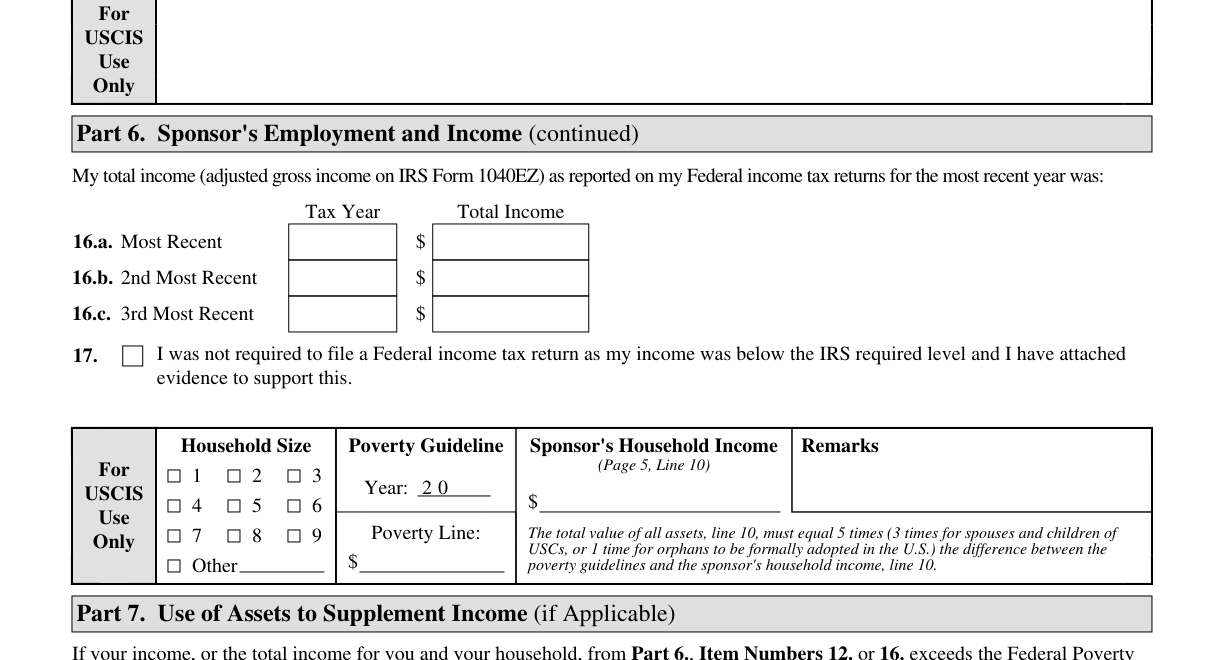
Item 16.a asks for your most recent tax year and Total Income. It cannot be left blank. Items 16.b and 16.c are optional earlier years.
You, the U.S. citizen or permanent resident, are the sponsor completing this section. The income figures here are from your past tax returns, not your current salary.
Most sponsors in 2026
Enter 2024 in Item 16.a (or 2025 if you have already filed that return).
Use your Total Income line from Form 1040 -- not Adjusted Gross Income. Submit an IRS transcript or a photocopy of the return with all W-2s and 1099s attached. Items 16.b and 16.c can be “N/A” unless you are submitting additional years.
Summary
Item 16.a is mandatory. Enter the year and your Total Income line from your most recent Form 1040. For most sponsors signing in 2026, that is the 2024 return. Items 16.b and 16.c are optional -- include earlier years only if you want to strengthen your income showing. USCIS requires either an IRS transcript or a photocopy of the return with all W-2s and 1099s; submitting a photocopy alone without those attachments causes a Request for Evidence.
| Item 16.a (required) | Enter the tax year (e.g., 2024) and your Total Income from that Form 1040. Cannot be left blank -- enter 'zero' or 'N/A' if needed. |
| Items 16.b and 16.c | Optional. Enter only if you are submitting additional years of returns. Otherwise enter 'N/A'. |
| What to submit | IRS transcript (preferred) or photocopy of your Federal 1040. Do not submit state returns. |
| If submitting a photocopy | You must also attach every Form W-2 and Form 1099 that relates to that return. |
| If you filed jointly | If qualifying on your income alone, you must include W-2s even if you are submitting an IRS transcript. |
| If self-employed | Attach every Schedule C, D, E, or F you filed with your 1040. |
| Item 17 | Check this box if you were not required to file because your income was below the IRS threshold, and attach a written explanation. |
Scope of this page
This page covers standard sponsor scenarios: individual and joint Federal 1040 filers, the transcript vs. photocopy choice, and the not-required-to-file exception. Consult an immigration attorney before completing Items 15-19 if: (1) you filed jointly and cannot cleanly separate your income from your spouse's income using W-2s and 1099s; (2) you claimed the Foreign Earned Income Exclusion on Form 2555; or (3) you were required to file for a given year but have not yet done so and need to assess the implications.
Free tool
I-864 Income Requirement Calculator
2026 · household of 3
$34,150
Answer a few plain questions about the sponsor's household and income to see whether they meet the 2026 I-864 Affidavit of Support amount, and what can close the gap if they do not.
Free — enter your email and it opens right up. Unsubscribe anytime.
We post free tips on preparing your marriage green card. Follow along:
What the USCIS instructions say
Verbatim from the I-864 Instructions, edition 08/24/26, Part 6, Items 15-19.
Verbatim from Form I-864 Instructions, edition 08/24/26, Part 6, Items 15-19
“Item Numbers 15. - 19. Federal Income Tax Return Information. You must provide either an Internal Revenue Service (IRS) transcript or a photocopy from your own records of your Federal individual income tax return for the most recent tax year, counting from the date of signing Form I-864. If you believe additional returns may help you to establish your ability to maintain sufficient income, you may submit transcripts or photocopies of your Federal individual income tax returns for the three most recent years.”
Verbatim -- Item 16 note (I-864 Instructions, edition 08/24/26, Part 6)
“NOTE: Do not leave the boxes for Item Number 16. blank. Type or print the most recent tax year and your total income for that most recent tax year. If the amount was zero, type or print "zero" or if you were not required to file a Federal income tax return type or print "N/A" for not applicable. Type or print "N/A" for not applicable for Item Numbers 16.b. - 16.c. if you do are not submitting any additional tax returns.”
The instructions also specify which income line to use:
Verbatim -- Total Income definition (I-864 Instructions, edition 08/24/26, Part 6)
“For purposes of this affidavit, the line for Total Income on IRS Forms 1040 and 1040A will be considered when determining income. For persons filing IRS Form 1040 EZ, the line for adjusted gross income will be considered.”
The rules for W-2s and 1099s depend on whether you submit a transcript or a photocopy:
Verbatim -- W-2 and 1099 rule (I-864 Instructions, edition 08/24/26, Part 6)
“If you provide a photocopy of your Federal individual income tax returns, you must include a copy of each and every Form W-2 and Form 1099 that relates to your returns. Do not include copies of these forms if you provide an IRS transcript of your Federal individual income tax returns rather than a photocopy unless you filed a joint income tax return with your spouse and are qualifying using only your income.”
Field-by-field guide
What goes in each item and what it means for your filing.
Answer Yes if you filed for all three years. Answer No if you did not file for one or more years (do not leave it blank).
Answering No does not automatically disqualify you -- it triggers a follow-up about why you did not file. If you were required to file but did not, the late-return rule applies.
Enter the year (e.g., "2024") and the Total Income figure from that year's Form 1040. Per the instructions, this box cannot be left blank. If your total income was $0, write "zero." If you were not required to file, write "N/A."
The Total Income line is not the same as Adjusted Gross Income (AGI). On current Form 1040, Total Income appears a few lines above AGI -- it is the sum of all income sources before deductions. This distinction matters: AGI can be lower because it subtracts items like student loan interest or IRA contributions.
These are optional. If you are not submitting returns for earlier years, enter "N/A" in both boxes. If your most recent year's income alone establishes sufficient support, earlier years are not required.
Adding earlier years can help if your income fluctuated -- for example, if your most recent year had lower income due to a job change but prior years show a stronger history.
Check this box if you were not required to file a Federal income tax return under U.S. tax law. You must attach a written explanation -- a typed or printed note explaining the basis for the exemption.
The most common reason is income below the IRS filing threshold. Per the instructions, living outside the United States does not exempt U.S. citizens or permanent residents from filing.
If you were required to file but did not -- verbatim from I-864 Instructions
“If you were required to file a Federal income tax return for that tax year but did not do so, you must file all late returns with the IRS and attach an IRS transcript or copy of your late return and submit it with Form I-864.”
If you were not required to file -- verbatim from I-864 Instructions
“If you were not required to file a Federal income tax return under U.S. tax law because your income was too low, attach a typed or printed explanation. If you were not required to file a Federal income tax return under U.S. tax law for any other reason, attach a typed or printed explanation including evidence of the exemption and how you are subject to it. Residence outside of the United States does not exempt U.S. citizens or lawful permanent residents from filing a U.S. Federal income tax return.”
Common mistakes on Part 6, Items 15-19
These errors appear on rejection notices and RFEs. Each has a specific cause and fix.
- 01
Leaving Item 16.a blank
The I-864 Instructions (edition 08/24/26, Part 6) state explicitly: 'Do not leave the boxes for Item Number 16. blank.' If Item 16.a is empty, the filing will be returned. Enter the year and income figure, or 'zero' or 'N/A' as applicable.
- 02
Entering Adjusted Gross Income instead of Total Income
Per the instructions, USCIS uses the Total Income line (not AGI) for Form 1040 filers. On a current Form 1040, Total Income and AGI appear on separate lines and can differ. Using AGI will understate your income if you claimed above-the-line deductions. Use the line labeled 'Total income' on your 1040.
- 03
Submitting a photocopy without W-2s and 1099s
If you submit a photocopy of your return (rather than an IRS transcript), you must attach every Form W-2 and Form 1099 that relates to that return. Omitting them causes an RFE. The W-2 requirement is waived only when you submit an IRS transcript -- unless you filed jointly and are qualifying on your own income alone.
- 04
Submitting state tax returns
The instructions say: 'Do not submit copies of your state income tax returns.' USCIS reviews Federal returns only. State returns add bulk without satisfying any requirement and can create confusion if state income figures differ from the Federal return.
- 05
Joint filers qualifying on own income but omitting W-2s with the transcript
If you filed a joint return with your spouse but are relying only on your own income to meet the threshold, the instructions require you to include W-2s even if you are otherwise submitting an IRS transcript. This is the one case where the transcript does not eliminate the W-2 requirement.
Marriage-based sponsors: what Items 15-19 typically look like
In a standard marriage-based case, the sponsor enters their most recent 1040 income in Item 16.a. USCIS is looking for historical earnings context -- the primary income test is Item 7 (current income) vs. the poverty guideline.
Standard case: single sponsor, filed individually
Situations that require extra attention
- Item 7 (current income) is significantly higher than your most recent total income. A large gap between your current Item 7 figure and your most recent 1040 total income can prompt an RFE. Attach an employer letter and recent pay stubs as Item 7 evidence to explain the change.
- You filed jointly with a prior spouse. If a recent return was filed jointly with someone other than the immigrant you are sponsoring, include W-2s to clearly identify your individual income. An explanation letter clarifying the prior marriage may also help.
- You did not file for a year because you lived abroad. The instructions state that residing outside the U.S. does not exempt U.S. citizens or permanent residents from filing. If you were required to file but did not, you must file the late return and submit it.
- Your income was below the threshold in recent years. Submit the most recent return even if the income is low. The income comparison that matters is Item 7 (current income) vs. the poverty guideline. Tax return income is historical context, not the primary threshold test.
Not sure if your tax return income supports your I-864?
Our software checks your income against the poverty guidelines, walks you through Items 7-19, and builds the complete affidavit packet.
Start FreeRelated guides
Form and pathway context
Frequently asked questions
Which line on Form 1040 do I use for Item 16.a?
The I-864 Instructions (edition 08/24/26, Part 6) specify 'the line for Total Income on IRS Forms 1040 and 1040A.' On current Form 1040, this is the line labeled 'Total income' -- not Adjusted Gross Income (AGI). AGI appears a few lines below and can be lower because it subtracts certain deductions. Use Total Income.
Do I need to submit all three years of tax returns?
No. Per the I-864 Instructions (edition 08/24/26, Part 6), you must submit only your most recent year's return. Items 16.b and 16.c are optional -- you fill them in only if you choose to submit additional years. Most sponsors submit one year.
Can I submit an IRS transcript instead of a copy of my return?
Yes. The instructions state you may provide 'either an Internal Revenue Service (IRS) transcript or a photocopy from your own records.' A transcript is generally preferred because it eliminates the W-2 and 1099 attachment requirement (with one exception: joint filers qualifying only on their own income must still include W-2s even with a transcript).
I filed a joint return with my spouse. What do I do?
Enter the Total Income from the joint return in Item 16.a. If that joint return income is what you are relying on, submit the joint return. If you are qualifying only on your own income from that return, include W-2s to clearly identify your portion -- this is required by the instructions even when submitting a transcript.
What if my income was very low and I was not required to file?
Check Item 17 on the form and attach a typed or printed explanation. The instructions say: 'If you were not required to file a Federal income tax return under U.S. tax law because your income was too low, attach a typed or printed explanation.' If your income was below the IRS filing threshold for that year, state that in the explanation.
What if my current income (Item 7) is much higher than what appears on my most recent tax return?
This is common when you recently changed jobs or received a raise. USCIS compares Item 7 (current annual income) against the poverty guideline threshold -- the tax return shows your prior year earnings for context, not the primary qualifying figure. You can explain the difference by attaching a current employer letter and recent pay stubs as supplemental evidence for Item 7.
Key takeaways
- ✓
Item 16.a is mandatory. Never leave it blank -- write the tax year and your Total Income figure, or 'zero' or 'N/A' if those apply.
- ✓
Use the Total Income line from Form 1040, not Adjusted Gross Income. They can differ, and AGI will typically be lower.
- ✓
An IRS transcript is generally simpler: it eliminates the need to attach W-2s and 1099s, except when you filed jointly and are qualifying only on your own income.
- ✓
Items 16.b and 16.c are optional. Submitting earlier years is a choice, not a requirement.
- ✓
If you were required to file but did not, you must file the late returns with the IRS and submit them with your I-864. The obligation does not go away by skipping it.
This page is for educational purposes only and is not legal advice. Green Card Genius is self-help immigration software, not a law firm, and does not provide legal representation. Immigration law and USCIS policy change frequently. For advice on a specific case, consult a licensed immigration attorney. Form I-864, edition 08/24/26. Last verified May 2026.
Stay informed
Green card guides in your inbox
Practical, plain-English updates to help you navigate the process with confidence.
Unsubscribe anytime.
Continue reading
- 01Form I-864 Affidavit of Support: Complete 2026 Guide
- 02What If the Petitioner's Income Is Too Low? Joint Sponsor Options
- 03How to File Taxes While Your Marriage Green Card Is Pending (2026)
- 04I-864 Current Annual Income (Part 6, Item 7): What to Enter in 2026
- 05I-864 Household Member Income (Part 6, Items 8-14): When to Add It and How in 2026
- 06I-864 Affidavit of Support Income Calculator (2026)
Be a Genius
Only pay when you file