Form I-864 · Part 5, Item 6
I-864 Prior Sponsorship Obligations (Part 5, Item 6): Do They Still Count in 2026?
Part 5, Item 6 counts LPRs you are currently obligated to support from previous I-864 filings. Each active prior obligation adds 1 to your household size and raises the income threshold you must meet.
Most marriage-based sponsors
First-time sponsors: enter 0.
If you have previously filed an I-864 or I-864EZ for a parent, sibling, or prior spouse, keep reading. Prior obligations that have not ended add to your household size and can affect whether your income qualifies.
Summary
For most marriage-based sponsors filing their first I-864, Item 6 is 0. If you have previously filed a Form I-864 or I-864EZ as a petitioning, substitute, or joint sponsor, Item 6 is the count of those previously sponsored immigrants who have already entered the United States and whose obligation has not yet ended. Each active prior obligation counts as one additional person in your household size, which raises the income threshold you must meet.
| What to enter | Count of LPRs you are currently obligated to support from previous I-864 or I-864EZ filings |
| First-time sponsors | Enter 0 -- no prior I-864 means no prior obligations |
| Why it matters | Each prior obligation adds 1 to your household size, raising the 125% poverty guideline threshold you must meet |
| Who counts | Previously sponsored immigrants already in the U.S. whose obligation has not terminated |
| When an obligation ends | Citizenship, death, abandonment of lawful permanent resident (LPR) status, 40 qualifying quarters of work, or new AOS in removal proceedings with a new I-864 |
| Divorce | Divorce does NOT end the obligation -- per the I-864 Instructions (edition 08/24/26) |
Scope of this page
This page covers the most common situations: first-time sponsors (enter 0) and sponsors who have previously filed I-864 or I-864EZ in a straightforward case and know the current status of those previously sponsored immigrants. If you are unsure whether a prior obligation has ended -- for example, because you have lost contact with the previously sponsored person, because their LPR status may be in question, or because you need to calculate 40 qualifying work quarters -- consult an immigration attorney before completing Part 5. Find a licensed immigration attorney via the AILA lawyer finder.
Free tool
I-864 Income Requirement Calculator
2026 · household of 3
$34,150
Answer a few plain questions about the sponsor's household and income to see whether they meet the 2026 I-864 Affidavit of Support amount, and what can close the gap if they do not.
Free — enter your email and it opens right up. Unsubscribe anytime.
We post free tips on preparing your marriage green card. Follow along:
What the USCIS instructions say
The following is verbatim from the I-864 Instructions, edition 08/24/26, Part 5, Item 6.
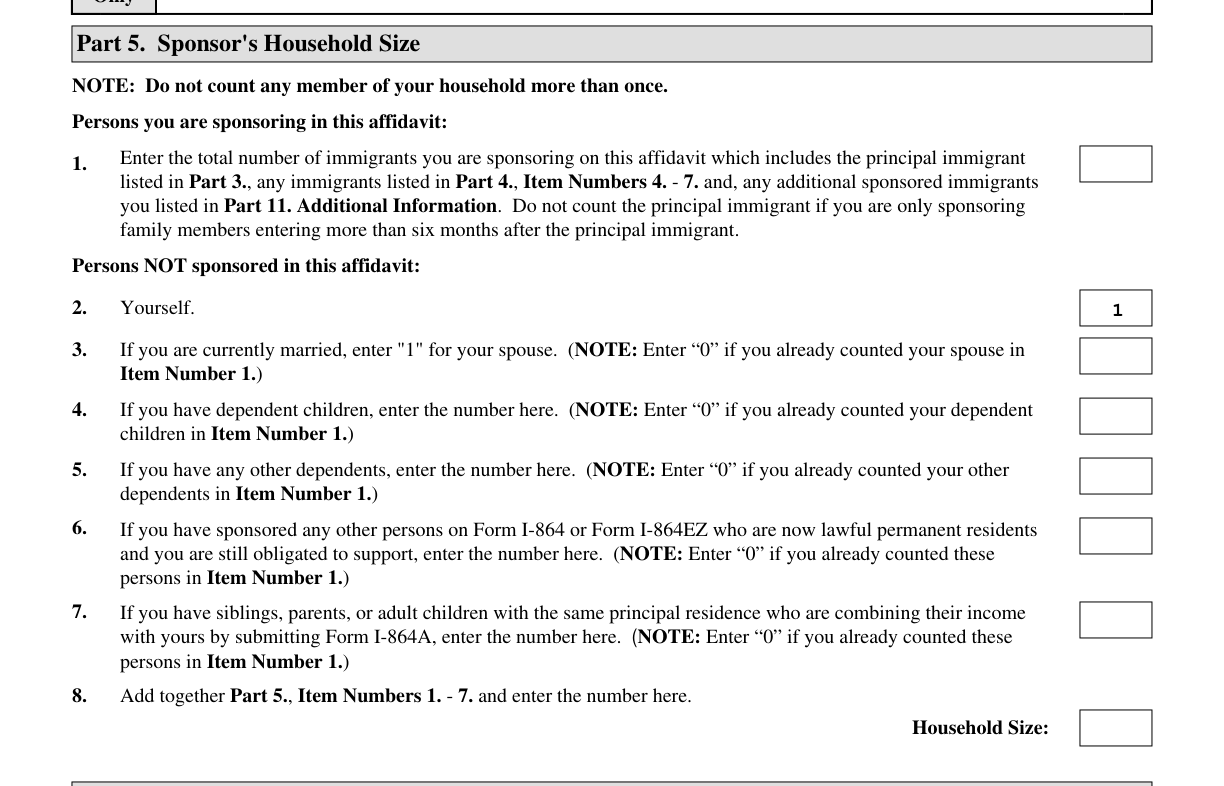
Verbatim from Form I-864 Instructions, edition 08/24/26, Part 5, Item 6
“Type or print the number of lawful permanent residents whom you are currently obligated to support based on your previous submission of Form I-864 as a petitioning, substitute, or joint sponsor, or Form I-864EZ, Affidavit of Support Under Section 213A of the INA, as a petitioning sponsor. Include only those persons who have already immigrated to the United States. Do not include anyone for whom your obligation to support has ended through the sponsored immigrant's acquisition of U.S. citizenship, death, abandonment of lawful permanent residence in the United States, acquisition of 40 quarters of earned or credited work in the United States, or obtaining a new grant of adjustment of status while in removal proceedings based on a new affidavit of support, if one is required. Type or print "0" if you already counted these persons in Item Number 1.”
The instruction names five specific events that end the obligation. Anything outside that list -- including divorce, the sponsored immigrant finding employment, or simply the passage of time -- does not terminate the obligation.
What USCIS does with this figure
USCIS adds Item 6 to the other Part 5 items to calculate your total household size in Item 8. A larger household size means a higher 125% Federal Poverty Guidelines threshold you must meet with your income.
How Item 6 raises your income requirement
If you are sponsoring your spouse (household of 2) and you have one active prior I-864 obligation, your household size becomes 3. The 2026 125% poverty threshold for a household of 3 is $34,150/year rather than $27,050/year. (Source: 2026 HHS Federal Poverty Guidelines, 125%, 48 contiguous states and D.C.) Each additional active obligation adds another $7,100 to the income requirement.
I-864 Instructions on how long the obligation lasts
I-864 Instructions, edition 08/24/26, “How Long Does My Obligation as a Sponsor Continue?”: “Your obligation to support the immigrants you are sponsoring in this Affidavit of Support will continue until the sponsored immigrant becomes a U.S. citizen, or can be credited with 40 qualifying quarters of work in the United States. Although 40 qualifying quarters of work (credits) generally equates to 10 years of work, in certain cases the work of a spouse or parent adds qualifying quarters. The Social Security Administration can provide information on how to count qualifying quarters (credits) of work. The obligation also ends if you or the sponsored immigrant dies or if the sponsored immigrant ceases to be a lawful permanent resident. Divorce does not end the sponsorship obligation.”
The 5 ways a prior I-864 obligation ends
Per the I-864 Instructions, edition 08/24/26, Part 5, Item 6 and the “How Long Does My Obligation Continue?” section. If none of these apply, the obligation is still active and the person counts in Item 6.
- 01
Acquisition of U.S. citizenship
Once the previously sponsored immigrant naturalizes and becomes a U.S. citizen, the obligation ends. This is the most common way the obligation terminates for parents or siblings you sponsored years ago.
Source: I-864 Instructions, edition 08/24/26, Part 5, Item 6
- 02
Death
The obligation ends if either the sponsor or the sponsored immigrant dies. Both sides of the sponsorship must be alive for the obligation to remain active.
Source: I-864 Instructions, edition 08/24/26, 'How Long Does My Obligation as a Sponsor Continue?'
- 03
Abandonment of lawful permanent residence
If the previously sponsored immigrant has formally abandoned their LPR status, or has been found to have abandoned it (e.g., living outside the U.S. for an extended period), the obligation ends.
Source: I-864 Instructions, edition 08/24/26, Part 5, Item 6
- 04
Acquisition of 40 qualifying quarters of work
40 qualifying quarters of Social Security credits (generally 10 years of work) ends the obligation. The work of a spouse or parent may also contribute qualifying quarters. The Social Security Administration can provide a quarters count.
Source: I-864 Instructions, edition 08/24/26, 'How Long Does My Obligation as a Sponsor Continue?'
- 05
New adjustment of status with a new affidavit of support
If the previously sponsored immigrant obtains a new grant of adjustment of status while in removal proceedings based on a new affidavit of support, if one is required, the original obligation ends. This is a narrow circumstance.
Source: I-864 Instructions, edition 08/24/26, Part 5, Item 6
Divorce does not end a prior I-864 obligation
This applies only if you have previously filed an I-864.
The I-864 Instructions (edition 08/24/26) state explicitly: “Divorce does not end the sponsorship obligation.” If you sponsored a prior spouse through immigration and later divorced, that obligation is still active unless one of the five termination events above has occurred. Sponsors filing a new I-864 for a second marriage frequently overlook this.
Common mistakes on Part 5, Item 6
These errors understate household size and produce incorrect income thresholds.
If this is your first I-864, none of these apply to you.
- 01
Assuming divorce ended a prior obligation
The I-864 Instructions (edition 08/24/26) state explicitly: 'Divorce does not end the sponsorship obligation.' If you sponsored a prior spouse through immigration and later divorced, that obligation remains active unless one of the five termination triggers has occurred. Sponsors filing a new I-864 for a second marriage frequently miss this.
- 02
Double-counting a person already listed in Item 1 or Item 3
If a previously sponsored person is already listed in Item 1, 3, 4, or 5 of Part 5, do not add them again in Item 6. The Part 5 instructions state: 'Make sure you do not count any individual more than once. In some cases, the same person could fit into two categories. For example, your spouse, whom you would enter in Item Number 3., might also be a lawful permanent resident for whom you have already sponsored using Form I-864 (Item Number 6.). If you included your spouse in Item Number 3., do not include him or her again in Item Number 6.' Check whether each prior obligation is already counted elsewhere in Part 5 before adding them to Item 6.
- 03
Omitting an obligation because the sponsored person 'seems independent'
Financial independence of a previously sponsored immigrant does not end the sponsorship obligation. The five termination triggers are specific legal events. A prior sponsored immigrant who is working, has a green card, and has not contacted you in years is still counted in Item 6 unless they have naturalized, died, abandoned LPR status, accumulated 40 quarters, or adjusted status again with a new I-864.
- 04
Not counting joint-sponsor or substitute-sponsor obligations
Item 6 covers prior obligations from filings as a petitioning sponsor, substitute sponsor, or joint sponsor. If you signed an I-864 in any of those roles and the sponsored immigrant has already entered the United States, that person counts in Item 6 if the obligation has not ended. Substitute sponsors (who step in when a petitioning sponsor dies mid-process) have the same obligation as petitioning sponsors.
Marriage-based sponsors: what Item 6 usually looks like
For the standard case -- a U.S. citizen filing their first I-864 to sponsor an immigrant spouse, no prior I-864 history -- Item 6 is 0. The household size from Part 5 in this standard case is 2 (you + immigrant spouse), and Item 6 adds nothing.
When Item 6 is not 0 for marriage-based sponsors
- Previously sponsored a parent who still holds their green card. Parent counts in Item 6 unless they have naturalized, died, or abandoned LPR.
- Previously sponsored a sibling or other relative through immigration. Same rule. Count them in Item 6 if the obligation has not ended.
- Filed I-864 as a joint sponsor for a friend's or relative's case. Joint-sponsor obligations count. Prior joint sponsorships are included in Item 6.
- Sponsored a prior spouse who is still an LPR after divorce. Divorce does not end the obligation. Prior spouse counts in Item 6 until a termination event occurs.
I-864 has many fields like this one
Our software walks through every Part 5 field, calculates your household size automatically, and checks your income against the correct poverty guideline threshold.
Start FreeRelated guides
Form and pathway context
Frequently asked questions
I am filing my first I-864 ever. What do I enter in Item 6?
Enter 0. Item 6 only covers prior I-864 or I-864EZ submissions. If this is your first time filing an affidavit of support, you have no prior obligations and the field is 0.
My prior spouse and I divorced. Does my I-864 obligation to them end?
No. The I-864 Instructions (edition 08/24/26) state: 'Divorce does not end the sponsorship obligation.' The obligation continues until one of the five termination events occurs: citizenship, death, abandonment of LPR, 40 qualifying work quarters, or a new AOS with a new I-864 in removal proceedings. If your former spouse is still an LPR, they count in Item 6.
I sponsored my parent 10 years ago. Do they still count in I-864 Part 5, Item 6?
Only if the obligation has not terminated. The obligation ends when the previously sponsored immigrant becomes a U.S. citizen, dies, abandons LPR status, accumulates 40 qualifying quarters of work, or adjusts status with a new I-864 during removal proceedings. If your parent has naturalized, they do not count. If they still hold their LPR (green card), they do count in Item 6 -- unless you already listed them in Item 1 or Items 3-5, in which case the instructions say not to count them again.
I was a joint sponsor on a friend's I-864. Does that count as a prior obligation?
Yes. Item 6 covers prior obligations from filings as a petitioning, substitute, or joint sponsor -- the same rule applies regardless of which role you filled. If you signed an I-864 in any of those roles and the sponsored immigrant has already entered the United States, that person counts in Item 6 unless the obligation has terminated. Someone sponsored through you who was never admitted to the U.S. does not count.
What are the 40 qualifying quarters of work and how do I verify them?
40 qualifying quarters of Social Security credits (roughly 10 years of covered employment) end the sponsorship obligation under the I-864 Instructions (edition 08/24/26). The work of a spouse or parent may also contribute qualifying quarters in certain cases. The Social Security Administration can provide a statement showing the previously sponsored immigrant's quarters count. This is a narrow termination trigger -- most sponsors should not assume it applies without a formal SSA record.
Key takeaways
- ✓
First-time I-864 sponsors enter 0 in Item 6 -- no prior filing means no prior obligation.
- ✓
Each active prior obligation adds 1 to your household size, raising the income threshold you must meet.
- ✓
Divorce does not end a prior I-864 obligation. Only the five specific termination events listed in the instructions do.
- ✓
The five termination triggers are: citizenship, death, abandonment of LPR, 40 qualifying work quarters, or new AOS with a new I-864 in removal proceedings.
- ✓
Don't double-count. If you already listed a previously sponsored person in Item 1, 3, 4, or 5, do not count them again in Item 6.
- ✓
Prior joint-sponsor obligations count just as much as prior petitioning-sponsor obligations.
This page is for educational purposes only and is not legal advice. Green Card Genius is self-help immigration software, not a law firm, and does not provide legal representation. Immigration law and USCIS policy change frequently. For advice on a specific case, consult a licensed immigration attorney. Form I-864, edition 08/24/26. Last verified May 2026.
Stay informed
Green card guides in your inbox
Practical, plain-English updates to help you navigate the process with confidence.
Unsubscribe anytime.
Continue reading
- 01Form I-864 Affidavit of Support: Complete 2026 Guide
- 02What If the Petitioner's Income Is Too Low? Joint Sponsor Options
- 03I-864 Part 5, Item 1: Total Number of Persons in Household (2026)
- 04I-864 Current Annual Income (Part 6, Item 7): What to Enter in 2026
- 05I-864 Affidavit of Support: Field-by-Field Guide (2026)
Be a Genius
Only pay when you file