Form I-485 · Part 1, Items 12 and 15
I-485 Expiration of Authorized Stay and D/S (Part 1, Items 12 and 15): Which Date Goes Where (2026)
The I-94 date, the I-797A date, and the visa sticker date are three different clocks. Two of them belong on Form I-485; here is which, where, and what “D/S” means.
Summary
Two fields on Form I-485 ask when your permission to be in the United States runs out, and they are answered from documents, not from memory. You are the applicant here: the immigrant spouse applying for the green card from inside the U.S. (a process called adjustment of status). Item 12 asks for the expiration date of authorized stay shown on your most recent Form I-94, the arrival record the U.S. government creates when it admits you (downloadable at i94.cbp.dhs.gov). Your most recent I-94 is not always the border one: an approved change or extension of status comes with a replacement I-94 printed at the bottom of the Form I-797A approval notice, and that becomes your most recent I-94. Item 15 asks when your current immigration status expires, which for nearly everyone is the same date. Students and exchange visitors (F-1, J-1) usually have no date at all: their I-94 says D/S, short for Duration of Status, and the form says to type or print exactly that. The date on the visa sticker in your passport belongs to neither field. If the date in your documents has already passed, stop and talk to an immigration attorney before answering.
| Item 12: expiration of authorized stay | The date printed on your most recent Form I-94, or "D/S" if that is what the I-94 shows. That is the CBP record at i94.cbp.dhs.gov for your last entry, or the replacement I-94 at the bottom of a Form I-797A if USCIS approved a change or extension of status since. |
| Item 15: expiration of current status | When the status you hold today runs out. For nearly everyone this is the same date (or D/S) as the most recent I-94 that answers Item 12. |
| F-1 or J-1 with "D/S" on the I-94 | Type or print "D/S", exactly as the form text directs. D/S means the stay lasts as long as the program and status are maintained, with no fixed date. |
| K-1 fiancé(e) | K-1 admissions get a fixed date: 90 days from entry, shown on the I-94. Filing the I-485 after that date has passed is common in K-1 cases, and marrying your petitioner within the 90 days preserves the path to a green card; how to complete a passed-date field, though, is covered by the attorney note below, like every other passed date. |
| The visa stamp in your passport | Not the answer to either item. A visa expiration date only limits when you can use the visa to request entry; it does not control how long you may stay (U.S. Department of State, Visa Expiration Date). |
Who this page is for
This page covers reading the expiration date (or D/S) off your most recent Form I-94 or Form I-797A for Items 12 and 15 of Part 1. If the date in your documents has already passed, if your I-94 conflicts with your passport stamp or an approval notice, or if you cannot work out what your authorized stay is, consult an immigration attorney before completing these fields; a passed date can mean overstay and unlawful presence (time in the U.S. without permission), which carry legal consequences this page does not address.
Free tool
Marriage Green Card Cost Calculator
2026 · AOS · full packet
$3,005
See your exact 2026 USCIS filing fees for a marriage green card through Adjustment of Status, with a full line-item breakdown and the costs most guides leave out.
Free — enter your email and it opens right up. Unsubscribe anytime.
We post free tips on preparing your marriage green card. Follow along:
What the form asks
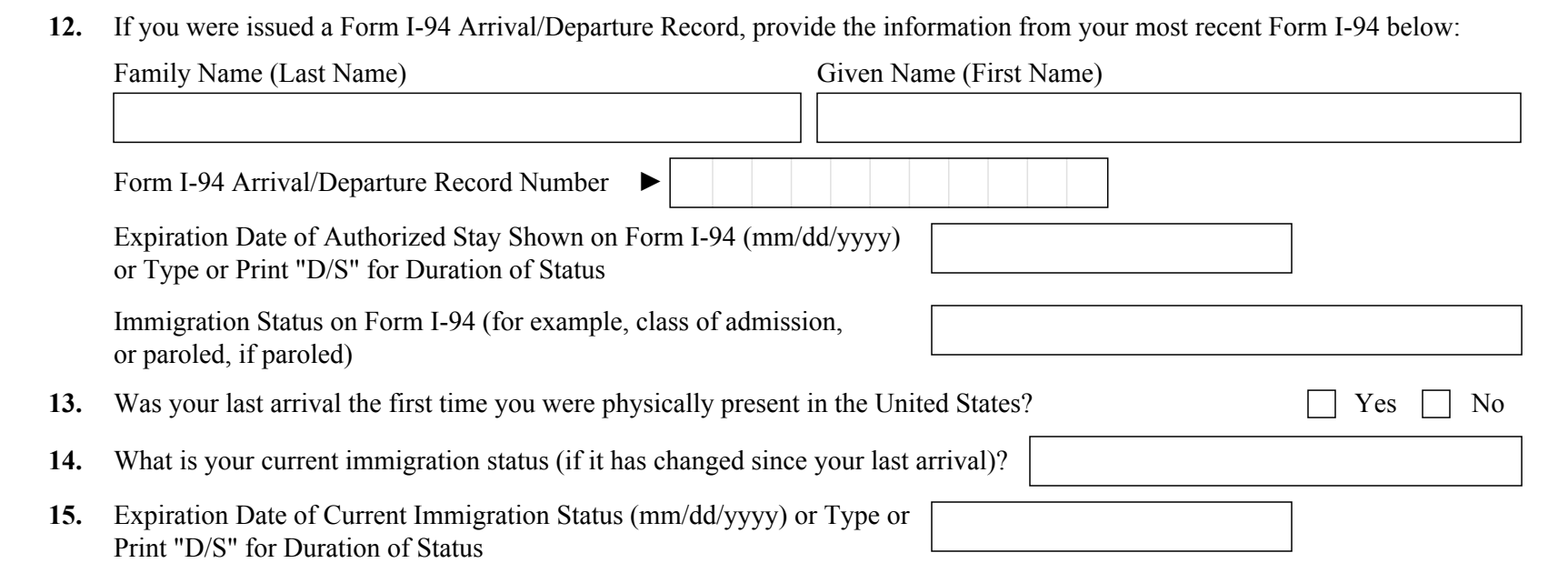
Verbatim · Form I-485, edition 09/18/26, page 3, Part 1, Item 12
“Expiration Date of Authorized Stay Shown on Form I-94 (mm/dd/yyyy) or Type or Print "D/S" for Duration of Status”
Verbatim · Form I-485, edition 09/18/26, page 3, Part 1, Item 15
“Expiration Date of Current Immigration Status (mm/dd/yyyy) or Type or Print "D/S" for Duration of Status”
The I-485 Instructions (edition 09/18/26) give no item-specific guidance for Items 12 or 15; the numbered guidance under "How To Complete Form I-485" skips from the Social Security questions straight to Part 9. The form text above is the operative direction, and it already answers the most-asked question: when the I-94 shows D/S, the form wants the literal characters "D/S", not a date you reconstruct from other paperwork.
Three documents, three dates: which one controls what?
Nearly every mistake on these two items comes from picking the wrong document.
| Document | What its date means | Which item it answers |
|---|---|---|
| Form I-94 from CBP (arrival record) | The date your authorized stay expires, or D/S | Items 12 and 15, when nothing changed after your last entry. This is your most recent I-94 until an approval replaces it. |
| Form I-797A (USCIS approval notice) | The new expiration of a changed or extended status, on the replacement I-94 printed at the bottom | Items 12 and 15, once USCIS approves a change or extension: the replacement I-94 becomes your most recent I-94 (until any later re-entry creates a newer one). |
| Visa sticker in your passport | The last day the visa can be used to request admission at a port of entry | Neither item. The State Department is explicit that the visa expiration date and the length of authorized stay are different things. |
Where to find the date (or the D/S)
In order of how often each document is the one you need.
- 1
Your most recent I-94, online
Air and sea arrivals are recorded electronically. Go to i94.cbp.dhs.gov, select Get Most Recent I-94, and enter your passport details. The record shows the admission class and the Admit Until Date, which is either a date or D/S. Land-border arrivals may have a paper I-94 card stapled in the passport instead.
- 2
The admission stamp in your passport
The stamp a U.S. Customs and Border Protection (CBP) officer put in your passport at your last entry shows the date of entry, the class of admission (the category you were let in under), and either a handwritten date or D/S. If the stamp and the online I-94 disagree, that mismatch is worth resolving before you file; the online record is what USCIS systems see.
- 3
Form I-797A, if USCIS approved a change or extension
The approval notice for a change or extension of status has a replacement I-94 printed at its bottom, with the new class and new Valid Until date. If you have not left and re-entered the U.S. since the approval, this replacement is your most recent I-94, and it answers both Item 12 and Item 15.
- 4
Your I-20 or DS-2019, for context only
F-1 students see a program end date on the Form I-20 and J-1 visitors see one on the DS-2019. Those are program documents. When the I-94 says D/S, the form asks for "D/S", not the program end date; the program document is why the D/S admission works the way it does, not a replacement for it.
Format rules
A date goes in as mm/dd/yyyy
The form prints the format next to the field. A date like 04/15/2027 comes straight off the I-94 or I-797A.
D/S goes in as the two letters and a slash
The form text says to type or print "D/S" for Duration of Status. Hybrid inventions that circulate on forums, like writing "D/S - 05/30/2027" with a program end date from SEVIS (the government's student-visa tracking system) attached, are not what the form asks for. The box wants what the I-94 shows.
The most recent I-94 wins
Every admission at the border creates a new I-94, and every approved change or extension of status creates a replacement one on the I-797A. The newest of these is what Item 12 asks about, and Item 15 should describe the same status. If your documents give you two different answers and you cannot see why, resolve that before filing rather than guessing.
What if the date has already passed?
Attorney review first
If the date in your documents has already passed, the question is no longer which box gets which date; it is what an expired authorized stay means for your filing, and that is a legal question. Overstay can mean unlawful presence under INA 212(a)(9), and how it interacts with a marriage-based case depends on facts this page cannot see. General context: spouses of U.S. citizens are immediate relatives, and the adjustment bars in INA 245(c)(2) and (c)(8) for unlawful status and unauthorized work do not apply to immediate relatives (USCIS Policy Manual, Vol. 7, Part B). That covers eligibility to adjust; it does not tell you how to complete these fields. An immigration attorney needs to review your facts before you answer.
Find an immigration attorneyYour I-94 details get asked on more than one form.
Our software collects your I-94 record once and places the number, class, and expiration (or D/S) into the I-485, I-765, and I-131 fields that ask for them, consistently.
Start FreeWhat USCIS does with these fields
USCIS reads Items 12 and 15 against its own records. The I-94 number in Item 12 lets the officer pull the CBP admission record and confirm the class and Admit Until Date you report; Item 15 tells the officer whether a later USCIS approval extended or changed that stay. Together they establish whether you were in a period of authorized stay on the day you filed, which matters for the INA 245(c) adjustment bars (from which spouses of U.S. citizens, as immediate relatives, are exempt) and for how the officer evaluates your status history at the interview. A reported date that conflicts with the CBP record is a routine trigger for a Request for Evidence (an RFE, a USCIS notice asking for more information).
Common mistakes
The ones that show up most often around Items 12 and 15.
- 1
Writing the visa expiration date from the passport sticker
The visa controls entry, not stay. The State Department's guidance says the visa expiration date has no bearing on how long you may remain; the I-94 does. A ten-year B-2 visa with a six-month admission means the I-94 date, not the sticker date, answers Item 12.
- 2
Inventing a date for a D/S admission
F-1 and J-1 filers sometimes substitute the I-20 or DS-2019 program end date because a real date feels safer than three characters. The form text asks for "D/S" when that is what the I-94 shows. The program end date is context, not the answer.
- 3
Using an old I-94 after a recent trip
Every admission creates a new I-94, and the form asks about the most recent one. If you traveled and re-entered after your status was approved, pull the current record at i94.cbp.dhs.gov rather than reusing the number and date from a previous entry.
- 4
Reading the wrong date off the I-797A
An approval notice carries several dates: a Notice Date and Received Date at the top, and the Valid Until date on the replacement I-94 at the bottom. The bottom one is the status expiration. Copying a date from the notice header puts a meaningless date in the box.
Related questions and guides
Form and pathway context
Frequently asked questions
My I-94 says D/S. What do I put for the expiration date of authorized stay?
Type or print "D/S", exactly as the form text directs: "Expiration Date of Authorized Stay Shown on Form I-94 (mm/dd/yyyy) or Type or Print 'D/S' for Duration of Status" (Form I-485, edition 09/18/26, page 3). D/S means your stay lasts as long as you maintain your program and status, with no fixed date, which is the standard admission for F-1 students and J-1 exchange visitors.
Should I write my I-20 or SEVIS program end date instead of D/S?
No. The I-20's program end date explains how long your studies run, but the form asks for what the I-94 shows, and for most students that is D/S. Formats like "D/S - 05/30/2027" that circulate on forums combine two documents into an answer the form does not ask for.
Where do I find my most recent I-94?
For air and sea arrivals, at i94.cbp.dhs.gov under Get Most Recent I-94; the record shows your class of admission and Admit Until Date. Land arrivals may have a paper I-94 card in the passport. If you had a change or extension of status approved, the replacement I-94 at the bottom of the Form I-797A is the record for your current status.
What is the difference between Item 12 and Item 15 on Form I-485?
Item 12 asks for the expiration shown on your most recent Form I-94, and that most recent I-94 can be the CBP arrival record or the replacement I-94 on an approved Form I-797A. Item 15 asks when your current status expires. For nearly everyone the two carry the same date (or D/S), because both trace to the newest I-94. If your documents give different answers and you cannot see why, resolve that before filing.
Is the expiration date on my visa the same as my authorized stay?
No. The visa expiration date is the last day the visa can be used to request admission at a port of entry; the length of stay is set at admission and recorded on the I-94. The State Department's Visa Expiration Date page draws exactly this distinction. A visa can outlive your authorized stay, and your authorized stay can outlive the visa.
The date on my I-94 already passed. What do I write?
This page does not answer that case. A passed date can mean overstay and unlawful presence, and what it means for your filing depends on your facts. Spouses of U.S. citizens are immediate relatives and exempt from the INA 245(c)(2) and (c)(8) adjustment bars (USCIS Policy Manual, Vol. 7, Part B), so an overstay does not automatically close the marriage-based path, but how to present it on a signed federal form is an immigration attorney's call.
Key takeaways
- ✓
Both items read off your most recent Form I-94; after an approved change or extension of status, the replacement I-94 at the bottom of the I-797A is the most recent one.
- ✓
When the I-94 shows D/S, the form's own text says to type or print "D/S"; no date gets invented from the I-20 or DS-2019.
- ✓
The visa sticker's expiration date answers neither item; visas control entry, the I-94 controls stay (U.S. Department of State).
- ✓
Every entry creates a new I-94, and the most recent one is the one that counts: check i94.cbp.dhs.gov after any trip.
- ✓
An I-797A carries several dates; the status expiration is the Valid Until date on the replacement I-94 at the bottom, not the notice dates at the top.
- ✓
A date that has already passed takes the question out of this page's scope: talk to an immigration attorney before answering.
This page is for educational purposes only and is not legal advice. Green Card Genius is self-help immigration software, not a law firm, and does not provide legal representation. Immigration law and USCIS policy change frequently. For advice on a specific case, consult a licensed immigration attorney. Form I-485, edition 09/18/26. Last verified July 2026.
Stay informed
Green card guides in your inbox
Practical, plain-English updates to help you navigate the process with confidence.
Unsubscribe anytime.
Continue reading
Be a Genius
Only pay when you file