Form I-485 · Part 4, Item 7
I-485 Employment History (Part 4, Item 7): Your 5-Year Record in 2026
Part 4, Item 7 wants every job, school, and gap for the last 5 years, current first, with the time fully accounted for.
Quick answer
List every job, school, and gap for the last 5 years, current or most recent first, working backward with no unexplained gaps. Include self-employment, unemployment, and retirement; for any unemployed or retired stretch, write down how you supported yourself. Out of room? Continue in Part 14.
Summary
Item 7 in Part 4 asks for all of your employment and educational history for the last 5 years, listed with your current or most recent position first and working backward with no gaps. Include time you spent self-employed, unemployed, or retired, and for any unemployment or retirement period, name your source of financial support. School counts too: a period spent studying is listed the same way as a job.
| Where it is on the form | Part 4, Item 7 (“Employment and Educational History”). Employer or school name, your occupation, the address, and the dates for each entry. |
| Time period covered | The last 5 years, listed current or most recent first and working backward. The 5 years should be fully accounted for with no unexplained gaps. |
| What counts as an entry | Jobs, self-employment, school attended, and stretches of unemployment or retirement. Each is its own line with start and end dates. |
| Unemployment and retirement | These are not left blank. List them as periods and, for each one, name your source of financial support (for example, savings, a spouse, family, or benefits). |
| Running out of space | Continue additional jobs, schools, or gaps in Part 14 (Additional Information). Do not drop any period to make the list fit. |
Who this page is for
This page covers how to complete the employment and educational history in Part 4, Item 7. It is a factual timeline. Whether any past work in the United States was done without authorization is a separate question with legal consequences (it appears in Part 9), and an immigration attorney should review that before you answer it.
Free tool
Marriage Green Card Cost Calculator
2026 · AOS · full packet
$3,005
See your exact 2026 USCIS filing fees for a marriage green card through Adjustment of Status, with a full line-item breakdown and the costs most guides leave out.
Free — enter your email and it opens right up. Unsubscribe anytime.
We post free tips on preparing your marriage green card. Follow along:
What Item 7 looks like on the form
Item 7 gives one block per entry: the employer or school, your occupation, the address, and the dates.
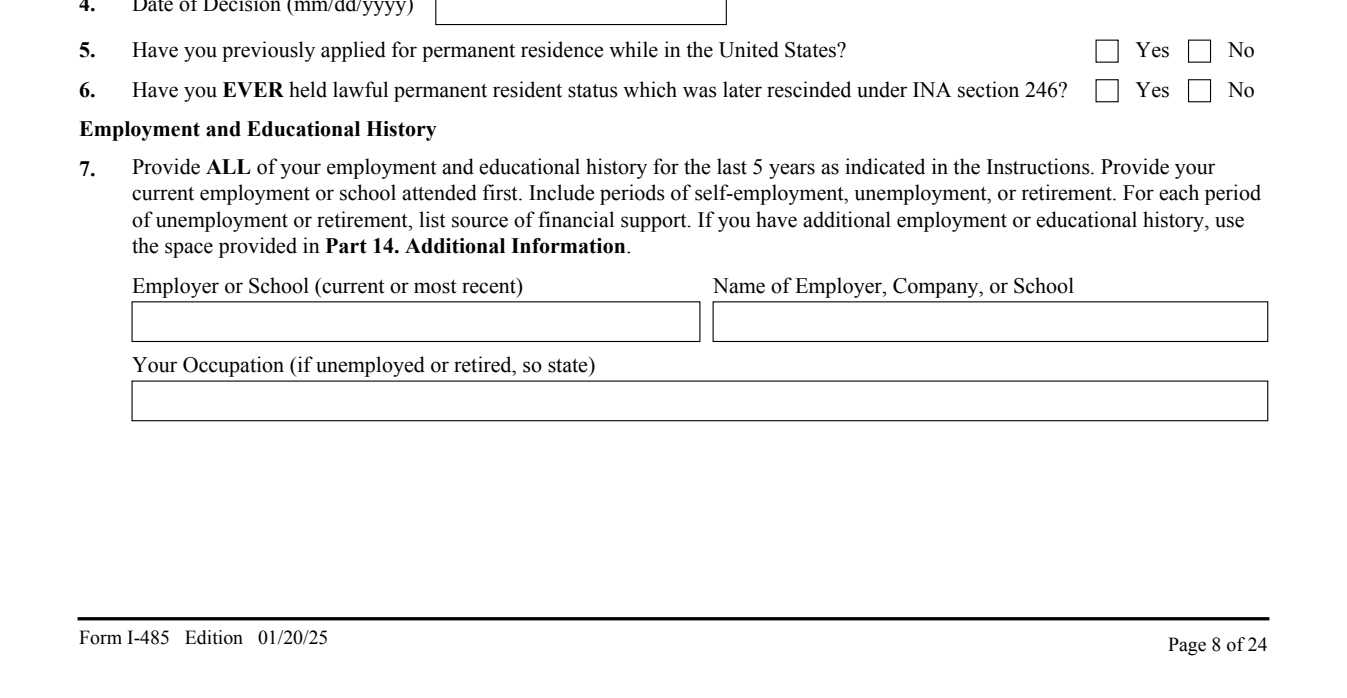
Verbatim -- Part 4, Item 7 (Form I-485, edition 09/18/26)
“Provide ALL of your employment and educational history for the last 5 years as indicated in the Instructions. Provide your current employment or school attended first. Include periods of self-employment, unemployment, or retirement. For each period of unemployment or retirement, list source of financial support. If you have additional employment or educational history, use the space provided in Part 14. Additional Information.”
“Your Occupation (if unemployed or retired, so state)”
Always complete the current edition downloaded from uscis.gov/i-485; USCIS rejects outdated editions.
How to fill in your employment history
Four steps cover almost every situation.
Start with your current or most recent entry
Put your current job or school first, then work backward in time. For each entry the form asks for the employer or school name, your occupation, the address, and the start and end dates.
Cover the full 5 years with no gaps
The end date of one entry should connect to the start date of the next. If you were between jobs, that stretch is its own entry (unemployment), not an empty space. USCIS reads the dates as a continuous record.
List unemployment and retirement, with your support source
A period with no job still gets a line. Mark it as unemployment or retirement and, as the form requires, name how you supported yourself during it (savings, a spouse or family, benefits, and so on).
Include school the same way
Time spent as a full-time student counts as part of your history. Enter the school as the “employer or school” and your status (for example, student) as the occupation, with the dates you attended.
Common situations
- You had several jobs or overlapping work. List each one. If two jobs overlapped, enter both with their real dates. If the form runs out of rows, continue in Part 14 (Additional Information) using the same format.
- You were a stay-at-home spouse or caregiver. That is a period of unemployment for this form. List it with dates and name your source of financial support (for example, your spouse). It is a normal answer, not a problem.
- You do not remember exact start and end dates. Use your best good-faith estimate of the month and year, and keep it consistent with the same periods on your other forms. The form uses mm/dd/yyyy; if you only know the month, use the first of the month.
- You worked in the United States without authorization. Item 7 is a factual record of where you worked, and it is listed as asked. Whether any of that work was unauthorized is a separate question with legal consequences (it appears in Part 9). If that applies to you, talk to an immigration attorney about the Part 9 question before you file.
What USCIS does with your employment history
USCIS uses your employment and educational history to confirm a continuous, accounted-for timeline and to cross-check it against the rest of your application, including the work history on Form I-130A and the income and employer details on the Form I-864 Affidavit of Support. Gaps with no explanation, or employers and dates that do not match across the forms, are a common reason USCIS issues a Request for Evidence. Listing your source of support during unemployment also speaks to the affidavit of support picture.
Common mistakes
These show up in Requests for Evidence (RFEs, USCIS notices asking for more documents).
- 01
Leaving unemployment periods blank
An empty stretch reads as a gap. Periods of unemployment or retirement are listed as their own entries, with dates and a source of financial support, exactly as the form instructs.
- 02
Listing only jobs and skipping school
Item 7 is employment AND educational history. Time spent as a student belongs in the timeline alongside jobs, with the school name and the dates you attended.
- 03
Employer names or dates that do not match your other forms
Your work history here should line up with Form I-130A and with the employer and income details on Form I-864. Inconsistent employers or dates across the packet are a frequent Request for Evidence trigger.
- 04
Dropping entries to fit the boxes
The form has limited rows. If you have more jobs, schools, or gaps than fit, continue them in Part 14 (Additional Information). Omitting a period leaves an incomplete record.
Keeping these timelines straight across forms is tedious.
Our software collects your work and school history once and keeps the employers and dates consistent across Form I-485, Form I-130A, and Form I-864, with overflow into Part 14 handled for you.
Start FreeRelated guides
Form and pathway context
Frequently asked questions
How far back does the I-485 employment history go?
Five years. Part 4, Item 7 asks for all of your employment and educational history for the last 5 years, listed with your current or most recent position first and working backward.
Do I have to list time I was unemployed?
Yes. Periods of unemployment or retirement are listed as their own entries with start and end dates. The form also asks you to name your source of financial support for each such period (for example, savings, a spouse, family, or benefits). Do not leave the time blank.
Does school count as employment history?
Item 7 is employment and educational history together. Time spent as a student is part of your timeline. Enter the school as the employer or school, your status (such as student) as the occupation, and the dates you attended.
What if I run out of space for all my jobs?
Continue the additional employment or educational history in Part 14 (Additional Information), using the same format. Do not drop any job, school, or gap to make the list fit the boxes on the form.
What if I worked without authorization?
Item 7 is a factual record of where you worked and is completed as asked. Whether any of that work was unauthorized is a separate question that carries legal consequences and appears in Part 9 of the form. If that applies to you, consult an immigration attorney about the Part 9 question before filing.
Key takeaways
- ✓
Part 4, Item 7 asks for all employment and educational history for the last 5 years, current or most recent first.
- ✓
Cover the full 5 years with no gaps; periods of unemployment or retirement are listed as entries, with a source of financial support for each.
- ✓
School counts: list it the same way as a job, with the dates you attended.
- ✓
Continue extra entries in Part 14 rather than dropping any.
- ✓
Match employers and dates to Form I-130A and Form I-864. Mismatches are a common Request for Evidence trigger.
This page is for educational purposes only and is not legal advice. Green Card Genius is self-help immigration software, not a law firm, and does not provide legal representation. Immigration law and USCIS policy change frequently. For advice on a specific case, consult a licensed immigration attorney. Form I-485, edition 09/18/26. Last verified May 2026.
Stay informed
Green card guides in your inbox
Practical, plain-English updates to help you navigate the process with confidence.
Unsubscribe anytime.
Continue reading
Be a Genius
Only pay when you file