Form I-485 · Part 6, Item 9
I-485 Date and Place of Marriage to Current Spouse (Part 6, Item 9) in 2026
Where and when you married your current spouse. Both answers come straight off your official marriage certificate.
Quick answer
Copy both answers straight off your marriage certificate, not from the venue's informal name. The place of marriage is the city or town, state or province, and country where the certificate was issued. The date of marriage is the date on the certificate in mm/dd/yyyy format. Match the I-130 exactly.
Summary
Form I-485 Part 6, Item 9 asks where and when you married your current spouse. Both answers live on one document: the official marriage certificate issued by the civil authority that registered your marriage. The place of marriage has three fields (city or town, state or province, country), and the date of marriage uses mm/dd/yyyy. In a marriage-based adjustment of status (AOS, applying for a green card from inside the United States), this couples directly to the relationship you are proving, so the date and place here must match what you entered on the Form I-130 and what your certificate says. Use the place the certificate names, not the wedding hall, church, or reception venue's casual name.
| What it asks | The city or town, state or province, and country where you married your current spouse (place), and the date of that marriage in mm/dd/yyyy. |
| Where the answer comes from | Your official marriage certificate, issued by the civil authority where the marriage was registered. Not the wedding venue's informal name and not the ceremony's later celebration date. |
| Format for place | Three fields: City or Town, State or Province, Country. Fill all that the certificate names. Foreign marriages use the province field instead of a U.S. state. |
| Format for date | mm/dd/yyyy. Use the date the marriage was legally effective on the certificate, even if a religious or symbolic ceremony happened on a different day. |
| Must match | The I-130 you filed, the marriage certificate you submit as evidence, and any other form that states your marriage date. A mismatch is a common reason USCIS asks follow-up questions. |
Who this page is for
This page covers the standard case: copying the date and place of your current marriage from an official civil marriage certificate. If your marriage was never registered with a civil authority, your certificate cannot be located, or your marriage date is disputed, those situations carry extra weight, and people in them often consult a licensed immigration attorney.
Free tool
Marriage Green Card Cost Calculator
2026 · AOS · full packet
$3,005
See your exact 2026 USCIS filing fees for a marriage green card through Adjustment of Status, with a full line-item breakdown and the costs most guides leave out.
Free — enter your email and it opens right up. Unsubscribe anytime.
We post free tips on preparing your marriage green card. Follow along:
What Item 9 looks like on the form
Item 9 sits in Part 6 (Information About Your Marital History), in the current-marriage subsection. The place of marriage has three sub-fields, followed by the date of marriage.
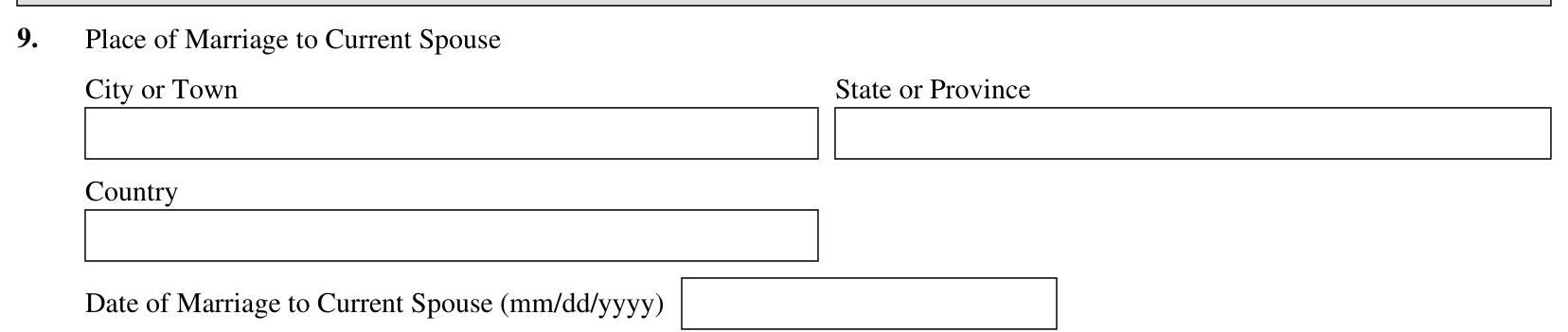
Verbatim · Part 6, Item 9 (Form I-485, edition 09/18/26, page 11)
“Place of Marriage to Current Spouse”
“Date of Marriage to Current Spouse (mm/dd/yyyy)”
9. Place of Marriage to Current Spouse
City or Town · State or Province · Country
Date of Marriage to Current Spouse (mm/dd/yyyy)
What the instructions tie it to
The Form I-485 Instructions point the place of marriage to the civil authority that recorded it, the same source as the marriage certificate USCIS expects in your packet:
Verbatim · Marriage Certificate and Other Proof of Family Relationship (I-485 Instructions, edition 09/18/26, page 12)
“If you are filing Form I-485 as the derivative applicant spouse of the principal applicant, you generally must submit a photocopy of your marriage certificate issued by the appropriate civil authority where the marriage took place.”
Always complete the current edition downloaded from uscis.gov/i-485; USCIS rejects outdated editions.
How to fill in your date and place of marriage
Four steps, all anchored to your official marriage certificate.
Pull both answers off the marriage certificate
Find your official marriage certificate, the one issued by the government office (a county clerk in the U.S., or the civil registry abroad) that recorded your marriage. The date printed on it is your date of marriage. The place printed on it is your place of marriage. A religious certificate, a wedding program, or a reception invitation is not the source; the civil record is.
Enter the place as city, state or province, and country
Item 9 has three lines. Put the city or town where the marriage was registered in the first line, the U.S. state or the foreign province in the second, and the country in the third. Write the place names as the certificate spells them, not the informal name of the wedding venue. "St. Mary's Cathedral" is not a place of marriage; the city it sits in is.
Enter the date in mm/dd/yyyy
Use two digits for the month, two for the day, four for the year. If your marriage was legally effective on a date that differs from a later religious or symbolic ceremony, use the legally effective date the certificate shows. That is the date your marriage exists for immigration purposes.
Cross-check against your I-130 and certificate
The petitioner (the U.S. citizen or green card holder who filed for you) listed your marriage date and place on the Form I-130. The beneficiary (the immigrant spouse seeking the green card) repeats it here on the I-485. Those two forms and the certificate you submit as evidence all need to agree on the same date and the same place, character for character.
Two worked examples
One U.S. marriage and one abroad, showing how the certificate maps onto Item 9.
U.S. marriage
A Texas marriage certificate issued by the Harris County Clerk, dated March 4, 2023, recording a marriage in Houston.
- City or Town: Houston
- State or Province: Texas
- Country: United States
- Date of Marriage: 03/04/2023
Foreign marriage
A marriage certificate from the Philippine Statistics Authority, dated June 12, 2022, for a marriage solemnized in Cebu City, Cebu province.
- City or Town: Cebu City
- State or Province: Cebu
- Country: Philippines
- Date of Marriage: 06/12/2022
Keeping your marriage date and place consistent across the packet matters.
Our software asks for your marriage details once and carries the same date and place onto the I-130, the I-485, and your evidence list, so they line up the way USCIS expects.
Start FreeWhat USCIS does with your date and place of marriage
On a marriage-based adjustment of status, your date and place of marriage are the spine of the case. USCIS reads Item 9 against the marriage certificate you submit, against the date and place the petitioner put on the Form I-130, and against the rest of your relationship evidence. When all of them line up, the field is routine. When the date on the form is off by a digit from the certificate, or the place names a venue the certificate does not, the officer cannot confirm the marriage matches the record, and that gap is one of the more common triggers for a Request for Evidence (an RFE, a USCIS notice asking for more documents). Entering the answers exactly as the civil record states them is how you keep this field quiet.
Common mistakes
These show up in Requests for Evidence (RFEs, USCIS notices asking for more documents).
- 1
Using the venue's name instead of the city
The place of marriage is the city or town, state or province, and country on the certificate, not the name of the chapel, hotel, courthouse, or banquet hall. Officers match the place against the certificate, which names a locality, not a building.
- 2
Using the ceremony date instead of the certificate date
If a religious or symbolic ceremony happened on a different day than the legally registered marriage, use the date the marriage became legally effective, the one on the civil certificate. That is the date the I-130 should already show too.
- 3
A date or place that does not match the I-130
The petitioner stated your marriage date and place on the I-130. If the I-485 disagrees, even by a transposed digit, USCIS sees an inconsistency. Open both forms and the certificate side by side and confirm they all say the same thing.
- 4
Forcing a foreign marriage into U.S. formatting
For a marriage abroad, the second line is the province or state-equivalent the certificate names, not a U.S. state. Some countries do not use a province at all; in that case fill the city and country and leave the province blank if the certificate has no equivalent.
- 5
Reformatting place names off the certificate
Spell the city, province, and country the way the certificate spells them, including the country's full name. Do not translate or abbreviate place names in a way the underlying document does not.
Related guides
Form and pathway context
Frequently asked questions
Where do the date and place of marriage come from?
From your official marriage certificate, the one issued by the civil authority that registered the marriage (a county clerk in the U.S., or the civil registry abroad). The date printed on it is your date of marriage; the locality printed on it is your place of marriage. A church certificate or wedding program is not the source.
Do I write the name of the wedding venue as the place of marriage?
No. The place of marriage is the city or town, state or province, and country. "The Grand Ballroom" or "St. Patrick's Church" is a venue, not a place USCIS records. Enter the city the venue is in, the state or province, and the country, exactly as the marriage certificate states them.
How do I format the place of marriage for a wedding abroad?
Use the same three fields. Put the foreign city or town first, the foreign province (or state-equivalent) second, and the country third, spelled as your certificate spells them. If the country does not use a province, fill the city and country and leave the province blank when the certificate has no equivalent.
What date do I use if the ceremony and the legal marriage were on different days?
Use the date the marriage became legally effective, the date on the civil marriage certificate, in mm/dd/yyyy. A separate religious or symbolic ceremony date does not go in this field. The legal date is also what should appear on your Form I-130.
Why does the date and place have to match the I-130?
Because USCIS reads them together. The petitioner stated your marriage date and place on the I-130; you repeat them on the I-485; and the marriage certificate you submit as evidence shows the same facts. When the three agree, the field is routine. A mismatch, even a single transposed digit, is a common reason USCIS sends a Request for Evidence.
Key takeaways
- ✓
Both answers come from your official marriage certificate, not the wedding venue's name or a later ceremony date.
- ✓
Place of marriage is three fields: City or Town, State or Province, Country. Enter them as the certificate spells them.
- ✓
Date of marriage uses mm/dd/yyyy and is the date the marriage was legally effective on the civil record.
- ✓
Foreign marriages use the province field instead of a U.S. state; leave the province blank only when the certificate has no equivalent.
- ✓
The date and place must match the I-130 and the certificate exactly; a mismatch is a common reason USCIS asks for more evidence.
This page is for educational purposes only and is not legal advice. Green Card Genius is self-help immigration software, not a law firm, and does not provide legal representation. Immigration law and USCIS policy change frequently. For advice on a specific case, consult a licensed immigration attorney. Form I-485, edition 09/18/26. Last verified May 2026.
Stay informed
Green card guides in your inbox
Practical, plain-English updates to help you navigate the process with confidence.
Unsubscribe anytime.
Continue reading
- 01Form I-485: Application to Adjust Status (2026 Guide)
- 02I-485 Filing Category (Part 2): Which Box a Spouse Checks (2026)
- 03I-485 Place and Date of Last Arrival (Part 1, Items 10-12) (2026)
- 04How to Prove Your Marriage is Real to USCIS (2026 Evidence Guide)
- 05Marriage Green Card Document Checklist (2026)
Be a Genius
Only pay when you file