Form I-130A · Part 4, Item 6.a
I-130A Signature: Does Your Spouse Sign If They Live Abroad? (Part 4, Item 6.a)
Whether your spouse signs Form I-130A in Part 4, Item 6.a depends on one thing: whether they live in the United States or abroad.
Quick answer
If your spouse lives in the United States, the spouse signs Form I-130A in Part 4, Item 6.a. If your spouse lives abroad, they still complete the whole form but do not sign Part 4, so the signature box is left blank. Either way, the U.S. citizen or green card holder petitioner signs the Form I-130 itself, not the I-130A.
Summary
For most marriage-based filers, the rule is short: the immigrant spouse (the beneficiary) fills out all of Form I-130A, but only signs Part 4, Item 6.a when they reside in the United States. If the spouse is overseas, they complete every other field and leave the signature blank, per the I-130 Instructions. The U.S. citizen or green card holder who started the case (the petitioner) signs the main Form I-130, not the I-130A. Form I-130A is filed only for a spouse, so this question applies to marriage-based petitions, not parent, child, or sibling petitions.
| Who completes I-130A | The spouse beneficiary (the immigrant being sponsored). It is their biographical, address, and employment history. |
| Spouse lives in the U.S. | Spouse signs Part 4, Item 6.a and dates Item 6.b. |
| Spouse lives abroad | Spouse completes the whole form but does NOT sign Part 4. Leave Item 6.a blank. |
| Who signs the I-130 itself | The petitioner (the U.S. citizen or green card holder) signs Form I-130, in every case. |
| Is I-130A always required for a spouse? | Yes. It must be completed and submitted with the I-130 for a spouse, signed or not. |
Who this page is for
This page covers the standard marriage-based case: a spouse beneficiary completing Form I-130A and deciding whether to sign Part 4 based on whether they live in the U.S. or abroad. It does not cover whether you should file from inside or outside the country (adjustment of status versus consular processing), which depends on your immigration history. If your case involves a prior visa denial, time out of status, or any question about which path to take, consult a licensed immigration attorney.
Free tool
Marriage Green Card Cost Calculator
2026 · AOS · full packet
$3,005
See your exact 2026 USCIS filing fees for a marriage green card through Adjustment of Status, with a full line-item breakdown and the costs most guides leave out.
Free — enter your email and it opens right up. Unsubscribe anytime.
We post free tips on preparing your marriage green card. Follow along:
What Part 4 looks like on Form I-130A
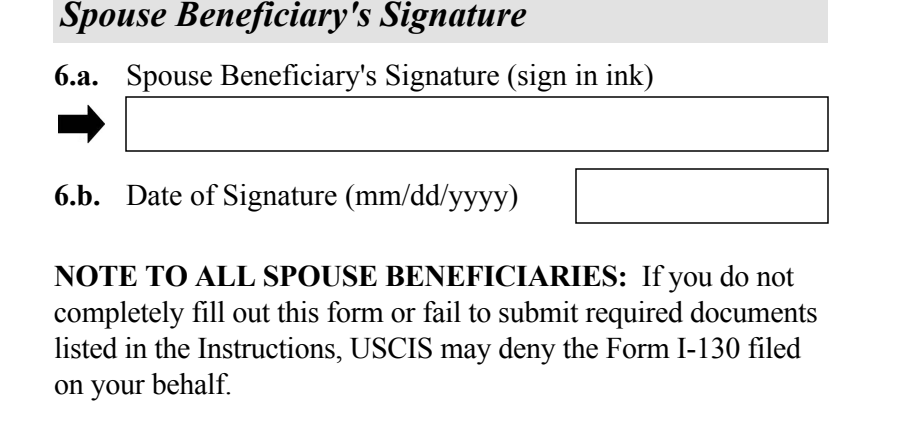
The signature sits in Part 4 (Spouse Beneficiary's Statement, Contact Information, Certification, and Signature). Item 6.a is the signature line; Item 6.b is the date.
Verbatim · I-130 Instructions, page 1 (edition 04/01/24)
“If you are filing for your spouse, he or she must complete and sign Form I-130A, Supplemental Information for Spouse Beneficiary. If your spouse is overseas, Form I-130A must still be completed, but your spouse does not have to sign Form I-130A. Form I-130A must be submitted with Form I-130.”
Part 4. Spouse Beneficiary's Statement, Contact Information, Certification, and Signature
6.a. Spouse Beneficiary's Signature (sign in ink)
6.b. Date of Signature (mm/dd/yyyy)
NOTE TO ALL SPOUSE BENEFICIARIES: If you do not completely fill out this form or fail to submit required documents listed in the Instructions, USCIS may deny the Form I-130 filed on your behalf.
The I-130A signature rule lives in the shared I-130/I-130A Instructions, not on the form face. The form's Part 4 simply provides the signature box. Always complete the current edition from uscis.gov/i-130; USCIS rejects outdated editions.
Does your spouse live in the U.S. or abroad?
That single question decides whether your spouse signs Part 4. The form gets completed in full either way.
| Spouse's residence | Complete the form? | Sign Part 4 (Item 6.a)? |
|---|---|---|
| Spouse lives in the United States | Yes, all parts | Yes: sign Item 6.a, date Item 6.b |
| Spouse lives abroad | Yes, all parts | No: leave Item 6.a blank |
How to handle the signature
Four steps that work whether your spouse lives in the U.S. or abroad.
Confirm who the beneficiary is
On a marriage petition the beneficiary is your immigrant spouse. Form I-130A is the spouse's form, so the spouse answers the biographical, address (Part 1), employment (Parts 2 and 3), and certification fields. The petitioner does not fill out I-130A for themselves.
Complete every part of the form regardless of where the spouse lives
The I-130 Instructions say Form I-130A must still be completed even when the spouse is overseas. A spouse abroad does not skip sections. They answer every question; the only difference is the Part 4 signature.
Sign Part 4 only if the spouse resides in the U.S.
If the spouse lives in the United States, the spouse signs in ink at Part 4, Item 6.a and enters the date at Item 6.b. If the spouse lives abroad, they leave Item 6.a blank. A blank signature box on an abroad case is correct, not an omission.
Sign the I-130 itself separately
The petitioner (the sponsoring U.S. citizen or green card holder) signs Form I-130 in its own signature part. That signature is always required and is different from the spouse's I-130A signature. Do not confuse the two forms' signature boxes.
Marriage-based filers: this form is only for a spouse
Form I-130A is filed only when the I-130 petition is for a spouse, so on a marriage case it always applies. The petitioner is the U.S. citizen or green card holder who starts the case; the beneficiary is the immigrant spouse. The petitioner signs Form I-130. The spouse beneficiary fills out Form I-130A and signs its Part 4 only when residing in the United States.
If your spouse is still abroad and will go through a U.S. consulate, they complete the full I-130A now and leave the Part 4 signature blank. They will sign and certify their information later in consular processing. If your spouse is already in the United States and adjusting status, the spouse signs Part 4 now.
Not sure whether your spouse signs?
Our software asks where your spouse lives and fills the I-130A the right way, so the Part 4 signature is handled correctly across your whole I-130 and I-485 packet.
Start FreeWhat USCIS does with the I-130A signature
USCIS treats Form I-130A as supplemental information about the spouse beneficiary that supports the petition. The spouse's signature in Part 4 is a certification under penalty of perjury that the information is true and authorizes release of records. USCIS does not require that certification from a spouse who is overseas at the petition stage, because that spouse will sign and certify their information later in consular processing through the Department of State. A spouse already in the United States is expected to sign now. The NOTE printed in Part 4 also warns that an incomplete I-130A can cause USCIS to deny the underlying Form I-130, which is why completing every field matters even when the signature is left blank.
Common mistakes
These are the ones that show up most often on this field.
- 1
Petitioner signs the I-130A
The U.S. citizen or green card holder signs the Form I-130, not the spouse's I-130A. Part 4 of the I-130A is the spouse beneficiary's signature line. If you signed it as the petitioner, that is the wrong person in the box.
- 2
Leaving I-130A out entirely for an overseas spouse
Some filers assume that because an abroad spouse does not sign, the form is optional. It is not. The instructions say I-130A must still be completed and submitted with the I-130. Skipping it can lead USCIS to deny the petition.
- 3
A spouse in the U.S. leaving Part 4 blank
The no-signature rule is only for a spouse residing abroad. If your spouse lives in the United States, an unsigned Part 4 is an incomplete form. The spouse needs to sign Item 6.a in ink and date Item 6.b.
- 4
Treating a blank signature on an abroad case as an error
If your spouse lives overseas, the empty signature box at Item 6.a is exactly what the instructions call for. There is no need to add a note, leave a placeholder, or have the petitioner sign in the spouse's place.
Related guides
Form and pathway context
Frequently asked questions
Does my spouse sign Form I-130A if they live abroad?
No. Per the I-130 Instructions, a spouse residing overseas completes the entire Form I-130A but does not have to sign Part 4. Leave Item 6.a blank. The form still must be filled out and submitted with the Form I-130.
Who completes Form I-130A, the petitioner or the spouse?
The spouse beneficiary (the immigrant being sponsored) completes Form I-130A. It collects the spouse's address history, employment history, and certification. The petitioner (the U.S. citizen or green card holder) completes and signs the main Form I-130 instead.
Is Form I-130A required if my spouse is overseas?
Yes. The instructions state Form I-130A must still be completed and submitted with the I-130 even when the spouse is abroad. The only difference for an overseas spouse is that the Part 4 signature is left blank.
My spouse lives in the United States. Do they sign?
Yes. A spouse residing in the U.S. signs Form I-130A in ink at Part 4, Item 6.a and enters the date at Item 6.b. The no-signature rule applies only to a spouse living abroad.
Does the petitioner sign Form I-130A?
No. The petitioner signs Form I-130. Part 4 of Form I-130A is the spouse beneficiary's signature line. Only the spouse signs the I-130A, and only when they reside in the United States.
Is Form I-130A filed for petitions other than a spouse?
No. Form I-130A is filed only when the I-130 is for a spouse. Petitions for a parent, child, or sibling do not use Form I-130A, so this signature question does not come up.
Key takeaways
- ✓
The spouse beneficiary completes Form I-130A, not the petitioner.
- ✓
A spouse living in the U.S. signs Part 4, Item 6.a in ink and dates Item 6.b.
- ✓
A spouse living abroad completes the whole form but leaves the Part 4 signature blank, per the I-130 Instructions.
- ✓
Form I-130A is required for a spouse petition either way and must be submitted with the Form I-130.
- ✓
The petitioner (the U.S. citizen or green card holder) signs the Form I-130 itself, in every case.
This page is for educational purposes only and is not legal advice. Green Card Genius is self-help immigration software, not a law firm, and does not provide legal representation. Immigration law and USCIS policy change frequently. For advice on a specific case, consult a licensed immigration attorney. Form I-130A, edition 04/01/24. Last verified May 2026.
Stay informed
Green card guides in your inbox
Practical, plain-English updates to help you navigate the process with confidence.
Unsubscribe anytime.
Continue reading
Be a Genius
Only pay when you file