Form I-130A · Part 1, Item 8
I-130A Last Physical Address Outside the United States (Part 1, Item 8)
The last place outside the United States where your immigrant spouse lived for more than one year, and how Part 1, Item 8 differs from the five-year address history above it.
Quick answer
Enter the last place outside the United States where your immigrant spouse lived for more than one year, with the dates they lived there. List it even if you already entered the same address in the five-year Address History above. If your spouse has never lived outside the United States, there is no qualifying address to enter.
Summary
For most marriage-based filers, Form I-130A Part 1, Item 8 asks for one thing: the last address outside the United States where the immigrant spouse (the beneficiary, the person being sponsored) lived for more than one year. On a marriage petition your U.S. citizen or green card holder spouse files the I-130 and you, the immigrant spouse, complete this I-130A. Item 8 is separate from the five-year Address History in Items 4 through 7 above it. The note on the form tells you to enter this last foreign address even if you already listed it in that history. The qualifier "of more than one year" means the most recent place abroad where the spouse lived for over a year, not a short visit or a brief stay.
| What it asks | The last address outside the United States where the beneficiary spouse lived for more than one year, with the dates lived there. |
| Most marriage cases | A spouse who moved to the US from abroad enters their last long-term home-country address, even if it is the same one already in the Address History above. |
| Spouse still abroad | Enter the foreign address where the spouse currently lives (or last lived over a year), the same one that appears as the current address in the history. |
| Never lived abroad | A spouse who has only ever lived in the United States has no qualifying foreign address. The form has no entry to make; people commonly write N/A. |
| Relationship to the 5-year history | Different field. The form says to list this address "even if listed above," so a repeat is expected, not an error. |
Who this page is for
This page covers the standard case: entering your spouse's last long-term address abroad, or writing N/A if they never lived outside the United States. If your spouse's residential history is hard to reconstruct, overlaps with time spent in the US without authorization, or differs across passports and prior filings in ways that could raise questions, a licensed immigration attorney can review your situation before you complete this field.
Free tool
Marriage Green Card Cost Calculator
2026 · AOS · full packet
$3,005
See your exact 2026 USCIS filing fees for a marriage green card through Adjustment of Status, with a full line-item breakdown and the costs most guides leave out.
Free — enter your email and it opens right up. Unsubscribe anytime.
We post free tips on preparing your marriage green card. Follow along:
What Part 1, Item 8 looks like on the form
This field sits in Part 1 (Information About You (Spouse Beneficiary)), directly below the five-year Address History. The section header on the form reads “Last Physical Address Outside the United States.” Item 8 (8.a through 8.f) collects the street, city, province, postal code, and country.
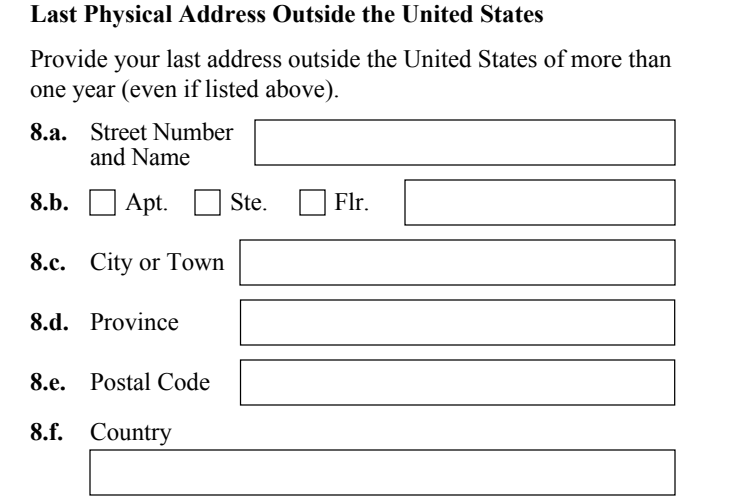
Verbatim · Part 1, Item 8 note (Form I-130A, edition 04/01/24, page 1)
“Provide your last address outside the United States of more than one year (even if listed above).”
8.a. Street Number and Name
8.b. Apt. Ste. Flr.
8.c. City or Town
8.d. Province
8.e. Postal Code
8.f. Country
The I-130/I-130A Instructions do not separately walk through Item 8; the note printed on the form itself is the controlling guidance. Always complete the current edition from uscis.gov/i-130; USCIS rejects outdated editions.
How is this different from the five-year address history?
Items 4 through 7 are the Address History: every physical address your spouse lived at over the last five years, current address first. Item 8 is a single, separate field that asks only for the last address outside the United States where your spouse lived for more than one year.
The two often point to the same place. That is fine. The form note tells you to provide the Item 8 address “even if listed above,” so a repeat is expected. The difference is the lens: the history is a five-year timeline, while Item 8 is one specific foreign home no matter how long ago your spouse lived there.
| Your spouse's situation | What goes in Item 8 |
|---|---|
| Spouse recently moved to the US (consular or adjustment case) | The last home-country address where they lived for more than one year before coming to the US. This is usually the same address that appears as the most recent foreign entry in the five-year Address History. |
| Spouse still lives abroad | Their current foreign address, if they have lived there over a year. It will match the current address already in the Address History. The form expects the repeat. |
| Spouse moved between several countries | The most recent country where they lived for more than one year. Skip stays shorter than a year when deciding which address is the "last" qualifying one. |
| Spouse has lived in the US for under a year after years abroad | The foreign address where they lived for over a year right before moving to the US. A US address of less than a year does not change the answer to this field. |
| Spouse has never lived outside the US (rare) | There is no qualifying foreign address. There is nothing to enter; filers commonly write N/A so a reviewer can see the field was not skipped by mistake. |
How to fill it in
Four steps. If your spouse has never lived outside the United States, skip to step four.
Find the last foreign home of more than one year
Look back over your spouse's history and find the most recent address outside the United States where they lived for over a year. A vacation, a work trip, or a stay shorter than a year does not count. The address that does count is the last long-term home abroad.
Enter the address in 8.a through 8.f
Put the street and number in 8.a, apartment or suite in 8.b, city or town in 8.c, province in 8.d, postal code in 8.e, and country in 8.f. Use the same spelling and format your spouse used for that address in the Address History above.
Repeat the address even if it is already listed
The form note says to provide this address "even if listed above." If the last foreign address is the same one you already entered in the five-year Address History, enter it again here. A repeat is what the form expects, not a mistake.
If your spouse never lived abroad, write N/A
A beneficiary who has only ever lived in the United States has no address to enter. There is no box on the form for this case, so filers commonly write N/A in 8.a so a reviewer can see the field was considered, not skipped.
Marriage-based filers: usually your spouse's last home abroad
Form I-130A is the supplement only the spouse beneficiary fills out. Your U.S. citizen or green card holder spouse (the petitioner) files the I-130; you, the immigrant spouse being sponsored (the beneficiary), complete the I-130A. So Item 8 is your information, the immigrant's, not the sponsor's.
The most common pattern is a spouse who lived abroad and is now joining their partner in the US, or who is still abroad and waiting on the case. In both, Item 8 is the last foreign address where you lived for more than one year, and it usually matches the most recent foreign address in your five-year Address History.
The one case where Item 8 has no answer is a beneficiary spouse who has only ever lived in the United States. That is uncommon on a marriage petition, but when it happens there is no foreign address to give, and filers commonly write N/A.
Not sure which address belongs in this field?
Our software asks a few plain questions about where your spouse has lived and fills the right address the right way, keeping it consistent across your whole I-130 and I-130A packet.
Start FreeWhat USCIS does with the last foreign address
USCIS uses the beneficiary's last long-term foreign address to run background and security checks against records held in that country, and to confirm the immigrant spouse's residential history lines up across the I-130A, the I-130, and later filings. A spouse's last home abroad of more than one year is where overseas police certificates, civil records, or security checks are most likely to be requested, so the field points the agency and the consulate to the right country. Keeping this address consistent with the five-year Address History reduces the chance of a follow-up question at the National Visa Center (the State Department office that processes immigrant visa cases before a consular interview) or the consulate.
Common mistakes
These are the ones that show up most often on this field.
- 1
Treating it as a repeat of the 5-year address history
Items 4 through 7 ask for every physical address over the last five years. Item 8 asks for one specific address: the last foreign home of more than one year. They overlap but are not the same field. Answer Item 8 on its own terms.
- 2
Leaving it blank because the address is already listed above
The form note says to provide the address "even if listed above." If your spouse's last foreign home is already in the five-year history, you still enter it again in Item 8. Skipping it can draw a Request for Evidence (an RFE, a USCIS notice asking for more information).
- 3
Entering a short stay instead of a home of over a year
A semester abroad, a six-month posting, or a long vacation does not qualify. The field wants the last place outside the US where your spouse lived for more than one year. Look past short stays to the last long-term foreign home.
- 4
Listing a US address
This field is specifically the last address outside the United States. A current or recent US address belongs in the Address History above, not here. If your spouse lives in the US now, Item 8 still points back to their last home abroad.
Related guides
Form and pathway context
Frequently asked questions
Is Item 8 the same as the five-year address history on Form I-130A?
No. The Address History in Items 4 through 7 lists every physical address over the last five years. Item 8 asks for one address: the last place outside the United States where the beneficiary spouse lived for more than one year. The form tells you to list it here even if it already appears in the five-year history.
What does "of more than one year" mean on Item 8?
It means the last address abroad where the beneficiary lived for over a year. A short stay, a vacation, or a temporary posting under a year does not count. You are looking for the most recent long-term foreign home, then entering that address and the dates lived there.
My spouse already lives in the United States. What do I put?
Enter the last foreign address where your spouse lived for more than one year before moving to the US. This field is the last address outside the United States, so a current US address does not belong here. It usually matches the most recent foreign address in the Address History above.
My spouse has never lived outside the United States. What do I do?
There is no qualifying foreign address, so there is nothing to enter. The form has no separate box for this case, so filers commonly write N/A in Item 8.a to show a reviewer the field was considered rather than skipped by mistake.
Do I repeat the address even if it is already in the address history?
Yes. The note on the form says to provide this address "even if listed above." If your spouse's last foreign home is the same address you already listed in the five-year Address History, enter it again in Item 8. The repeat is expected.
Key takeaways
- ✓
Item 8 asks for the last address outside the United States where the beneficiary spouse lived for more than one year.
- ✓
It is a separate field from the five-year Address History in Items 4 through 7, even though the two often overlap.
- ✓
The form note says to enter this address "even if listed above," so repeating an address from the history is expected.
- ✓
"Of more than one year" excludes short stays, vacations, and postings under a year; look for the last long-term foreign home.
- ✓
A spouse who has never lived outside the United States has no qualifying address; filers commonly write N/A.
This page is for educational purposes only and is not legal advice. Green Card Genius is self-help immigration software, not a law firm, and does not provide legal representation. Immigration law and USCIS policy change frequently. For advice on a specific case, consult a licensed immigration attorney. Form I-130A, edition 04/01/24. Last verified May 2026.
Stay informed
Green card guides in your inbox
Practical, plain-English updates to help you navigate the process with confidence.
Unsubscribe anytime.
Continue reading
Be a Genius
Only pay when you file