Form I-130 · Part 4, Item 59
I-130 Last Address You Lived Together (Part 4, Item 59)
The last home you and your spouse actually shared, the dates in Items 60.a and 60.b, and what to enter if you have never lived together.
Quick answer
List the last home address where you and your spouse physically lived together, then the dates you lived there in Items 60.a (from) and 60.b (to). If you have never lived together (common for couples who married abroad and the spouse is overseas), type or print "Never lived together" in Item 59.a.
Summary
Form I-130 Part 4, Item 59 asks for the last address where you and your spouse actually shared a home, and Items 60.a and 60.b ask for the dates you lived at that address. The petitioner is the U.S. citizen or green card holder filing the form; the beneficiary is the immigrant spouse. If you have lived together, list the most recent shared address and the from and to dates. If you have never shared a home, the form gives you a built-in answer: type or print "Never lived together" in Item 59.a. This is a routine entry for couples who married abroad and the spouse still lives overseas, not something you need to explain away.
| What it asks | The last address where you and your spouse physically lived together (Item 59), plus the dates you lived there: from (60.a) and to (60.b). |
| Marriage-only field | This appears only on spousal petitions. It asks about a shared home, so it does not apply when filing for a parent, child, or sibling. |
| If you never lived together | Type or print "Never lived together" in Item 59.a. This is a normal entry, common in consular cases where the spouse is abroad. |
| Which address | If you lived together in more than one place, list the last (most recent) shared address, not the first. |
| Physically lived together | A home you actually shared. Visits, vacations, and trips to see each other do not count as living together. |
Who this page is for
This page covers the standard case: a married couple completing Item 59 with the last home they shared, or entering “Never lived together” when they have not shared a home. It explains the field factually. It does not tell you how to prove your marriage is genuine, and it is not legal advice. Couples with a complicated living history often consult a licensed immigration attorney.
Free tool
Marriage Green Card Cost Calculator
2026 · AOS · full packet
$3,005
See your exact 2026 USCIS filing fees for a marriage green card through Adjustment of Status, with a full line-item breakdown and the costs most guides leave out.
Free — enter your email and it opens right up. Unsubscribe anytime.
We post free tips on preparing your marriage green card. Follow along:
What Item 59 looks like on the form
These fields sit in Part 4 (Information About Beneficiary). Item 59 is the last shared address; Items 60.a and 60.b are the from and to dates for that address.
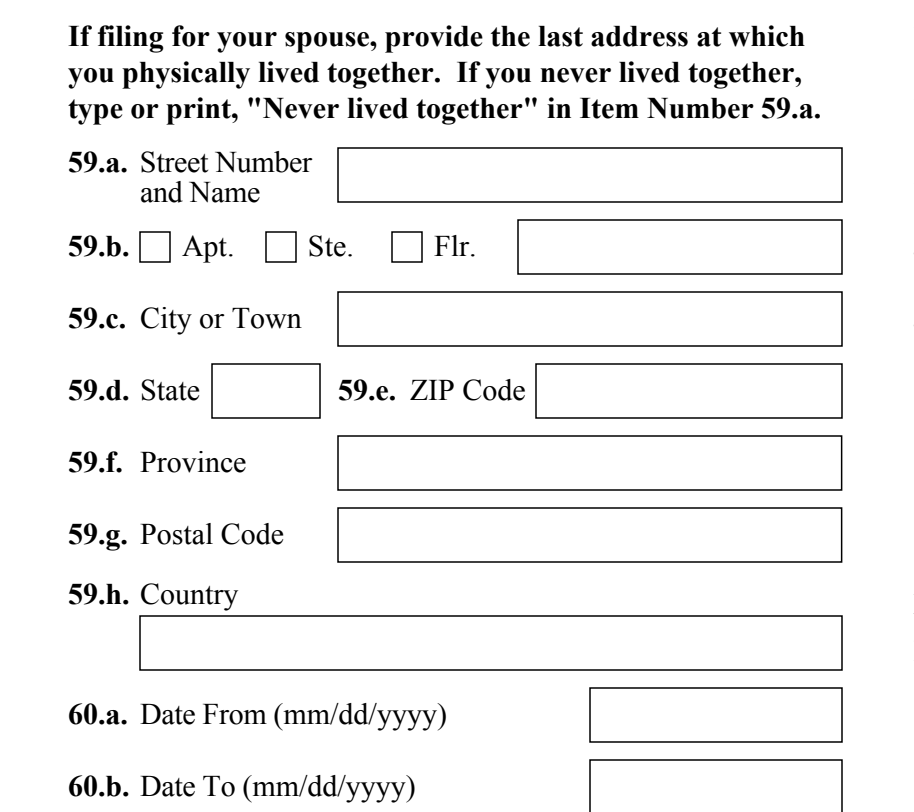
Verbatim · Part 4 note above Item 59 (Form I-130, edition 04/01/24, page 8)
“If filing for your spouse, provide the last address at which you physically lived together. If you never lived together, type or print, "Never lived together" in Item Number 59.a.”
59.a. Street Number and Name 59.b. Apt./Ste./Flr. 59.c. City or Town 59.d. State 59.e. ZIP Code
59.f. Province 59.g. Postal Code 59.h. Country
60.a. Date From (mm/dd/yyyy) 60.b. Date To (mm/dd/yyyy)
The I-130 Instructions do not separately walk through Item 59; the note printed on the form itself is the controlling guidance. Always complete the current edition from uscis.gov/i-130; USCIS rejects outdated editions.
What goes in Items 59 and 60 by situation
Item 59 asks for the last shared home and Items 60.a/60.b ask for the dates. Find the row that matches your facts.
| Your situation | Item 59 | Items 60.a / 60.b |
|---|---|---|
| Married abroad, spouse still lives overseas, never shared a home | Type "Never lived together" in 59.a | Leave the date fields blank |
| Lived together in the U.S., then the spouse returned abroad | The U.S. address you shared | The from and to dates at that address |
| Lived together abroad before the petitioner moved back to the U.S. | The foreign address you shared (use 59.f to 59.h) | The from and to dates abroad |
| Lived in several shared homes together | The last (most recent) shared address only | The from and to dates for that last address |
| Still living together now | Your current shared address | The from date, with the to date as "PRESENT" per the form's date convention |
How to fill it in
Four steps. The first decides whether you list an address or use the form's “Never lived together” wording.
Decide if you have ever physically lived together
Physically lived together means you shared a home as a couple. Dating visits, holidays, and trips to see each other do not count. If you have never shared a home, skip to the next step. If you have, find the last address you shared.
If you never lived together, use the form's wording
Type or print "Never lived together" in Item 59.a exactly as the note above the field instructs. This is the answer the form expects for couples who married overseas and have not yet shared a home. It is a routine, allowed entry.
If you did live together, list the last shared address
Enter the most recent address you shared in Items 59.a through 59.h: street and number, any apartment or suite, city, and either state and ZIP code for a U.S. address or province, postal code, and country for a foreign one.
Enter the dates in Items 60.a and 60.b
Put the date you began living at that shared address in 60.a (Date From) and the date you stopped in 60.b (Date To), both in mm/dd/yyyy. If you still live there together, follow the form's date convention for an ongoing address.
Marriage-based filers: this field exists only for spouses
Item 59 and Items 60.a/60.b are spouse-only fields. They ask whether you and your immigrant spouse have ever shared a home, and if so, where and when. The petitioner is the U.S. citizen or green card holder filing the form; the beneficiary is the immigrant spouse. If you have shared a home, you enter the last shared address and its dates. If you have not, you enter “Never lived together” in Item 59.a.
A “Never lived together” entry is routine in consular cases, where a couple married abroad and the immigrant spouse is still overseas waiting for the visa. The form provides those exact words for that situation, so it is a normal answer, not a mark against the petition.
Not sure how to enter your living history?
Our software asks a few plain questions about you and your spouse and fills Item 59 and the date fields the right way, keeping your I-130 consistent with the rest of your packet.
Start FreeWhat USCIS does with this field
Item 59 and its dates give USCIS a factual snapshot of the couple's living history: whether you have shared a home and, if so, where and when. On a marriage petition USCIS reviews whether the marriage is genuine, and a cohabitation history is one data point among many. A "Never lived together" entry is expected in plenty of consular cases where the couple married abroad and the immigrant spouse has not yet moved to the United States, so it does not by itself signal a problem. USCIS reads this field alongside the rest of the petition and the supporting evidence you provide.
Common mistakes
These are the ones that show up most often on this field.
- 1
Counting visits as living together
Trips to see each other, vacations, and short stays are not the same as sharing a home. If the only time you were under one roof was during visits, the accurate entry is "Never lived together" in Item 59.a.
- 2
Listing the first shared address instead of the last
If you lived together in more than one place, Item 59 asks for the last (most recent) shared address. Filers sometimes enter the first home they shared by mistake.
- 3
Leaving Item 59 blank when you never lived together
A blank field reads as unanswered. The form provides a specific entry: type or print "Never lived together" in 59.a. Use those words rather than leaving the field empty.
- 4
Filling in dates that do not match the address
Items 60.a and 60.b are the dates for the address in Item 59, not your whole relationship timeline. If you entered "Never lived together," there are no dates to add.
Related guides
Form and pathway context
Frequently asked questions
We married abroad and have never shared a home. What do we put?
Type or print "Never lived together" in Item 59.a, exactly as the note above the field says. This is a common and accepted entry for couples who married overseas while the immigrant spouse still lives abroad. There are no dates to enter in Items 60.a and 60.b.
Do visits or vacations count as living together?
No. "Physically lived together" means a home you actually shared as a couple. Trips to see each other, holidays, and short stays do not count. If those visits are the only time you were together under one roof, the accurate answer is "Never lived together."
We lived together in two different places. Which address goes in Item 59?
The last one. Item 59 asks for the last (most recent) address where you physically lived together, and Items 60.a and 60.b are the from and to dates for that address.
Is "Never lived together" a red flag that will get our case denied?
No. The form builds in this exact answer because it is normal in consular cases where a couple married abroad and the spouse has not yet moved to the United States. USCIS reviews the marriage based on the full petition and supporting evidence, not on this one field.
We still live together now. What do we put in the date fields?
Enter your current shared address in Item 59 and the date you started living there in Item 60.a (Date From). For an ongoing address, follow the form's date convention for an address you still occupy.
Does this field apply if I am not filing for a spouse?
No. Item 59 and Items 60.a/60.b appear only on spousal petitions and ask about a shared home. They do not apply when the petition is for a parent, child, or sibling.
Key takeaways
- ✓
Item 59 asks for the last address where you and your spouse physically lived together; Items 60.a and 60.b are the from and to dates for that address.
- ✓
This field appears only on spousal petitions, since it asks about a shared home.
- ✓
Visits, vacations, and trips to see each other do not count as physically living together.
- ✓
If you have never shared a home, type or print "Never lived together" in Item 59.a; this is a routine, accepted entry in consular cases.
- ✓
If you lived together in more than one place, list the last (most recent) shared address.
This page is for educational purposes only and is not legal advice. Green Card Genius is self-help immigration software, not a law firm, and does not provide legal representation. Immigration law and USCIS policy change frequently. For advice on a specific case, consult a licensed immigration attorney. Form I-130, edition 04/01/24. Last verified May 2026.
Stay informed
Green card guides in your inbox
Practical, plain-English updates to help you navigate the process with confidence.
Unsubscribe anytime.
Continue reading
- 01Form I-130: Petition for Alien Relative (2026 Guide)
- 02I-485 Place and Date of Last Arrival (Part 1, Items 10-12) (2026)
- 03How to Prove Your Marriage is Real to USCIS (2026 Evidence Guide)
- 04I-864 Part 5, Item 1: Total Number of Persons in Household (2026)
- 05Marriage Green Card by Country: Country-Specific Guides (2026)
Be a Genius
Only pay when you file