Mexico Civil Documents · Updated May 2026
CURP and U.S. Immigration: What It Is, Where to Find It, and How to Translate It
You don’t submit CURP separately to USCIS, but it still trips up thousands of applicants every year through avoidable RFEs.
Summary
You don’t submit CURP separately to USCIS. It appears on the Mexican civil documents you do submit, and the translator must reproduce all 18 characters verbatim. Skipping or summarizing it is the #1 cause of a Mexican document RFE.
At a Glance
| Topic | Details |
|---|---|
| What CURP stands for | Clave Única de Registro de Población (Mexico's 18-character national population registry code) |
| Required for USCIS? | Yes, indirectly. Every visible field on a Mexican civil document must be translated. CURP appears on birth certificates, marriage certificates, and death certificates. It must be reproduced character-for-character. Never summarize. |
| Required for consular processing? | The CURP itself is not submitted separately to the consulate. It appears on the civil documents you do submit, and must be translated verbatim in those translations. |
| Where to look up your CURP | consulta.curp.gob.mx (free, official RENAPO lookup). Enter full name, date of birth, state of birth, and sex. |
| Most common translation error | Summarizing or abbreviating the CURP instead of reproducing all 18 characters exactly as they appear on the document. This triggers an RFE. |
| What if CURP is missing from your document? | Order a new certified copy from miregistrocivil.gob.mx. The current formato único (post-2016) includes the CURP. Older sepia-format certificates may not. |
Free tool
Marriage Green Card Cost Calculator
2026 · AOS · full packet
$3,005
See your exact 2026 USCIS filing fees for a marriage green card through Adjustment of Status, with a full line-item breakdown and the costs most guides leave out.
Free — enter your email and it opens right up. Unsubscribe anytime.
We post free tips on preparing your marriage green card. Follow along:
Why CURP Matters for USCIS
CURP (Clave Única de Registro de Población) is Mexico’s 18-character national registry code, assigned to every person born in Mexico or naturalized as a Mexican citizen. You don’t submit it separately to USCIS. What makes it matter: it appears on every civil document you do submit, birth certificate, marriage certificate, and under 8 CFR 103.2(b)(3), every foreign-language document submitted to USCIS must be accompanied by a complete certified English translation. “Complete” means every visible element, including the CURP.
USCIS adjudicators check that the CURP in the translation matches the CURP on the original document. A mismatch, or an absent CURP, signals that the translation is incomplete. The result is a Request for Evidence (RFE) asking for a corrected translation.
Translation Rules for CURP
When briefing your translator, or when reviewing a translation before submission, verify these rules are followed:
- 1Reproduce all 18 characters exactly as they appear: no spaces, no dashes, no abbreviation. BAGL870412HCHRRN09 is not the same as BAGL870412HCHRRN0 (missing the last digit) or BAGL870412... (abbreviated).
- 2Do not describe the CURP with a phrase like 'Mexican national ID: BAGL870412HCHRRN09' if the document just shows 'CURP: BAGL870412HCHRRN09'. Match the label exactly.
- 3The CURP is case-sensitive in display: it is always uppercase. Reproduce it in uppercase.
- 4If the CURP appears in multiple places on the document (header, body, and footer, for example), reproduce it in every position it appears in the translation.
- 5The translator's Certificate of Accuracy must state they are competent to translate from Spanish to English and that the translation is complete. The CURP must be included under that certification.
How to Look Up Your CURP
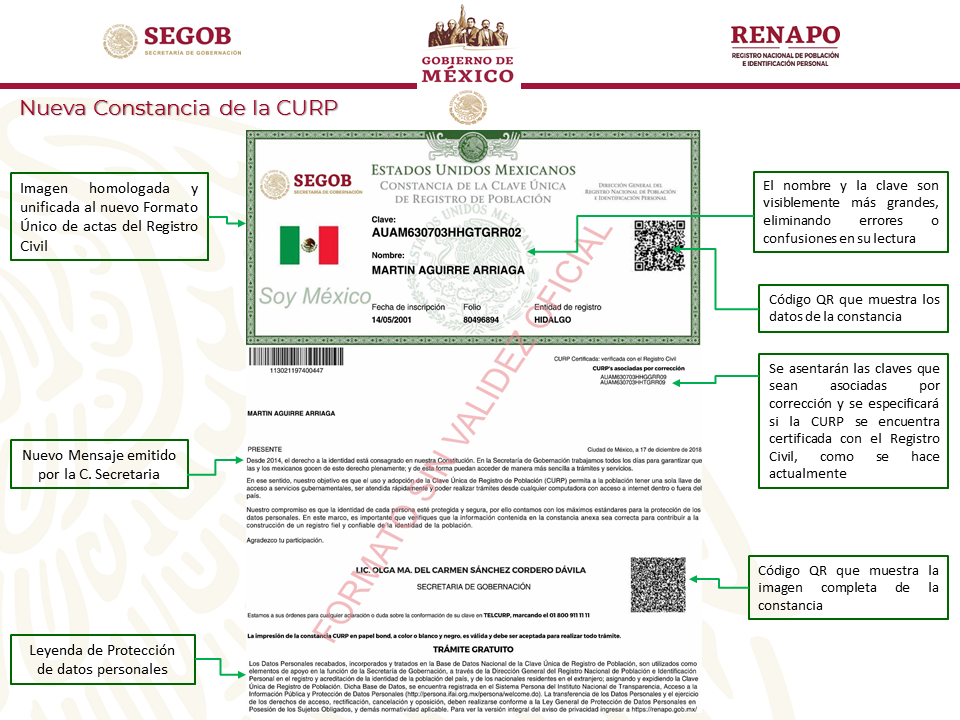
If you do not know your CURP or cannot read it clearly on an older document, the official RENAPO portal gives you the authoritative record for free.
Step 1: Go to consulta.curp.gob.mx
This is the official RENAPO (Registro Nacional de Población) lookup portal. It is free. You do not need an account to search.
Step 2: Enter your information
You need: first name (primer nombre), apellido paterno, apellido materno, date of birth (day, month, year), state of birth, and sex. If you have a compound first name (e.g., María José), enter both parts.
Step 3: Copy the full 18 characters
The result page shows your CURP. Copy all 18 characters exactly, including the final digit. The portal also lets you download a CURP certificate (Constancia de CURP) as a PDF. Download it for your records.
What CURP Is
CURP stands for Clave Única de Registro de Población (Unique Population Registry Code). It is Mexico’s national identifier, assigned by RENAPO (Registro Nacional de Población) to every person born in Mexico or naturalized as a Mexican citizen. The code is 18 characters long and encodes information about the person’s name, date of birth, sex, and state of birth.
CURP appears on Mexican birth certificates, marriage certificates, and most other civil documents issued after 2004. On the current formato único (the digital green-format certificate issued since 2016), CURP appears prominently on the face of the document. Older sepia-format certificates may have it printed in smaller type or, in some cases, not at all.
How the 18-Character Code Works
Understanding the structure helps you verify that a CURP is complete and correctly reproduced. A CURP always has exactly 18 characters. Example: BAGL870412HCHRRN09
| Position | What it encodes |
|---|---|
| 1–2 | First two letters of apellido paterno (paternal surname) |
| 3 | First internal vowel of apellido paterno |
| 4 | First letter of apellido materno (maternal surname) |
| 5–6 | First two letters of first given name (primer nombre) |
| 7–12 | Date of birth: YYMMDD format |
| 13 | Sex: H (hombre/male) or M (mujer/female) |
| 14–15 | Two-letter state of birth code (e.g., CH for Chihuahua, DF or CM for Mexico City) |
| 16–17 | Two consonants derived from the full name (differentiator to avoid duplicates) |
| 18 | Verification digit: number 0–9 or letter A |
A CURP that is 17 or 19 characters long is wrong. If the one in your translation does not match the character count on the original document, the translation needs to be corrected.
Frequently Asked Questions
What is a CURP and why does it appear on Mexican immigration documents?
CURP stands for Clave Única de Registro de Población. It is Mexico's 18-character national population registry code, assigned to every person born in Mexico or naturalized as a Mexican citizen. It appears on birth certificates, marriage certificates, and other civil documents as a unique identifier. Because every visible field on a civil document must be translated for USCIS under 8 CFR 103.2(b)(3), the CURP must appear in the translation exactly as it appears on the original document.
Does USCIS require me to submit my CURP separately?
No. USCIS does not ask for a CURP as a standalone document. The CURP becomes relevant because it appears on Mexican civil documents you do submit (birth certificate, marriage certificate, etc.) and must be translated verbatim in the certified English translation of those documents. An RFE is triggered when a translator omits or abbreviates the CURP rather than reproducing it character-for-character.
What happens if my CURP is missing or wrong in my translation?
USCIS may issue a Request for Evidence (RFE) asking for a corrected translation. The fix is to get a new certified translation that reproduces the CURP in full. If the CURP does not appear on your original document (older certificates sometimes lack it), order a new certified copy from miregistrocivil.gob.mx. The current formato único includes the CURP. Bring the new copy to a translator who understands the verbatim requirement.
How do I look up my CURP if I don't know it?
Go to consulta.curp.gob.mx, the official RENAPO portal. Enter your full name, date of birth, state of birth, and sex. The portal will return your CURP and let you download an official Constancia de CURP certificate. This is free and does not require a Mexican phone number or account.
My CURP on the birth certificate looks different from the one RENAPO shows. Which is correct?
Use the CURP exactly as it appears on the civil document you are submitting to USCIS. If there is a discrepancy between the document and the RENAPO database, this may indicate a data-entry error in one of the two systems. Do not attempt to correct the document yourself. Note the discrepancy in a cover letter and consider consulting an immigration attorney before submitting, as a mismatch can cause additional scrutiny.
Can my translator just describe what the CURP is instead of copying it?
No. USCIS requires the translation to reproduce every visible element of the document. Replacing the CURP value with a description like '18-character Mexican ID code' is not a complete translation. The actual 18-character string must appear in the translation. This is the single most common CURP-related RFE trigger.
Key Takeaways
- ✓
CURP is Mexico's 18-character national registry code. It appears on birth certificates, marriage certificates, and other civil documents.
- ✓
For USCIS, the CURP must be reproduced character-for-character in the certified English translation of any document that shows it. Summarizing or abbreviating it triggers an RFE.
- ✓
If your document is missing the CURP, order a new certified copy from miregistrocivil.gob.mx. The post-2016 formato único includes the CURP; older sepia-format certificates may not.
- ✓
To look up your CURP, go to consulta.curp.gob.mx (free, official RENAPO lookup). No account or Mexican phone number required.
- ✓
If the CURP on your document differs from the RENAPO database, note it in a cover letter and do not try to correct it yourself. A mismatch can draw scrutiny.
Putting together your green card document packet?
Green Card Genius walks you through every document, form, and translation requirement for your specific filing pathway.
See if you’re a good fitStay informed
Green card guides in your inbox
Practical, plain-English updates to help you navigate the process with confidence.
Unsubscribe anytime.
Be a Genius
Only pay when you file