Mexico Civil Documents · Updated May 2026
Mexican Birth Certificate (Acta de Nacimiento) for U.S. Immigration: Complete 2026 Guide
Order it online in minutes, apostille it at the right government office, and translate every field that USCIS will check.
Summary
For adjustment of status (I-485 inside the U.S.), no apostille is needed: only a certified English translation. For consular processing via NVC, get the apostille from your state Secretaría General de Gobierno (not the SRE). Order a fresh certified copy at miregistrocivil.gob.mx for under $15 USD. Translate every field including CURP and all marginal notes.
At a glance
| Topic | Details |
|---|---|
| Where to order | miregistrocivil.gob.mx (online, immediate) |
| Document cost | MXN $54–$239 by state (about $3–$14 USD) as of May 2026. Verify before ordering. |
| Apostille for AOS (I-485) | Not required. USCIS only needs a certified English translation. |
| Apostille for consular processing | Yes. Go to the Secretaría General de Gobierno of the issuing state (not the SRE). |
| Apostille cost | Less than MXN $200 in most states (about $5–$12 USD). Verify with your state. |
| Translation required | Always. Every visible field including CURP and anotaciones marginales. |
| Common RFE trigger | Missing CURP or untranslated marginal notes. |
Free tool
Marriage Green Card Cost Calculator
2026 · AOS · full packet
$3,005
See your exact 2026 USCIS filing fees for a marriage green card through Adjustment of Status, with a full line-item breakdown and the costs most guides leave out.
Free — enter your email and it opens right up. Unsubscribe anytime.
We post free tips on preparing your marriage green card. Follow along:
What is an acta de nacimiento?
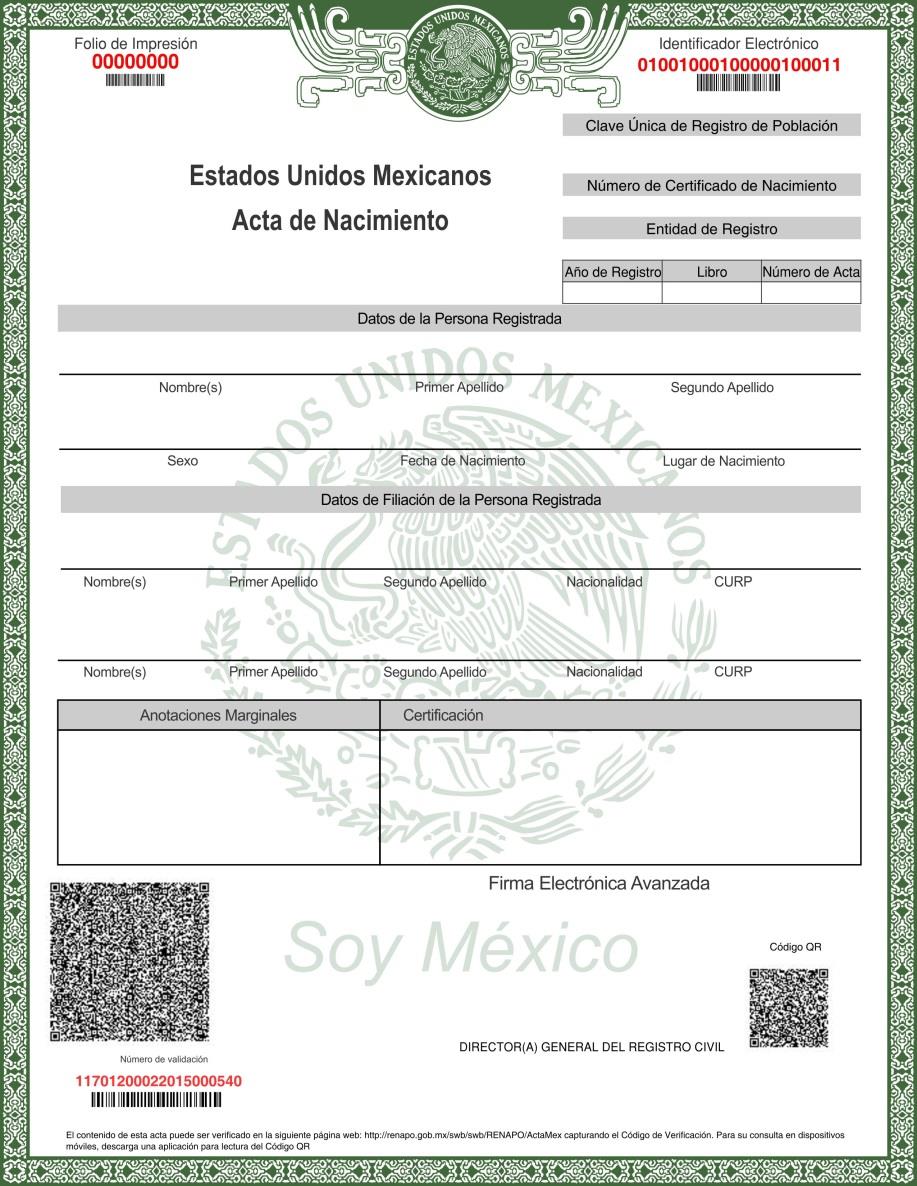
An acta de nacimiento is the official Mexican birth certificate, issued by the state civil registry (Registro Civil) where you were born. Every major U.S. immigration form that involves a foreign-born applicant requires one: I-130, I-485, I-129F (K-1), and the immigrant visa application at the consulate.
Since 2016, Mexico uses a standardized green formato único nationwide. Pre-2016 certificates in the older sepia format remain fully valid for U.S. immigration. Since 2018, certified copies can be generated online with a QR code through the RENAPO national registry, confirmed by the State Department Mexico reciprocity page (verified May 2026).
How to order a certified copy online
The fastest way to get a certified copy is through miregistrocivil.gob.mx (the platform behind the gob.mx/actas shortlink). You can do this from anywhere in the world, including from inside the U.S.
Step 1: Create a Llave MX account
Llave MX is Mexico's secure government login. You need a valid email address, a phone number for SMS verification (a Mexican number is helpful but not always required), and a password. Account creation takes about five minutes.
Step 2: Enter your CURP or birth details
If you know your CURP (18-character Mexican national ID code), enter it directly. If not, enter your full name, date of birth, and state of birth to search the RENAPO database.
Step 3: Pay online and download
Pay by credit or debit card. The cost is MXN $54 to $239 depending on your state of birth (verified May 2026; verify before ordering as state fees are updated annually). The certified PDF with QR code is available to download immediately.
Do you need an apostille?
The answer depends entirely on whether you are adjusting status inside the U.S. or going through consular processing.
Adjustment of Status (AOS)
No apostille required. For I-485 (and the accompanying I-130), USCIS only requires a certified English translation per 8 CFR 103.2(b)(3).
Consular Processing (NVC + Embassy)
Apostille required. When your documents go to NVC and then to a U.S. consulate abroad, an apostille on the birth certificate is expected. Get it before submitting to NVC.
Mexico joined the Hague Apostille Convention in 1995, so apostilles from Mexican government authorities are recognized by U.S. consulates.
How to get the apostille: state government, not the SRE
Birth certificates are state civil registry documents, so the apostille must come from the Secretaría General de Gobierno of the state where the birth was registered. The federal SRE only apostilles federal documents. If you go to the SRE with a birth certificate, they will turn you away.
Step 1: Obtain a current certified copy
Get a fresh certified copy from miregistrocivil.gob.mx or the Registro Civil. Photocopies cannot be apostilled; you need an original certified copy with an official seal.
Step 2: Find your state's Secretaría General de Gobierno
Each state's Secretaría General de Gobierno is the apostille authority for civil documents in that state. Search for your state name plus 'apostilla acta de nacimiento' to find the current office and address.
Step 3: Submit in person (or through a representative)
Bring the original certified copy, a valid official ID (INE voter card or passport), and payment. A family member or authorized third party can submit on your behalf. Call ahead to confirm whether an appointment is needed.
Step 4: Receive the apostille
The apostille is a seal or sticker affixed to the document with a verification number. Most offices complete small batches the same day (five or fewer documents typically done within 90 minutes). Fees are under MXN $200 in most states (verified May 2026; verify with your state before going).
Source: Schmidt & Schmidt, Apostille in Mexico 2025 (verified May 2026)
Translation requirements
A certified English translation is required for every immigration filing that includes an acta de nacimiento. Under 8 CFR 103.2(b)(3), every foreign-language document must be accompanied by a complete translation and a signed Certificate of Accuracy.
What every translator must include
- 1CURP (Clave Única de Registro de Población): reproduce all 18 characters exactly as they appear. Do not summarize or describe.
- 2Both surnames: apellido paterno and apellido materno as separate surnames, not merged into one. Example: 'García Hernández' stays as two surnames.
- 3Parents' and grandparents' full names, including both of their surnames each.
- 4Registry identifiers: book number, entry number, page number, and oficialía (registry office) designation.
- 5Registration date and place of birth with the original Spanish place names (transliterated, not translated). 'Nuevo León' stays 'Nuevo León'. Never 'New Lion'.
- 6All stamps and seals: describe their content and official nature.
- 7Anotaciones marginales (marginal notes): translate every marginal note fully. These record name corrections, paternal recognition, adoptions, and corrections. Omitting them is the most common RFE trigger.
- 8QR code: describe as '[QR code for online verification]'. Do not reproduce the code itself.
Certificate of Accuracy wording
The translator must sign a statement that includes: (1) they are competent to translate from Spanish to English, and (2) the translation is complete and accurate. A generic "certified translation" stamp without the competency language has caused RFEs.
Delayed birth registration (extemporánea)
A delayed registration is a birth registered more than three years after it occurred. It does not automatically disqualify you, but it will trigger additional scrutiny at USCIS or the consulate.
What to prepare if your registration is delayed
- •Your parents' original birth certificates (both, if possible)
- •Birth certificates of siblings born in the same period
- •School enrollment records from your childhood (any year that shows your name and date of birth)
- •Baptismal records or church registrations from your birth year
- •A cover letter explaining the circumstances of the delayed registration
What applicants report
Aggregated from immigration translation guides, VisaJourney forums, and USCIS-documented RFE patterns. Confirm the specifics for your case before you act.
Tips from the community
Order a fresh digital copy before filing
The current formato único from miregistrocivil.gob.mx is digitally generated with a QR verification code. It costs under $15 USD, is always legible, and eliminates any format or photocopy objection from USCIS. Older physical copies can have faded ink or missing annotations that cause RFEs.
Documented in multiple USCIS translation guides and State Dept reciprocity page
Get the apostille before the translation
If your pathway requires an apostille, have the apostille affixed first. Then translate the entire package, apostille included, so nothing is missed. Translating before apostilling and then needing to re-translate the apostille text is a preventable extra cost.
Noted in certtranslate.com apostille-translation guide
Use the same translator for every document in your packet
Mexico's two-surname system (apellido paterno + apellido materno) renders your name differently from the way it appears on U.S. documents. Using the same translator for your acta de nacimiento, marriage certificate, and any other civil documents ensures consistent name rendering across the packet and avoids the most common RFE trigger.
Flagged in certtranslate.com USCIS translation guide and acta translation guide
Check for marginal notes before submitting
Anotaciones marginales (marginal notes) record name corrections, paternal recognition, or adoptions. They must be translated in full. If your physical copy does not show them clearly, order a fresh digital copy, which pulls from the complete RENAPO record.
Identified as a top RFE trigger in certtranslate.com Mexican birth certificate USCIS guide
You can order from the U.S. without traveling to Mexico
miregistrocivil.gob.mx allows anyone with a Llave MX account and the registrant's CURP to order a certified copy from abroad. No consulate visit required for the document itself. Create the Llave MX account in advance, as SMS verification to a Mexican phone number is sometimes required.
Confirmed by miregistrocivil.gob.mx and Mexican consulate resources
Common rejection patterns
| Issue | Fix |
|---|---|
| CURP missing or summarized in translation | Reproduce all 18 characters exactly as shown |
| Marginal notes (anotaciones marginales) omitted | Order fresh digital copy; ensure translator includes all anotaciones |
| Name inconsistency across packet (two-surname system) | Same translator for all documents; add naming convention note |
| Certificate of Accuracy missing competency language | Translator must explicitly state competence to translate Spanish to English |
| Short-form extract submitted instead of full certified copy | Submit the full copia certificada with parents' names and registry data |
| Illegible older document (faded ink, poor scan) | Order a new certified copy from miregistrocivil.gob.mx |
| Photocopy submitted instead of certified copy | Only original certified copies or the digital formato único with QR code |
| Wrong apostille authority (went to SRE, not state government) | Go to Secretaría General de Gobierno of the issuing state |
Sources
- U.S. Department of State: Mexico Reciprocity and Civil Documents (verified May 2026)
- RENAPO: miregistrocivil.gob.mx (verified May 2026)
- U.S. Department of State: Immigrant Visa Civil Document Requirements (verified May 2026)
- U.S. Consulate General Ciudad Juárez: Supplement Page (verified May 2026)
- Schmidt & Schmidt: Apostille in Mexico 2025 (verified May 2026)
- 8 CFR 103.2(b)(3): translation requirements for foreign-language documents
- VisaJourney forum reports on delayed registration documentation, 2024
Frequently asked questions
Does a Mexican birth certificate need an apostille for U.S. immigration?
It depends on your pathway. For adjustment of status (I-485 filed inside the U.S.), USCIS does not require an apostille. Only a complete certified English translation is required under 8 CFR 103.2(b)(3). For consular processing through NVC and a U.S. consulate abroad, an apostille may be requested. If you are going through Ciudad Juárez or any other U.S. consulate, get the apostille before you submit your documents to NVC.
How do I order a certified copy of my Mexican birth certificate from the U.S.?
Go to miregistrocivil.gob.mx (the current platform behind the gob.mx/actas link). Create a Llave MX account, enter your CURP or full birth details, and pay online. The certified digital copy with a QR verification code is available immediately to print. Cost is MXN $54 to $239 depending on your state, roughly $3 to $14 USD.
Who apostilles a Mexican birth certificate: the SRE or the state government?
The state government, not the SRE (Secretaría de Relaciones Exteriores). Birth certificates are issued by state-level civil registry offices (Registro Civil), so the apostille must come from the Secretaría General de Gobierno of the state where the birth was registered. The SRE only apostilles federal documents such as professional titles from SEP or federal criminal background certificates. Going to the SRE for a birth certificate apostille is a common and costly mistake.
How long does it take to get a state apostille on a Mexican birth certificate?
Most state Secretaría General de Gobierno offices process apostilles the same day for small batches (1 to 5 documents within about 90 minutes is typical). Some offices require an appointment. Call the specific state office before traveling, especially if you are submitting more than five documents at once.
What are the translation requirements for submitting an acta de nacimiento to USCIS?
Every visible element on the document must be translated: CURP (reproduced character-for-character, not summarized), both surnames (paternal and maternal), parents' and grandparents' full names, registry book and entry numbers, oficialía designation, registration date, all stamps, and all marginal notes (anotaciones marginales). The translator must attach a signed Certificate of Accuracy stating they are competent to translate from Spanish to English and that the translation is complete and accurate. Notarization is not required unless specific form instructions say otherwise.
My birth certificate shows a delayed registration (extemporánea). Will that cause problems?
A delayed registration, defined as a birth registered more than three years after it occurred, can trigger extra scrutiny at the consulate or from USCIS. You will need corroborating documents to establish your birth date and identity. Useful supporting documents include your parents' birth certificates, siblings' birth certificates, school enrollment records, and baptismal records. Present these proactively with a cover letter explaining the delayed registration.
How recent does my Mexican birth certificate need to be?
USCIS does not set an expiration date for Mexican birth certificates because they document a historical fact. The State Department reciprocity page for Mexico confirms both the post-2016 green formato único and older sepia-format certificates remain valid. That said, ordering a fresh certified copy from miregistrocivil.gob.mx is the right call: it is digitally generated, always legible, and costs under $15 USD.
Key takeaways
- ✓
Order from miregistrocivil.gob.mx: a fresh certified digital copy with a QR code costs MXN $54 to $239 (about $3 to $14 USD) and is accepted by USCIS and the State Department.
- ✓
Apostille is state-level, not federal: the Secretaría General de Gobierno of the issuing state handles birth certificate apostilles. The SRE only apostilles federal documents. Going to the SRE for a birth certificate apostille is a common mistake.
- ✓
AOS applicants do not need an apostille at all. For adjustment of status filed inside the U.S., only a certified English translation is required.
- ✓
Missing CURP or marginal notes in the translation is the most common RFE trigger. Every character of the CURP must be reproduced, and anotaciones marginales must be fully translated.
- ✓
A delayed birth registration (extemporánea) does not bar you but requires corroborating documents: parents' birth certificates, siblings' birth certificates, school records.
- ✓
Both the green formato único (post-2016) and the older sepia format are valid for U.S. immigration. The State Department reciprocity page for Mexico explicitly confirms both.
Collecting documents for consular processing?
Green Card Genius guides you through every step of the consular processing path, including which civil documents NVC requires and in what order. See if it fits your situation.
See how it worksStay informed
Green card guides in your inbox
Practical, plain-English updates to help you navigate the process with confidence.
Unsubscribe anytime.
Continue reading
- 01Consular Processing Guide (2026): Marriage Green Card
- 02Panel Physicians in Ciudad Juárez: Which Clinic Should You Use? (2026)
- 03Ciudad Juárez U.S. Consulate Interview Trip: Hotels, Border Crossings, and What to Expect
- 04CURP and U.S. Immigration: What It Is, Where to Find It, and How to Translate It
Be a Genius
Only pay when you file