Form I-765 · Part 2, Items 24-25
I-765 Immigration Status at Your Last Arrival (Part 2, Items 24-25): What to Enter in 2026
Part 2 asks two status questions in a row: Item 24, the class you were admitted in at your last arrival, and Item 25, the status you hold right now. Here is which is which and what a marriage-based filer enters.
Quick answer
Item 24 (Immigration Status at Your Last Arrival) is the class you were admitted in the last time you entered, copied straight from your Form I-94 arrival record: for a fiance(e) who entered on a K-1 visa, that is "K-1." Item 25 (Your Current Immigration Status or Category) is the status you hold right now. If you are still in a valid, unexpired status, write that status. If your status has expired, you overstayed, you entered without inspection, or you would write "no status," stop and speak with an immigration attorney before answering.
Summary
Form I-765, Part 2, asks two different status questions back to back. You are the applicant, the person requesting a work permit (Employment Authorization Document, or EAD); on a marriage-based case your U.S. citizen or green card holder spouse is the petitioner who filed the Form I-130 for you. Item 24, "Immigration Status at Your Last Arrival," is historical: it is the class you were admitted in the last time you entered the United States, taken from your Form I-94 (the arrival/departure record a U.S. officer created when you were admitted). Item 25, "Your Current Immigration Status or Category," is present-tense: the status you hold today. For someone who entered on a K-1 fiance(e) visa, Item 24 is "K-1." For someone currently in a valid nonimmigrant (temporary) status such as F-1 or H-1B, Item 25 is that same status. The form and its instructions want a short letter-and-number status code (for example "B-2 visitor" or "F-1 student"), not a sentence. If your status has lapsed, you overstayed a visa, you entered without inspection, or your honest answer to either field would be "no status," that is a legal-eligibility question about whether you can apply for your green card from inside the country (adjustment of status), not a box to guess. Speak with an immigration attorney first.
| What Item 24 asks | Immigration Status at Your Last Arrival: the class you were admitted in the last time you entered the United States. The instructions want the letter-and-number code that matches that status, for example "B-2 visitor" or "F-1 student." |
| What Item 25 asks | Your Current Immigration Status or Category: the status you hold right now, which can differ from how you last entered. Same format: a short status code such as "F-1 student." |
| Where to read Item 24 from | Your Form I-94 arrival record and the admission stamp or visa you entered on. The class of admission is printed there. It does not change based on what has happened since. |
| K-1 fiance(e) entrant | Item 24 is "K-1," the class shown on your I-94 when you were admitted as a fiance(e). Item 25 is your status right now: still within your K-1 admission period, it is "K-1." Once that period has ended, your current status is an attorney question (see below). |
| Attorney territory | An expired status, a visa overstay, an entry without inspection, or any answer of "no status" for either field affects whether you can adjust status at all. Do not guess it. Have an immigration attorney review your facts first. |
Who this page is for
This page covers someone who was inspected and admitted at a port of entry and is either still in a valid status or reading their admission class off their records to fill in Items 24 and 25. It does not cover what your entry or your status means for your eligibility. If your status has expired, you overstayed a visa, you entered without inspection, or your honest answer to either field would be “no status,” those are legal questions with consequences for whether you can adjust status. Consult an immigration attorney before completing these fields. That branch is flagged again below.
Free tool
Marriage Green Card Cost Calculator
2026 · AOS · full packet
$3,005
See your exact 2026 USCIS filing fees for a marriage green card through Adjustment of Status, with a full line-item breakdown and the costs most guides leave out.
Free — enter your email and it opens right up. Unsubscribe anytime.
We post free tips on preparing your marriage green card. Follow along:
What Items 24 and 25 look like on the form
Both fields sit in Part 2, under “Information About Your Last Arrival in the United States,” a block that also collects your Form I-94 number (Item 17), your last arrival date and place (Items 22 and 23), and your SEVIS number if you have one (Item 26).
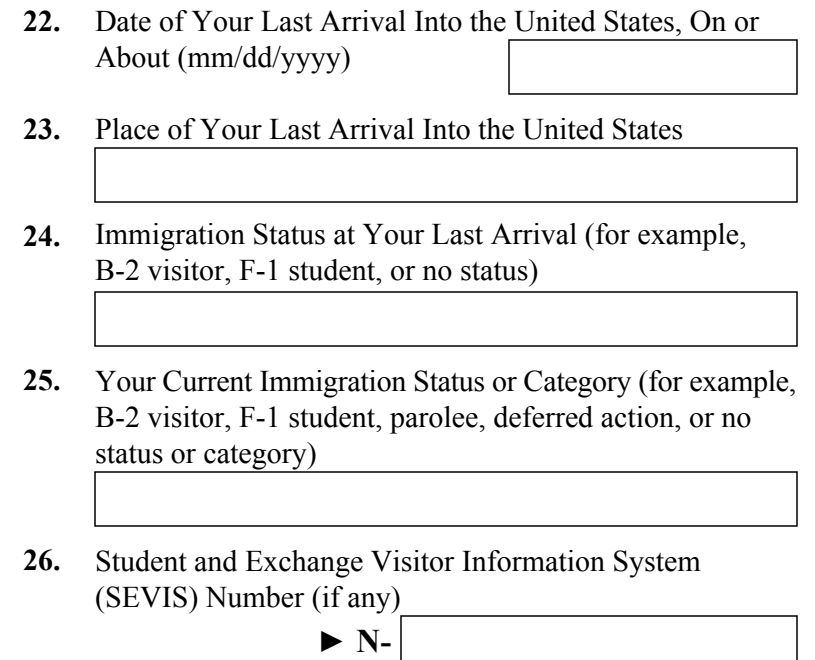
Verbatim · Form I-765, Part 2, Items 24 and 25 (edition 09/15/26, page 3)
“24. Immigration Status at Your Last Arrival (for example, B-2 visitor, F-1 student, or no status)”
“25. Your Current Immigration Status or Category (for example, B-2 visitor, F-1 student, parolee, deferred action, or no status or category)”
The instructions describe each field one line at a time. Item 24 is your status when you last entered:
Verbatim · I-765 Instructions, Item Number 24 (edition 09/15/26, page 19)
“Provide the letter and number that correlates with your status when you last entered the United States. For example, if you last entered the United States as a temporary visitor for pleasure, B-2, type or print “B-2 visitor” in the space provided.”
Item 25 is your status now:
Verbatim · I-765 Instructions, Item Number 25 (edition 09/15/26, page 19)
“Provide your current immigration status. For example, if your current status is student academic, F-1, type or print “F-1 student” in the space provided.”
In plain terms: Item 24 is a fact about the past that you copy from your admission record, and Item 25 is a fact about the present. They read the same way when your status has not changed since entry, and differently when it has.
Always complete the current edition downloaded from uscis.gov/i-765; USCIS rejects outdated editions.
Item 24 vs Item 25: which is which
The two fields look almost identical on the page. The difference is timeframe.
Item 24
Immigration Status at Your Last Arrival
Historical: fixed at the moment you were admitted
Your Form I-94 arrival record and the visa or admission stamp you entered on. The class of admission is printed there.
Item 25
Your Current Immigration Status or Category
Present: your status as it stands today
The status you hold right now. If you are still in the same valid status you entered on, Items 24 and 25 match. If your status changed after entry, they differ.
Which status code applies to you
Common ways a marriage-based filer entered, and what goes in each field. The K-1 fiance(e) row is the one most marriage cases start from.
| How you entered | Item 24 (last arrival) | Item 25 (current) |
|---|---|---|
| Entered on a B-2 visitor visa, still within the authorized stay | “B-2 visitor” | “B-2 visitor” while the admission period on your I-94 is still valid. |
| Entered on an F-1 student visa, program still active | “F-1 student” | “F-1 student” if you are maintaining F-1 status. Your SEVIS number goes in Item 26. |
| Entered on an H-1B worker visa, employment ongoing | “H-1B” | “H-1B” if you are still in valid H-1B status. |
| Entered on a K-1 fiance(e) visa | “K-1” | “K-1” while you are still within your K-1 admission period. Once that period ends, your current status is an attorney question. |
| Paroled into the United States | “Parolee” (the form lists parolee as a current-status example in Item 25) | Parole is a distinct situation with its own rules. Confirm your category with an attorney before answering. |
Stop here if your status has lapsed, you overstayed, or you entered without inspection
This branch involves how you entered and whether you are in a valid status now. If your status has expired, you overstayed a visa, you were not inspected and admitted at a port of entry, or your honest answer to Item 24 or Item 25 would be “no status,” the answer bears on whether you can adjust status inside the United States at all. Answering incorrectly can affect your green card eligibility in ways that are difficult to undo.
This page explains what the two fields are asking. It does not tell you how to answer them for that situation. An immigration attorney needs to review your facts before you complete these fields.
Find an immigration attorneyCommon mistakes on these fields
These are the ones that show up most often on Items 24 and 25.
- 1
Putting the same answer in both boxes without checking
Items 24 and 25 are the same only if your status has not changed since you entered. If you entered on one status and later changed to another, Item 24 stays the entry class and Item 25 reflects your status now. Read each field for its own timeframe.
- 2
Writing a sentence instead of the status code
The instructions ask for the letter and number that correlates with your status, shown as a short code such as “B-2 visitor” or “F-1 student.” A long description of your travel history in the box is not what either field wants.
- 3
Reading Item 24 off memory instead of your I-94
The class of admission is printed on your Form I-94 arrival record, which you can retrieve from the CBP website. Copy the admission class from the record rather than guessing, so Item 24 matches the government's entry data.
- 4
Confusing your visa type with your current status
The visa in your passport got you to the border; your status is what a U.S. officer admitted you in and what you hold now. They are usually the same at entry, but a visa can be expired while you are still in a valid status, or valid while your status has lapsed. Item 25 asks about status, not the visa foil.
- 5
Typing “no status” without getting advice first
The form lists “no status” as a possible answer, but that answer signals an overstay or an entry without inspection, which affects whether you can adjust status inside the country. Do not enter it on your own. The attorney-review box below covers this branch.
Not sure which status code goes in each box?
Our software asks a few plain questions about how you entered and where your status stands, fills Items 24 and 25 the right way, keeps them consistent across your whole I-130, I-485, and I-765 packet, and flags when your entry situation calls for an attorney.
Start FreeWhat USCIS does with your status answers
USCIS uses Items 24 and 25 to line up your work-permit request with its record of how you entered and what status you hold. The Item 24 class of admission is matched against your Form I-94 and the electronic entry record, and Item 25 tells the officer where you stand now, which the officer reads alongside the eligibility category you claim in Item 27 (for a pending marriage-based Form I-485, that category is (c)(9), the adjustment of status applicant code). Form I-765 must be filed while you are in the United States, so these fields also confirm your presence and entry for the adjudicator. The two answers are cross-checked against each other and against the rest of your packet: a current status in Item 25 that does not line up with the status history in the file can prompt a Request for Evidence (an RFE, a USCIS notice asking for more documents) and slow the case. This is a record-matching pair of fields, not a scoring one, which is why an answer that quietly signals an overstay or an entry without inspection is a legal question to resolve with counsel, not a string to type in without advice.
Related guides
Form and pathway context
Frequently asked questions
What is the difference between Item 24 and Item 25 on Form I-765?
Item 24, “Immigration Status at Your Last Arrival,” is historical: the class you were admitted in the last time you entered the United States, taken from your Form I-94 arrival record. Item 25, “Your Current Immigration Status or Category,” is present-tense: the status you hold right now. They match if your status has not changed since entry, and differ if it has.
I entered on a K-1 fiance(e) visa. What do I put for Item 24?
Item 24 is “K-1,” the class of admission shown on your Form I-94 when you were admitted as a fiance(e). That is a historical fact about how you entered and does not change. For Item 25 (your current status), if you are still within your K-1 admission period, it is “K-1”; once that period has ended, how to describe your current status interacts with your adjustment eligibility, so speak with an immigration attorney first.
How should I format the answer to Items 24 and 25?
The instructions ask for the letter and number that correlates with your status, entered as a short code. Their own examples are “B-2 visitor” for a temporary visitor for pleasure and “F-1 student” for an academic student. Use that short status-code style rather than a full sentence.
Where do I find my immigration status at last arrival?
It is your class of admission, printed on your Form I-94 arrival/departure record and reflected on the admission stamp or visa you entered on. If you were admitted at an airport or seaport after April 30, 2013, CBP likely issued an electronic Form I-94, which you can retrieve from the CBP website. Copy the admission class from that record.
My status expired or I overstayed. What do I put for my current status?
Stop and get advice before answering. An expired status, an overstay, or an entry without inspection means your honest answer could be “no status,” and that answer bears on whether you can adjust status inside the United States at all. That is a legal question about your eligibility, not a box to fill in on your own. An immigration attorney needs to review your specific facts first.
Key takeaways
- ✓
Item 24 (Immigration Status at Your Last Arrival) is historical: the class you were admitted in, copied from your Form I-94. Item 25 (Your Current Immigration Status or Category) is present-tense: the status you hold now.
- ✓
The two answers match only if your status has not changed since you entered; otherwise Item 24 stays the entry class and Item 25 reflects today.
- ✓
Both fields want a short status code such as “B-2 visitor” or “F-1 student,” per the instructions, not a sentence.
- ✓
A K-1 fiance(e) entrant puts “K-1” in Item 24; the current-status field turns on whether your K-1 admission period is still running.
- ✓
An expired status, a visa overstay, an entry without inspection, or any “no status” answer is an attorney question. Do not guess it on the form.
This page is for educational purposes only and is not legal advice. Green Card Genius is self-help immigration software, not a law firm, and does not provide legal representation. Immigration law and USCIS policy change frequently. For advice on a specific case, consult a licensed immigration attorney. Form I-765, edition 09/15/26. Last verified July 2026.
Stay informed
Green card guides in your inbox
Practical, plain-English updates to help you navigate the process with confidence.
Unsubscribe anytime.
Be a Genius
Only pay when you file