Form I-485 · Part 2, Item 2
I-485 Receipt Number of Underlying Petition (Part 2, Item 2): Where to Find It
What the “Receipt Number of Underlying Petition” field in Part 2, Item 2 wants, where the number sits on your Form I-797, and what to enter when you file concurrently before the petition is receipted.
Quick answer
Copy the 13-character receipt number (3 letters then 10 digits) printed on the Form I-797 Notice of Action that USCIS mailed for the Form I-130 your spouse filed for you. Enter it in Part 2, Item 2. If you are filing your I-485 in the same package as the I-130 (concurrent filing) and have not received an I-797 yet, you have no receipt number, and the field is marked "if any," so type "N/A."
Summary
Form I-485 Part 2, Item 2 asks for the "Receipt Number of Underlying Petition (if any)." You are the applicant, the immigrant spouse filing this I-485 to become a lawful permanent resident (a green card holder); your U.S. citizen or green card holder spouse is the petitioner who filed the underlying petition for you. For a marriage case, that underlying petition is Form I-130, Petition for Alien Relative, and its receipt number is the 13-character code (three letters followed by ten digits) printed on the Form I-797 Notice of Action USCIS mailed after the I-130 was filed. Copy that code into Item 2. The three letters at the front show where USCIS processed the petition (for example, IOE for a petition filed through a USCIS online account), but you enter the whole code exactly as printed, letters and all. The field is marked "if any" because a principal applicant who files the I-485 in the same package as the I-130 (concurrent filing) has not been issued a receipt number yet: in that case you enter "N/A." If your I-130 was denied or revoked, your petitioning spouse has died, or you are not sure whether a petition was ever filed for you, that is an attorney question, not a number to copy off a notice.
| What it asks | The receipt number of the immigrant visa petition your green card is based on. For a marriage case that is the Form I-130 your spouse filed. The field is marked "if any." |
| Where the number is | On the Form I-797 Notice of Action USCIS mailed for the I-130. It is the 13-character code (3 letters then 10 digits) labeled "Receipt Number" near the top of the notice. |
| If you are filing the I-130 and I-485 together | You have no receipt number yet. A principal applicant filing concurrently has not received an I-797 for the petition, so enter "N/A" per the instructions' general rule for questions that do not apply. |
| Principal vs derivative | A spouse of a U.S. citizen or lawful permanent resident is the principal applicant and uses the I-130 filed for them. A derivative applicant (a dependent applying under someone else's petition) uses the principal's petition number. |
| Attorney territory | A denied or revoked I-130, a petitioner who has died, or being unsure whether a petition exists or whether you file as principal or derivative affects whether you can adjust at all. Do not guess. Have an attorney review it. |
Who this page is for
This page covers reading the I-130 receipt number off your Form I-797 Notice of Action and knowing what to enter when you file concurrently before the petition is receipted. It does not cover which filing category to select (that is a separate field, Part 2, Item 3.a) or whether you are eligible to adjust status. If your underlying I-130 was denied or revoked, your petitioning spouse has died, or you are not sure whether a petition exists or whether you file as a principal or derivative applicant, those are legal questions with consequences for your case. Consult an immigration attorney before completing this field. That branch is flagged again below.
Free tool
Marriage Green Card Cost Calculator
2026 · AOS · full packet
$3,005
See your exact 2026 USCIS filing fees for a marriage green card through Adjustment of Status, with a full line-item breakdown and the costs most guides leave out.
Free — enter your email and it opens right up. Unsubscribe anytime.
We post free tips on preparing your marriage green card. Follow along:
What Item 2 looks like on the form
The receipt-number field sits at the top of Part 2 (Application Type or Filing Category), next to a box for the priority date and above where you mark whether you are filing as a principal or a derivative applicant.
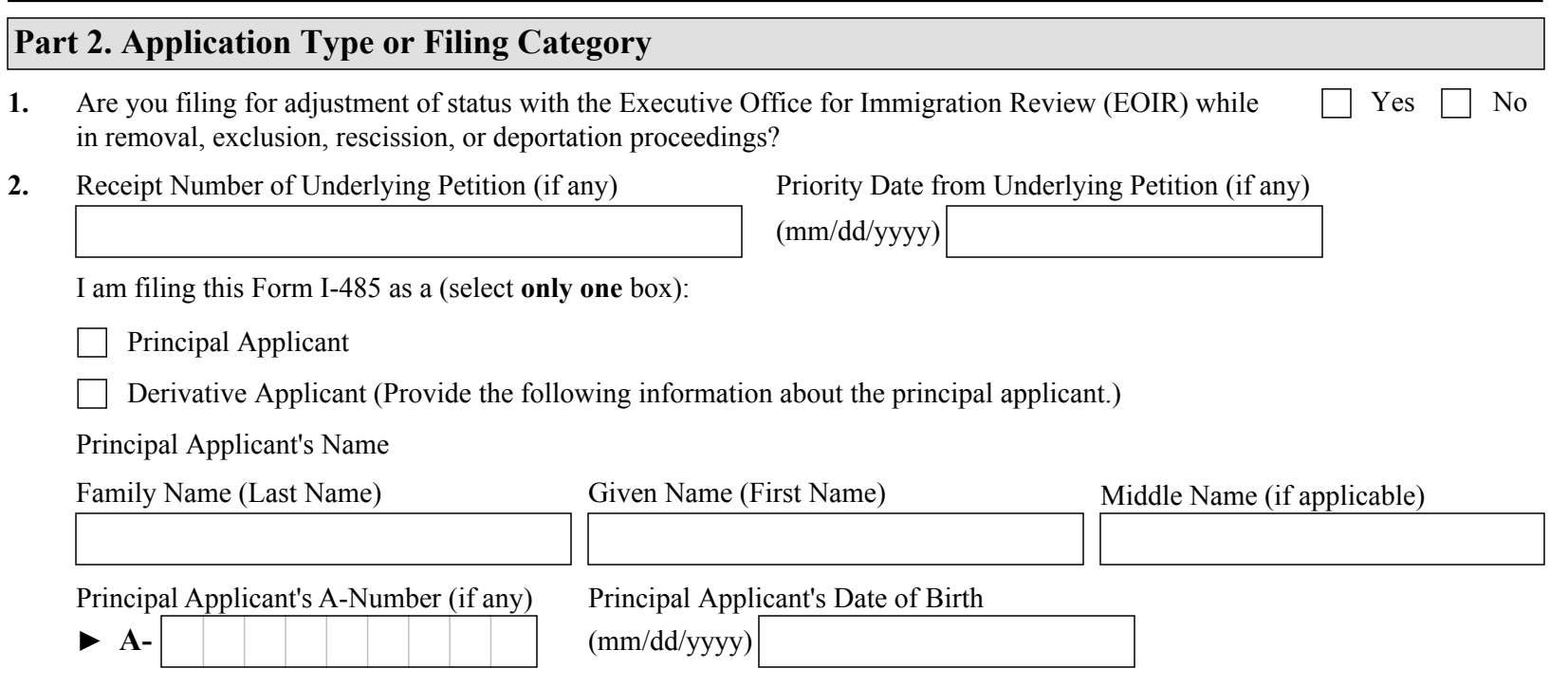
Verbatim · Form I-485, Part 2, Item 2 (edition 09/18/26, page 5)
“Receipt Number of Underlying Petition (if any)” · “Priority Date from Underlying Petition (if any) (mm/dd/yyyy)”
“I am filing this Form I-485 as a (select only one box):” “Principal Applicant” · “Derivative Applicant (Provide the following information about the principal applicant.)”
What the instructions say the underlying petition is
The I-485 Instructions explain that your green card rests on an underlying petition, and that its Form I-797 (the receipt or approval notice that carries the receipt number) is what you submit as proof:
Verbatim · I-485 Instructions, “Documentation of Your Immigrant Category” (edition 09/18/26, page 11)
“If you are filing as a beneficiary of an immigrant visa petition, you generally must submit a photocopy of Form I-797, Notice of Action, for your underlying visa petition (or the principal applicant's petition, if you are a derivative applicant), as appropriate. The underlying visa petition is the basis for the immigrant category upon which you are applying for adjustment of status.”
For a marriage case, the underlying petition is Form I-130, Petition for Alien Relative, and you are its beneficiary (the immigrant the petition is filed for). The receipt number Item 2 asks for is the code printed on that I-130’s Form I-797.
What the instructions say when you file before the petition is approved
A spouse of a U.S. citizen may file the I-485 in the same package as the I-130 (concurrent filing). The instructions describe what a principal applicant sends in that case:
Verbatim · I-485 Instructions, “Documentation of Your Immigrant Category” (edition 09/18/26, pages 11-12)
“If you are filing as a principal applicant and your immigrant category allows you to file Form I-485 before your visa petition is approved, you may submit your Form I-485 together with:”
- “Your immigrant visa petition; or”
- “A photocopy of the receipt notice (Form I-797), for your immigrant visa petition.”
A concurrent filer has not received a Form I-797 for the petition yet, so there is no receipt number to copy. The field is marked “if any,” and the instructions give the general rule for a question that does not apply:
Verbatim · I-485 Instructions, “How To Complete Form I-485,” Item 3 (edition 09/18/26, page 5)
“Answer all questions fully and accurately. If a question does not apply to you (for example, if you have never been married and the question asks, “Provide the name of your current spouse”), type or print “N/A,” unless otherwise directed. If your answer to a question which requires a numeric response is zero or none (for example, “How many children do you have” or “How many times have you departed the United States”), type or print “None,” unless otherwise directed.”
Always complete the current edition from uscis.gov/i-485; USCIS rejects outdated editions.
How to read the receipt number
A USCIS receipt number is 13 characters: three letters followed by ten digits, for example IOE0912345678. The three letters show where USCIS processed the petition. You enter the whole code exactly as printed, so you do not need to decode it, but here is what each prefix means. The instructions confirm the IOE prefix marks a form filed through a USCIS online account:
Verbatim · I-485 Instructions, “How To Complete Form I-485,” Item 4 (edition 09/18/26, page 5)
“You will only have a USCIS Online Account Number (OAN) if you previously filed a form that has a receipt number that begins with IOE.”
| Prefix | What it indicates |
|---|---|
| IOE | Filed through a USCIS online account (electronic filing). The instructions confirm this prefix marks an online-filed form. |
| EAC | Processed at the Vermont Service Center. |
| WAC | Processed at the California Service Center. |
| LIN | Processed at the Nebraska Service Center. |
| SRC | Processed at the Texas Service Center. |
| MSC / NBC | Processed at the National Benefits Center. |
| YSC | Processed at the Potomac Service Center. |
Where to find the receipt number
Work through these in order. If you have a Form I-797 for the I-130, the receipt number is on it. If you do not, the last step points you to the next section.
Find the Form I-797 for your I-130
When your spouse filed the underlying petition (Form I-130, Petition for Alien Relative), USCIS mailed back a Form I-797, Notice of Action, confirming it was received. A petition that was later approved has an I-797 approval notice too. Either notice carries the receipt number.
Read the code labeled “Receipt Number”
Near the top of the Form I-797, look for the field labeled “Receipt Number.” It is 13 characters: three letters followed by ten digits, for example IOE0912345678 or EAC2290123456. That whole code is what Item 2 wants.
Use the I-130's number, not the I-485's
The “underlying petition” is the I-130 that establishes your relationship, not this I-485 and not any work-permit (I-765) or travel (I-131) form you file alongside it. Copy the receipt number off the I-130 notice.
Derivative applicant? Use the principal's number
A derivative applicant is a dependent adjusting under someone else's petition. In a marriage case you are usually the principal applicant and this does not apply. If you are a derivative, the instructions say to use the principal applicant's petition, so read the receipt number off the principal's Form I-797.
Filing concurrently with no receipt yet? The field may not apply
If you are the principal applicant and you are mailing the I-130 and I-485 together, USCIS has not issued an I-797 for the petition yet, so there is no receipt number to copy. See the section below on what to enter when you have none.
How to enter the number
Four rules for the receipt-number field.
Copy all 13 characters exactly
Enter the three letters and ten digits exactly as printed on the Form I-797. Do not drop the letter prefix, do not add spaces or dashes, and do not shorten it to the last few digits.
The letter prefix is part of the number
Whether the code starts with IOE, EAC, WAC, LIN, SRC, MSC, or YSC, those letters belong in the field. You do not need to know which office they point to. Copy the code whole.
The priority date is the field next to it
Item 2 also has a separate box for “Priority Date from Underlying Petition” (the priority date is the date USCIS received the petition, which fixes your place in any visa line), entered as mm/dd/yyyy. Read that date off the same I-797. Keep the receipt number in the receipt-number box and the date in the date box.
“N/A” when there is no receipt number
If the field genuinely does not apply, for example a principal applicant filing concurrently who has no I-797 yet, type “N/A” rather than leaving it blank or inventing a number. The instructions direct “N/A” for questions that do not apply.
If you have no receipt number
The field is marked “if any” because not every filer has a receipt number yet. Here is what applies when you have none.
Filing the I-130 and I-485 together (concurrent filing)
If you are the principal applicant and you are mailing the petition and the I-485 in one package, USCIS has not issued a Form I-797 for the I-130 yet, so there is no receipt number. Type “N/A” in the receipt-number and priority-date boxes, per the instructions’ general rule above, and include a copy of the I-130 in the package so the officer can match the two.
Filing after the I-130 was receipted or approved
If USCIS has already sent a Form I-797 receipt notice or approval notice for the I-130, you have a receipt number. Copy it from that notice. An approved petition keeps the same receipt number that appeared on the original receipt notice.
Derivative applicant using the principal’s petition
A derivative applicant is a dependent adjusting under someone else’s petition. In a marriage case you are usually the principal, so this rarely applies. If you are a derivative, the instructions say to use the principal applicant’s petition, so read the receipt number off the principal’s Form I-797.
Stop here if the petition was denied or revoked, or your petitioner has died
This field assumes there is a valid underlying petition behind your application. If the I-130 was denied or revoked, your petitioning spouse has died, or you are not sure whether a petition was ever filed for you or whether you qualify as a principal or derivative applicant, the question is no longer about copying a number. It touches whether you can adjust status at all, and there may be options (such as humanitarian reinstatement) that depend on your specific facts.
This page explains what the field is asking. It does not tell you how to answer it for that situation. An immigration attorney needs to review your facts before you complete this field.
Find an immigration attorneyWhat USCIS does with the receipt number
USCIS uses the receipt number to tie this I-485 to the record of the underlying petition, the Form I-130 that establishes your qualifying relationship. Adjustment of status (applying for a green card from inside the United States) has to rest on a petition that places you in an immigrant category, and the receipt number lets the officer pull up that petition and confirm it is pending or approved. It is a record-matching field, not a scoring field: a correct number does not add points, but a missing or wrong one can slow the case or trigger a Request for Evidence (an RFE, a USCIS notice asking for more documents). When the field truly does not apply, such as a principal applicant filing the I-130 and I-485 together, a clear “N/A” is better than a guessed number, and you submit the petition itself in the same package so the officer can match the two.
Common mistakes
These are the ones that show up most often on this field.
- 1
Entering the A-Number instead of the receipt number
The Alien Registration Number (A-Number) is a 7-to-9-digit number that starts with “A.” The receipt number is a 13-character code that starts with three letters. They are different fields. Item 2 wants the receipt number off the Form I-797.
- 2
Copying the I-485 or I-765 receipt number instead of the I-130's
The “underlying petition” is the I-130. If you are refiling or already have receipt numbers for other forms, do not use those. Read the number off the Form I-797 for the I-130.
- 3
Leaving it blank when filing concurrently
A principal applicant mailing the I-130 and I-485 together has no receipt number yet. Type “N/A” rather than leaving the box empty, so the officer can see the field was answered and not skipped, and include a copy of the petition in the package.
- 4
Dropping the letter prefix or adding spaces
The three letters at the front (IOE, EAC, WAC, and so on) are part of the receipt number. Enter all 13 characters with no spaces or dashes, exactly as printed on the notice.
- 5
Confusing the receipt number with the USCIS Online Account Number
A receipt number that begins with IOE means the form was filed online, and only then do you have a USCIS Online Account Number (OAN). The receipt number and the OAN are two different numbers in two different fields. Do not put one where the other belongs.
Not sure which number goes where?
Our software asks a few plain questions about your petition, fills the receipt-number and filing-category fields the right way, keeps them consistent across your whole I-130 and I-485 packet, and flags when your situation calls for an attorney.
Start FreeRelated guides
Form and pathway context
Frequently asked questions
What is the “underlying petition” on Form I-485?
It is the immigrant visa petition your green card is based on. For a marriage case that is Form I-130, Petition for Alien Relative, which your U.S. citizen or lawful permanent resident spouse (the petitioner) filed to establish your relationship. The I-485 Instructions call the underlying petition “the basis for the immigrant category upon which you are applying for adjustment of status.”
Where do I find the receipt number of the underlying petition?
On the Form I-797 Notice of Action USCIS mailed for the I-130. Look for the field labeled “Receipt Number” near the top of the notice. It is 13 characters: three letters followed by ten digits, for example IOE0912345678. Copy that whole code into Part 2, Item 2.
I am filing my I-485 and I-130 together and do not have a receipt number yet. What do I enter?
Enter “N/A.” As a principal applicant filing concurrently, USCIS has not issued a Form I-797 for the petition, so there is no receipt number to copy. The field is marked “if any,” and the I-485 Instructions direct you to type “N/A” for a question that does not apply. Include a copy of the I-130 in the same package so the officer can match the two.
What do the letters at the start of the receipt number (IOE, EAC, WAC) mean?
The three-letter prefix shows where USCIS processed the petition. IOE means it was filed through a USCIS online account, which the instructions confirm. EAC, WAC, LIN, SRC, MSC, and YSC point to different USCIS service centers. You do not need to know which office it is; enter the full 13-character code exactly as printed.
Is the underlying petition receipt number the same as my A-Number?
No. The A-Number (Alien Registration Number) is a 7-to-9-digit number that starts with “A” and identifies you as a person. The receipt number is a 13-character code that starts with three letters and identifies a specific filing. They go in different fields on the I-485.
What if my I-130 was denied or revoked, or my petitioning spouse has died?
Stop and get advice before answering. A denied or revoked underlying petition, or a petitioner who has died, affects whether you can adjust status at all, and there may be options (such as humanitarian reinstatement) that depend on your specific facts. That is a legal question, not a number to copy off a notice, and an immigration attorney needs to review your situation first.
Key takeaways
- ✓
The underlying petition for a marriage case is the Form I-130 your spouse filed. Its receipt number is the 13-character code (3 letters then 10 digits) on the Form I-797 Notice of Action.
- ✓
Copy all 13 characters exactly, including the letter prefix. IOE means online filing; EAC, WAC, LIN, SRC, MSC, and YSC point to USCIS service centers. You enter the code whole regardless.
- ✓
The field is marked “if any.” A principal applicant filing the I-130 and I-485 together has no receipt number yet and enters “N/A,” including a copy of the petition in the package.
- ✓
The receipt number is not your A-Number and not the receipt number for any other form (I-485, I-765, I-131). Use the I-130's number.
- ✓
A denied or revoked I-130, a deceased petitioner, or an unsettled principal-vs-derivative status is an attorney question. Do not guess it on the form.
This page is for educational purposes only and is not legal advice. Green Card Genius is self-help immigration software, not a law firm, and does not provide legal representation. Immigration law and USCIS policy change frequently. For advice on a specific case, consult a licensed immigration attorney. Form I-485, edition 09/18/26. Last verified July 2026.
Stay informed
Green card guides in your inbox
Practical, plain-English updates to help you navigate the process with confidence.
Unsubscribe anytime.
Continue reading
- 01What Is a USCIS Receipt Number and How to Read It (2026)
- 02I-485 Filing Category (Part 2): Which Box a Spouse Checks (2026)
- 03I-485 USCIS Online Account Number (Part 1, Item 9): Leave It Blank? (2026)
- 04How to Add a Paper-Filed Case to Your USCIS Online Account (2026)
- 05I-485 A-Number (Part 1, Item 4): Leave It Blank? (2026)
Be a Genius
Only pay when you file