Form I-485 · Part 1, Item 10
I-485 Nonimmigrant Visa Number (Part 1, Item 10): Where To Find It, or Leave It Blank
How to find the nonimmigrant visa number on your visa foil for Part 1, Item 10, how to tell it apart from your passport number and I-94, and why many entrants correctly leave it blank.
Quick answer
The nonimmigrant visa number is the eight-character number printed in red ink in the lower-right corner of the visa foil (the full-page sticker) in the passport you used the last time you entered the United States. Copy that red number exactly. If you last entered without a visa foil, for example on the Visa Waiver Program or ESTA, as a Canadian visitor, on parole, or as a returning green card holder, you have none: the field is marked "(if any)," so you leave it blank or write N/A.
Summary
Form I-485 Part 1, Item 10 ("Recent Immigration History") asks for the "Nonimmigrant Visa Number Used During Most Recent Arrival (if any)." You, the immigrant spouse, are the applicant filing this I-485 for a green card; your U.S. citizen or green card holder spouse is the petitioner who filed the I-130, and you are the beneficiary of that petition. A nonimmigrant visa is the temporary (non-green-card) visa a U.S. consulate places in your passport, and its number is the eight-character code printed in red ink in the lower-right corner of the visa foil. Find the passport you used for your most recent entry into the United States, open it to the visa page, and copy the red number in the bottom-right corner. That number is not your passport number, not the 11-digit I-94 admission number (the Form I-94 is the arrival record U.S. Customs and Border Protection creates at entry), not the control number at the top of the foil, and not the black machine-readable text at the bottom. Because the field says "(if any)," anyone who last entered the U.S. without a visa foil in their passport leaves it blank or writes N/A.
| What it asks | The number of the nonimmigrant (temporary) visa in the passport you used for your most recent entry into the United States. The field is marked "(if any)." |
| Where to find it | The eight-character number printed in red ink in the lower-right corner of the visa foil (the full-page sticker) in your passport. Copy the red number exactly. |
| If you have no visa foil | Leave it blank or write N/A. Entrants on the Visa Waiver Program or ESTA, Canadian visitors, parolees, and returning green card holders usually have no visa foil. |
| Not the same as | Not your passport number, not the 11-digit I-94 admission number, not the control number at the top of the foil, and not the black machine-readable text at the bottom. |
| If you cannot find it | Your visa foil number is not on your I-94 or admission stamp. Look at the physical passport used for your last entry, or a photo of the visa page, before entering anything. |
Who this page is for
This page helps you read the nonimmigrant visa number off your visa foil, tell it apart from your other numbers, and confirm when you have none. It does not cover whether your entry itself could be a problem for your green card. If your most recent entry was without inspection or parole, if you overstayed or worked without permission, or if your arrival record and passport do not match, that is worth talking through with a licensed immigration attorney before you complete Part 1.
Free tool
Marriage Green Card Cost Calculator
2026 · AOS · full packet
$3,005
See your exact 2026 USCIS filing fees for a marriage green card through Adjustment of Status, with a full line-item breakdown and the costs most guides leave out.
Free — enter your email and it opens right up. Unsubscribe anytime.
We post free tips on preparing your marriage green card. Follow along:
What Item 10 looks like on the form
The nonimmigrant visa number sits in Part 1 (Information About You), Item 10, the “Recent Immigration History” block. It is one of several fields in that block, below the passport number and above the date the visa was issued.
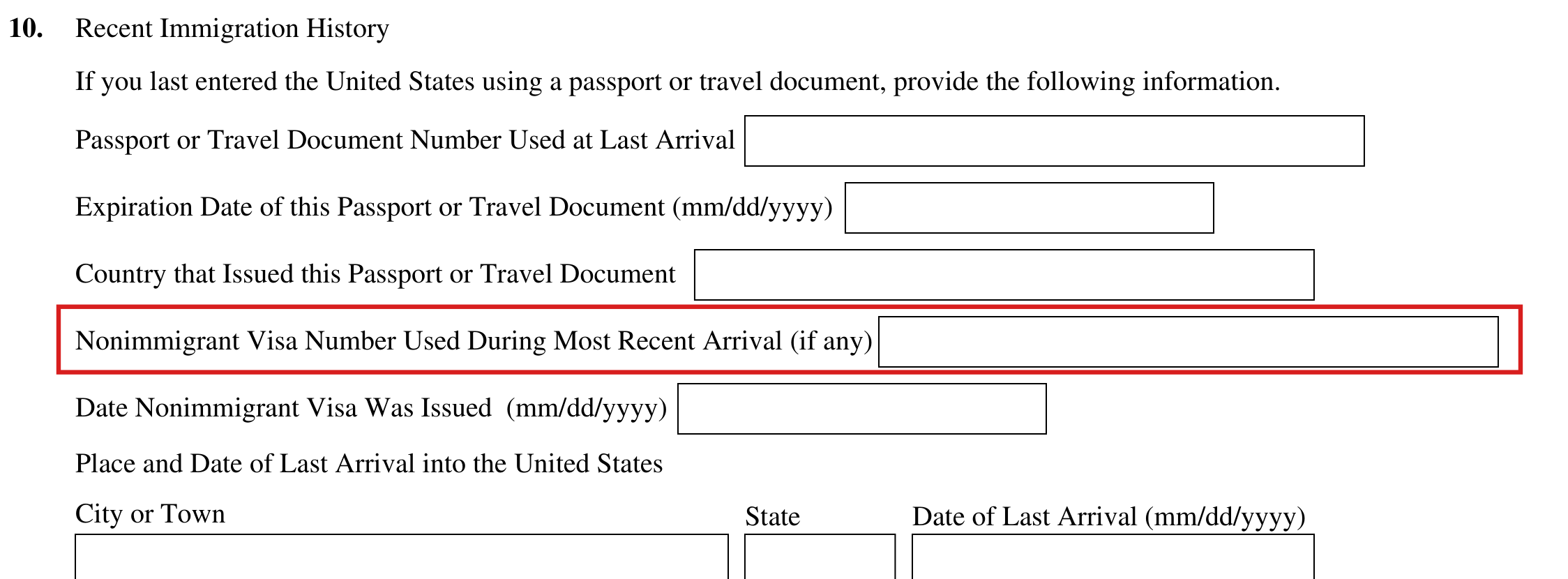
Verbatim · Form I-485, Part 1, Item 10 (edition 09/18/26, page 2)
“Recent Immigration History”
“If you last entered the United States using a passport or travel document, provide the following information.”
“Nonimmigrant Visa Number Used During Most Recent Arrival (if any)”
The I-485 Instructions give no step-by-step guidance for Item 10, so two things on the form govern the answer: the label says “(if any),” and the Instructions’ general rule tells you what to do when a field does not apply to you.
Verbatim · I-485 Instructions, “How To Complete Form I-485,” Item 3 (edition 09/18/26, page 5)
“Answer all questions fully and accurately. If a question does not apply to you (for example, if you have never been married and the question asks, "Provide the name of your current spouse"), type or print "N/A," unless otherwise directed.”
Always complete the current edition from uscis.gov/i-485; USCIS rejects outdated editions.
What the nonimmigrant visa number is
A nonimmigrant visa is the visa a U.S. embassy or consulate places in your passport so you can travel to a U.S. port of entry and ask to be admitted temporarily, for example as a visitor (B-1/B-2), a student (F-1), or a temporary worker (H-1B). "Nonimmigrant" means temporary, as opposed to an immigrant visa, which is for permanent residence. The physical visa is a full-page sticker, called a foil, glued into your passport. Item 10 wants the number that identifies that specific foil, and only the one in the passport you actually used for your most recent arrival into the United States. If you have entered on more than one visa over the years, the form asks for the one tied to your most recent arrival, not every visa you have ever held.
Where to find it on your visa
Work through these in order. If you open the passport and there is no visa sticker, you have none, and the field stays blank.
Pull out the passport you used for your most recent U.S. entry
Item 10 is tied to your most recent arrival, so use the passport you actually traveled on the last time you entered the United States, even if you now hold a newer passport. Open it to the page with the full-page U.S. visa sticker (the foil).
Find the number printed in red in the lower-right corner
The visa number is the eight-character code printed in red ink in the bottom-right area of the foil. Use its position to identify it: lower-right corner, usually eight characters. Do not confuse it with the control number near the top of the foil, which tracks a different thing. Copy the lower-right number exactly as it appears.
Do not use the black machine-readable text or the control number
Ignore the two lines of black characters filled with chevrons (<<<) at the very bottom of the foil; that is the machine-readable zone, not the visa number. Also ignore the control number near the top of the foil, which is a longer number (ten or more digits) the consulate uses internally.
If there is no visa foil in the passport, you have none
Not every traveler has a visa. If you last entered on the Visa Waiver Program or ESTA, as a Canadian visitor (Canadians usually enter without a visa foil), on parole, or as a returning green card holder using the card instead of a visa, there is no nonimmigrant visa number to copy. The field is marked "(if any)," so this is a normal and correct outcome, not a gap you need to fill.
Which number is this? Five that get mixed up
Item 10 wants only the visa-foil number. These are the five numbers people confuse it with, and where each one actually lives.
Scroll the table sideways to see the “On the I-485” column →
| Number | What it is | Where shown | On the I-485 |
|---|---|---|---|
| Nonimmigrant visa number | Identifies the visa foil (sticker) in your passport. Usually eight characters, printed in red ink. | Lower-right corner of the visa foil, in red | Part 1, Item 10, "Nonimmigrant Visa Number Used During Most Recent Arrival (if any)" |
| Passport number | Identifies your passport book itself, issued by your home country, not the U.S. visa in it. | Passport data page, and the top field of Item 10 | Part 1, Item 10, "Passport or Travel Document Number Used at Last Arrival" (a different field) |
| I-94 admission number | The 11-digit number U.S. Customs and Border Protection (CBP) assigns to your admission record each time you are admitted. | Your Form I-94 at the CBP website (cbp.gov/i94), or a paper I-94 | Used for Part 1, Items 11-12 (manner and record of entry), not the visa number field |
| Visa control number | An internal tracking number the issuing consulate uses. You almost never enter it on a form. | Near the top of the visa foil, ten or more digits | Not requested anywhere on the I-485 |
| Machine-readable text | The two lines of black characters and arrows at the bottom of the foil that scanners read. Not a number you type in. | Bottom of the visa foil, in black | Not requested anywhere on the I-485 |
How to write the visa number in the box
If you do have a visa foil, the format matters. These four rules cover the visa-number field in Item 10.
Copy the red number exactly, character for character
Enter the eight-character visa number exactly as it is printed in red on the foil. Include any letter it starts with. Do not add spaces, dashes, or leading zeros, and do not shorten or round it.
It is not the passport number
The passport number goes in the separate "Passport or Travel Document Number Used at Last Arrival" field at the top of Item 10. The visa number is a different number, printed on the visa sticker, not on your passport data page.
Match the visa in the passport you actually used to enter
If you hold more than one passport or have had more than one visa, the number must come from the visa in the passport tied to your most recent arrival. Using an older visa's number describes the wrong entry.
Blank or N/A is a valid entry, not an error
If you had no visa foil at your last entry, leaving the field blank or writing N/A is the correct answer under the instructions' general N/A rule. Do not invent a number or copy one from an unrelated document to fill the box.
What USCIS does with the visa number
USCIS uses the visa number to confirm which nonimmigrant visa you traveled on for your most recent entry and to match it to the government's own records of how and when you were admitted. Item 10 asks about your last entry because that entry is what matters for adjustment of status (the process of getting a green card without leaving the country), so the visa number, the passport number, and the arrival record together let the officer see that trip clearly. This is a recordkeeping field that helps USCIS line up your paperwork, not a test you pass or fail. Leaving it blank when you had no visa foil does not hurt you, because the field is marked "(if any)." What can slow your case is entering the wrong number, such as the passport number, the I-94 number, or the control number, so that the visa number on your form does not match the visa in your passport.
Common mistakes
These are the ones that show up most often on this field.
- 1
Entering the passport number instead of the visa number
The passport number identifies your passport book; the visa number identifies the visa sticker inside it. They are two different fields in Item 10. Copying the passport number into the visa-number box is the most common mix-up on this field.
- 2
Using the I-94 admission number
The 11-digit I-94 admission number comes from Customs and Border Protection at entry and is not printed on your visa. It belongs to your arrival record, not to Item 10's visa-number field. Look at the visa foil, not your I-94, for this number.
- 3
Copying the control number or the machine-readable text
The control number at the top of the foil and the black machine-readable characters at the bottom are not the visa number. The visa number is the shorter code in red at the lower right. Entering the wrong one makes your form disagree with your actual visa.
- 4
Guessing a number when you had no visa
If you last entered on the Visa Waiver Program, ESTA, as a Canadian visitor, on parole, or as a returning green card holder, you have no nonimmigrant visa number. The field is marked "(if any)," so leaving it blank or writing N/A is correct. Inventing a number to fill the box creates a false record.
- 5
Using a visa from an earlier trip
Item 10 asks for the visa used during your most recent arrival. If you entered on different visas over the years, pull the number from the visa in the passport you used the last time you came in, not from an older one.
Not sure which number goes in which box?
Our software asks a few plain questions and fills the right fields the right way, keeping your visa, passport, and arrival numbers consistent across your whole I-130 and I-485 packet.
Start FreeRelated guides
Frequently asked questions
Where exactly is the nonimmigrant visa number on my visa?
It is the eight-character number printed in red ink in the lower-right corner of the visa foil (the full-page sticker) in your passport. Position is the tell: look in the lower-right corner. Copy it exactly, and do not use the machine-readable characters at the bottom or the control number near the top of the foil, which tracks something different.
I entered on the Visa Waiver Program (ESTA). What do I put for the visa number?
Nothing, or N/A. The Visa Waiver Program and ESTA let you travel without a visa foil, so there is no nonimmigrant visa number to report. Part 1, Item 10 marks the field "(if any)," and the I-485 Instructions say to write N/A for a question that does not apply to you.
Is the visa number the same as the number on my I-94?
No. The I-94 admission number is the 11-digit number Customs and Border Protection assigns to your admission record, which you retrieve at cbp.gov/i94. The visa number is printed in red on the visa sticker in your passport. They are different numbers from different documents, and only the visa-foil number goes in this field.
My most recent entry used a passport that has since expired. Which visa do I use?
Use the visa in the passport you actually traveled on for your most recent arrival, even if that passport has since expired or been replaced. Item 10 is about the specific entry, so the visa tied to that entry is the one that belongs in the field.
The form has one wide box, not digit boxes. Do I add zeros or dashes?
No. Enter the visa number exactly as printed in red, character for character, with no added spaces, dashes, or leading zeros. Unlike the A-Number field, this box is not a fixed set of digit squares, so you type the number as it appears on the foil.
Key takeaways
- ✓
The nonimmigrant visa number is the eight-character number printed in red ink in the lower-right corner of the visa foil in the passport you used for your most recent U.S. entry.
- ✓
It is not your passport number, not the 11-digit I-94 admission number, not the control number at the top of the foil, and not the black machine-readable text at the bottom.
- ✓
Copy the red number exactly, character for character, with no added spaces, dashes, or leading zeros.
- ✓
The field is marked "(if any)." Visa Waiver Program or ESTA, Canadian, parolee, and returning green card holder entrants usually have no visa foil and leave it blank or write N/A.
- ✓
Use the visa tied to your most recent arrival, in the passport you actually traveled on, not an older visa from an earlier trip.
This page is for educational purposes only and is not legal advice. Green Card Genius is self-help immigration software, not a law firm, and does not provide legal representation. Immigration law and USCIS policy change frequently. For advice on a specific case, consult a licensed immigration attorney. Form I-485, edition 09/18/26. Last verified August 2026.
Stay informed
Green card guides in your inbox
Practical, plain-English updates to help you navigate the process with confidence.
Unsubscribe anytime.
Continue reading
- 01Form I-485: Application to Adjust Status (2026 Guide)
- 02I-485 Passport Number Used at Last Arrival (Part 1, Item 10): Which Passport (2026)
- 03I-485 Place and Date of Last Arrival (Part 1, Items 10-12) (2026)
- 04I-485 A-Number (Part 1, Item 4): Leave It Blank? (2026)
- 05I-485 Current Immigration Status (Part 1, Item 14): What Goes in the Box
- 06Adjustment of Status Guide (2026): Marriage Green Card
Be a Genius
Only pay when you file