Form I-131 · Part 7, Items 1 and 5
I-131 Date of Intended Departure and Length of Trip (Part 7, Items 1 and 5) in 2026
The travel document form asks when you intend to leave and how long you expect to be away. If you have no trip booked, these are estimates, not a confirmed itinerary.
Quick answer
Filing advance parole with no trip booked? Part 7, Item 1 (Date of Intended Departure) and Item 5 (Expected Length of Trip, in days) ask for your intended travel, not a confirmed itinerary. Enter a good-faith estimate, for example a date a few months out and a round number of days. The form asks what you intend, and you are not bound to travel on that exact date or for that exact length.
Summary
On Form I-131, Part 7, Item 1 asks for your Date of Intended Departure and Item 5 asks for your Expected Length of Trip (in days). These appear in Part 7, the section you complete when you are applying for an Advance Parole Document (advance permission to travel and return while a green card case is pending) under Part 1, Item 5. Both fields ask for your intended travel, so if you do not have a trip booked you enter a good-faith estimate. The estimate does not lock you into traveling on that date or for that length.
| Where it is on the form | Part 7 (Information About Your Proposed Travel). Item 1 is the Date of Intended Departure (mm/dd/yyyy). Item 5 is the Expected Length of Trip (in days). You complete Part 7 only when you selected the Advance Parole Document box in Part 1, Item 5. |
| Item 1: Date of Intended Departure | A single date in mm/dd/yyyy format. It is the day you intend to leave the United States. The field asks for your intent, so an estimated future date is what goes here when no trip is booked. |
| Item 5: Expected Length of Trip | A number of days. It is how long you expect to be outside the United States on the trip. A round estimate (such as 14 or 30) is acceptable when you have no firm plans. |
| No trip planned | Common for marriage-based applicants who file advance parole as a precaution. The instructions ask what you intend, so you give a good-faith estimate. Entering an estimate does not commit you to that date or length, and it does not require you to travel at all. |
| What it is not | Not a binding itinerary and not a request for proof of a booked flight. Part 7 collects your proposed travel; the date and length are estimates, not confirmed bookings. |
Who this page is for
This page covers filling in the two travel-date fields, Part 7, Items 1 and 5, when you are applying for advance parole (advance permission to travel and return while your green card case is pending) on the basis of a pending marriage-based Form I-485. It does not cover whether you should travel. Leaving the United States while a green card application is pending can affect your case, and that question depends on your specific facts. If you are deciding whether to travel, read our travel-during-pending guide and consider speaking with a licensed immigration attorney.
Free tool
Marriage Green Card Cost Calculator
2026 · AOS · full packet
$3,005
See your exact 2026 USCIS filing fees for a marriage green card through Adjustment of Status, with a full line-item breakdown and the costs most guides leave out.
Free — enter your email and it opens right up. Unsubscribe anytime.
We post free tips on preparing your marriage green card. Follow along:
What the travel-date fields look like on the form
Both fields sit in Part 7, the section you complete only if you selected the Advance Parole Document box in Part 1, Item 5. Item 1 is the date you intend to leave; Item 5 is the number of days you expect to be away.
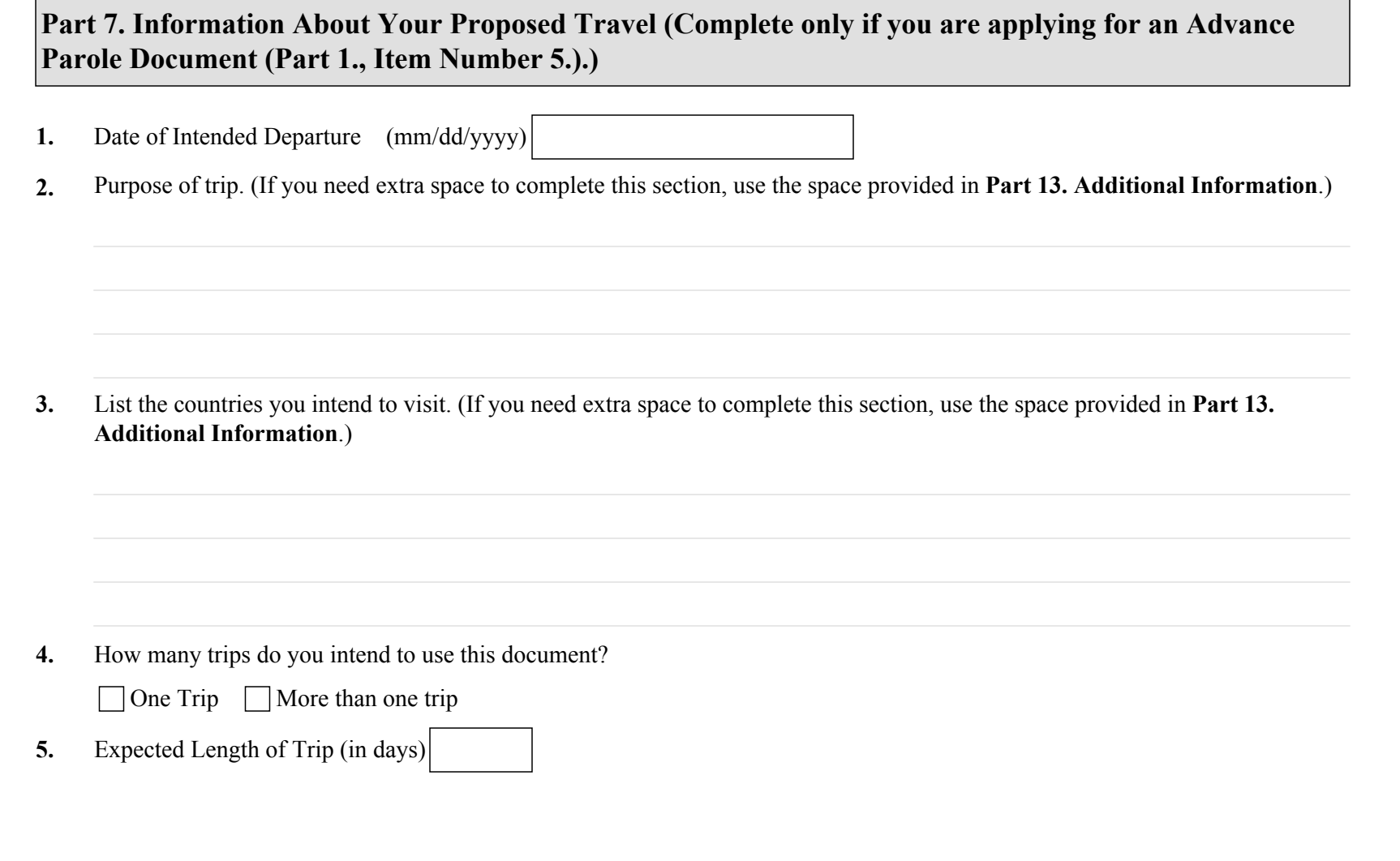
Verbatim · Part 7 header and field labels (Form I-131, edition 01/20/25, page 10)
“Part 7. Information About Your Proposed Travel (Complete only if you are applying for an Advance Parole Document (Part 1., Item Number 5.).)”
1. Date of Intended Departure (mm/dd/yyyy)
5. Expected Length of Trip (in days)
The instructions describe the whole Part 7 block in one place:
Verbatim · Part 7, Item Numbers 1 to 5 (Form I-131 Instructions, edition 01/20/25, page 21)
“Item Numbers 1. - 5. Information About Proposed Travel. You must indicate when you intend to depart the United States, the purpose for your trip, which countries you intend to visit while you are abroad, how many trips you intend to use this document for, and the expected length of the trip in days.”
Always complete the current edition downloaded from uscis.gov/i-131; USCIS rejects outdated editions.
What if I have no trip planned?
Both fields ask for what you intend, not what you have booked. The form heading calls Part 7 your proposed travel, and the instructions describe Item 1 as when you intend to depart and Item 5 as the expected length of the trip. Intended and expected are estimate words. Nothing on the form or in the Part 7 instructions asks for a flight confirmation, a reservation, or proof of a fixed itinerary.
Many marriage-based applicants file advance parole defensively: they ask for the travel document while their green card case is pending so the option to travel exists if something comes up (a family emergency abroad, a work trip, a wedding), even though no trip is on the calendar yet. If that is you, you still answer Items 1 and 5 with a good-faith estimate. A common approach is a departure date a few months out and a round number of days, such as 30.
Putting an estimate in these boxes does not bind you. The fields capture your intent at the time you file; they are not a contract. You are not required to leave on that exact date, stay for that exact number of days, or travel at all. If your plans change later, or if you never end up using the document, the estimate you entered does not create a problem on its own.
Filing advance parole with your green card packet?
Our software fills Form I-131 alongside your I-485 and I-765, asks plain questions about your travel plans, and fills Part 7 the right way whether or not you have a trip booked.
Start FreeWhat USCIS does with the travel dates
USCIS uses the proposed-travel information to understand the trip you are requesting the Advance Parole Document for and to adjudicate the request. The Date of Intended Departure and Expected Length of Trip describe the travel; they are the applicant's stated intent, not a guarantee. USCIS does not approve a specific flight, and the document, once issued, is valid for its printed validity period rather than only for the single date you entered. Whether you are actually paroled back into the United States is a separate decision made by an officer at the port of entry when you return, regardless of the dates you wrote in Part 7.
Related guides
Form and pathway context
Frequently asked questions
What date do I put for Date of Intended Departure if I have no trip planned?
Part 7, Item 1 asks for your intended departure date, so when you have no booked trip you enter a good-faith estimate, such as a date a few months in the future. The field captures your intent, and you are not committed to leaving on that exact date.
What do I put for Expected Length of Trip if I do not know how long I will be away?
Part 7, Item 5 asks for the expected length in days. A round estimate (for example 14 or 30) is acceptable when you have no firm plans. It is an estimate of how long you expect to be outside the United States, not a fixed commitment.
Where are the travel-date fields on Form I-131?
They are in Part 7, Information About Your Proposed Travel. You complete Part 7 only if you selected the Advance Parole Document box in Part 1, Item 5. Item 1 is the Date of Intended Departure (mm/dd/yyyy) and Item 5 is the Expected Length of Trip (in days).
Am I bound to travel on the date I enter?
No. The form asks for your intended and expected travel, which is an estimate. Entering a date and a length does not require you to leave on that day, stay for that number of days, or travel at all. Your plans can change after you file.
Does USCIS need proof of a booked flight for these fields?
No. Part 7 and its instructions ask you to describe your proposed travel, not to attach a reservation or itinerary. The Date of Intended Departure and Expected Length of Trip are your stated intent, not documents you must support with a booking.
Key takeaways
- ✓
The travel-date fields are Form I-131, Part 7, Item 1 (Date of Intended Departure, mm/dd/yyyy) and Item 5 (Expected Length of Trip, in days). You complete Part 7 only when applying for an Advance Parole Document under Part 1, Item 5.
- ✓
The Part 7 instructions describe Item 1 as when you intend to depart and Item 5 as the expected length of the trip; both ask for intent, so an estimate is what goes here when no trip is booked.
- ✓
Marriage-based applicants often file advance parole defensively, with no trip on the calendar. Enter a good-faith estimate, such as a date a few months out and a round number of days.
- ✓
Entering an estimate does not bind you to that date or length, and it does not require you to travel at all. The fields are not a flight reservation and need no booking as proof.
- ✓
Whether you are paroled back into the United States is decided by an officer at the port of entry when you return, separate from the dates you wrote in Part 7.
This page is for educational purposes only and is not legal advice. Green Card Genius is self-help immigration software, not a law firm, and does not provide legal representation. Immigration law and USCIS policy change frequently. For advice on a specific case, consult a licensed immigration attorney. Form I-131, edition 01/20/25. Last verified May 2026.
Stay informed
Green card guides in your inbox
Practical, plain-English updates to help you navigate the process with confidence.
Unsubscribe anytime.
Be a Genius
Only pay when you file