Form I-131 · Part 1, Item 5
I-131 Application Type (Part 1, Item 5): Advance Parole vs. Reentry Permit (2026)
Part 1 asks which travel document you want. For a marriage-based green card applicant with a pending Form I-485, the answer is the Advance Parole Document, not the reentry permit.
Quick answer
If you are inside the United States with a pending (or concurrently filed) marriage-based Form I-485, your application type is the Advance Parole Document. On the current form that is Part 1, Item 5, option A (“A pending Form I-485”). Advance parole is travel permission for someone whose green card is still pending. Do not select the reentry permit (Item 1): that box is only for people who already hold a green card.
Summary
Form I-131 covers several different travel and parole documents, and Part 1 is where you tell USCIS which one you are asking for. For a marriage-based green card applicant who is inside the United States with a pending Form I-485, the correct box is the Advance Parole Document, Part 1, Item 5, option A. Advance parole is a document that lets someone with a pending application travel and seek to return while their case is decided. The most common error is checking the reentry permit (Item 1), which is a different document only for people who are already lawful permanent residents (green card holders). The petitioner is the U.S. citizen or green card holder who filed the I-130; the beneficiary is the immigrant spouse adjusting status (AOS), and the beneficiary is the one who files this I-131.
| Where it is on the form | Part 1, “Application Type.” You select one document type. For a pending marriage-based I-485, that is Item 5 (Advance Parole Document), option A. |
| Your box | Item 5 → 5.A, “A pending Form I-485.” This is the advance parole document for someone inside the United States with a pending adjustment of status case. |
| Not your box | Item 1 (Reentry Permit) is only for people who already hold a green card. If you are still waiting on your I-485, you are not a permanent resident yet, so Item 1 does not apply. |
| Refugee travel document | Items 2 and 3 are for people in refugee or asylee status. They are not the marriage-based AOS box. |
| Changing the box later | When you file online, the application type drives the rest of the form and cannot be changed after submission. If you picked the wrong type, you generally have to start a new application. |
Who this page is for
This page is for a marriage-based green card applicant who is inside the United States with a pending (or concurrently filed) Form I-485 and is choosing the application type on Form I-131. It explains which box to select. It does not advise on whether you should travel, or on how travel affects a pending case. If your basis for travel comes from a different status, the Form I-131 Instructions list the document type that matches your situation.
Free tool
Marriage Green Card Cost Calculator
2026 · AOS · full packet
$3,005
See your exact 2026 USCIS filing fees for a marriage green card through Adjustment of Status, with a full line-item breakdown and the costs most guides leave out.
Free — enter your email and it opens right up. Unsubscribe anytime.
We post free tips on preparing your marriage green card. Follow along:
What Part 1 looks like on the form
Part 1 lists the document types as numbered items. You select the one that matches your situation. A marriage-based applicant with a pending I-485 selects Item 5 (Advance Parole Document), option A.
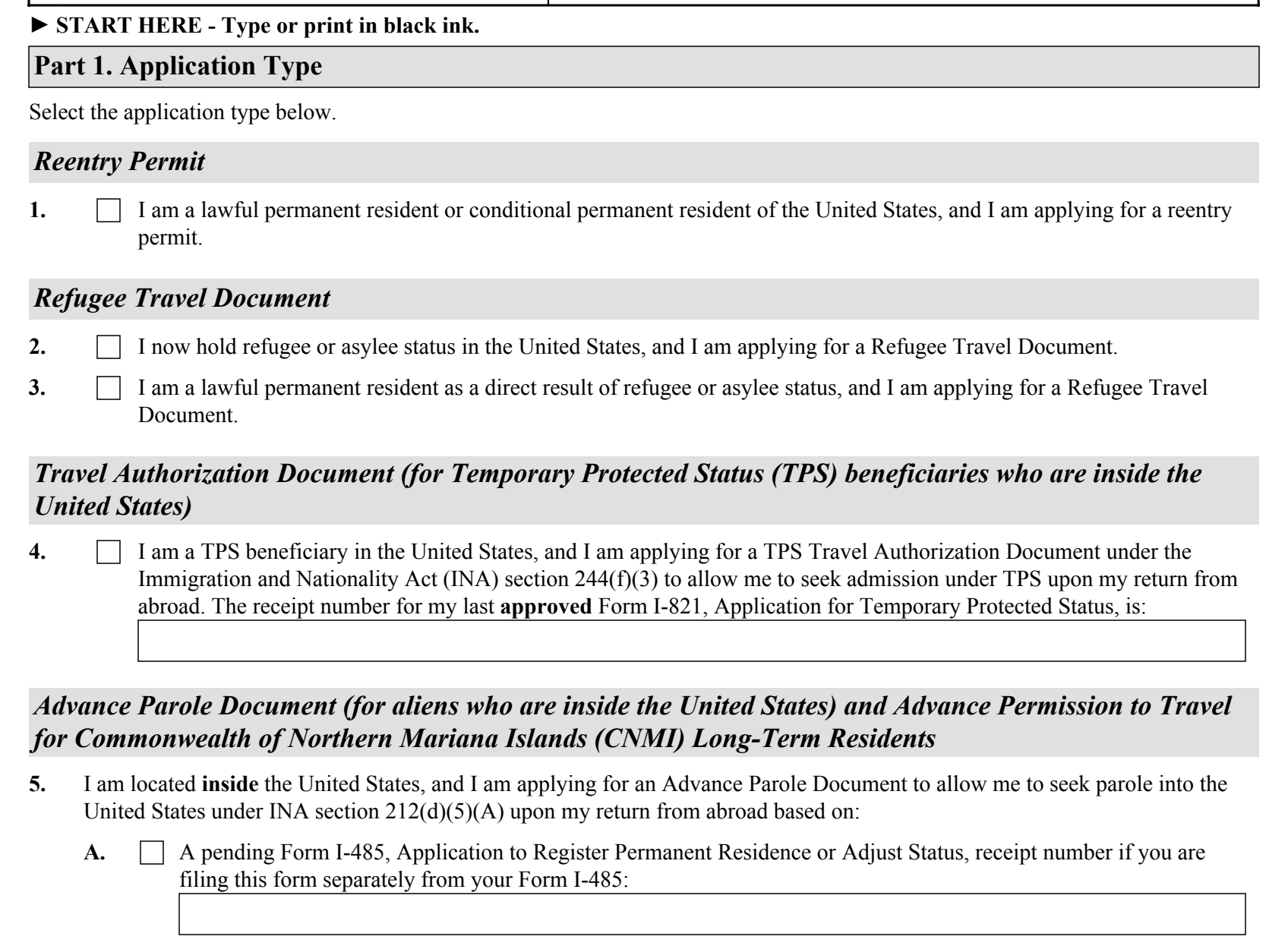
Verbatim · Part 1, Item 5 and option A (Form I-131, edition 01/20/25, page 1)
“I am located inside the United States, and I am applying for an Advance Parole Document to allow me to seek parole into the United States under INA section 212(d)(5)(A) upon my return from abroad based on: A. A pending Form I-485, Application to Register Permanent Residence or Adjust Status, receipt number if you are filing this form separately from your Form I-485:”
For contrast, here is the reentry permit box. Note that it starts with “I am a lawful permanent resident,” which a pending-I-485 applicant is not:
Verbatim · Part 1, Item 1 (Form I-131, edition 01/20/25, page 1)
“I am a lawful permanent resident or conditional permanent resident of the United States, and I am applying for a reentry permit.”
Always complete the current edition downloaded from uscis.gov/i-131; USCIS rejects outdated editions.
The application types on the current form
Part 1 covers several documents. Only one applies to a marriage-based AOS case: the Advance Parole Document at Item 5.
| Item | Document | Who it is for |
|---|---|---|
| Item 1 | Reentry Permit | A lawful permanent resident or conditional permanent resident (someone who already has a green card). Not for a pending I-485. |
| Items 2–3 | Refugee Travel Document | Someone in refugee or asylee status, or a permanent resident who got status through refugee or asylee status. |
| Item 4 | TPS Travel Authorization Document | A Temporary Protected Status beneficiary inside the United States. |
| Item 5 | Advance Parole Document | Someone inside the United States with a pending application, including a pending Form I-485 (option 5.A). This is the marriage-based AOS box. |
| Items 6–8 | Initial parole and parole-in-place | People applying for an initial parole document or parole in place under specific programs. Not the standard marriage-AOS situation. |
Reentry permit vs. advance parole: the box people mix up
A reentry permit and an advance parole document are easy to mix up because both relate to travel, but they are for different people. A reentry permit (Item 1) is issued to someone who already holds a green card, lets that permanent resident keep their status through a longer trip abroad, and is valid for up to two years. An advance parole document (Item 5) is for someone whose green card is still pending: it gives travel permission and lets you seek to return while your I-485 is being decided. If your I-485 has not been approved yet, you are not a permanent resident, so Item 1 is the wrong box. A marriage-based applicant with a pending I-485 selects Item 5, option A.
Verbatim · Reentry Permits (Form I-131 Instructions, edition 01/20/25, page 1)
“The U.S. Department of Homeland Security (DHS) may issue a Reentry Permit to a lawful permanent resident or a conditional permanent resident, which allows them to apply for admission to the United States upon returning from abroad during the permit’s validity without the need to obtain a returning resident visa from a U.S. Embassy or U.S. Consulate.”
Which box for your situation
Match your situation to the correct Part 1 box.
| Your situation | Box to select |
|---|---|
| Marriage-based Form I-485 pending, filed at the same time as this I-131, both inside the United States | Item 5 → 5.A (Advance Parole Document, “A pending Form I-485”). Leave the receipt-number line blank when filing together. |
| Marriage-based Form I-485 already filed and pending, filing this I-131 separately afterward | Item 5 → 5.A, and enter your I-485 receipt number on the line in 5.A. |
| Already a green card holder (the I-485 was approved) | Item 1 (Reentry Permit), not advance parole. Advance parole is for a pending case, not an approved one. |
| Conditional permanent resident (a two-year green card) | Item 1 (Reentry Permit). A conditional resident already holds a green card. |
| In refugee or asylee status (not a marriage-based case) | Item 2 or 3 (Refugee Travel Document), depending on your exact status. |
Filing advance parole with your green card packet?
Our software fills Form I-131 with the right application type for a pending I-485, files it alongside your I-485 and I-765, and keeps your details consistent across the whole marriage-based packet.
Start FreeWhat USCIS does with the application type
Part 1 tells USCIS which document you are requesting, and that choice controls everything downstream: the eligibility rules that apply, the supporting evidence USCIS expects, and the document USCIS issues if it approves. Picking Item 5 (Advance Parole Document) signals that you are inside the United States with a pending application and want travel permission tied to that case. Picking Item 1 (Reentry Permit) tells USCIS you are already a permanent resident. Because the application type sets the rules for the rest of the form, a wrong selection can lead to a rejection, a Request for Evidence (an RFE, a USCIS notice asking for more information), or a denial of the wrong kind of request.
Common mistakes
These are the ones that show up most often on this field.
- 01
Selecting the reentry permit instead of advance parole
The reentry permit (Item 1) is only for people who already hold a green card. A marriage-based applicant with a pending I-485 is not a permanent resident yet, so the correct box is the Advance Parole Document at Item 5, option A. This is the single most common application-type error for AOS applicants.
- 02
Choosing a refugee travel document or TPS box
Items 2 and 3 (Refugee Travel Document) and Item 4 (TPS Travel Authorization Document) are for refugee, asylee, or TPS status. A marriage-based green card case is not any of those, so none of these boxes apply.
- 03
Filling in the 5.A receipt-number line when filing together
Option 5.A asks for the I-485 receipt number only “if you are filing this form separately from your Form I-485.” If you file the I-131 in the same package as the I-485, you do not have a receipt number yet, so you leave that line blank.
- 04
Assuming the box can be fixed after filing online
When you file online, the application type you pick drives the rest of the form and cannot be changed after you submit. If you realize you chose the wrong type, you generally have to start a new application rather than edit the submitted one.
Related guides
Form and pathway context
Frequently asked questions
Which application type does a marriage green card applicant select on Form I-131?
The Advance Parole Document. On the current form (edition 01/20/25) that is Part 1, Item 5, option A, “A pending Form I-485.” It is the box for someone inside the United States whose adjustment of status case is pending.
What is the difference between a reentry permit and advance parole?
A reentry permit (Item 1) is for someone who already holds a green card and wants to keep that status during a longer trip abroad. Advance parole (Item 5) is travel permission for someone whose green card is still pending. If your I-485 has not been approved, you are not a permanent resident yet, so you use advance parole, not the reentry permit.
Do I enter my I-485 receipt number in option 5.A?
Only if you are filing the I-131 separately from your I-485. Option 5.A says to enter the receipt number “if you are filing this form separately from your Form I-485.” If you file them together in the same package, you do not have a receipt number yet, so you leave that line blank.
Can I change the application type after I file online?
No. When you file online, the application type you select drives the rest of the form and cannot be changed after submission. If you picked the wrong type, you generally have to start a new application. That is why it is worth confirming Item 5 before you submit.
Is advance parole the same thing as a work permit?
No. Advance parole is travel permission and is requested on Form I-131. The work permit (Employment Authorization Document) is requested on Form I-765. Marriage-based applicants often file all three together (I-485, I-765, and I-131), but each form asks for a different thing.
Key takeaways
- ✓
A marriage-based applicant inside the United States with a pending Form I-485 selects the Advance Parole Document: Part 1, Item 5, option A.
- ✓
Item 1 (Reentry Permit) is only for people who already hold a green card, so it is the wrong box for a pending case.
- ✓
Items 2–3 (Refugee Travel Document) and Item 4 (TPS) are for other statuses, not a marriage-based AOS case.
- ✓
Enter the I-485 receipt number in 5.A only when filing the I-131 separately from the I-485; leave it blank when filing them together.
- ✓
When you file online, the application type cannot be changed after submission, so confirm Item 5 before you file.
This page is for educational purposes only and is not legal advice. Green Card Genius is self-help immigration software, not a law firm, and does not provide legal representation. Immigration law and USCIS policy change frequently. For advice on a specific case, consult a licensed immigration attorney. Form I-131, edition 01/20/25. Last verified May 2026.
Stay informed
Green card guides in your inbox
Practical, plain-English updates to help you navigate the process with confidence.
Unsubscribe anytime.
Continue reading
Be a Genius
Only pay when you file