Form I-130 · Part 4, Item 10
I-130 Prior Petitions for the Beneficiary (Part 4, Item 10): Has Anyone Else Ever Filed?
Part 4, Item 10 asks whether anyone ever filed an immigrant petition for your spouse, and how to answer Yes, No, or Unknown.
Quick answer
Answer "Yes" if any immigrant petition was ever filed for your spouse by anyone before, even if it was withdrawn or denied: a prior spouse's I-130, a parent's I-130, an employer's I-140, or a prior fiance(e) petition (I-129F). If no one ever filed for your spouse, answer "No." Select "Unknown" only when both you and your spouse genuinely do not know.
Summary
For most marriage-based filers, Form I-130 Part 4, Item 10 asks whether anyone has ever filed an immigrant petition for your spouse (the beneficiary, the immigrant you are sponsoring). You, the U.S. citizen or green card holder, are the petitioner; your spouse is the beneficiary. If no one has ever filed a petition for your spouse, you answer "No." If a prior petition was filed by anyone, including a former spouse, a parent, an employer, or a prior fiance(e), you answer "Yes," even if that earlier petition was withdrawn or denied. "Unknown" is reserved for the rare case where neither you nor your spouse knows whether a petition was ever filed. This is a factual disclosure: USCIS wants the filing history, not an explanation.
| What it asks | Whether anyone ever filed an immigrant petition for your spouse (the beneficiary) before this I-130. It is about your spouse's filing history, not yours. |
| Most marriage cases | Answer "No" if no one has ever filed a petition for your spouse. This is the common answer for a first-time beneficiary. |
| When the answer is "Yes" | A prior spouse's I-130, a parent's I-130, an employer's I-140, or a prior fiance(e) petition (Form I-129F) was filed. Withdrawn and denied prior petitions still count as "Yes." |
| "Unknown" | Per the on-form NOTE, select it only if you do not know and your spouse also does not know whether anyone ever filed a petition for them. |
| What USCIS wants | The fact of a prior filing, not the reasons or the result. The disclosure itself is administrative. |
Who this page is for
This page covers the disclosure itself: whether a prior petition existed and how to mark Yes, No, or Unknown. It does not cover what a prior petition means for your case. If a prior petition for your spouse was denied for fraud or misrepresentation, involved a marriage that was investigated, or raises any question about your spouse's eligibility, talk to a licensed immigration attorney before you file.
Free tool
Marriage Green Card Cost Calculator
2026 · AOS · full packet
$3,005
See your exact 2026 USCIS filing fees for a marriage green card through Adjustment of Status, with a full line-item breakdown and the costs most guides leave out.
Free — enter your email and it opens right up. Unsubscribe anytime.
We post free tips on preparing your marriage green card. Follow along:
What Item 10 looks like on the form
Item 10 sits in Part 4 (Information About Beneficiary), just below the beneficiary's sex field. It offers three boxes, Yes, No, and Unknown, with a NOTE that limits when Unknown applies.
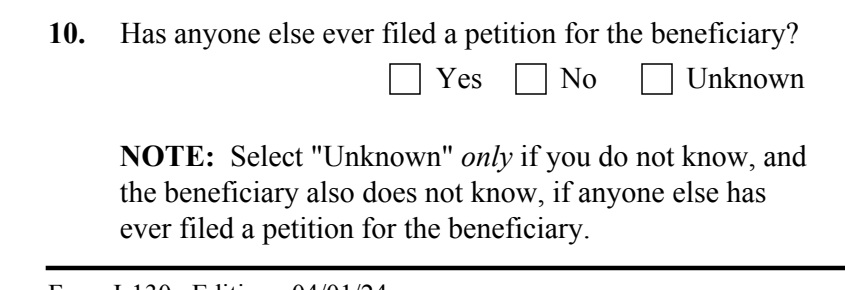
Verbatim · Part 4, Item 10 (Form I-130, edition 04/01/24, page 5)
“Has anyone else ever filed a petition for the beneficiary?”
Options: Yes No Unknown
NOTE: “Select "Unknown" only if you do not know, and the beneficiary also does not know, if anyone else has ever filed a petition for the beneficiary.”
The I-130 Instructions do not separately walk through Item 10; the question and the NOTE printed on the form itself are the controlling guidance. Always complete the current edition from uscis.gov/i-130; USCIS rejects outdated editions.
How common marriage scenarios answer Item 10
The answer turns on one fact: did any immigrant petition ever exist for your spouse? Here is how the situations that come up most often map to Yes, No, or Unknown.
| Your spouse's situation | What it counts as | Item 10 |
|---|---|---|
| Your spouse's first immigrant petition is this one. No one ever filed before. | No prior petition | No |
| A former spouse filed an I-130 for your spouse during an earlier marriage. | Prior relative petition (I-130) | Yes |
| A parent filed an I-130 for your spouse years ago. | Prior relative petition (I-130) | Yes |
| An employer filed an I-140 (employment-based petition) for your spouse. | Prior employment petition (I-140) | Yes |
| A prior fiance(e) filed a K-1 fiance(e) petition (Form I-129F) for your spouse. | Prior fiance(e) petition (I-129F) | Yes |
| A prior petition was filed for your spouse but it was later withdrawn. | Withdrawn prior petition | Yes |
| A prior petition was filed for your spouse and USCIS denied it. | Denied prior petition | Yes |
| Neither you nor your spouse knows whether anyone ever filed. | Genuinely unknown to both of you | Unknown |
What counts as a “petition” here?
Item 10 covers any immigrant petition filed for your spouse, by anyone, in any category. These all answer “Yes”:
- ✓
A prior spouse's Form I-130 (Petition for Alien Relative) filed during an earlier marriage.
- ✓
A parent's, sibling's, or adult child's Form I-130 filed for your spouse as a relative.
- ✓
An employer's Form I-140 (Immigrant Petition for Alien Worker) filed on your spouse's behalf.
- ✓
A prior fiance(e)'s Form I-129F (Petition for Alien Fiance(e)) that named your spouse for a K-1 visa.
- ✓
Any of the above that was withdrawn, abandoned, or denied. The petition still existed, so the answer is "Yes."
How to answer it
Four steps to mark the right box.
Ask your spouse about every prior filing
Item 10 is about your spouse, so the answer depends on your spouse's history, not yours. Ask whether any former spouse, family member, employer, or prior fiance(e) ever filed an immigrant petition for them. Your spouse is the person most likely to know.
Count withdrawn and denied petitions
If a petition was filed and later withdrawn, abandoned, or denied, it still happened. The form asks whether anyone ever filed, not whether a petition succeeded. In that situation the answer is still "Yes."
Use "No" for a first-time beneficiary
If this I-130 is the first immigrant petition anyone has ever filed for your spouse, mark "No." That is the common answer for a spouse who has never been sponsored before.
Reserve "Unknown" for genuine two-sided uncertainty
The form's NOTE says to pick "Unknown" only when you do not know and your spouse also does not know. If your spouse can answer the question, do not select "Unknown."
Marriage-based filers: usually “No,” but check your spouse's history
On a marriage petition the beneficiary is your immigrant spouse, so Item 10 is about their filing history, not yours. For a spouse who has never been sponsored before, the answer is “No.” That is the common case: a first marriage, no prior visa process, no employer ever sponsored them.
The answer becomes “Yes” when your spouse has any prior petition behind them: a former spouse filed an I-130 in an earlier marriage, a parent filed an I-130 years ago, an employer filed an I-140, or a prior fiance(e) filed a K-1 petition (Form I-129F). Ask your spouse directly, because they are the person who knows. A withdrawn or denied prior petition still makes the answer “Yes.”
Not sure how your spouse's history fits Item 10?
Our software asks a few plain questions about prior petitions and marks the right box for you, keeping the answer consistent across your whole I-130 packet.
Start FreeItem 10 is not the Part 5 prior-petition question
Item 10 in Part 4 is asked about the beneficiary: has anyone ever filed a petition for your spouse? A separate question in Part 5, Item 1 ("Have you EVER previously filed a petition for this beneficiary or any other alien?") is asked about you, the petitioner. They are different questions on different people. Item 10 covers any petitioner who ever filed for your spouse; Part 5, Item 1 covers your own prior filings for anyone. Read each one against the right person before you check a box.
What USCIS does with this answer
USCIS uses Item 10 to flag whether your spouse has a prior immigrant petition on file so the officer can pull and review that earlier record. Prior petitions are part of your spouse's immigration history, and an officer comparing the new I-130 against an older filing checks that the identifying details line up. The question is a disclosure prompt: it tells USCIS where to look. Answering it accurately keeps the new petition consistent with whatever is already in your spouse's file.
Common mistakes
These are the ones that show up most often on this field.
- 1
Answering "No" because the prior petition failed
A petition that was withdrawn or denied still counts. The question asks whether anyone ever filed, not whether it was approved. If a prior petition existed, the answer is "Yes."
- 2
Confusing Item 10 with the Part 5 petitioner question
Part 4, Item 10 asks about the beneficiary (your spouse). Part 5, Item 1 asks about you, the petitioner, and your own prior filings. Answer each against the correct person.
- 3
Overusing "Unknown"
"Unknown" is not a way to skip the question. The on-form NOTE limits it to cases where both you and your spouse genuinely do not know. If your spouse knows the answer, use "Yes" or "No."
- 4
Forgetting employer or fiance(e) petitions
Filers often remember a prior spouse's I-130 but forget an employer's I-140 or a prior fiance(e)'s I-129F. Any immigrant petition filed for your spouse counts, regardless of category.
Related guides
Form and pathway context
Frequently asked questions
Does a withdrawn or denied prior petition still count as "Yes"?
Yes. Item 10 asks whether anyone ever filed a petition for your spouse, not whether it was approved. A petition that was withdrawn, abandoned, or denied still existed, so the answer is "Yes."
My spouse had a K-1 fiance(e) petition from a prior relationship. Does that count?
Yes. A prior fiance(e)'s Form I-129F (the petition behind a K-1 fiance(e) visa) is a petition filed for your spouse, so Item 10 is answered "Yes."
When should I select "Unknown"?
Only when you do not know and your spouse also does not know whether anyone ever filed a petition for them. That is the exact condition printed in the NOTE under Item 10 on the form. If your spouse can answer, do not choose "Unknown."
Is Item 10 the same as the Part 5 question about prior petitions?
No. Part 4, Item 10 asks whether anyone ever filed a petition for the beneficiary (your spouse). Part 5, Item 1 asks whether you, the petitioner, ever previously filed a petition for this beneficiary or any other person. They are separate questions about two different people.
An employer once filed a green card petition for my spouse. Do I disclose that here?
Yes. An employer's Form I-140 (Immigrant Petition for Alien Worker) is a petition filed for your spouse, so Item 10 is answered "Yes," the same as a relative petition.
Key takeaways
- ✓
Item 10 asks whether anyone ever filed an immigrant petition for the beneficiary (your spouse), not about your own filings.
- ✓
Answer "Yes" for any prior petition by anyone: a prior spouse's or parent's I-130, an employer's I-140, or a prior fiance(e)'s I-129F.
- ✓
Withdrawn and denied prior petitions still count as "Yes." The question is whether a petition existed, not whether it succeeded.
- ✓
Use "No" when this is the first immigrant petition ever filed for your spouse.
- ✓
Select "Unknown" only when you and your spouse both genuinely do not know, exactly as the on-form NOTE specifies.
This page is for educational purposes only and is not legal advice. Green Card Genius is self-help immigration software, not a law firm, and does not provide legal representation. Immigration law and USCIS policy change frequently. For advice on a specific case, consult a licensed immigration attorney. Form I-130, edition 04/01/24. Last verified May 2026.
Stay informed
Green card guides in your inbox
Practical, plain-English updates to help you navigate the process with confidence.
Unsubscribe anytime.
Continue reading
Be a Genius
Only pay when you file