Form I-130 · Part 4, Item 12
I-130 Beneficiary's Intended U.S. Address (Part 4, Item 12)
The U.S. address where your immigrant spouse intends to live, and when to write “SAME” instead of repeating it.
Quick answer
Item 12 is the U.S. address where your immigrant spouse intends to live. For most couples who plan to live together that is the petitioner's U.S. address, so you type or print "SAME" in 12.a if it matches the beneficiary's physical address in Item 11. If your spouse already lives in the United States at a different address, write that address in 12.a through 12.e.
Summary
Form I-130 Part 4, Item 12 asks for the address in the United States where the beneficiary intends to live. The petitioner is the U.S. citizen or green card holder filing the form; the beneficiary is the immigrant spouse the petition is for. For a couple who will live together, the intended U.S. address is usually the petitioner's home address. If that address is the same as the beneficiary's physical address already entered in Item 11, you type or print "SAME" in Item 12.a instead of repeating it. If your spouse lives abroad and will join you, the intended address is still your U.S. home. If your spouse already lives in the United States at a different address, that current U.S. address goes here.
| What it asks | The U.S. address where the beneficiary spouse intends to live after the case is approved (Item 12.a through 12.e). |
| Couple living together | Usually the petitioner's U.S. home address. If it matches the beneficiary's physical address in Item 11, type or print "SAME" in Item 12.a. |
| Spouse abroad | Enter the U.S. address your spouse will move into, which is typically your home as the petitioner. |
| Spouse already in the U.S. | Enter the current U.S. address where the spouse lives, if it is different from Item 11. |
| Consistency | The address should line up with the petitioner's address in Part 1 when you plan to live together, and with the I-485 address if your spouse files to adjust status. |
Who this page is for
This page covers the standard case: a couple who plans to live together at the petitioner's U.S. address. If you and your spouse will live apart, or the intended address has no clear link to the petitioner, USCIS may ask follow-up questions, and people in that situation often consult a licensed immigration attorney.
Free tool
Marriage Green Card Cost Calculator
2026 · AOS · full packet
$3,005
See your exact 2026 USCIS filing fees for a marriage green card through Adjustment of Status, with a full line-item breakdown and the costs most guides leave out.
Free — enter your email and it opens right up. Unsubscribe anytime.
We post free tips on preparing your marriage green card. Follow along:
What Item 12 looks like on the form
Item 12 sits in Part 4 (Information About Beneficiary), right after the beneficiary's physical address in Item 11. It has five lines: 12.a through 12.e.
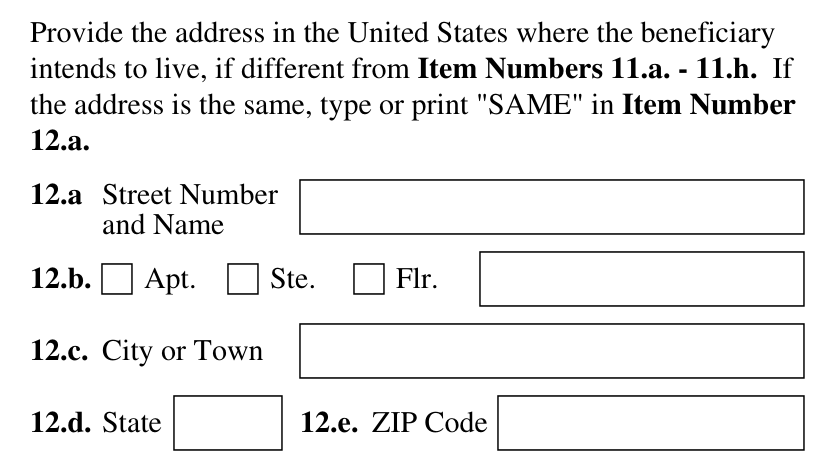
Verbatim · Part 4 instruction above Item 12 (Form I-130, edition 04/01/24, page 5)
“Provide the address in the United States where the beneficiary intends to live, if different from Item Numbers 11.a. - 11.h. If the address is the same, type or print "SAME" in Item Number 12.a.”
12.a. Street Number and Name · 12.b. Apt./Ste./Flr.
12.c. City or Town · 12.d. State · 12.e. ZIP Code
The I-130 Instructions do not separately walk through Item 12; the instruction printed on the form itself is the controlling guidance. Always complete the current edition from uscis.gov/i-130; USCIS rejects outdated editions.
What to enter for your situation
Item 12 is always a U.S. address. What you write depends on where your spouse lives now and where the two of you intend to live.
| Your situation | What to enter in Item 12 |
|---|---|
| Spouse lives abroad, will move in with you | Your U.S. home address as the petitioner. This is the address your spouse intends to live at. |
| Spouse lives abroad, will live with you, and you listed your address as their physical address | Type or print "SAME" in Item 12.a if Item 12 would repeat the Item 11 physical address. |
| Spouse already in the U.S. at your shared home | If Item 11 already shows that shared address, type or print "SAME" in Item 12.a. |
| Spouse already in the U.S. at a different address than where they intend to settle | Enter the U.S. address where the spouse intends to live in Item 12.a through 12.e. |
| You have not finalized where you will live yet | Use the U.S. address where you realistically expect to live together, normally the petitioner's current home. |
How to fill it in
Four steps that work for both a spouse abroad and a spouse already in the United States.
Decide whose address this is
Item 12 is the U.S. address the beneficiary spouse intends to live at, not the petitioner's mailing address by definition. For couples who plan to live together it is usually the same place: the petitioner's home in the United States.
Check it against Item 11 first
Item 11 is the beneficiary's physical address. If the intended U.S. address in Item 12 is the same as the Item 11 physical address, do not retype it. Type or print "SAME" in Item 12.a, exactly as the form instructs.
Otherwise fill 12.a through 12.e
When the intended U.S. address differs from Item 11, enter the street number and name in 12.a, any unit in 12.b, the city or town in 12.c, the state in 12.d, and the ZIP code in 12.e.
Keep it consistent with your other entries
If you plan to live together, the intended U.S. address normally matches the petitioner's address in Part 1. If your spouse will file Form I-485 to adjust status, use the same U.S. address there so the two forms agree.
Marriage-based filers: this is usually your shared U.S. home
On a marriage petition the beneficiary is your immigrant spouse, so Item 12 is the U.S. address where your spouse intends to live, not yours by definition. For the typical couple who plans to live together, that is the same place: your home as the petitioner. If your spouse lives abroad and will move in with you, the intended U.S. address is your current home. If your spouse already lives with you in the United States, the address is the one you share.
When the intended U.S. address is the same as the beneficiary's physical address in Item 11, the form tells you to type or print “SAME” in Item 12.a rather than repeat it. Keeping this address consistent with the petitioner's address in Part 1, and with any I-485 your spouse files, gives an officer a clear, matching picture of where you live as a couple.
Not sure what address belongs in Item 12 for your situation?
Our software asks a few plain questions about where you and your spouse live and fills the address fields the right way, keeping them consistent across your whole I-130 and I-485 packet.
Start FreeWhat USCIS does with the intended U.S. address
USCIS uses the intended U.S. address to know where the beneficiary will live once they are a permanent resident, and the agency may use it to route the case and send notices. For a marriage case, an intended address that matches the petitioner's home supports the picture of a couple who lives together or plans to. A U.S. intended address that has no connection to the petitioner, with no explanation, is the kind of detail an officer can notice when weighing whether the marriage is bona fide.
Common mistakes
These are the ones that show up most often on this field.
- 1
Entering the spouse's foreign address
Item 12 is specifically a U.S. address. The beneficiary's address abroad goes in the foreign-address items earlier in Part 4, not here. If your spouse lives overseas, enter the U.S. address they intend to move to, which is usually your home.
- 2
Retyping the address instead of writing SAME
When the intended U.S. address matches the beneficiary's physical address in Item 11, the form tells you to type or print "SAME" in Item 12.a. Retyping the full address is not what the form asks for and can create a small mismatch if the two entries are not identical.
- 3
An intended address that does not match the petition
If you plan to live together but Item 12 shows an address with no link to the petitioner, and Part 1 shows a different home, the inconsistency can prompt questions. Use the address where you actually intend to live together.
- 4
Leaving it blank
Item 12 is asking where the beneficiary intends to live in the United States. Leaving it empty when you do have an intended address can draw a Request for Evidence (an RFE, a USCIS notice asking for more information).
Related guides
Form and pathway context
Frequently asked questions
My spouse lives abroad. What U.S. address do I put in Item 12?
The U.S. address where your spouse intends to live once they immigrate. For a couple who will live together, that is normally your home as the petitioner. The beneficiary's current foreign address goes in the foreign-address items in Part 4, not in Item 12.
When do I write "SAME" in Item 12.a?
When the intended U.S. address in Item 12 is the same as the beneficiary's physical address already entered in Item 11. The form tells you to type or print "SAME" in Item 12.a rather than repeat the address.
My spouse already lives in the United States. What goes here?
If your spouse already lives in the U.S. and that is where they intend to stay, enter that current U.S. address. If it is the same as the physical address in Item 11, write "SAME" in Item 12.a instead.
Should Item 12 match the petitioner's address?
For couples who plan to live together it usually does, and matching the petitioner's address in Part 1 keeps the petition consistent. It does not have to match in every case, but an intended U.S. address that has no connection to the petitioner, with no explanation, can prompt questions about whether the marriage is bona fide.
Does the intended address need to match my spouse's I-485?
If your spouse files Form I-485 to adjust status inside the United States, using the same intended U.S. address on both forms keeps your filings consistent. Consistent addresses across the packet are one less thing for an officer to question.
Key takeaways
- ✓
Item 12 is the U.S. address where the beneficiary spouse intends to live, not a foreign address.
- ✓
For a couple who will live together, it is usually the petitioner's U.S. home address.
- ✓
If the intended address matches the beneficiary's physical address in Item 11, type or print "SAME" in Item 12.a.
- ✓
If your spouse already lives in the U.S. at a different address, enter that current U.S. address.
- ✓
Keep the intended address consistent with the petitioner's Part 1 address and with any I-485 your spouse files.
This page is for educational purposes only and is not legal advice. Green Card Genius is self-help immigration software, not a law firm, and does not provide legal representation. Immigration law and USCIS policy change frequently. For advice on a specific case, consult a licensed immigration attorney. Form I-130, edition 04/01/24. Last verified May 2026.
Stay informed
Green card guides in your inbox
Practical, plain-English updates to help you navigate the process with confidence.
Unsubscribe anytime.
Continue reading
- 01Form I-130: Petition for Alien Relative (2026 Guide)
- 02I-130 Beneficiary's Native Written Language (Part 4, Items 57-58)
- 03I-864 Country of Domicile (Part 2, Item 5): What It Means and How to Answer (2026)
- 04Marriage Green Card Document Checklist (2026)
- 05Marriage Green Card by Country: Country-Specific Guides (2026)
Be a Genius
Only pay when you file