Form I-130 · Part 4, Items 25-44
I-130 Beneficiary's Children (Part 4, Items 25-44): Who to List
Which of your immigrant spouse's children to list in Part 4 (Items 25-44, with the relationship in Item 26 for the first child), what each child needs, and why listing a child is not the same as petitioning for them.
Quick answer
Items 25-44 are the form's 'Information About Beneficiary's Family' block, which lists the beneficiary's spouse and children; this page covers listing the children. List every one of your spouse's children in Part 4, regardless of their age, marital status, or whether they are immigrating. For each child enter the name (Items 25.a-c for the first child), the relationship (Item 26), the date of birth (Item 27), and the country of birth (Item 28). Listing a child here is not the same as petitioning for them.
Summary
For most marriage-based filers, Form I-130 Part 4 (Information About Beneficiary's Family), Items 25 through 44, is the block that lists the beneficiary's spouse and children together; this page covers how to list the children within it. The petitioner is the U.S. citizen or green card holder filing the form; the beneficiary is the immigrant spouse. You list all of the beneficiary's children: their own biological children, stepchildren, and adopted children, no matter how old they are, whether they are married, or whether they will immigrate. The form gives space for Person 1 through Person 5 (Items 25 through 44), and each child needs a name, relationship, date of birth, and country of birth. Listing a child here records who exists; it does not by itself ask USCIS to give that child a green card.
| What it asks | The beneficiary spouse's children, listed in the 'Information About Beneficiary's Family' block of Part 4 (Person 1 through Person 5, Items 25-44). |
| Which children to list | All of them. Every child of your spouse, regardless of age, marital status, or whether the child is immigrating. |
| Info per child | Family/given/middle name, relationship (for example son or daughter), date of birth, and country of birth. |
| Step and adopted children | Count as the beneficiary's children. List them the same way, with the relationship shown as stepchild or adopted child. |
| Listing vs. petitioning | Listing a child here is not a petition for that child. A green card for a child comes through a separate path: a derivative claim or a separate Form I-130. |
| Who provides it | The immigrant spouse knows the children's details. The petitioner enters them on the form. |
Who this page is for
Items 25-44 are the form's ‘Information About Beneficiary's Family’ block, which lists the beneficiary's spouse and children; this page covers the standard case of listing your spouse's children within that block. If a child of your spouse has a non-standard adoption history, or if you are trying to work out whether a child is still young enough to immigrate (an age-out or Child Status Protection Act question), that turns on facts a licensed immigration attorney should review before you rely on any answer.
Free tool
Marriage Green Card Cost Calculator
2026 · AOS · full packet
$3,005
See your exact 2026 USCIS filing fees for a marriage green card through Adjustment of Status, with a full line-item breakdown and the costs most guides leave out.
Free — enter your email and it opens right up. Unsubscribe anytime.
We post free tips on preparing your marriage green card. Follow along:
What the children section looks like on the form
These fields sit in Part 4 (Information About Beneficiary), in the block headed “Information About Beneficiary's Family.” The form gives space for Person 1 through Person 5, and each person gets a name, a relationship line, a date of birth, and a country of birth.
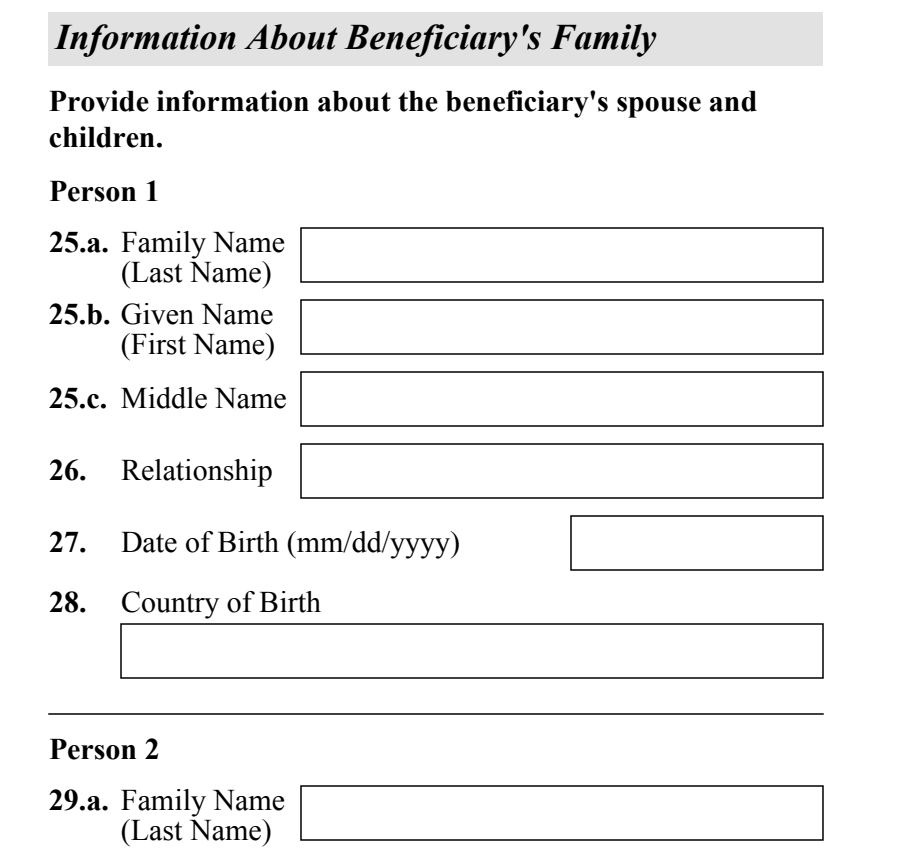
Verbatim · Part 4 note above Person 1 (Form I-130, edition 04/01/24, page 6)
“Provide information about the beneficiary's spouse and children.”
Person 1 · 25.a. Family Name (Last Name) · 25.b. Given Name (First Name) · 25.c. Middle Name · 26. Relationship · 27. Date of Birth (mm/dd/yyyy) · 28. Country of Birth
Person 2 · 29.a-c Name · 30. Relationship · 31. Date of Birth · 32. Country of Birth
Person 3 · 33.a-c Name · 34. Relationship · 35. Date of Birth · 36. Country of Birth
Person 4 · 37.a-c Name · 38. Relationship · 39. Date of Birth · 40. Country of Birth
Person 5 · 41.a-c Name · 42. Relationship · 43. Date of Birth · 44. Country of Birth
The I-130 Instructions do not separately walk through Items 25-44; the note printed on the form itself is the controlling guidance for this block. Always complete the current edition from uscis.gov/i-130; USCIS rejects outdated editions.
Which of your spouse's children do you list?
All of them. The block asks for the beneficiary's children with no filter on age, marital status, or whether the child is immigrating.
| Child of your spouse | List in Part 4? |
|---|---|
| Minor child living with your spouse | Yes, list |
| Adult child (21 or older) | Yes, list |
| Married child | Yes, list |
| Child who will not immigrate | Yes, list |
| Child living in another country | Yes, list |
| Child from a prior relationship of your spouse | Yes, list |
| Stepchild (your spouse's spouse's child) | Yes, list |
| Child your spouse adopted | Yes, list |
| Your own children who are not your spouse's | No, this block is the beneficiary's children |
How to fill it in
One Person block per child. Each child needs four things: name, relationship, date of birth, and country of birth.
List the beneficiary's spouse first, then the children
The form heading reads 'Provide information about the beneficiary's spouse and children.' The same Person 1 through Person 5 blocks hold both. List your spouse's current spouse only if your spouse is in a situation that involves one, then list the children. On a normal marriage petition the petitioner is the beneficiary's spouse, so usually the children fill these blocks.
One Person block per child
Each child gets a numbered Person block: family name, given name, and middle name (Items 25.a, 25.b, 25.c for the first child), then relationship (Item 26), date of birth (Item 27), and country of birth (Item 28). Person 2 starts at Item 29, Person 3 at Item 33, and so on.
Use the relationship line to say son or daughter
Item 26 (and 30, 34, 38, 42) is where you write the relationship: son, daughter, stepson, stepdaughter, adopted son, or adopted daughter. This is how the form distinguishes a biological child from a step or adopted child.
Run out of room? Use Part 9
The form prints five Person blocks. If your spouse has more than five children, continue in Part 9 (Additional Information). Write the Part 4 item number you are continuing, then the next child's name, relationship, date of birth, and country of birth.
Marriage-based filers: list your spouse's children, not your own
On a marriage petition the beneficiary is your immigrant spouse, so this block is about your spouse's children, not yours. A U.S. citizen or green card holder (the petitioner) filing for a spouse lists the spouse's biological children, the spouse's stepchildren, and any children the spouse adopted. If you and your spouse have children together, those are your spouse's children too, so they belong here. Your own children from a relationship that does not include your spouse are not the beneficiary's children and do not go in this block.
One point that surprises marriage filers: a spouse's children do not immigrate on the strength of the spouse's I-130. They are not derivative beneficiaries (family members who can immigrate based on the main petition) the way a sibling petition's children are. So listing your spouse's child in Part 4 records that the child exists; a child who needs a green card generally needs a separate Form I-130.
Not sure which children to list or whether a separate petition applies?
Our software asks a few plain questions about your spouse's family and fills the right fields the right way, keeping names and relationships consistent across your whole I-130 and I-485 packet.
Start FreeListing a child is not the same as petitioning for them
Listing a child in Part 4 records that the child exists. It does not ask USCIS to give that child a green card. How a child gets a green card depends on the petition. When the beneficiary is a U.S. citizen's sibling or married or adult son or daughter, the beneficiary's unmarried children under 21 are derivative beneficiaries and can immigrate on the same petition, which is why the instructions tell you to list them. On a marriage petition (a U.S. citizen or green card holder filing for a spouse), the spouse's children are not derivatives. A child of your spouse who needs a green card generally needs their own separate Form I-130, filed by the U.S. citizen or green card holder if the relationship and timing qualify. Filling in Part 4 is not that separate petition.
When to get an attorney
Working out whether a particular child can still immigrate as they approach 21, or handling a non-standard adoption, depends on specific facts and timing. We do not analyze those here. A licensed immigration attorney can review the child's situation before you make a decision that affects the case.
What USCIS does with the list of children
USCIS uses this list to see the beneficiary's full family picture and to identify children who may qualify to immigrate alongside your spouse. For a brother, sister, or married/adult son or daughter of a U.S. citizen, the beneficiary's unmarried children under 21 are derivative beneficiaries (family members who can immigrate based on the main petition), and the instructions say to list them in Part 4. A spouse petition does not work that way: a spouse's children do not ride along on the spouse's I-130, so listing them here is a record of who exists, not a request for their green cards. Either way, USCIS reads this block to understand the family, not to grant anything on its own.
Common mistakes
These are the ones that show up most often on this block.
- 1
Leaving out children who are not immigrating
List every child of your spouse, even one who will stay abroad or has no plan to immigrate. Part 4 asks for the full family, not only the children who are coming. Omitting a child can look like an inconsistency later when other records show the child.
- 2
Skipping adult or married children
Age and marital status do not change whether you list a child. A 30-year-old married child of your spouse still goes in a Person block. The list is about who the children are, not who can immigrate.
- 3
Treating the list as a petition
Writing a child's name in Part 4 does not file for that child. If a child of your spouse needs a green card, that usually requires a separate Form I-130. Do not assume the child is covered because you listed them here.
- 4
Forgetting step and adopted children
A stepchild or a child your spouse adopted is the beneficiary's child for this block. List them and show the relationship as stepchild or adopted child in the relationship line (Item 26, 30, 34, 38, or 42).
Related guides
Form and pathway context
Frequently asked questions
Do I list my spouse's children even if they are not immigrating?
Yes. Part 4 (Information About Beneficiary's Family) asks for all of your spouse's children, regardless of age, marital status, or whether the child plans to immigrate. List every one.
Does listing a child here mean I am petitioning for them?
No. Listing a child in Part 4 records that the child exists. It does not ask USCIS to give the child a green card. On a marriage petition the spouse's children are not derivative beneficiaries, so a child who needs a green card generally needs a separate Form I-130.
Do stepchildren and adopted children count as my spouse's children?
Yes. A stepchild or a child your spouse adopted counts as the beneficiary's child for this block. List them and show the relationship (stepchild or adopted child) on the relationship line, Item 26 for Person 1.
What information does each child need?
For each child you enter the family, given, and middle name (Items 25.a-c for Person 1), the relationship in Item 26 (for example son or daughter), the date of birth in Item 27, and the country of birth in Item 28. Person 2 starts at Item 29, and so on.
My spouse has more than five children. Where do I put the rest?
The form prints five Person blocks (Items 25 through 44). If your spouse has more than five children, continue the list in Part 9 (Additional Information), noting the Part 4 item number and the same details for each additional child.
Key takeaways
- ✓
List every one of your spouse's children in Part 4, regardless of age, marital status, or whether they are immigrating.
- ✓
Each child needs a name, relationship (Item 26 for the first child), date of birth, and country of birth.
- ✓
Step and adopted children count as the beneficiary's children. Show the relationship on the relationship line.
- ✓
Listing a child is not the same as petitioning for them. A child's green card comes through a derivative claim or a separate Form I-130.
- ✓
The form prints five Person blocks (Items 25-44). More than five children continue in Part 9.
This page is for educational purposes only and is not legal advice. Green Card Genius is self-help immigration software, not a law firm, and does not provide legal representation. Immigration law and USCIS policy change frequently. For advice on a specific case, consult a licensed immigration attorney. Form I-130, edition 04/01/24. Last verified May 2026.
Stay informed
Green card guides in your inbox
Practical, plain-English updates to help you navigate the process with confidence.
Unsubscribe anytime.
Continue reading
- 01Form I-130: Petition for Alien Relative (2026 Guide)
- 02I-864 Part 5, Item 1: Total Number of Persons in Household (2026)
- 03I-485 How Many Times Have You Been Married (Part 6, Item 3) (2026)
- 04Marriage Green Card Document Checklist (2026)
- 05Marriage Green Card by Country: Country-Specific Guides (2026)
Be a Genius
Only pay when you file