Dominican Republic Civil Documents · Updated May 2026
Dominican Birth Certificate (Acta de Nacimiento) for U.S. Immigration: Acta Inextensa and the 2025 Format Change
Get the long-form certificate U.S. immigration actually accepts, understand what the July 2025 format change means for you, and order it without paying for things you do not need.
Summary
You need the Acta Inextensa (the long-form birth certificate), or any acta issued on or after July 1, 2025 in the new unified format. Never the extracto (short form): bringing it is the most common cause of a same-day delay at the Santo Domingo interview, so ask for it by name at the JCE counter. No apostille is required for visa purposes. Order from the Junta Central Electoral (JCE) for RD$600 (about $10 USD), or from inside the U.S. through a Dominican consulate.
At a glance
| Topic | Details |
|---|---|
| Document name | Acta de Nacimiento. The long-form is the Acta Inextensa; the short form is the extracto. |
| What U.S. immigration needs | The Acta Inextensa (long-form), or any acta issued on or after July 1, 2025 in the new unified format. Never the extracto. |
| Issuing authority | Junta Central Electoral (JCE), through the Oficialías del Estado Civil (the local civil registry offices). |
| Cost | RD$600 Dominican pesos for the unified format (about $10 USD) as of July 2025, per JCE notices. Verify before ordering. |
| Apostille / legalization | Not required for visa purposes. The State Department confirms Dominican civil documents need no legalization. |
| Translation | Not needed at the Santo Domingo interview, which accepts Spanish-language documents. A certified English translation is required for adjustment of status (AOS) filed with USCIS inside the U.S. |
| Most common day-of delay | Bringing the extracto (short form) instead of the Acta Inextensa. |
Free tool
Marriage Green Card Cost Calculator
2026 · AOS · full packet
$3,005
See your exact 2026 USCIS filing fees for a marriage green card through Adjustment of Status, with a full line-item breakdown and the costs most guides leave out.
Free — enter your email and it opens right up. Unsubscribe anytime.
We post free tips on preparing your marriage green card. Follow along:
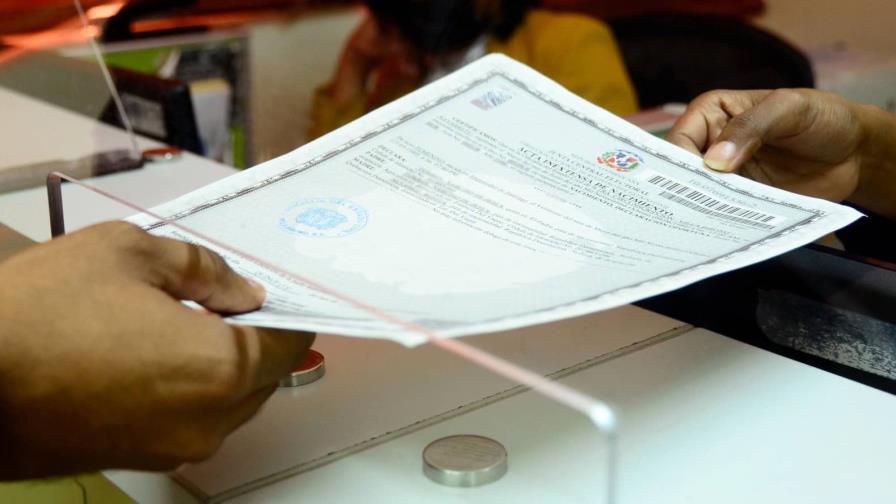
Which version you need: the Acta Inextensa, not the extracto
The Dominican Republic has issued birth certificates in more than one form. The one that matters for U.S. immigration is the Acta Inextensa: the long-form certificate that reproduces the full birth record, including your parents and the registry details. The extracto is a short-form summary used for routine local purposes like school enrollment. The U.S. Embassy in Santo Domingo does not accept the extracto.
The State Department reciprocity page and the embassy both state the requirement plainly: bring the original Acta Inextensa, or a certificate issued after July 1, 2025. Showing up with the extracto means rescheduling, which is the most common avoidable delay Dominican applicants hit.
The July 1, 2025 format change: what it means for you
On July 1, 2025, the Junta Central Electoral (JCE) unified all civil documents (birth, recognition, marriage, divorce, and death) into a single standardized format and dropped the "extracto" and "inextensa" labels. New certificates carry a QR code that lets government offices and embassies verify them online. Per JCE notices, the unified acta costs RD$600 (about $10 USD); confirm the current fee at the Oficialía before you go.
Acta issued on or after July 1, 2025
It is in the new unified format and is accepted as-is. There is no "inextensa" label to look for anymore, and no legalization is required.
Acta issued before July 1, 2025
It stays valid if it carries a QR code. For U.S. immigration you still need the Inextensa long-form version, not the extracto. If yours is an extracto or has no QR, order a fresh unified acta.
The change came in under JCE Resolución 09-2025 (later modified by Resolución 14-2025). Because it is recent, many applicants are unsure whether their older document still works. The short answer: an older Inextensa with a QR code is fine; an extracto is not. U.S. immigration does not put an expiration date on a birth certificate, so a valid older Inextensa does not need to be reissued simply because it is a few years old.
How to order: from the Dominican Republic or from the U.S.
The acta is issued by the JCE through the Oficialías del Estado Civil. How you order depends on where you are.
Step 1: Go to a JCE Oficialía or Service Center
Request the acta at the Oficialía del Estado Civil (local civil registry office) where the birth was registered, or at any JCE Service Center (Centro de Servicio). At the office that holds your original record the certified copy is usually issued the same day; another office may need to route the request, which takes longer. You can book an appointment first at citas.jce.gob.do to avoid the walk-in line.
Step 2: Bring your cédula and the fee
Bring your Dominican cédula (national ID) and the fee. The unified-format acta costs RD$600 (about $10 USD) as of July 2025. Ask specifically for the Acta Inextensa if your record predates the new format, or the new unified acta if it is more recent.
Step 3: Ordering from the United States
If you are already in the U.S., you cannot order directly from the JCE website. Request the acta through the nearest Dominican consulate, which forwards it to the JCE in Santo Domingo for issuance. Build in extra weeks for the consular round trip, and start before your NVC (National Visa Center) document deadline.
Do you need an apostille or a translation?
Two costs that trip people up are the apostille and the translation. For a Dominican acta, the answer to both is simpler than most countries.
Apostille / legalization
Not required. The State Department reciprocity page states legalization of Dominican civil documents is not required for visa purposes. Do not pay for an apostille unless a specific U.S. agency asks for one in writing.
Translation
Depends on your path. At the Santo Domingo interview, none is needed (the consulate works in Spanish). For adjustment of status filed with USCIS inside the U.S., a certified English translation is required.
The translation rule for adjustment of status comes from a U.S. federal regulation (8 CFR 103.2(b)(3)): every foreign-language document needs a complete certified English translation with a signed Certificate of Accuracy (a short statement from the translator confirming the translation is complete and accurate). The Santo Domingo consulate is the exception because it accepts Spanish-language documents.
What applicants report
Aggregated from r/USCIS and r/immigration green-card-interview threads, the VisaJourney Dominican Republic process guide, and U.S. Embassy Santo Domingo applicant notices (2024–2026). Real applicant reports, not legal advice; your office and case may differ.
Tips from the community
Bring your cédula and about $20 USD to the JCE
The VisaJourney Dominican Republic process guide tells beneficiaries to go to the nearest Junta Central Electoral with their cédula and roughly $20 USD (in pesos) and request the long-form (inextensa) acta. That covers the document fee with margin for service variations between offices.
VisaJourney Dominican Republic process guide
Get an inextensa for every child, even ones not traveling yet, and keep spare copies
The community guide says to have inextensa actas ready for the interview for every child of the principal applicant, whether they immigrate with you now or follow to join later. r/USCIS interview threads add a hard-won reason to keep spares: applicants who mailed in their only copies as part of an RFE were later told to bring the originals to the interview and had nothing left. Pull them all, with extra copies, in one JCE trip.
VisaJourney Dominican Republic process guide; r/USCIS interview threads, 2025–2026
The wrong format is the single most common day-of delay
The U.S. Embassy in Santo Domingo has posted repeated 'come prepared' and 'bring the Acta Inextensa' notices. That volume of reminders signals that showing up with the short extracto is a frequent, avoidable failure that forces a reschedule.
U.S. Embassy Santo Domingo applicant notices, 2024–2025
If your acta predates July 2025, check it for a QR code
Actas issued before July 1, 2025 stay valid if they carry a QR code, so you may not need a new one. But for U.S. immigration the embassy still wants the Inextensa long-form for older records, not the extracto. When in doubt, order a fresh unified-format acta with the QR.
U.S. Embassy Santo Domingo and JCE notices, 2025
In their words
The acta itself draws little Dominican-specific forum chatter, but applicants preparing for the green-card interview keep running into the same document realities:
“They require me to bring my kids' Birth Certificates after I already mailed the only copies I had of them as an RFE through the mail.”
“My original birth certificate is back home in my country. I only have a digital/printed copy, which is the same one I submitted with my application. My lawyer said a printed copy was fine for the interview, but now I am second-guessing it.”
Common problems and fixes
| Issue | Fix |
|---|---|
| Brought the extracto (short form) to the interview | Request the Acta Inextensa long-form, or a post-July-1-2025 unified-format acta, from the JCE before your interview. |
| Pre-2025 acta with no QR code | Order a fresh unified-format acta with a QR code; it is verifiable online and avoids authenticity questions. |
| Paid for an apostille that was not needed | Legalization is not required for visa purposes at Santo Domingo. Skip the apostille unless a specific U.S. agency asks for one. |
| Filed adjustment of status with a Spanish-only acta and no translation | USCIS requires a certified English translation for adjustment of status (AOS) under 8 CFR 103.2(b)(3). The Santo Domingo consulate does not, because it accepts Spanish-language documents. |
Sources
- U.S. Department of State: Dominican Republic Reciprocity and Civil Documents (verified May 2026)
- U.S. Embassy Santo Domingo: Immigrant Visa Interview Supplement (verified May 2026)
- U.S. Embassy Santo Domingo: Applicants Must Bring Acta Inextensa Birth Certificates (verified May 2026)
- Junta Central Electoral (JCE): Civil Registry Services and Requirements (verified May 2026)
- JCE notice: unified acta format and RD$600 fee in effect July 1, 2025 (Resolución 09-2025) (verified May 2026)
- Diario Libre: JCE Unveils New Unified Civil-Document Design (June 30, 2025) (verified May 2026)
- 8 CFR 103.2(b)(3): certified English translation requirement for foreign-language documents
- VisaJourney Dominican Republic process guide (community), 2024–2025
Frequently asked questions
What is the difference between the Acta Inextensa and the extracto?
The Acta Inextensa is the long-form Dominican birth certificate: it reproduces the full birth record, including parents' details and registry data. The extracto is a short-form summary used mainly for school enrollment. U.S. immigration requires the Acta Inextensa (or a post-July-1-2025 unified acta). Bringing the extracto to a Santo Domingo interview is the most common cause of a same-day delay.
Do I still need to ask for the 'inextensa' after the July 2025 format change?
It depends on when your acta was issued. As of July 1, 2025 the JCE unified all civil documents into one format and dropped the extracto and inextensa labels, so a new acta no longer carries either name and is accepted as-is. If your record was issued before July 1, 2025, ask for the Acta Inextensa specifically, because the older short-form extracto is not accepted.
Does a Dominican birth certificate need an apostille for U.S. immigration?
No. The U.S. State Department reciprocity page states that legalization of Dominican civil documents is not required for visa purposes. The U.S. Embassy in Santo Domingo accepts the Acta Inextensa (or a post-July-2025 acta) directly, and USCIS does not require an apostille for adjustment of status either. Do not pay for an apostille unless a specific U.S. agency asks for one in writing.
Do I need to translate my Dominican acta into English?
For the immigrant visa interview at the U.S. Embassy in Santo Domingo, no: the embassy accepts Spanish-language Dominican documents and only requires a translation for documents not in English or Spanish. For adjustment of status filed with USCIS inside the United States, yes: under 8 CFR 103.2(b)(3), a U.S. federal regulation, every foreign-language document needs a complete certified English translation with a signed Certificate of Accuracy (a short statement from the translator confirming the translation is complete and accurate).
How do I order my Dominican acta if I am already in the United States?
You cannot order directly from the JCE website from abroad. Request the acta through the nearest Dominican consulate in the U.S., which forwards the request to the JCE in Santo Domingo and returns the issued document to you. Build in several extra weeks for the round trip and start well before your NVC civil-document deadline.
How much does the acta cost and where do I get it?
The unified-format acta costs RD$600 Dominican pesos (about $10 USD) as of July 2025, according to JCE notices. Get it at the Oficialía del Estado Civil (local civil registry office) where the birth was registered, or at any JCE Service Center. You can book an appointment at citas.jce.gob.do to skip the walk-in line. Bring your cédula and the fee.
My birth was never registered in the Dominican Republic. Can I still get an acta in time?
If your birth was never registered, the JCE has no record to issue, so you cannot simply order an acta. Contact the Oficialía del Estado Civil in the municipality where you were born to start a late registration (declaración tardía). This process takes time and can require supporting evidence, so begin well before your NVC civil-document deadline rather than waiting until the interview is scheduled.
Key takeaways
- ✓
U.S. immigration requires the Acta Inextensa (long-form), or any acta issued on or after July 1, 2025 in the JCE's new unified format. The short-form extracto is not accepted.
- ✓
Since July 1, 2025 the JCE issues one unified civil-document format with a verifiable QR code at RD$600 (about $10 USD). The extracto and inextensa labels no longer appear on new documents.
- ✓
Actas issued before July 1, 2025 remain valid if they carry a QR code, but for U.S. immigration you still need the Inextensa long-form for older records, not the extracto.
- ✓
No apostille or legalization is required for Dominican civil documents for visa purposes. Paying for one is a common, avoidable expense.
- ✓
Translation is needed only for adjustment of status with USCIS (certified English translation under 8 CFR 103.2(b)(3)). The Santo Domingo consulate works in Spanish and does not require it.
- ✓
From inside the U.S., order through a Dominican consulate, not the JCE website. Start early so the consular round trip does not miss your NVC deadline.
Collecting documents for consular processing?
Green Card Genius guides you through every step of the consular processing path, including which civil documents NVC requires and in what order. See if it fits your situation.
See how it worksStay informed
Green card guides in your inbox
Practical, plain-English updates to help you navigate the process with confidence.
Unsubscribe anytime.
Continue reading
- 01Dominican Marriage Certificate (Acta de Matrimonio) for U.S. Immigration: Acta Inextensa & the 2025 Format Change (2026)
- 02Mexican Birth Certificate (Acta de Nacimiento) for U.S. Immigration: Complete 2026 Guide
- 03Consular Processing Guide (2026): Marriage Green Card
- 04Adjustment of Status vs Consular Processing (2026 Guide)
- 05What Happens After I-130 Is Approved? (2026 Guide)
Be a Genius
Only pay when you file