Vietnam Civil Documents · Updated May 2026
Vietnamese Birth Certificate (Giấy Khai Sinh) for U.S. Immigration: How to Get It, Translate It, and Skip the Apostille
Get the certified copy the U.S. Consulate in Ho Chi Minh City actually accepts, add the translation it needs, and avoid paying for legalization you do not need.
Summary
Order a certified copy (bản sao) or an extract (trích lục) of your giấy khai sinh from the People’s Committee (Ủy ban nhân dân) of the district where the birth was registered, then add a certified English translation. You do not need an apostille or consular legalization for the U.S. green-card filing. The hospital notice of birth (giấy chứng sinh) is not accepted. If your record was never registered or was lost (common for births before 1975 or in rural areas), get a registrar’s statement that it is unavailable and submit secondary evidence instead.
At a glance
| Topic | Details |
|---|---|
| Document name | Giấy khai sinh (Birth Certificate). For U.S. immigration you submit a certified copy (bản sao) or an extract (trích lục), not your single paper original. |
| What U.S. immigration needs | A certified copy (bản sao) or extract (trích lục) from the People's Committee of the district where the birth was registered, plus a certified English translation. The hospital notice of birth (giấy chứng sinh) is not accepted. |
| Issuing authority | The People's Committee (Ủy ban nhân dân) at the commune or district level where the birth was registered. There is no national birth-records database, so you go to the place of registration. |
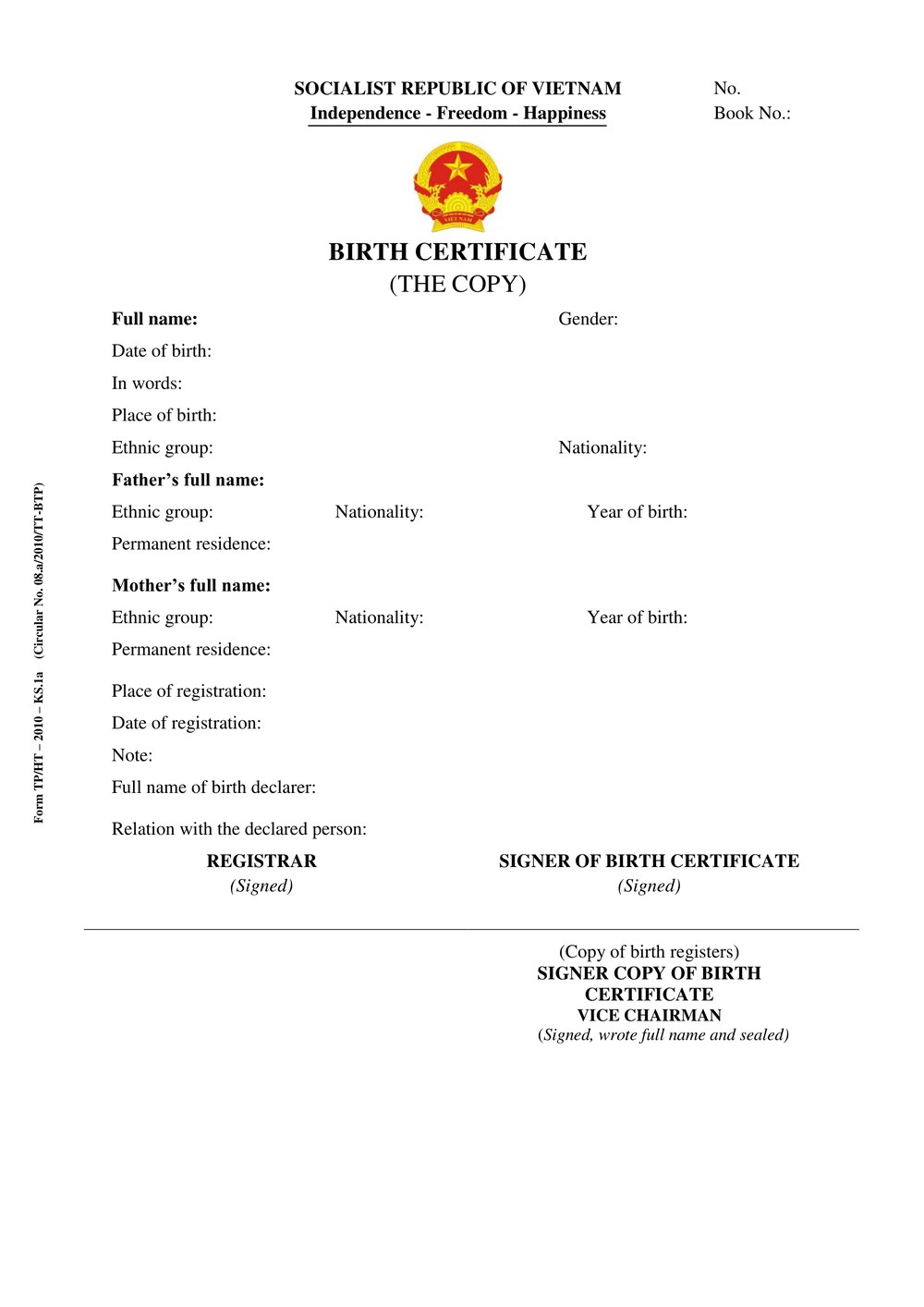
| What it looks like | The original is light green with a red seal; the design has been standard since July 16, 2020. Certified copies are white or orange. Certificates issued after January 1, 2016 carry a Personal Identification Number (PIN). |
| Apostille / legalization | Not required for U.S. immigration. USCIS and the U.S. Consulate in Ho Chi Minh City accept the Vietnamese certificate with a translation. Do not pay for consular legalization or an apostille for the green-card filing. |
| Translation | A complete certified English translation is required (the consulate and USCIS both ask for it). The translation needs a signed statement that it is complete and accurate. |
| If no record exists | For births before 1975 or in rural areas where records were lost, never registered, or destroyed, get a written statement from the civil registrar that the record is unavailable, then submit secondary evidence (household registration / sổ hộ khẩu, school records, or baptismal certificate). |
| Where the interview happens | The U.S. Consulate General in Ho Chi Minh City (4 Le Duan, District 1) handles every Vietnam immigrant visa. Hanoi processes nonimmigrant visas only. |
Document details verified May 2026 against the U.S. Department of State Vietnam reciprocity page. Verify directly before relying on them.
Free tool
Marriage Green Card Cost Calculator
2026 · AOS · full packet
$3,005
See your exact 2026 USCIS filing fees for a marriage green card through Adjustment of Status, with a full line-item breakdown and the costs most guides leave out.
Free — enter your email and it opens right up. Unsubscribe anytime.
We post free tips on preparing your marriage green card. Follow along:
How to get it: the order of operations
The certificate is issued by the local People’s Committee (Ủy ban nhân dân). Because Vietnam has no national birth-records database, the steps depend on getting to the office that holds your original record. Follow this sequence.
Step 1: Go to the People's Committee of the birth district
Request the certified copy at the People's Committee (Ủy ban nhân dân) office of the commune or district where the birth was registered, normally the district where the mother was resident under her household book (sổ hộ khẩu) at the time. Because Vietnam has no national birth-records database, only the office that holds the original record can issue a copy directly. Ask for a certified copy (bản sao) of the giấy khai sinh.
Step 2: Or request an extract (trích lục) if you only need the data
If the office cannot reproduce the full certificate, it can issue an extract (trích lục) of the birth record on file. Both the bản sao and the trích lục are accepted for the immigrant visa. Certificates issued after February 18, 2022 may also come as an officially issued electronic copy with a QR code, which the Vietnamese government treats as valid.
Step 3: Add a certified English translation
Have the certificate translated into English by a competent translator and attach a signed Certificate of Accuracy: a short statement that the translation is complete and accurate. The U.S. Consulate in Ho Chi Minh City and USCIS both require the English translation. The translation does not need to be done in Vietnam; any qualified translator can do it.
Step 4: Requesting from the United States
If you are already in the U.S., you cannot pull the record yourself. Authorize a relative or friend in Vietnam to request the certified copy from the local People's Committee on your behalf with a power of attorney, or request reissue of the original through a Vietnamese consulate. Build in extra weeks and start before your National Visa Center (NVC) civil-document deadline.
Which document you need: bản sao or trích lục, not the hospital slip
Vietnam issues only one paper original (bản chính) of the giấy khai sinh per person, so you keep that and submit a copy. There are two acceptable forms: the certified copy (bản sao), which reproduces the full certificate, and the extract (trích lục), which restates the data on file. Both come from the People’s Committee and both are accepted for the immigrant visa.
What is not accepted is the hospital notice of birth, the giấy chứng sinh. That is the slip the hospital gives you to register the birth, not the registered civil document. The U.S. Consulate’s own birth-record guidance flags this swap as a common mistake.
What the certificate looks like
The original is light green with a red seal; this design has been standard since July 16, 2020. Certified copies are white or orange. Certificates issued after January 1, 2016 carry a Personal Identification Number (PIN), and official electronic copies (with a QR code) have been valid since February 18, 2022.
Where to request it
Go to the People’s Committee of the commune or district where the birth was registered, usually the district where the mother was resident under her household book (sổ hộ khẩu). No other office can retrieve the record, because there is no national database.
Apostille and translation: what you do and do not need
Two costs trip people up: legalization and translation. For the U.S. green-card filing, one is skipped entirely and the other is required.
Apostille / legalization
Not required for U.S. immigration. USCIS and the U.S. Consulate in Ho Chi Minh City accept the Vietnamese certificate with a translation; they do not ask for an apostille or consular legalization on the foreign document. Do not pay for one unless a specific U.S. agency requests it in writing.
Translation
Required. Attach a complete certified English translation with a signed Certificate of Accuracy, a short statement that the translation is complete and accurate. Both the consulate and USCIS require it; any qualified translator can do it.
You may have read that Vietnam is not an apostille country. That changed: Vietnam acceded to the Hague Apostille Convention on December 31, 2025, and it takes effect for Vietnam on September 11, 2026. That change governs how Vietnamese documents are recognized abroad and how foreign apostilles are recognized in Vietnam. It does not add a step to your U.S. green-card filing, which still accepts the certificate plus a certified English translation.
If your birth was never registered or the record is lost
The State Department notes that some records of those born before 1975 may have been lost or destroyed, that records from smaller cities or rural communities may be unavailable, and that there are no alternate documents for Vietnam. If the People’s Committee cannot produce a certificate, here is what to do, in order.
Step 1: Get a statement of unavailability
Ask the civil registrar’s office in the place of birth for a written statement that the record was destroyed, lost, or never created and that the government will not issue a certificate. The consulate needs this statement before it will accept substitute evidence.
Step 2: Gather secondary evidence
Submit secondary evidence of birth: an old family household registration (sổ hộ khẩu), school records, or a baptismal certificate. The more independent records that agree on your date and place of birth, the stronger the package.
Step 3: Consider late registration in time
If you can register the birth now (late registration through the People’s Committee), do it well before your interview. Both the late-registration process and the secondary- evidence package take time to assemble, so start before your NVC civil-document deadline.
What applicants report
Aggregated from the VisaJourney Vietnam forum, U.S. Embassy Vietnam civil-records guidance, and r/immigration and r/USCIS Vietnam threads (2024–2026). The Vietnamese birth certificate draws little forum chatter, so we lead with the patterns that repeat. Real applicant reports, not legal advice; your office and case may differ.
Tips from the community
Request the copy in the exact district where the birth was registered
Embassy guidance and applicant accounts agree: go to the People's Committee of the district where you were born, usually where your mother lived under her household book (sổ hộ khẩu). A different office cannot find the record because there is no national database. People requesting from abroad authorize a family member to do this in person.
U.S. Embassy Vietnam local-civil-records guidance; VisaJourney Vietnam forum, 2024
Many older Vietnamese birthdates default to December 31
VisaJourney members preparing Ho Chi Minh City cases note that older relatives often do not remember exact birthdates, and many records show 12/31 of the birth year as a placeholder. If the date on your certificate does not match another document, expect the consular officer to ask about it, and bring whatever supporting record you have.
VisaJourney Vietnam forum (user ToNhi), April–June 2024
The hospital notice of birth is not a birth certificate
Applicants sometimes bring the giấy chứng sinh (hospital notice of birth) by mistake. The U.S. Consulate accepts only the registered giấy khai sinh from the People's Committee. The hospital slip is the input you take to register the birth, not the civil document itself.
U.S. Embassy Vietnam CRBA checklist and reciprocity notes, 2025
Bring originals to the interview and keep spare certified copies
VisaJourney Vietnam reports stress bringing original civil documents to the Ho Chi Minh City interview; the consulate reviews them and returns them. Pull more than one certified copy in a single People's Committee trip so a copy mailed in earlier as evidence does not leave you short at the interview.
VisaJourney Vietnam forum, 2024–2025
In their words
“Nhi does not remember most of her family's birthdates and names. Most people in Vietnam put 12/31/Year as their birthdate.”
“If our messages to one another are primarily in Vietnamese, should I also provide English translations as well (not sure if they would need to be certified translations)?”
Common problems and fixes
| Issue | Fix |
|---|---|
| Brought the hospital notice of birth (giấy chứng sinh) instead of the registered certificate | Register the birth (or confirm it is registered) and request a certified copy (bản sao) of the giấy khai sinh from the People's Committee of the birth district. |
| Requested the copy at the wrong office | Go to the People's Committee where the birth was originally registered, usually the mother's household-book district. There is no national database, so other offices cannot retrieve the record. |
| Paid for consular legalization or an apostille for the green-card filing | Neither is required for U.S. immigration. USCIS and the Ho Chi Minh City consulate accept the certificate with a certified English translation. Skip legalization unless a specific U.S. agency asks for it in writing. |
| Submitted a Vietnamese certificate with no English translation | Attach a complete certified English translation with a signed Certificate of Accuracy. Both the consulate and USCIS require it. |
| Record was never registered or was lost (often pre-1975 or rural births) | Get a written statement from the civil registrar that the record is unavailable, then submit secondary evidence: household registration (sổ hộ khẩu), school records, or a baptismal certificate. |
Sources
- U.S. Department of State: Vietnam Reciprocity and Civil Documents (verified May 2026)
- U.S. Embassy & Consulate in Vietnam: Local Civil Records Information (verified May 2026)
- U.S. Embassy & Consulate in Vietnam: Immigrant Visas (Ho Chi Minh City) (verified May 2026)
- U.S. Consulate General Ho Chi Minh City: Immigrant Visa Post Supplement (verified May 2026)
- Erickson Immigration Group: Vietnam accedes to the Apostille Convention (in force September 11, 2026) (verified May 2026)
- 8 CFR 103.2(b)(3): certified English translation requirement for foreign-language documents
- VisaJourney Vietnam forum (community), 2024–2025
Frequently asked questions
What is the Vietnamese birth certificate called, and who issues it?
It is the giấy khai sinh (Birth Certificate), issued by the People's Committee (Ủy ban nhân dân) at the commune or district level where the birth was registered. Vietnam has no national birth-records database, so you must request a copy from the office that holds the original, normally the district where the mother lived under her household book (sổ hộ khẩu).
Do I submit my original birth certificate, or a copy?
Only one paper original is ever issued in Vietnam, so you keep that and submit a certified copy (bản sao) or an extract (trích lục) instead. Both are issued by the People's Committee and are accepted for the immigrant visa. Certificates issued after February 18, 2022 may also come as an official electronic copy with a QR code, which is treated as valid.
Does a Vietnamese birth certificate need an apostille or legalization for U.S. immigration?
No. USCIS and the U.S. Consulate General in Ho Chi Minh City accept the Vietnamese certificate with a certified English translation; they do not require an apostille or consular legalization on the foreign document. Vietnam acceded to the Hague Apostille Convention on December 31, 2025, and it takes effect for Vietnam on September 11, 2026, but that change is about Vietnamese documents being recognized abroad and foreign documents being recognized in Vietnam, not about a requirement for your U.S. green-card filing. Do not pay for legalization unless a specific U.S. agency asks for it in writing.
Do I need to translate my Vietnamese birth certificate into English?
Yes. A complete certified English translation is required for both the immigrant visa interview in Ho Chi Minh City and for adjustment of status with USCIS. The translation needs a signed Certificate of Accuracy: a short statement from the translator confirming the translation is complete and accurate. Any qualified translator can do it; it does not have to be done in Vietnam.
How do I get my Vietnamese birth certificate if I already live in the United States?
You cannot pull the record yourself from abroad. Authorize a relative or friend in Vietnam, with a power of attorney, to request the certified copy from the People's Committee of your birth district, or request reissue of the original through a Vietnamese consulate in the U.S. Start early and build in several extra weeks so the request does not miss your NVC civil-document deadline.
What if I was born before 1975 or my birth was never registered?
Some records from before 1975, and some rural or small-city records, were lost, destroyed, or never created, and the State Department lists no alternate civil document for Vietnam. In that case, get a written statement from the civil registrar's office that the record is unavailable, then submit secondary evidence of birth: an old household registration (sổ hộ khẩu), school records, or a baptismal certificate. Begin this well before your interview because it takes time to assemble.
Is the hospital notice of birth (giấy chứng sinh) enough?
No. The giấy chứng sinh is the hospital's notice of birth, which you use to register the birth; it is not the civil document itself. The U.S. Consulate accepts only the registered giấy khai sinh issued by the People's Committee.
Key takeaways
- ✓
U.S. immigration needs a certified copy (bản sao) or extract (trích lục) of the giấy khai sinh from the People's Committee of the district where the birth was registered, plus a certified English translation. The hospital notice of birth is not accepted.
- ✓
No apostille or consular legalization is required for the green-card filing. Vietnam joins the Apostille Convention on September 11, 2026, but that does not change what USCIS or the Ho Chi Minh City consulate ask for.
- ✓
Because Vietnam has no national records database, you must request the copy from the exact office that registered the birth, usually the mother's household-book district.
- ✓
If you are in the U.S., authorize a relative in Vietnam to obtain the copy, or request a reissue through a Vietnamese consulate. Start before your NVC deadline.
- ✓
If the record was lost or never registered (common for pre-1975 or rural births), get a registrar's statement of unavailability and submit secondary evidence: household registration, school records, or a baptismal certificate.
- ✓
All Vietnam immigrant visa interviews happen at the U.S. Consulate General in Ho Chi Minh City (4 Le Duan, District 1). Hanoi handles nonimmigrant visas only.
Collecting documents for consular processing?
Green Card Genius guides you through every step of the consular processing path, including which civil documents the National Visa Center requires and in what order. See if it fits your situation.
See how it worksStay informed
Green card guides in your inbox
Practical, plain-English updates to help you navigate the process with confidence.
Unsubscribe anytime.
Continue reading
- 01Vietnamese Marriage Certificate (Giấy chứng nhận kết hôn) for U.S. Immigration (2026)
- 02Vietnam Police Certificate (Judicial Record Card No. 2 / Phiếu Lý Lịch Tư Pháp số 2) for U.S. Immigration (2026)
- 03Ho Chi Minh City Immigrant Visa Interview Trip: U.S. Consulate Logistics & Medical (2026)
- 04Consular Processing Guide (2026): Marriage Green Card
Be a Genius
Only pay when you file