Philippines Civil Documents · Updated May 2026
Annotated PSA Documents for U.S. Immigration: What They Are and What to Submit (2026)
If your Philippine civil document has been legally changed, you need the CDLI copy and a three-part bundle for NVC. Here is what to order and how to prevent a 221(g) hold.
Summary
An annotated PSA document carries a marginal note recording a court-ordered or administratively approved change: a name correction, legitimation, recognition of a foreign divorce, late registration, or adoption. If your PSA document has been legally changed, request the CDLI (Court Decree and Legal Instrument) copy from PSA. A standard copy without the annotation is not valid for U.S. visa purposes. Submit a three-part bundle to NVC: the annotated PSA document, the court order or administrative decision that caused the annotation, and certified English translations of any non-English documents. Add a cover letter if the name on the annotated document differs from the applicant's passport.
At a glance
| Topic | Details |
|---|---|
| What is an annotation? | A marginal note printed on the PSA security paper recording a legally approved change: name correction, legitimation, recognition of foreign divorce, late registration, or adoption. |
| CDLI requirement | If your PSA document has been legally changed, you must request the CDLI (Court Decree and Legal Instrument) copy. An un-annotated copy is not valid for visa purposes per the State Dept reciprocity page (verified May 2026). |
| What to submit to NVC / embassy | Three-part bundle: (1) annotated PSA document with CDLI endorsement, (2) the underlying court order or administrative decision that caused the annotation, (3) certified English translations of both. |
| Translation required? | Yes. PSA civil documents are in English, but the court order or LCRO decision that caused the annotation is typically in Filipino or the regional language and must be translated. |
| Where to order | PSA Serbilis (psaserbilis.com.ph) or PSA Helpline (psahelpline.ph) for delivery. For the first annotated copy after a new annotation, you must go in person to a PSA office. |
| Common immigration trigger | Name on the annotated PSA document differs from the name on the applicant's passport or other civil documents, causing a 221(g) hold or RFE for explanation. |
| Recognition of foreign divorce | Philippine courts must recognize the foreign divorce before PSA will annotate the marriage certificate. A court order plus registration at the Local Civil Registry (LCRO) is required before the annotation appears in PSA records. |
Free tool
Marriage Green Card Cost Calculator
2026 · AOS · full packet
$3,005
See your exact 2026 USCIS filing fees for a marriage green card through Adjustment of Status, with a full line-item breakdown and the costs most guides leave out.
Free — enter your email and it opens right up. Unsubscribe anytime.
We post free tips on preparing your marriage green card. Follow along:
What is an annotation on a PSA document?
Philippine civil registry documents (birth certificates, marriage certificates) are issued by the Philippine Statistics Authority (PSA), which absorbed the former National Statistics Office (NSO) in 2013. When a court order or an approved administrative petition changes a fact recorded on one of these documents, the PSA does not issue a completely new document. Instead, a marginal note is printed on the PSA security paper alongside the original entry. That note is the annotation.
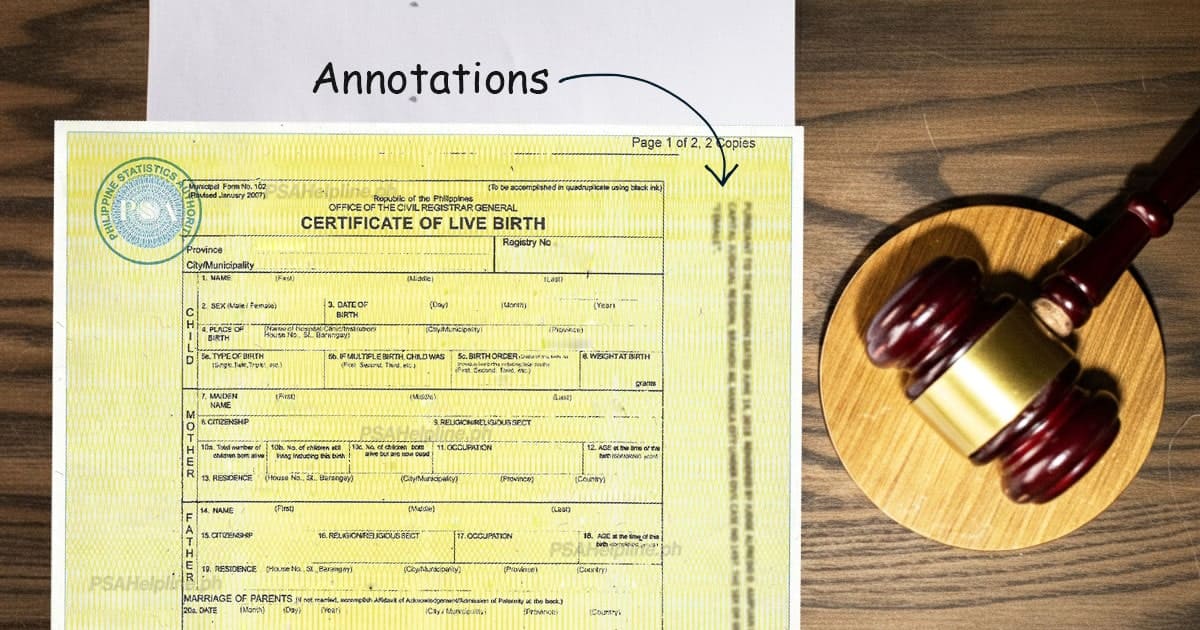
For U.S. immigration purposes, the annotation matters because the State Department reciprocity page for the Philippines (verified May 2026) requires the CDLI (Court Decree and Legal Instrument) version of any PSA document that has been changed. A standard copy without the annotation is not valid for visa purposes.
The five types of annotations and what they mean for immigration
Each annotation type has a different legal basis and a different immigration implication. Knowing which type applies to your document tells you what supporting documents to include in your NVC submission.
Name correction or change (R.A. 9048 / court order)
What triggers it: A clerical error in the original civil registration or a court-approved first-name change.
What it looks like: The PSA document shows a marginal note such as "Corrected under R.A. 9048" with the corrected name.
Legitimation (parents marry after birth)
What triggers it: Child born outside of marriage whose parents later married, filing an Affidavit of Legitimation at the Local Civil Registry Office (LCRO).
What it looks like: Birth certificate annotation reflects legitimate status and may show the father's surname where the original showed only the mother's surname.
Late registration annotation
What triggers it: Birth registered more than 10 days after birth. The late registration date and the affidavit of late registration are noted on the PSA document.
What it looks like: Document shows the registration date separately from the birth date, with an annotation indicating late registration.
Recognition of foreign divorce
What triggers it: A Filipino national whose foreign spouse (or, in some cases, a naturalized Filipino) obtained a divorce abroad files a petition in a Philippine Regional Trial Court (RTC) to have that foreign divorce recognized.
What it looks like: After the RTC grants recognition and the decision is registered at the LCRO and PSA, the marriage certificate is annotated to reflect that the marriage has been dissolved by foreign divorce.
Adoption annotation
What triggers it: Philippine court decree of adoption. Note: adoption does not produce a marginal annotation in the same way as other changes. Instead, the original birth certificate is sealed and a new amended certificate is issued reflecting the adoptive parents.
What it looks like: A new PSA birth certificate is issued; the original is sealed. The amended certificate may show a different name and different parents.
The CDLI requirement: why a standard PSA copy is not enough
CDLI stands for Court Decree and Legal Instrument. It is the PSA document version that includes all annotations from court proceedings and approved administrative petitions. The State Department reciprocity page states: “Unless a CDLI copy is requested, the requester will receive the un-amended or original copy of the document, which will not be considered valid for visa application purposes.” (Verified May 2026.)
How to request the CDLI copy
- 1.Go to PSA Serbilis (psaserbilis.com.ph) or PSA Helpline (psahelpline.ph).
- 2.When ordering, select the option indicating you need the document with annotations or the CDLI version. Both services offer this option for civil documents that have been changed.
- 3.For the first annotated copy after a new annotation is processed: pick it up in person at a PSA outlet (or authorize a representative via Special Power of Attorney). Subsequent copies can be ordered online.
- 4.International delivery is available via DHL or PHLPost. Processing time after payment is typically 4 to 8 business days within the Philippines; add shipping time for international delivery.
How to build your NVC submission bundle
NVC requires more than just the annotated PSA document. Every annotation has an underlying legal basis: a court order, an administrative decision, or a registered affidavit. Submit all of it together.
Step 1: Order the CDLI copy from PSA
Request the version of your PSA document with CDLI (Court Decree and Legal Instrument) endorsement. Do not order a standard copy if your document has been legally changed. PSA Serbilis and PSA Helpline both offer the CDLI copy option. Specify "with annotations" when ordering. For a document that was recently annotated for the first time, the first annotated copy must be picked up in person at a PSA outlet.
Step 2: Obtain the underlying court order or administrative decision
This is the document that caused the annotation: the RTC recognition order for foreign divorce, the LCRO administrative order for an R.A. 9048 name correction, or the Affidavit of Legitimation registered at the LCRO. Request a certified true copy from the court or LCRO where the proceeding was filed. The Embassy Manila supplement (January 2026) requires this document alongside the annotated PSA certificate.
Step 3: Get certified English translations
PSA civil documents are printed in English, so the PSA document itself may not require translation. However, court orders and LCRO decisions are typically in Filipino or a regional language and must be accompanied by a certified English translation with a signed Certificate of Accuracy. Under 8 CFR 103.2(b)(3), every foreign-language document must be accompanied by a complete English translation and a certification of competency from the translator.
Step 4: Prepare a cover letter explaining the annotation
Write a brief, factual cover letter that: (a) identifies the document, (b) explains what the annotation records (e.g., a court-ordered name correction, legitimation after parents married, or recognition of a foreign divorce), and (c) explains any name discrepancy between the annotated PSA document and the applicant's passport or other documents. This cover letter is not required by NVC regulations, but applicants who include it consistently report fewer follow-up requests.
Step 5: Submit the complete bundle to NVC
Upload all three components (annotated PSA document, court order or administrative decision, and certified translations) as a single package in CEAC (Consular Electronic Application Center). Label each document clearly in the upload. Bring originals of all documents to the Embassy Manila interview.
Translation requirements
PSA civil documents are printed in English and generally do not require translation. Court orders and LCRO decisions are typically in Filipino or a regional language. Under 8 CFR 103.2(b)(3), every foreign-language document must be accompanied by a complete certified English translation and a signed Certificate of Accuracy. See GCG's translation guide for requirements.
Recognition of foreign divorce: a special case for Filipino nationals
The Philippines does not recognize divorce between two Filipino nationals (as of May 2026). However, if a Filipino national was married to a foreign national and the foreign national obtained a divorce abroad, the Filipino can have that divorce recognized under Philippine law through a petition in the Regional Trial Court (RTC). Once the RTC grants recognition and the decision is registered with the Local Civil Registry and PSA, the marriage certificate is annotated to reflect that the marriage was dissolved.
Why this matters for U.S. immigration
U.S. immigrant visa and green card forms ask about prior marriages and civil status. If a Filipino applicant was previously married to a foreigner who obtained a divorce abroad but never filed for Philippine recognition, PSA records still show the person as married. That record is inconsistent with the applicant's claim of being divorced or single. Consular officers will flag the inconsistency.
What to submit for recognition of foreign divorce
- •Annotated PSA marriage certificate (CDLI copy) showing the recognition of foreign divorce annotation
- •Certified copy of the RTC order recognizing the foreign divorce, including the Entry of Judgment and Certificate of Finality
- •Certified English translation of the RTC order (court decisions are in Filipino or English; if in Filipino, a translation is required)
- •Original foreign divorce decree with certified English translation, if the divorce was issued in a non-English-speaking country
The recognition proceeding typically takes about 18 months due to Philippine court scheduling and required publication periods. (Source: Lawyers in the Philippines: Recognition of Foreign Divorce Process, verified May 2026.)
What applicants report
Aggregated from VisaJourney forums, r/Philippines, and immigration attorney guidance. Use as context, not as instructions.
Order the CDLI copy, not the standard copy
Multiple VisaJourney members report receiving a 221(g) or document request because they submitted a standard PSA copy instead of the CDLI (Court Decree and Legal Instrument) version. The standard copy does not show annotations. The State Dept reciprocity page explicitly states that a non-CDLI copy is not valid for visa purposes when the document has been changed.
VisaJourney Philippines forum, 2024-2025
The first annotated copy must be picked up in person
After a new annotation is processed, PSA requires the first copy to be claimed at a PSA outlet in person. Once you have that first copy, subsequent copies can be ordered online through PSA Serbilis or PSA Helpline. Applicants outside the Philippines who need the first annotated copy often authorize a family member through a Special Power of Attorney (SPA).
PSA Helpline guidance, confirmed by VisaJourney members, 2025
PSA records can lag 3-6 months behind the LCRO
Once the LCRO processes an annotation, it forwards the record to PSA for endorsement. That endorsement process can take 3 to 6 months. If PSA does not yet show the annotation, you cannot order the annotated copy online. Request a certification from the LCRO showing the annotation is pending PSA endorsement, and include that with your NVC submission to show good-faith progress.
Reported by multiple users in r/Philippines and VisaJourney, 2024
Name discrepancy between PSA and passport is the top cause of 221(g) holds
If a legitimation annotation changes a surname on the birth certificate, or if an R.A. 9048 correction changes a first name, the name on the PSA document may differ from the name on the applicant's passport. Consular officers flag this as a name inconsistency. A short cover letter explaining the history and attaching the underlying court order or administrative decision resolves the issue in most cases.
Pattern identified across VisaJourney Philippines threads, 2024-2025
“I submitted the regular PSA copy and got a 221(g) asking for documents with the CDLI endorsement. Had to order again and wait another two months. Make sure you specifically request the CDLI copy when you place your PSA order.”
“My wife's birth cert was annotated for legitimation after her parents married. Her birth cert shows a different last name than her passport. We included a one-page letter explaining the legitimation timeline with the court records attached and the consular officer accepted it without any extra questions.”
Sources
- U.S. Department of State: Philippines Reciprocity and Civil Documents (verified May 2026)
- U.S. Embassy Manila: Immigrant Visa Supplement Page (verified May 2026)
- PSA Serbilis: Online Civil Document Ordering (verified May 2026)
- PSA Helpline: Online PSA Document Service (verified May 2026)
- Lawyers in the Philippines: Recognition of Foreign Divorce Process (verified May 2026)
- Respicio & Co.: How to Annotate PSA Birth Certificate (verified May 2026)
- 8 CFR 103.2(b)(3): translation requirements for foreign-language documents
- VisaJourney Philippines forum: CDLI requirements and annotation processing, 2024-2025
- Republic Act 9048: administrative correction of clerical errors and first-name changes
- Republic Act 9255: use of father's surname for children with acknowledged paternity
Frequently asked questions
What is an annotated PSA document?
An annotated PSA document is a civil registry certificate (birth certificate, marriage certificate) issued by the Philippine Statistics Authority (PSA) that includes a marginal note recording a legally approved change. Common annotations include name corrections under R.A. 9048, legitimation when parents marry after a child's birth, recognition of a foreign divorce, and late registration notations. The annotation appears as printed text in the margin of the PSA security paper.
What is the CDLI endorsement and why does NVC require it?
CDLI stands for Court Decree and Legal Instrument. It is a PSA document version that includes all annotations from court orders and legal proceedings. If your PSA document has been changed through a court order or administrative proceeding, you must request the CDLI copy. The State Department reciprocity page for the Philippines states explicitly that a standard (un-annotated) copy is not valid for visa application purposes when the document has been legally changed. Order the CDLI version from PSA Serbilis or PSA Helpline.
My spouse's name on the annotated PSA birth certificate is different from the name on their passport. What do we do?
This is a common situation when a legitimation annotation changes a surname, or when an R.A. 9048 correction changes a first name. The solution is to include a brief cover letter explaining the name history: which document shows which name, what legal proceeding caused the change, and when. Attach the underlying court order or administrative decision to the cover letter. Applicants who proactively include this explanation consistently report smoother processing than those who leave the discrepancy unexplained.
What is the recognition of foreign divorce and why does it matter for U.S. immigration?
In the Philippines, foreign divorce decrees are not automatically recognized. A Filipino national whose foreign spouse obtained a divorce abroad must file a petition in a Philippine Regional Trial Court (RTC) to have that foreign divorce recognized under Philippine law. Once the court grants recognition and the decision is registered with the Local Civil Registry and PSA, the marriage certificate is annotated to reflect the dissolution of the marriage. For U.S. immigration, this matters because immigration forms ask about prior marriages and current civil status. If PSA records still show the person as married (because recognition was never filed), the record is inconsistent with the applicant's claim of being unmarried or divorced. Submit the annotated marriage certificate plus the certified copy of the RTC recognition order.
The annotation on my PSA document happened recently and PSA does not yet show it online. What do I do?
PSA records can lag 3 to 6 months behind the Local Civil Registry after an annotation is processed. If you need to file with NVC before PSA has endorsed the annotation, request a certification letter from the LCRO confirming the annotation is in progress and pending PSA endorsement. Include this letter with your NVC submission alongside any court order or administrative decision. Flag the situation clearly in a cover letter. NVC may accept the submission pending the final PSA document, though this depends on the specific officer reviewing the case.
Do I need to translate my PSA birth certificate or marriage certificate?
PSA civil documents are printed in English, so the PSA document itself generally does not require translation. However, any court order, LCRO administrative decision, or Affidavit of Legitimation that caused the annotation is likely in Filipino or a regional language and must be accompanied by a certified English translation under 8 CFR 103.2(b)(3). The translator must sign a Certificate of Accuracy stating they are competent to translate and that the translation is complete.
I was adopted. My PSA birth certificate shows my adoptive parents' names. Is this an annotated document?
Not in the traditional sense. Adoption in the Philippines does not produce a marginal annotation on the original birth certificate. Instead, a new amended birth certificate is issued reflecting the adoptive parents, and the original is sealed. For U.S. immigration, bring the amended PSA birth certificate plus a certified copy of the court adoption decree. If questions arise about a name that appears different from other documents (for example, a passport issued before the adoption), include a cover letter and the adoption decree.
How do I order an annotated PSA document from outside the Philippines?
Order through PSA Serbilis (psaserbilis.com.ph) or PSA Helpline (psahelpline.ph), which offer international delivery via DHL or PHLPost. Specify that you need the version with all annotations (CDLI copy). Important exception: the first annotated copy after a new annotation is processed must be claimed in person at a PSA outlet. If you are outside the Philippines, authorize a family member or representative through a Special Power of Attorney (SPA) to claim it on your behalf.
Key takeaways
- ✓
Always request the CDLI (Court Decree and Legal Instrument) copy of your PSA document if it has been legally changed. A standard copy without annotations is not valid for visa purposes at the U.S. Embassy Manila.
- ✓
Submit a three-part bundle to NVC: the annotated PSA document, the court order or administrative decision that caused the annotation, and certified English translations of any non-English documents.
- ✓
If the annotated PSA document shows a different name than the applicant's passport, include a cover letter explaining the name history and attach the underlying legal document. Unexplained name discrepancies are the most common reason for 221(g) holds on Philippine cases.
- ✓
Recognition of foreign divorce requires a Philippine court proceeding before PSA will annotate the marriage certificate. A foreign divorce decree alone does not update PSA records.
- ✓
PSA records can lag 3 to 6 months behind the Local Civil Registry after an annotation is processed. If you need to file before PSA has endorsed the annotation, obtain a certification from the LCRO and include it with your NVC submission.
- ✓
The first annotated copy after a new annotation must be picked up in person at a PSA outlet. Subsequent copies can be ordered online through PSA Serbilis or PSA Helpline.
Collecting documents for your Manila consular interview?
Green Card Genius guides you through every step of the consular processing path from the Philippines, including which PSA documents NVC requires and how to handle annotations. See if it fits your situation.
See how it worksStay informed
Green card guides in your inbox
Practical, plain-English updates to help you navigate the process with confidence.
Unsubscribe anytime.
Continue reading
- 01PSA Birth Certificate for U.S. Immigration: How to Order and What to Submit (2026)
- 02PSA Marriage Certificate (Marriage Contract) for U.S. Immigration: 2026 Guide
- 03Church Records vs PSA: Which Documents U.S. Immigration Accepts from the Philippines (2026)
- 04Consular Processing Guide (2026): Marriage Green Card
Be a Genius
Only pay when you file