Colombia Civil Documents · Updated May 2026
Registro Civil de Nacimiento (Colombian Birth Certificate) for U.S. Immigration
Get the full version U.S. immigration actually accepts, apostille it the right way, and add the English translation USCIS needs, without paying twice for the wrong copy.
Summary
Order a full registro civil de nacimiento (the “copia del folio,” a copy of the registry book page) from the Registraduría Nacional del Estado Civil or a notaría, apostille it through the Cancillería, and add a certified English translation. A summarized notary certificate is not accepted, and the cheap online digital copy often cannot be apostilled because it omits the marginal-notes space. Colombia is a Hague Apostille member, so the U.S. takes an apostille, not consular legalization.
At a glance
| Topic | Details |
|---|---|
| Document name | Registro Civil de Nacimiento (Colombian birth certificate), issued by the Registraduría Nacional del Estado Civil or a notaría. |
| What U.S. immigration needs | The full "copia del folio" (a copy of the registry book page), with parents' names and ID numbers, place of birth, witnesses, and the marginal-notes space. A summarized notary certificate is not accepted. |
| Issuing authority | The Registraduría Nacional del Estado Civil, or the notaría that registered the birth. In areas without a notary, the municipal registrar. |
| Cost | About COP 11,000 in person, or COP 18,750 for the online digital copy through the Registraduría, as listed by Colombian guidance in 2026. Verify the current fee before ordering. |
| Apostille | Required. Colombia is a Hague Apostille member. Apostille online through the Cancillería (Ministry of Foreign Affairs) for about COP 36,000. |
| Translation | A certified English translation by a traductor oficial is required when filing with USCIS or the National Visa Center. Spanish-language documents are read at the Bogotá interview. |
| Validity | Digital certificates carry a QR code and are valid for three months from issuance. The embassy may ask for a recently issued copy. |
| Most common trap | Ordering the cheap online digital copy, which omits the marginal-notes (notas marginales) space and cannot be apostilled through the Registraduría. |
Fees in Colombian pesos (COP) as listed by Colombian government and attorney guidance in 2026. Verify the current amount with the issuing office and the Cancillería before paying.
Free tool
Marriage Green Card Cost Calculator
2026 · AOS · full packet
$3,005
See your exact 2026 USCIS filing fees for a marriage green card through Adjustment of Status, with a full line-item breakdown and the costs most guides leave out.
Free — enter your email and it opens right up. Unsubscribe anytime.
We post free tips on preparing your marriage green card. Follow along:
Which version you need: the full “copia del folio,” not a summary
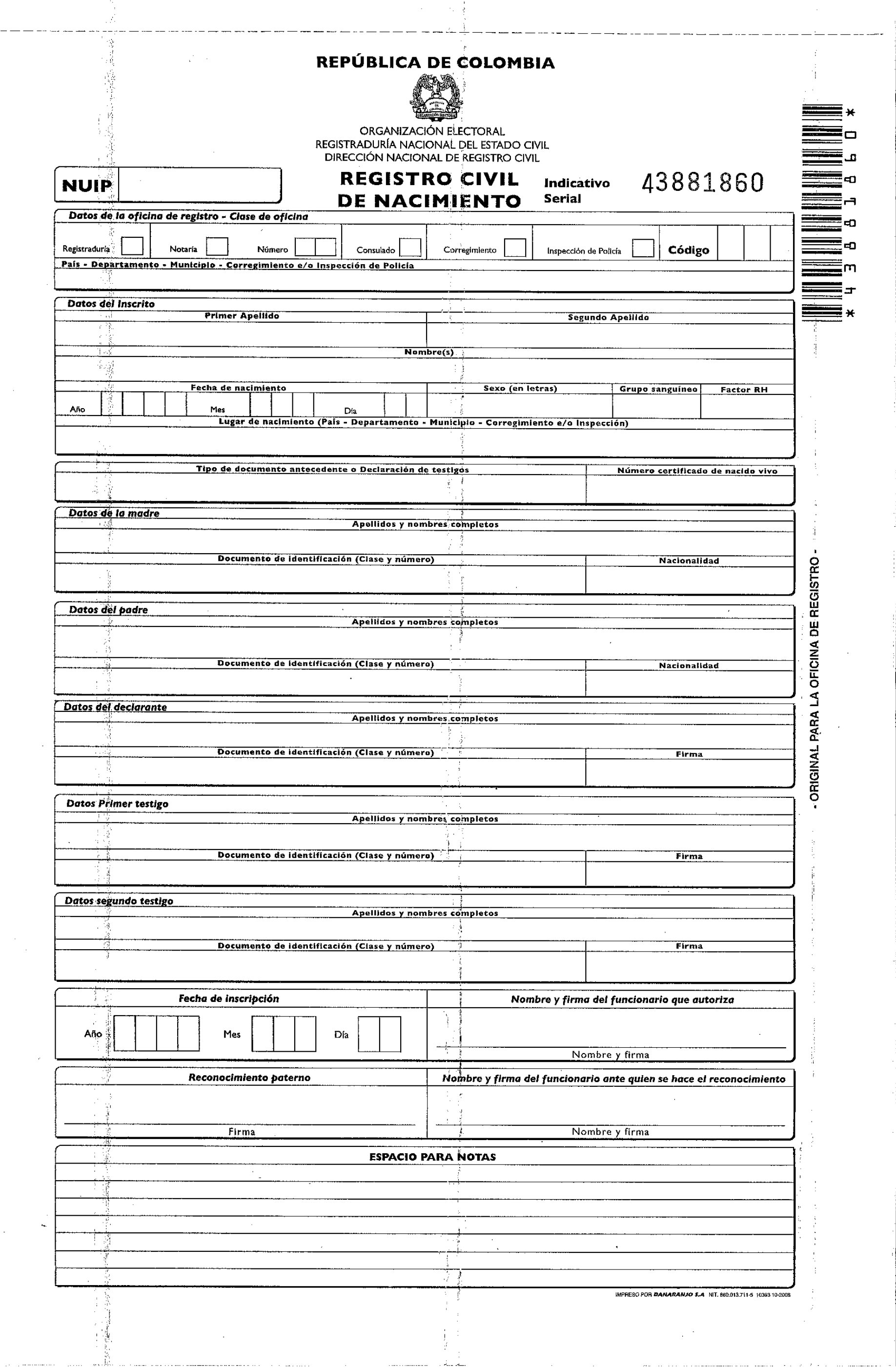
U.S. immigration needs the full registro civil de nacimiento, which Colombians call the “copia del folio”: a copy of the actual registry book page. It shows your parents' names and ID numbers, the place of birth, the witnesses, and the marginal-notes space where later civil-status changes are recorded. The U.S. State Department reciprocity page states plainly that summarized birth certificates issued by notaries are not accepted.
That distinction matters because notaries can issue a shorter, abbreviated certificate for routine local use. It is cheaper and quicker, but it leaves out the registry detail the embassy and the National Visa Center expect. Asking for the wrong, shorter version is the most common reason a Colombian applicant has to re-order.
The online digital copy trap
The Registraduría offers a digital copy you can download online (about COP 18,750), and it is tempting because it is fast and cheap. The problem: Colombian legal guidance reports the online digital copy omits the marginal-notes (notas marginales) space and is not accepted for apostille through the Registraduría. Because the apostille is required for U.S. immigration, a copy you cannot apostille is a dead end.
Full copy (in person or notaría)
About COP 11,000 in person, or roughly COP 32,850 by mail from the Notaría Primera de Bogotá. Includes the registry detail and the notas marginales space, and can be apostilled.
Online digital copy
About COP 18,750, with a QR code, valid three months. Convenient, but reported to omit the notas marginales space and not accepted for Registraduría apostille. Confirm it shows the notas space before relying on it.
If you are sure your online copy shows the marginal-notes space and your apostille route accepts it, it can save a trip. When in doubt, get the in-person or notaría copy so the apostille step does not bounce you back to the start.
How to do it, in order
Here is the full sequence from blank to ready-to-file, whether you are in Colombia or already in the United States. Do the steps in this order so you do not apostille or translate the wrong copy.
Step 1: Order the full copy with the marginal-notes space
Ask for the full registro civil de nacimiento ("copia del folio"), not a summarized certificate. Order in person at any notaría or Registraduría office (about COP 11,000), or by mail from the Notaría Primera de Bogotá (registrocivil@notaria1bogota.com.co, about COP 32,850 with shipping, delivered in roughly two to three business days). To order you need your serial number (Indicativo Serial) and the tomo and folio from an existing copy. Births registered before 1970 can only be pulled at the office where they were first inscribed.
Step 2: Avoid the online-only digital copy unless you confirm it works
The Registraduría's online copy (rcenlinea.registraduria.gov.co, about COP 18,750) is fast and cheap, but Colombian guidance reports it omits the marginal-notes (notas marginales) space and is not accepted for apostille through the Registraduría. If you order online, confirm it shows the notas space before you rely on it. When in doubt, get the notaría or in-person copy.
Step 3: Apostille it through the Cancillería
Colombia is a Hague Apostille member, so the U.S. accepts an apostille instead of consular legalization. Apostille online at the Cancillería (the Ministry of Foreign Affairs) at cancilleria.gov.co/apostilla-legalizacion: scan the certificate front and back as a single PDF under 11 MB, upload it, pay about COP 36,000, and download the digital apostille with its verification code. A notaría-issued copy must go through the Cancillería; see our Colombia apostille guide for the full mechanics.
Step 4: Add a certified English translation
After the apostille, order a certified English translation from a traductor oficial (an official translator certified by the Ministry of Foreign Affairs). USCIS and the National Visa Center require a complete English translation with a signed Certificate of Accuracy for every Spanish-language document. Translate after the apostille so the apostille text is included, unless a specific office tells you otherwise.
Step 5: Order from inside the United States if you have already moved
If you are in the U.S., request the registro civil through the nearest Colombian consulate using your serial number, or have a relative in Colombia pull a copy at a notaría and mail it. Then apostille and translate as above. Build in extra weeks for the round trip and start before your National Visa Center document deadline.
Apostille and translation: both are required
Unlike some countries, Colombia needs both an apostille and (for U.S. filings) a translation. This is the part that trips people up, so handle them in the right order.
Apostille
Required. Colombia is a Hague Apostille member, so the U.S. accepts an apostille instead of consular legalization. Apostille online through the Cancillería for about COP 36,000. See our Colombia apostille guide for the full mechanics.
Translation
Required for U.S. filings. Because the certificate is in Spanish, USCIS and the National Visa Center need a certified English translation. The Bogotá embassy reads Spanish, so it is the exception. Use a certified translation from a traductor oficial.
Order matters: apostille the original Spanish certificate first, then have the apostilled document translated, so the apostille text is included in the English translation. The translation rule for adjustment of status comes from a U.S. federal regulation (8 CFR 103.2(b)(3)): every foreign-language document needs a complete certified English translation with a signed Certificate of Accuracy (a short statement from the translator confirming the translation is complete and accurate).
What applicants report
Aggregated from the U.S. State Department Colombia reciprocity page, Colombian immigration-attorney and notaría guidance, and VisaJourney Colombia CR-1/IR-1 threads (2024–2026). VisaJourney thread bodies are not directly scrapable, so quotes below are honest paraphrases of named, dated threads, not verbatim text. Experiences vary; use as context, not instructions.
Tips from the community
Order the full "copia del folio," not the summarized notary certificate
The U.S. Embassy and immigration attorneys covering Colombia repeat that summarized birth certificates issued by notaries are not accepted: the embassy wants the copia del folio, a copy of the registry book page itself with parents, place of birth, witnesses, and the notes space. Asking for the wrong, shorter version is the most common reason a Colombian applicant has to re-order.
U.S. State Department reciprocity page and immigration-attorney guidance, 2024–2026
Scan front and back, even if the back is blank
The State Department instruction is explicit: when scanning a non-digital Colombian civil document for the National Visa Center, include the front and the back, even when the back is blank. Applicants who upload only the front get a checklist hold at the National Visa Center.
U.S. State Department reciprocity page, 2026
The cheap online copy can fail at the apostille step
Colombian legal guides warn that the online digital registro civil leaves out the marginal-notes (notas marginales) space and is not accepted for apostille through the Registraduría. People order it because it is fast and about COP 18,750, then discover they cannot apostille it and have to start over with a notaría copy.
Medellín-based immigration-attorney guides and the Mamá in Medellín document guide, 2024–2026
Apostille first, translate second
Colombian apostille-and-translation guides advise apostilling the original Spanish certificate first, then having a traductor oficial translate the apostilled document, so the apostille text is captured in the translation. Translating first and apostilling later can mean redoing the translation.
Colombian apostille/translation attorney guides, 2025–2026
What the threads describe
Forum members in the VisaJourney Colombian birth certificate thread describe the registro civil as straightforward to obtain at a notaría, but flag the apostille and the certified English translation as the steps that take the most time, and recommend starting both before the National Visa Center asks.
In VisaJourney CR-1/IR-1 apostille threads, applicants from Hague-member countries like Colombia repeat that the U.S. wants an apostille rather than embassy legalization, and that the apostille goes on the civil document itself, not on a photocopy.
Common problems and fixes
| Issue | Fix |
|---|---|
| Ordered a summarized notary certificate | Re-order the full registro civil de nacimiento (copia del folio) that reproduces the registry book page, including parents' ID numbers and the marginal-notes space. |
| Used the online digital copy and could not apostille it | The online copy omits the notas marginales space. Order the in-person or notaría copy, then apostille that through the Cancillería. |
| Skipped the apostille | Colombia is a Hague Apostille member, so U.S. immigration expects an apostille from the Cancillería. Apostille the certificate before submitting it. |
| Filed with USCIS or the National Visa Center with a Spanish-only certificate | USCIS and the National Visa Center require a certified English translation by a traductor oficial with a signed Certificate of Accuracy. |
| Uploaded only the front of the certificate | Scan both the front and the back, even if the back is blank, as the State Department instructs. |
Sources
- U.S. Department of State: Colombia Reciprocity and Civil Documents (verified May 2026)
- U.S. Embassy Bogotá: Immigrant Visa Interview Supplement (verified May 2026)
- Cancillería de Colombia: Apostille of a Birth Certificate (verified May 2026)
- Registraduría Nacional del Estado Civil: Registro de Nacimiento (verified May 2026)
- Mamá in Medellín: Colombian Registro Civil Copy guide (community) (verified May 2026)
- 8 CFR 103.2(b)(3): certified English translation requirement for foreign-language documents
- VisaJourney Colombian birth certificate and IR-1/CR-1 apostille discussions (community), 2024–2025
Frequently asked questions
What version of the Colombian birth certificate does U.S. immigration need?
U.S. immigration needs the full registro civil de nacimiento, known as the "copia del folio": a copy of the registry book page that shows the parents' names and ID numbers, place of birth, witnesses, and the marginal-notes space. The U.S. State Department reciprocity page states that summarized birth certificates issued by notaries are not accepted. Order the full version from a notaría or the Registraduría, not the abbreviated certificate.
Do I need to apostille my Colombian registro civil de nacimiento?
Yes. Colombia is a member of the Hague Apostille Convention, so the United States accepts an apostille instead of consular legalization. You apostille the certificate online through the Cancillería (the Ministry of Foreign Affairs) at cancilleria.gov.co/apostilla-legalizacion for about COP 36,000. A notaría-issued copy must be apostilled through the Cancillería.
Do I have to translate my Colombian birth certificate into English?
It depends on where you file. For the immigrant visa interview at the U.S. Embassy in Bogotá, the embassy reads Spanish, so a translation is not required for a Spanish-language document. When you file with USCIS or submit civil documents to the National Visa Center, a complete certified English translation is required, with a signed Certificate of Accuracy. Use a traductor oficial (an official translator certified by the Ministry of Foreign Affairs).
Can I just download the digital registro civil online?
Be careful. The Registraduría's online digital copy (about COP 18,750) is fast, but Colombian legal guidance reports it omits the marginal-notes (notas marginales) space and is not accepted for apostille through the Registraduría. Because the apostille is required for U.S. immigration, most applicants need the in-person or notaría "copia del folio" instead. If you do order online, confirm it shows the notas space before relying on it.
How recent does the certificate have to be?
Digital certificates with a QR code are valid for three months from the date of issuance, and the U.S. Embassy may ask for a recently issued copy. Birth certificates do not expire as a record, but because consulates often want a recent issue, order yours close to when you will submit it rather than reusing an old copy.
What is the NUIP and the Indicativo Serial on the certificate?
The NUIP (Número Único de Identificación Personal, the Unique Personal Identification Number) is the lifelong identification number assigned to you when your birth is registered. The Indicativo Serial is the serial number printed on the certificate that identifies that specific registration. You need the serial number, plus the tomo (volume) and folio, to order a copy, especially from abroad through a Colombian consulate.
How do I get my registro civil if I already live in the United States?
Request it through the nearest Colombian consulate using your serial number, or have a relative in Colombia pull a full copy at a notaría and mail it to you. Then apostille it through the Cancillería and order a certified English translation. Start early, because the consular round trip adds weeks, and you do not want to miss your National Visa Center civil-document deadline.
Key takeaways
- ✓
U.S. immigration needs the full registro civil de nacimiento (the "copia del folio"), with parents' ID numbers, witnesses, and the marginal-notes space. Summarized notary certificates are not accepted.
- ✓
Colombia is a Hague Apostille member, so apostille the certificate online through the Cancillería (about COP 36,000) instead of seeking consular legalization.
- ✓
Because the document is in Spanish, a certified English translation by a traductor oficial is required when you file with USCIS or the National Visa Center. The Bogotá interview reads Spanish.
- ✓
Avoid the cheap online digital copy: Colombian guidance reports it omits the notas marginales space and cannot be apostilled through the Registraduría.
- ✓
Order the right copy first, apostille second, translate third. Scan both the front and the back, even if the back is blank.
- ✓
From inside the U.S., order through a Colombian consulate using your serial number, then apostille and translate. Start before your National Visa Center deadline.
Collecting documents for consular processing?
Green Card Genius guides you through every step of the marriage green card, including which civil documents the National Visa Center requires from Colombia and in what order. See if it fits your situation.
See how it worksStay informed
Green card guides in your inbox
Practical, plain-English updates to help you navigate the process with confidence.
Unsubscribe anytime.
Continue reading
- 01Colombian Apostille via the Cancillería (and Certified Translation) for U.S. Immigration
- 02Registro Civil de Matrimonio (Colombian Marriage Certificate) for U.S. Immigration: The Copia del Folio (2026)
- 03Colombia Police Certificate (Certificado de Antecedentes Judiciales) for U.S. Immigration
- 04Adjustment of Status vs Consular Processing (2026 Guide)
Be a Genius
Only pay when you file